Panchatantra Stories
Explore our collection of 170 Panchatantra stories — the world’s most influential collection of animal fables. Composed by the legendary scholar Vishnu Sharma around 200 BCE, the Panchatantra (meaning “Five Treatises”) was originally designed to teach statecraft, political science, and practical wisdom to young Indian princes.
Our retelling preserves the five books of the original Sanskrit text: Mitra-bheda (The Loss of Friends), Mitra-labha (The Gaining of Friends), Kakolukiyam (Of Crows and Owls), Labdhapranasam (Loss of Gains), and Apariksitakarakam (Ill-Considered Actions). Each story features vivid animal characters — clever jackals, wise tortoises, cunning crows, and greedy crocodiles — who embody universal human traits.
The Panchatantra has been translated into over 50 languages and has influenced storytelling traditions worldwide, from Aesop’s Fables to the Arabian Nights. These bedtime moral stories for kids remain powerful teaching tools, each carrying lessons about friendship, leadership, deception, and the consequences of our choices. Perfect for children ages 5-12, parents, and educators looking for Indian moral stories with values.
 Panchatantra Stories
Ages 9-12
Panchatantra Stories
Ages 9-12
Right-Mind and Wrong-Mind
Right-Mind and Wrong-Mind: Avoid the company of the wicked or you will pay a heavy price for it.” Once upon a time there were two friends in a small village
 Panchatantra Stories
Ages 9-12
Panchatantra Stories
Ages 9-12
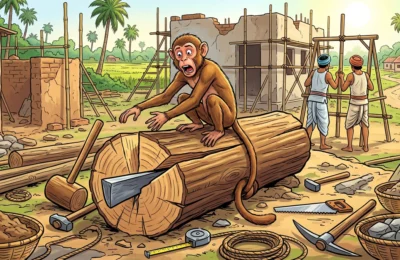
The Story of the Monkey and the Log
The Story of the Monkey and the Log: A merchant had started building a temple beneaththe trees on the outskirts of a town. Every day thecarpenters and the
 Panchatantra Stories
Ages 3-5
Panchatantra Stories
Ages 3-5
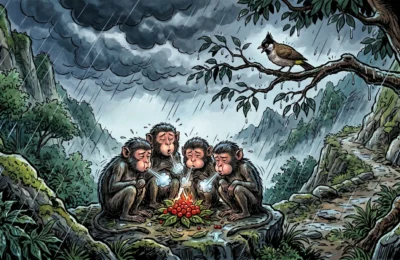
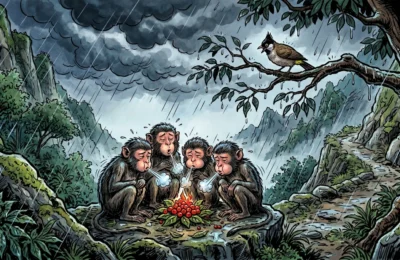
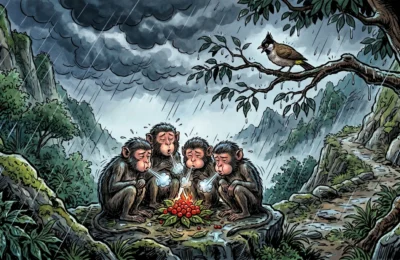
Suchimukha and The Monkey
A Panchatantra fable about a well-meaning bird named Suchimukha, a troop of cold monkeys, and the danger of giving advice where none is wanted.
 Panchatantra Stories
Ages 6-8
Panchatantra Stories
Ages 6-8
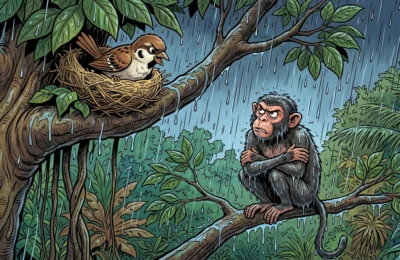
The Story of the Sparrow and the Monkey
The Story of the Sparrow and the Monkey: Somewhere in the jungle; there grew a Shami tree. On its long branches, a pair of sparrows had made theirhorpe. The
 Panchatantra Stories
Ages 9-12
Panchatantra Stories
Ages 9-12
The Story of Dharmabuddhi and Papabuddhi
The Story of Dharmabuddhi and Papabuddhi: In a village, there lived two friends, whose nameswere Dharmabuddhi and Papabuddhi. One day Papabuddhi thought to
 Panchatantra Stories
Ages 3-5
Panchatantra Stories
Ages 3-5
The Story of the Thief and the Brahmins
The Story of the Thief and the Brahmins: In a certain town, there lived a very learned Brahminwho, as a result of his actions i, n his previous life, had. The
 Panchatantra Stories
Ages 6-8
Panchatantra Stories
Ages 6-8
The Story of the Bug and the Flea
The Story of the Bug and the Flea: In a certain country lived a king who had a verybeautifully decorated bedroom. An exquisite white silksheet covered the bed
 Panchatantra Stories
Ages 6-8
Panchatantra Stories
Ages 6-8
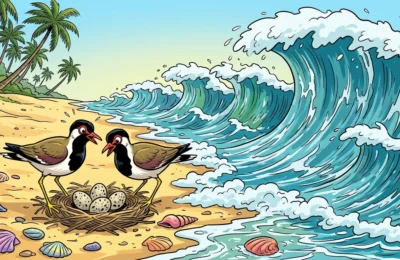
The Story of the Tittibha Birds and the Sea
The Story of the Tittibha Birds and the Sea: Somewhere in the world, on a seashore, there liveda pair of tittibha birds, husband and wife.. the courseof time
 Panchatantra Stories
Ages 3-5
Panchatantra Stories
Ages 3-5
The Story of the Cobra and the Crow
The Story of the Cobra and the Crow: Somewhere in the country, under a banyan tree, therelived a pair of crows, husband and wife. Now, wheneverthe female
 Panchatantra Stories
Ages 9-12
Panchatantra Stories
Ages 9-12
The Story of the Turtle Who Fell Off the Stick
The Story of the Turtle Who Fell Off the Stick: In a certain lake, there lived a turtle, by the nameof Kambugriva. Two swans, whose names were Sankata and
 Panchatantra Stories
Ages 9-12
Panchatantra Stories
Ages 9-12
The Story of the Elephant and the Sparrow
The Story of the Elephant and the Sparrow: Somewhere in the jungle, a pair of sparrows hadmade their nest in a Tamal tree. In due course, thefemale sparrow
 Panchatantra Stories
All Ages
Panchatantra Stories
All Ages
The Story of Vajradaunstra the Lion and Chaturaka the Jackal
The Story of Vajradaunstra the Lion and Chaturaka the Jackal: In a jungle, there lived a lion by the name of Vajradaunstra. A jackal called Chaturaka and a