Right-Mind and Wrong-Mind
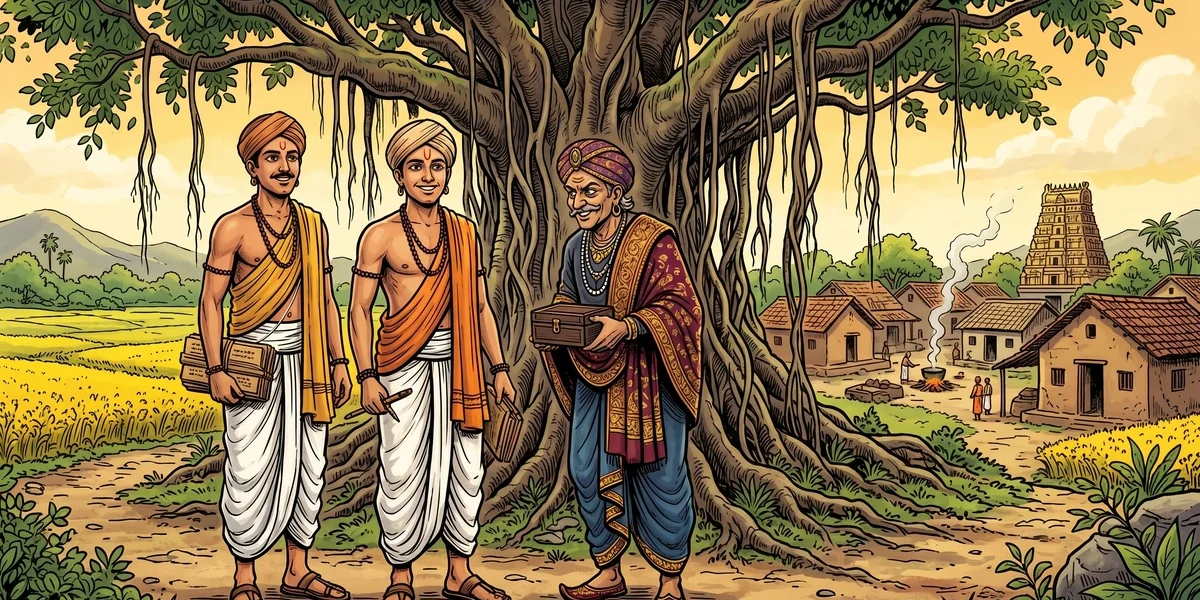
Right-Mind and Wrong-Mind: Avoid the company of the wicked or you will pay a heavy price for it.” Once upon a time there were two friends in a small village
Right-Mind and Wrong-Mind
Source: Panchatantra, Book I — Mitrabheda (The Separation of Friends), attributed to the sage Vishnu Sharma, composed c. 300 BCE–300 CE; this redaction follows the Sanskrit critical text and A. N. D. Haksar’s annotated translation (HarperCollins India, 1998).
सत्याद् मऌति सुखं, सत्यं भुंक्ते सिंहसं ृव१ःः
Two traveling merchants — Dharmabuddhi (Right-Mind) and Papabuddhi (Wrong-Mind) — journey together and acquire considerable wealth. On their return, Papabuddhi secretly hides the shared wealth and accuses his partner of theft. When the case comes before a judge and a truth-ordeal is demanded, Papabuddhi arranges an elaborate deception involving his own father hidden in a tree. The tree speaks. The deception is believed. And then the tree is set on fire, and truth arrives in the most painful form available to a father who agreed to help his son cheat an honest man.
Part I: The Partnership and the Hidden Plan
In the city of Vardhamana there lived two merchants who had been neighbours since childhood. Dharmabuddhi was the son of an honest trader and had inherited both the business and the disposition. Papabuddhi was the son of an equally honest man, which made his own character a matter of individual election rather than inheritance — he had chosen calculation over principle early in life and had found the choice profitable.
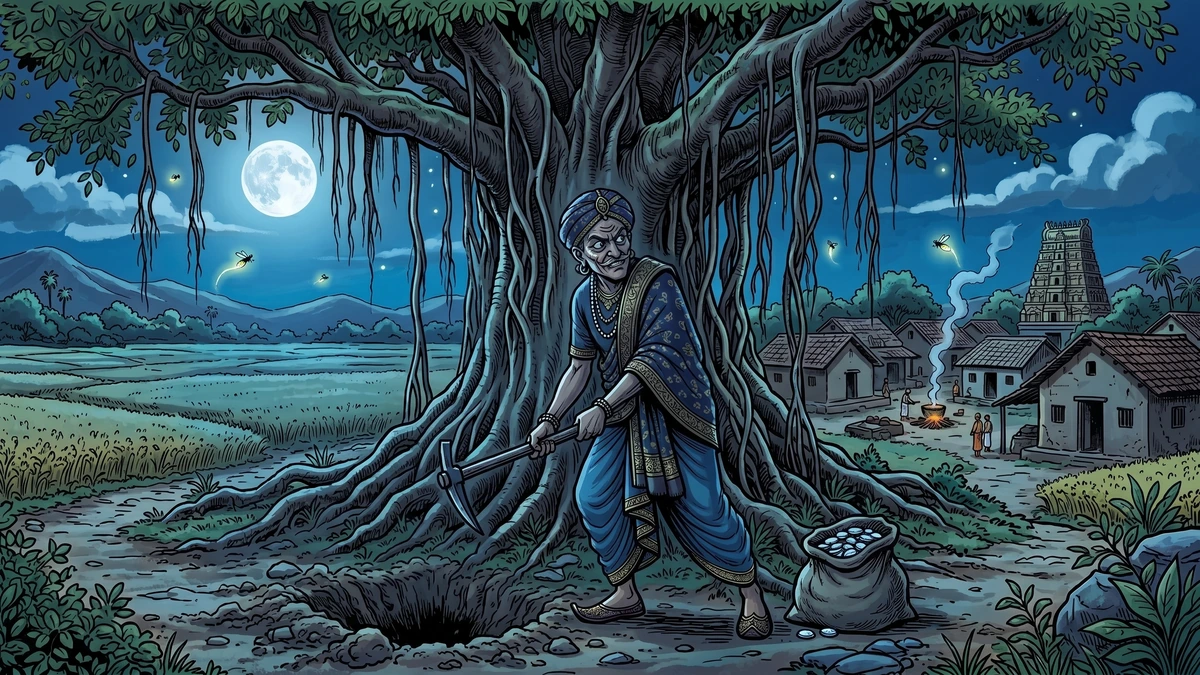
The two travelled together to a distant trading fair and returned with substantial shared profit. On the road home, Papabuddhi had already decided what to do with his partner’s share. They buried the combined wealth in a forest location known only to both, agreed to return to divide it at an appointed time, and parted. That night, Papabuddhi returned to the forest alone and took the entire sum.
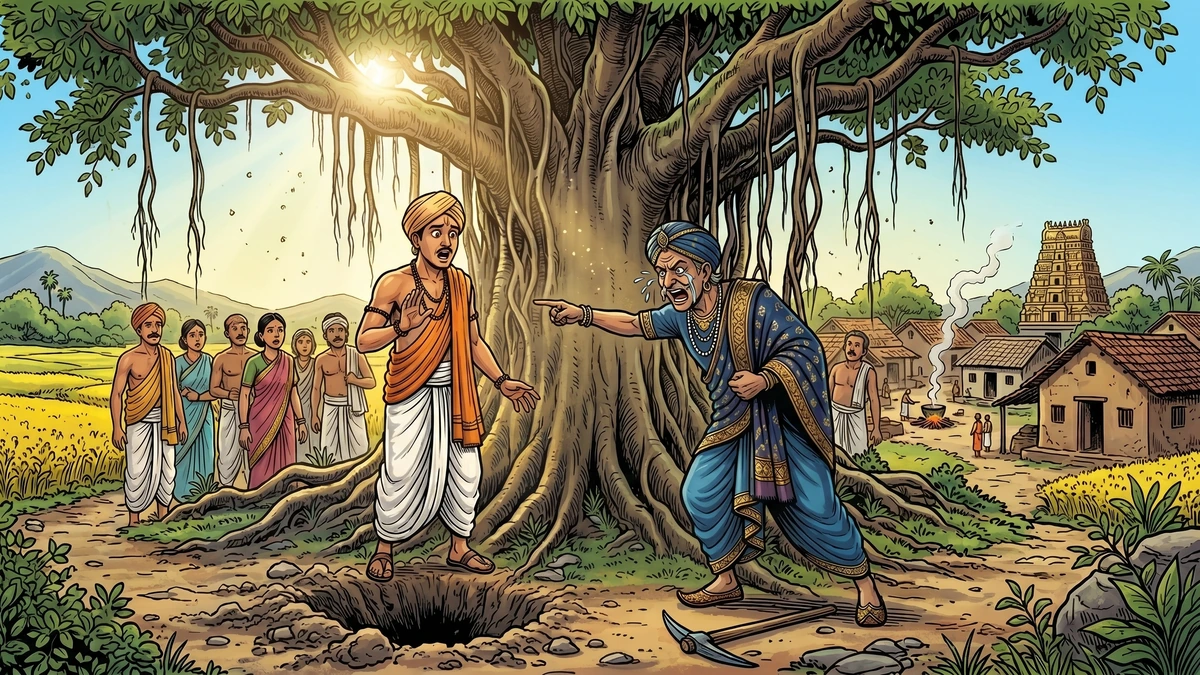
When the two met to divide the wealth and found the burial site empty, Papabuddhi performed grief and outrage with the conviction of a man who had rehearsed both. He accused Dharmabuddhi of returning secretly to steal the money. Dharmabuddhi was genuinely innocent and genuinely shocked — which, in a witness, looks identical to guilt on a bad day and to innocence on a good one. The case was brought before the city judges.
The judges faced the problem that faces every court when two parties give irreconcilable accounts of an event with no witnesses: they requested a truth-ordeal. In the system of that place and time, a truth-ordeal required both parties to swear their account before a sacred witness — in this case, the deity believed to inhabit a particular ancient tree at the forest edge.
Part II: The Father in the Tree
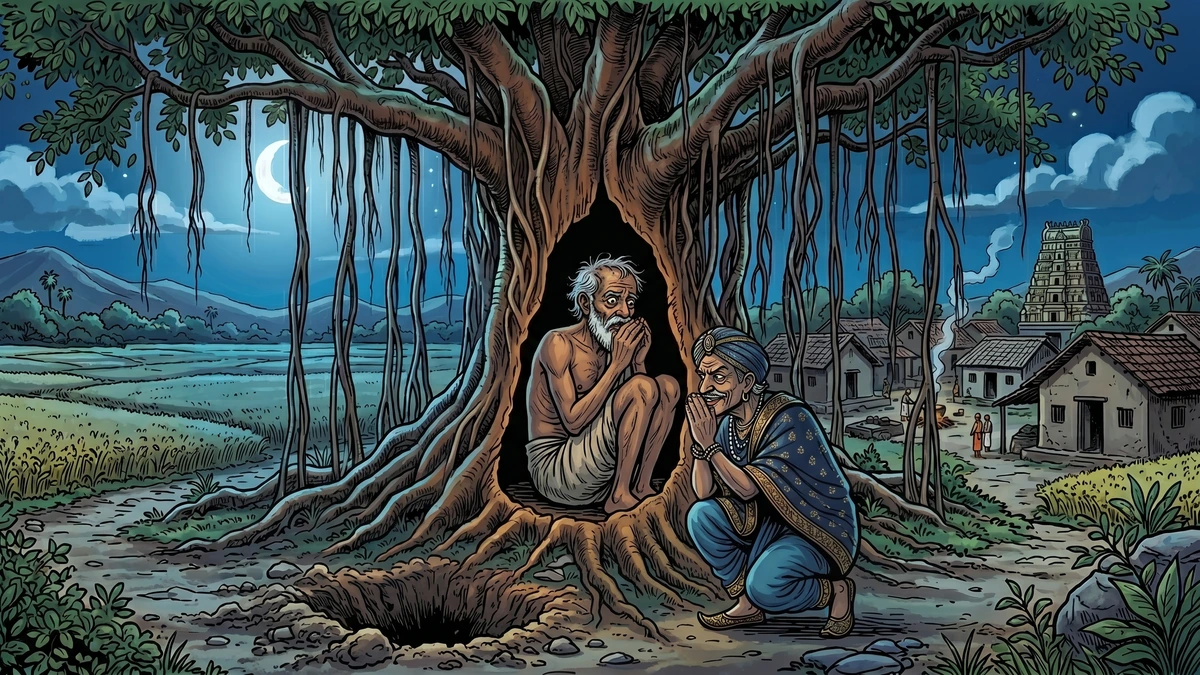
Papabuddhi went home and explained the situation to his father. The old man’s reaction was not straightforward approval, and the text records his hesitation: he knew his son had stolen the money, knew the tree would be asked to adjudicate, and understood that what was being proposed was not just fraud but a sacrilege against the very institution of the truth-ordeal. He objected.
Papabuddhi argued, with the particular fluency of people who have decided what they want and are working backward to justification, that the money was rightfully his anyway, that Dharmabuddhi would not be harmed in any way that mattered, and that the old man’s role was minimal — simply to hide inside the hollow of the tree, wait for the oath ceremony, and speak a brief confirmation through the bark when Papabuddhi swore his account.
The father agreed. He should not have, and the text does not pretend otherwise; but the story is honest about the mechanism: a parent asked by a child to do something wrong will often find sufficient reason to agree. He entered the tree’s hollow before dawn and settled in to wait.
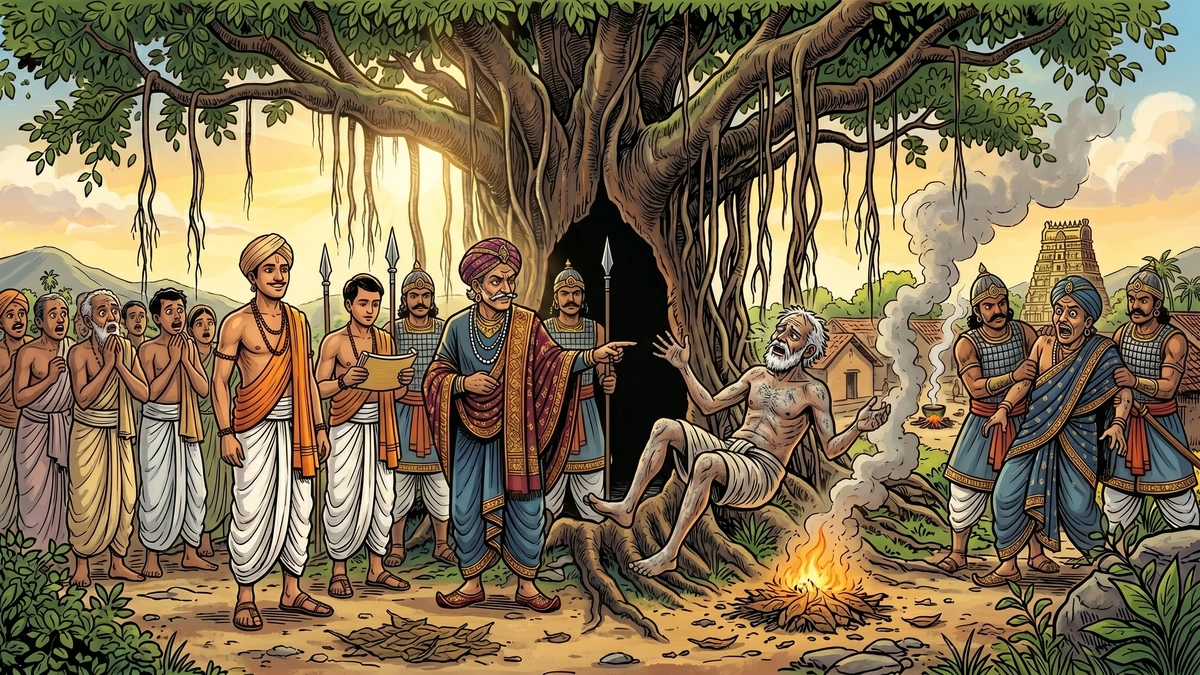
The oath ceremony was held at midday. Both merchants presented themselves before the tree. Dharmabuddhi swore that he had taken nothing and knew nothing of the missing money. The tree was silent. Papabuddhi swore that his partner was the thief and that he himself was entirely innocent. From within the bark came a resonant voice: “Papabuddhi speaks the truth.”
The judges were prepared to accept this. Dharmabuddhi was prepared to accept his ruin. And then he paused, and looked at the tree, and thought about what he knew about truth-ordeals and about trees, and asked the judges for permission to test the testimony.
Part III: The Test of Fire
Dharmabuddhi’s request was simple and, given the theological framework of the ordeal, unanswerable: if the voice in the tree was genuinely divine, fire could not harm it. He proposed to test the tree’s testimony by lighting dry grass at its base. A deity would be unaffected. If the tree was simply a tree — hollow, perhaps, and inhabited by something mortal — the fire would establish that fact.
The judges, who were not unintelligent and who had perhaps noted something slightly too convenient about the tree’s timing, granted the permission. Dharmabuddhi lit the grass. The fire caught the dry bark of the base. Within moments, smoke began to pour from the tree’s hollow, and within a few minutes more, Papabuddhi’s father came out of the tree’s opening, coughing, burned, and carrying an account of what had happened that he gave to the judges before his injuries overcame him.
The account was complete and accurate. It covered the theft of the buried money, the plan for the oath ceremony, his own agreement to hide in the tree, and his son’s instructions. He had not intended to give it — the fire had made the choice for him, in the way that physical extremity tends to eliminate the social calculations that ordinarily regulate speech.
Papabuddhi was convicted. Dharmabuddhi received his share of the money plus compensation. The father survived his burns and is not recorded as having anything further to say on the subject of his son’s schemes.
Part IV: What the Story Teaches
Vishnu Sharma’s closing observation operates on two levels. The first is practical: “The most elaborate deception contains within it the material of its own discovery. Papabuddhi’s scheme required a living witness inside the tree; the living witness could be tested; testing revealed the truth. The complexity of the deception was the complexity of its undoing.”
The second level is more abstract and more characteristic of the Panchatantra’s ethical register: the story does not require divine intervention to deliver justice. Dharmabuddhi does not pray and wait for the universe to vindicate him; he thinks, identifies the specific structural weakness in the deception, and applies a test that the deception cannot survive. Justice in the Panchatantra is almost always the product of intelligence and action, not of patience and faith.
The father’s position is treated with unusual nuance: he was a victim of his own weakness and his son’s manipulation, and he paid a significant price. But the text does not excuse him entirely. He knew what was being asked. He agreed. The fire extracted the truth that his conscience had failed to provide voluntarily, and the story treats this as proportionate — not a punishment but a completion, the situation producing from within itself the mechanism of its resolution.
Why This Story Has Lasted Three Thousand Years
“Right-Mind and Wrong-Mind” endures because it is a legally sophisticated fable about evidence, testimony, and the testing of claims — and because its central insight, that elaborate deceptions contain the material of their own discovery, is as applicable to modern forensic investigation as to an ancient truth-ordeal. The story is not primarily about morality; it is about epistemology: how do you determine what is true when two parties give irreconcilable accounts?
The Panchatantra’s answer is characteristically practical: you identify the mechanism through which the false account was sustained and test that mechanism under conditions it cannot survive. Dharmabuddhi does not out-argue Papabuddhi; he does not produce a counter-witness; he does not appeal to the judges’ sympathy. He finds the one pressure point in the deception’s architecture and applies force there. This is legal reasoning, not moral feeling, and the story’s longevity is partly a reflection of how rarely those two things are clearly distinguished in popular narrative.
The tale entered Arabic Kalila wa Dimna and was used in medieval Islamic legal education as an example of the principle that testimony should always be tested against the physical conditions under which it was produced. In European legal history, parallel arguments appear in the critique of ordeal-by-combat and oath-swearing as evidence standards — the argument being that testimony produced by a mechanism that can be manipulated is testimony that must be independently verified. The story anticipated the critique of its own era’s legal standards by embedding within it the very test that exposes those standards’ limits.
Frequently Asked Questions
What is the moral of Right-Mind and Wrong-Mind?
The story teaches that elaborate deceptions contain within themselves the material of their own discovery — the more complex the fraud, the more points of failure it has. Dharmabuddhi does not win through patience or divine favor but through identifying the structural weakness in Papabuddhi's deception and applying a test it cannot survive. Justice in the Panchatantra is almost always the product of intelligence and action, not of faith alone.
What is the significance of the father in the tree?
Papabuddhi's father represents a common failure: a person who knows that what is being asked of them is wrong, objects briefly, then agrees because of family loyalty. The fire extracts from him the truth his conscience failed to provide voluntarily. The story treats this as proportionate — not purely punitive, but the natural completion of a deception that required a mortal witness and therefore created a vulnerability that could be tested.
Which book of the Panchatantra does this story come from?
The story comes from Book I, Mitrabheda (The Separation of Friends), which examines the many ways that trust between people can be destroyed. This tale is the most legally sophisticated example in the book: the friendship is destroyed not by external manipulation but by one party's premeditated betrayal, and the restoration of justice requires not moral appeal but practical reasoning about evidence.
How does Dharmabuddhi expose the deception?
Dharmabuddhi reasons that if the voice in the tree is genuinely divine, fire cannot harm the divine. He proposes to test the testimony by lighting dry grass at the tree's base. The judges grant permission. The fire reveals Papabuddhi's father hiding in the hollow, who then gives a full account of the scheme. The test works because it identifies the one physical condition that the deception's mechanism cannot survive.
How did this story influence legal thought in later cultures?
The story entered Arabic Kalila wa Dimna and was used in medieval Islamic legal education to illustrate the principle that testimony produced through a manipulable mechanism must be independently verified. European parallel arguments appear in critiques of ordeal-by-combat and oath-swearing as evidence standards. The story's core argument — that evidence procedures themselves must be testable — anticipates by centuries the evidentiary standards of modern legal systems.
You May Also Like
 Panchatantra Stories
Ages 3-5
Panchatantra Stories
Ages 3-5
Light Makes Prosperity
Light Makes Prosperity: There is a Tamil proverb dîpam lakshmîkaram, meaning, “light makes prosperity,” and the following story is related to explain it: The
 Panchatantra Stories
Ages 9-12
Panchatantra Stories
Ages 9-12
The Unforgiving Monkey
The Unforgiving Monkey: Chandra was a king, whose sons kept a group of monkeys as pets. These monkeys were treated as royal pets, and were provided with the
 Panchatantra Stories
Ages 6-8
Panchatantra Stories
Ages 6-8
The Hermit and The Mouse
The Hermit and The Mouse: In the southern city of Mahilaropya,” said Hiranyaka, “lived a hermit named Tamrachud in a Shiva temple on the outskirts of the city.