The Brahmin and the Cobra
The Brahmin and the Cobra: Kindness to a cobra costs the brahmin his life. Nature cannot be reformed by compassion A classic Indian folk tale retold for...
The Ungrateful Cobra and Dev Sharma’s Gold
Among the most morally unsettling fables of the Panchatantra, “The Brahmin and the Cobra” explores not the dangers of haste — as its sibling tale “The Brahmani and the Mongoose” does — but the far more troubling territory of ingratitude, greed, and the corruption that wealth can breed even in the most sacred of relationships. A poor Brahmin farmer befriends a hooded cobra that lives in an anthill on his field; the cobra rewards his daily milk-offerings with a gold coin found beneath its coils each morning. When greed overrides gratitude, the story pivots to violence and its ruinous aftermath.
The tale is rooted in a widespread Indo-Iranian narrative kernel — the idea of a nāga (serpent deity) as guardian of hidden treasure — and has parallels in Greek fable (Aesop’s “The Farmer and the Viper”), Slavic folklore, and as far afield as West African oral tradition. Yet the Panchatantra version is distinguished by its psychological acuity: the moral collapse happens not in one dramatic act but across a sequence of rationalised decisions that would be recognisable to any reader of economic psychology.
The Farmer’s Covenant with the Serpent
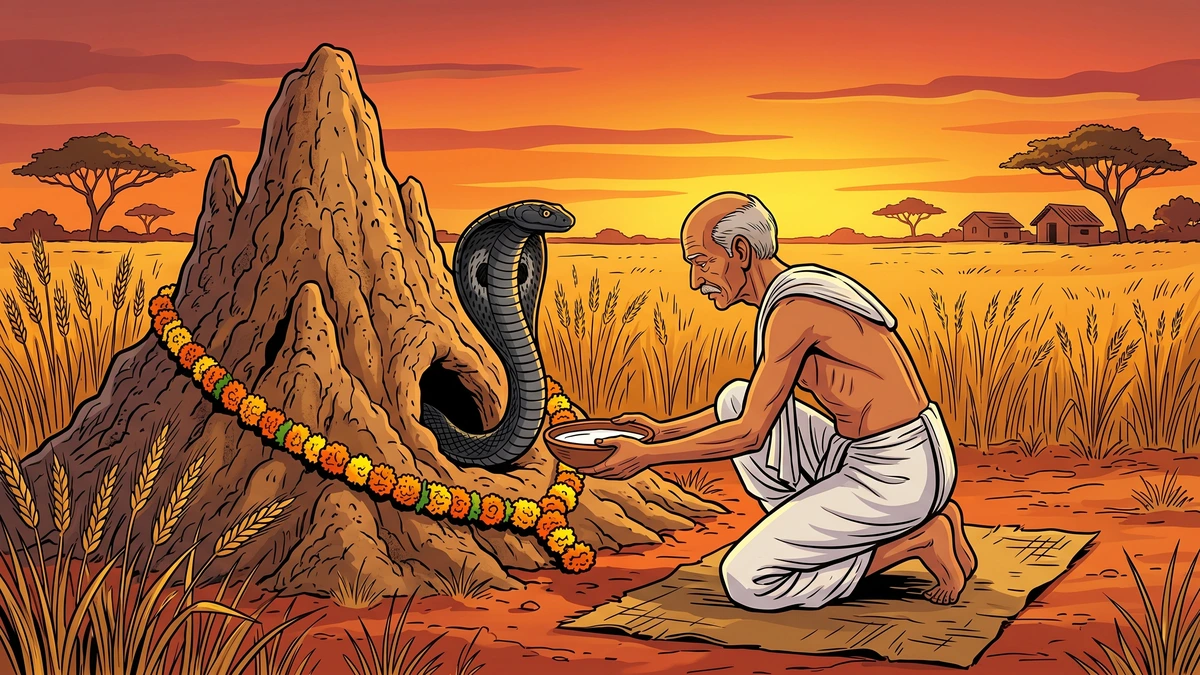
A poor Brahmin named Dev Sharma — the same household that appears across the Panchatantra‘s Mitra-labha (“Gaining Friends”) book — cultivates a small plot of arid land. One day he notices a large hooded cobra emerging from the anthill at the field’s edge. Recalling that serpents are forms of Shesha-nāga, the cosmic serpent who upholds the world, and that propitiating a field-guardian brings agricultural blessings, he offers the cobra a bowl of milk.
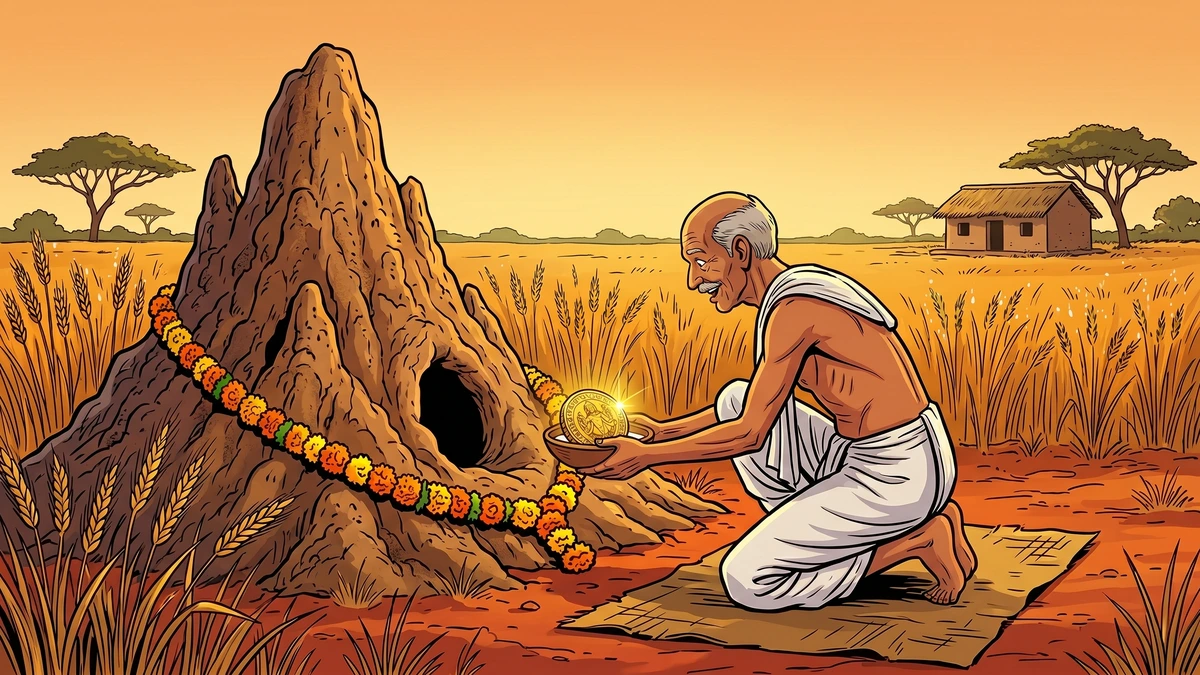
The next morning he finds a gold coin in the bowl. He repeats the offering; the pattern holds — one coin per day, precisely. Dev Sharma’s poverty dissolves. He builds a modest prosperity around this silent, dependable pact. The cobra never speaks; the Brahmin never presses for more. Scholars of reciprocity theory note that the arrangement exemplifies balanced reciprocity: equivalent exchange sustained by mutual restraint.
The Son’s Assault and the Serpent’s Retaliation
Dev Sharma is called away to a distant village. He instructs his son to continue the daily milk-offering. The son obeys — once — then, staring at the gold coin, begins a different calculation: if one coin emerges daily, how much gold must be hidden in the anthill itself? He resolves to kill the cobra, seize the hoard, and end the dependency.
Armed with a stick, the son strikes the cobra. He fails to kill it. The cobra, wounded and enraged, bites him. He dies that same night. When Dev Sharma returns and learns what happened, he is devastated — but his grief is compounded by a dawning comprehension: his son’s greed has destroyed not merely a life but a covenant. The relationship cannot be restored by mourning alone.

The Brahmin’s Return and the Broken Peace
Dev Sharma grieves his son, performs the funeral rites, and then — in a move that distinguishes this fable from simpler morality tales — returns to the anthill with a fresh bowl of milk. He apologises to the cobra for his son’s act. The cobra appears but refuses the offering. It speaks — for the first and only time in the story — with a devastating directness:
“How can there be friendship between us now? Your son struck me with a stick. I bit him. The wound in my hood and the wound in your heart cannot both be forgotten. We can no longer trust each other as we once did.”
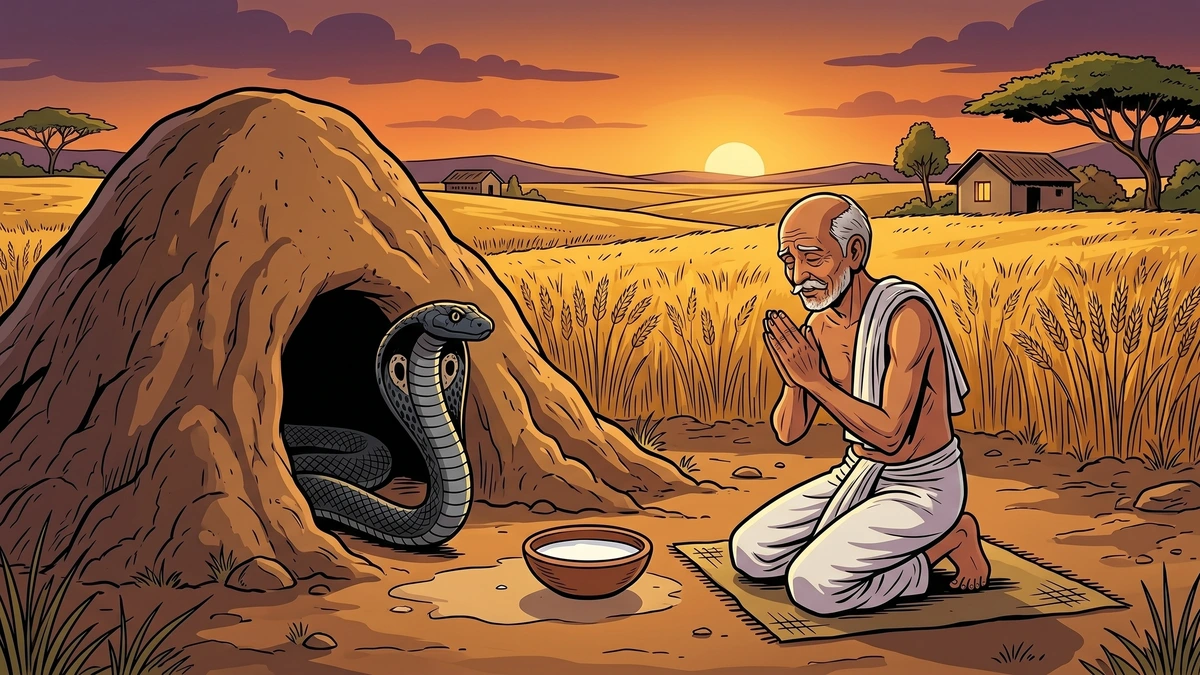
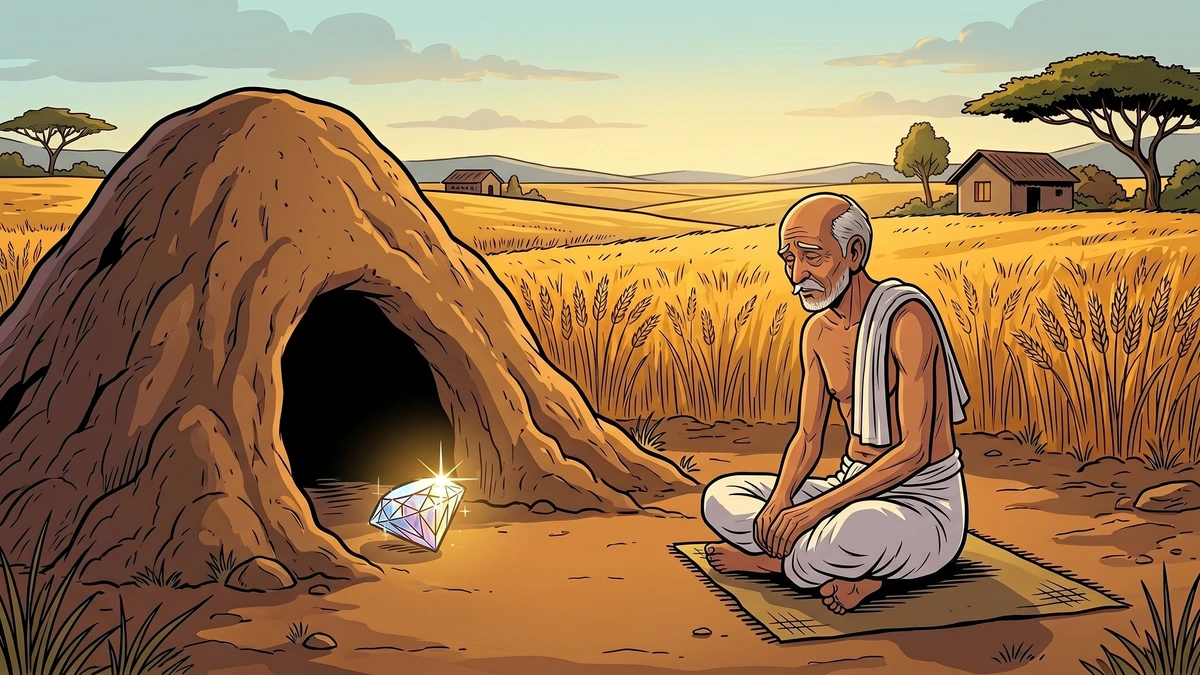
The cobra then shows Dev Sharma a jewel — a precious gem left as a parting gift — and retreats permanently into the anthill. The daily gold coins stop. The friendship, built on years of quiet exchange, is irrevocably ended by a single act of violence motivated by greed.
Textual History and Comparative Folkoristics
The tale appears in Book I of the Panchatantra (the Mitra-bheda or “Loss of Friends” sequence in several recensions, and Mitra-labha in others) and in the Hitopadesha‘s “Mitralabha” section. The Sanskrit critical tradition dates the core narrative to at least 300 BCE, with the oldest surviving manuscript tradition (the Purnabhadra recension, 1199 CE) preserving what scholars believe is the most faithful version.
Aarne-Thompson-Uther tale-type ATU 285B (“The Child and the Snake / Grateful Serpent”) covers the broad family to which this story belongs, though the Panchatantra variant is notably darker than most European cognates. In Greek tradition (Babrius, Aesop), the farmer typically attacks the snake out of grief for a child the snake supposedly killed — a different motivational structure. In the Indian version, the son attacks from pure acquisitive greed, making the moral indictment more precise and less sympathetic to the human actors.
The Nāga Guardian in Hindu Cosmology
Central to the story’s cultural resonance is the figure of the nāga — the class of semi-divine serpent beings who inhabit the subterranean realm of Pātāla and are custodians of underground wealth (nidhi). The cobra of the anthill is understood by Dev Sharma not as an ordinary reptile but as a kṣetrapāla (field-guardian deity), and his milk-offering is a form of pūjā. This frame transforms the story from a simple fable about ingratitude into a meditation on the proper relationship between humans and the numinous forces that underlie agrarian fertility.
The gold coin that appears daily echoes the Arthaśāstra‘s concept of nidhāna — treasure buried by earlier owners or deposited by divine agencies — and the cobra’s role as its steward. When the son attempts to steal the hoard by force, he is not merely being greedy; he is committing an act of sacrilege against a guardian deity. The cobra’s retaliation is therefore not merely self-defence but the reassertion of a cosmic order that the son has violated.
Moral Philosophy: The Economy of Trust
The Panchatantra‘s framing verse for this tale encapsulates its teaching: na viśvasyet kadācana — “one should never betray trust.” But the story’s genius lies in its ambiguity about where the primary betrayal occurs. Dev Sharma himself is implicated: he left his son — known to be impulsive — in charge of a sacred covenant without adequate instruction about its nature. The son’s greed is the immediate cause; the father’s negligence is the enabling condition.
Modern readers may also note the cobra’s final statement as a sophisticated account of how trust, once broken, cannot be rebuilt by apology alone — a position that anticipates game-theoretic models of iterated cooperation. The cobra is not cruel; it is rational. It has updated its model of the relationship based on new evidence (the violent attack) and correctly concludes that the prior equilibrium cannot be restored. The jewel it leaves is a gesture of residual goodwill — an acknowledgement that Dev Sharma himself did not betray the covenant — but it cannot substitute for the ongoing relationship that greed destroyed.
Frequently Asked Questions
Milk, Nāgas, and the Agricultural Covenant
The ritual offering of milk to serpents (nāga pūjā) remains a living practice across South Asia. Cobra anthill shrines — called putthu in Tamil Nadu and nāga katte in Karnataka — are found at the edges of fields, under sacred fig trees, and beside temple tanks. Farmers offer milk, turmeric, and sandalwood paste to the resident cobra on the fifth day of the bright fortnight (nāga pañcamī), the festival that commemorates the serpent’s role as cosmic water-holder and grain-protector.
Within this living ritual context, Dev Sharma’s gesture is not naïve or superstitious — it is the normal, culturally correct response of a Brahmin farmer who recognises a kṣetra-devatā (field deity) manifesting at his property boundary. The cobra’s reciprocal gift of gold participates in the same symbolic economy: the deity blesses the field with fertility, which in agricultural societies translates directly into wealth. One gold coin per day — modest but dependable — is precisely the kind of steady, long-term fertility-blessing that distinguishes divine patronage from windfall luck.
The Hitopadesha Variant: A Subtler Indictment
The Hitopadesha version, composed by Nārāyaṇa Paṇḍita in Bengal around the twelfth century CE, preserves important variants. In Nārāyaṇa’s telling, the Brahmin himself — not merely his son — is initially tempted by the idea of seizing the anthill’s full treasure. He restrains himself, delegates the offering to his son while he travels, and the tragedy unfolds identically. This version makes the father’s own cupidity more visible: the son’s action is the father’s temptation made flesh by a less disciplined mind.
Some manuscripts of the Kathāsaritsāgara (the eleventh-century “Ocean of Story” compiled by Somadeva) include a tangential version in which the cobra explicitly identifies itself as a Brahmin reborn in serpent form due to a previous life’s hoarding — adding a karmic dimension that explains why the creature is both wealthy and generous. This layer of past-life causality is absent from the canonical Panchatantra text but shows how the story accreted meaning across retellings.
International Variants: The Grateful Serpent Family
ATU 285B has been documented in over forty national traditions. Common structural elements include: a human protagonist who treats a serpent with unexpected kindness; the serpent rewarding this kindness with treasure or good fortune; a second human (often a relative) attempting to replicate the gift-getting through greed; the greedy character being killed or permanently losing the serpent’s favour. What makes the Indian versions distinctive is their treatment of the serpent as a fully moral agent — capable of making reasoned judgments about human character — rather than a simple force of nature.
In contrast, Aesop’s “The Farmer and the Viper” (Perry 176) presents the snake as essentially dangerous and unreformable: the farmer who nurses the frozen viper back to health is bitten the moment the snake revives. The moral is about the inherent nature of dangerous creatures, not about the complexity of inter-species covenants. The Panchatantra cobra is something far more interesting: a being capable of loyalty, restraint, rational assessment, and eventually tragic wisdom about the limits of forgiveness.
Legacy in Indian Literature and Art
The cobra of the anthill appears as a recurring archetype in classical Sanskrit literature. In the Mahābhārata, the Pāṇḍavas encounter nāga guardians of underground rivers who demand ritual respect before permitting access to their domain. The Viṣṇu Purāṇa describes the nāga-king Śeṣa as the foundation upon which the entire visible universe rests — a cosmological elaboration of the same idea that underlies the folk story: serpents are not to be trifled with because they hold the structural integrity of the world itself.
In the visual tradition, anthill cobras appear in Warli tribal paintings from Maharashtra, in the wooden sculptural panels of Kerala’s serpent groves (sarpa kāvu), and in the terracotta votive offerings found across Tamil Nadu. The Amar Chitra Katha series published a version of this story in its Panchatantra Tales volumes, using the same flat-color, bold-outline aesthetic that has defined popular Indian mythology illustration since the 1970s — the same visual vocabulary used in the images accompanying this retelling.
You May Also Like
 Panchatantra Stories
Ages 6-8
Panchatantra Stories
Ages 6-8
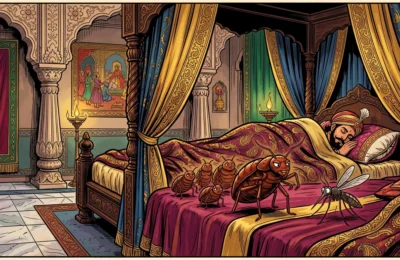
The bug and the mosquito – A twist of the Panchtantra tale
The bug and the mosquito – A twist of the Panchtantra tale: Long, long ago was a lavish Kingdom of king “Extraordinary”, where there lived green trees, loving
 Panchatantra Stories
Ages 3-5
Panchatantra Stories
Ages 3-5
The Young Greedy Bird – A Panchatantra Tale from India
The Young Greedy Bird – A Panchatantra Tale from India: Long ago, a flock of birds stayed on the trees near a lake. The flock was ruled by an old queen bird.
 Panchatantra Stories
Ages 6-8
Panchatantra Stories
Ages 6-8
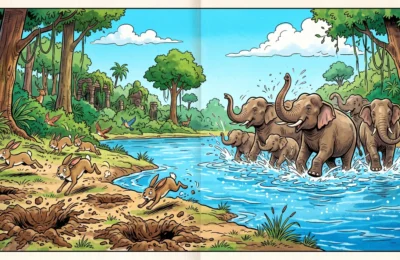
The Elephants and the Hares
The Elephants and the Hares: The weak must make use of all tactics to survive.” Deep in the jungle, there lived a big group of elephants. The elephants lived