The Story of the Monkey and the Log
The Story of the Monkey and the Log: A merchant had started building a temple beneaththe trees on the outskirts of a town. Every day thecarpenters and the
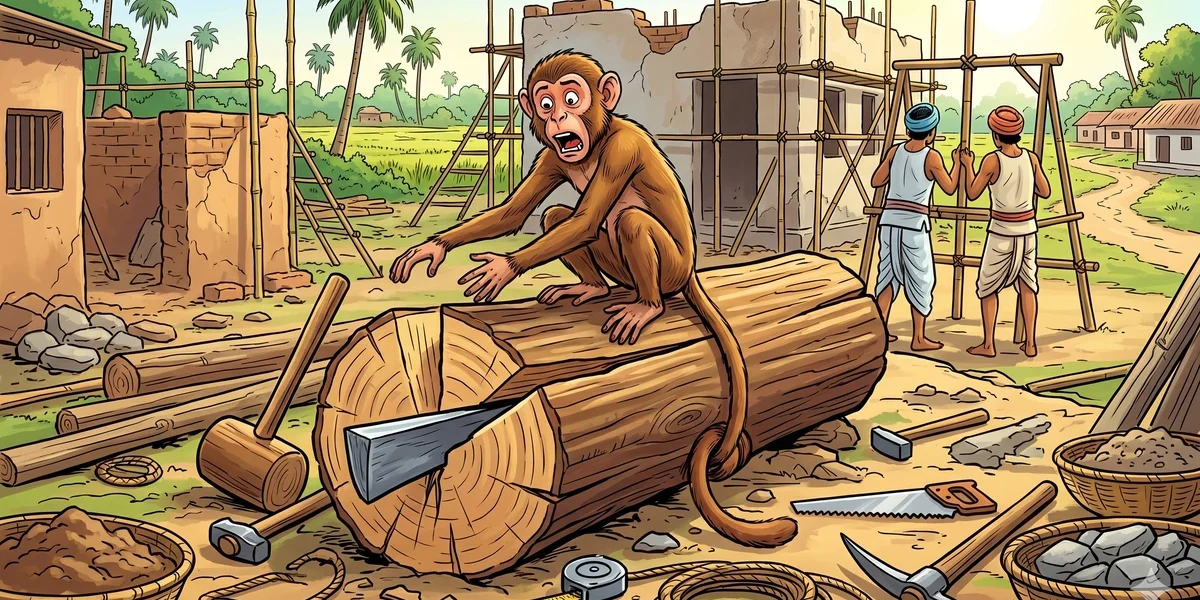
The Story of the Monkey and the Log
Origin and Manuscript Tradition
This tale is one of the Panchatantra’s most economical fables: three scenes, one action, one consequence, zero ambiguity. It belongs to Book V, Aparikshitakaraka (Acting Without Thinking), and is designed to deliver the book’s central principle through the most vivid possible demonstration: a creature interferes with a mechanism it does not understand, and the mechanism responds according to its nature rather than the creature’s intentions. The wedge and the log do not care that the monkey is curious rather than malicious. They respond to the physical action of the wedge being removed. This precision — the total indifference of physical systems to the intentions of those who disturb them — is the lesson Vishnu Sharma is encoding. The story appears in all major Sanskrit manuscript families and passed through the Persian and Arabic transmission without losing a single essential element.
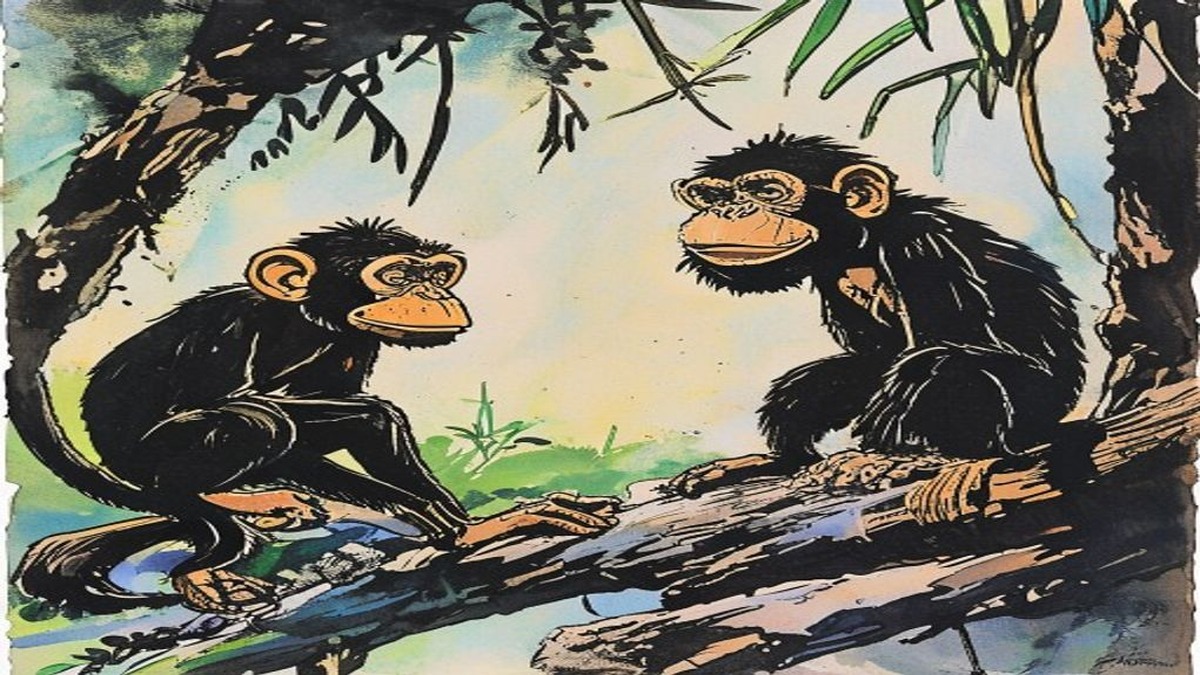
The Carpenters and the Wedge
A group of carpenters had been cutting a large log in a forest near a temple that was under construction. They had set the log on supports and were splitting it lengthwise with a saw. To hold the cut open while they worked, they had driven a wooden wedge into the gap — a standard practice that kept the log from closing around the saw blade and trapping it. At midday, when the sun was at its most punishing, the carpenters set down their tools and went to eat their meal in the shade of a nearby tree, leaving the log on its supports with the wedge in place and the half-finished cut gaping open.
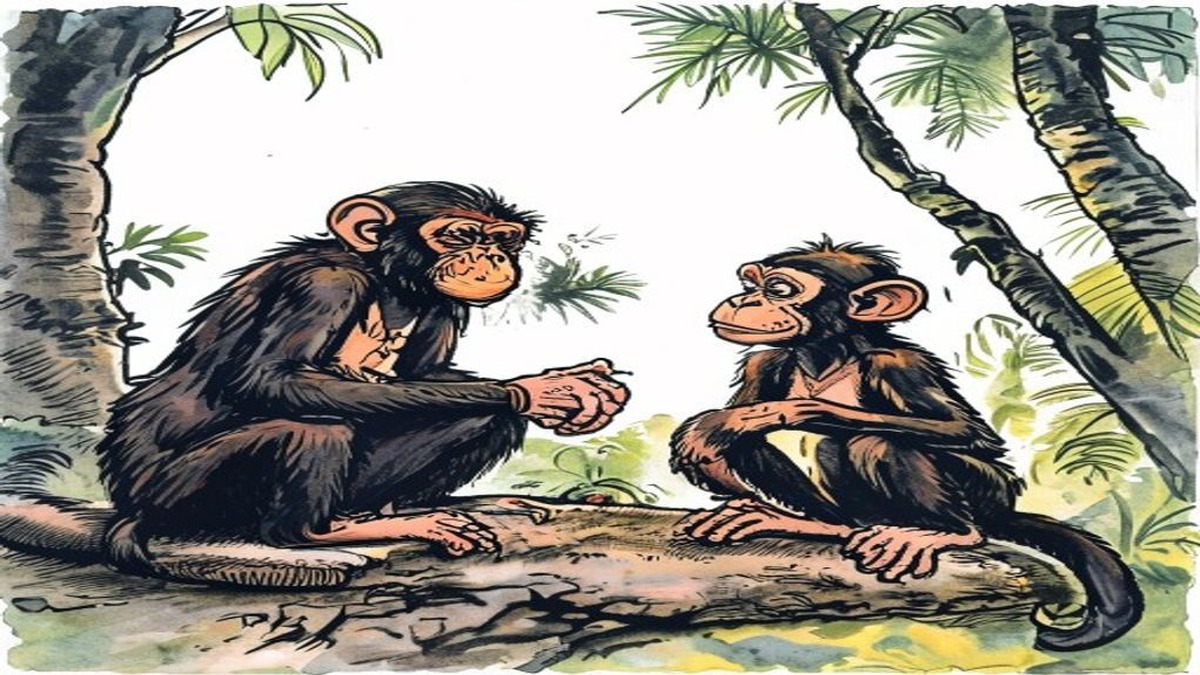
A troop of monkeys had been watching from the trees above. Monkeys are by nature investigators of anything left unattended, and the log with its wedge and its half-open gap presented several interesting features: it was large, it smelled of freshly cut wood, and there was an object sticking out of it that had not been there before the carpenters arrived. Several of the monkeys descended to inspect. Most sniffed, climbed on top, and moved on. One did not.
This monkey, which the Panchatantra does not name — because it does not need to; the monkey represents a type rather than an individual — settled directly on top of the log, straddling the gap, and focused its attention on the wedge. It was clearly connected to the log in some functional way. It was clearly something the carpenters had placed there deliberately. The question the monkey was unable to form, because it did not have the concept, was: Why is it there and what will happen if it is removed? The monkey pulled the wedge out.
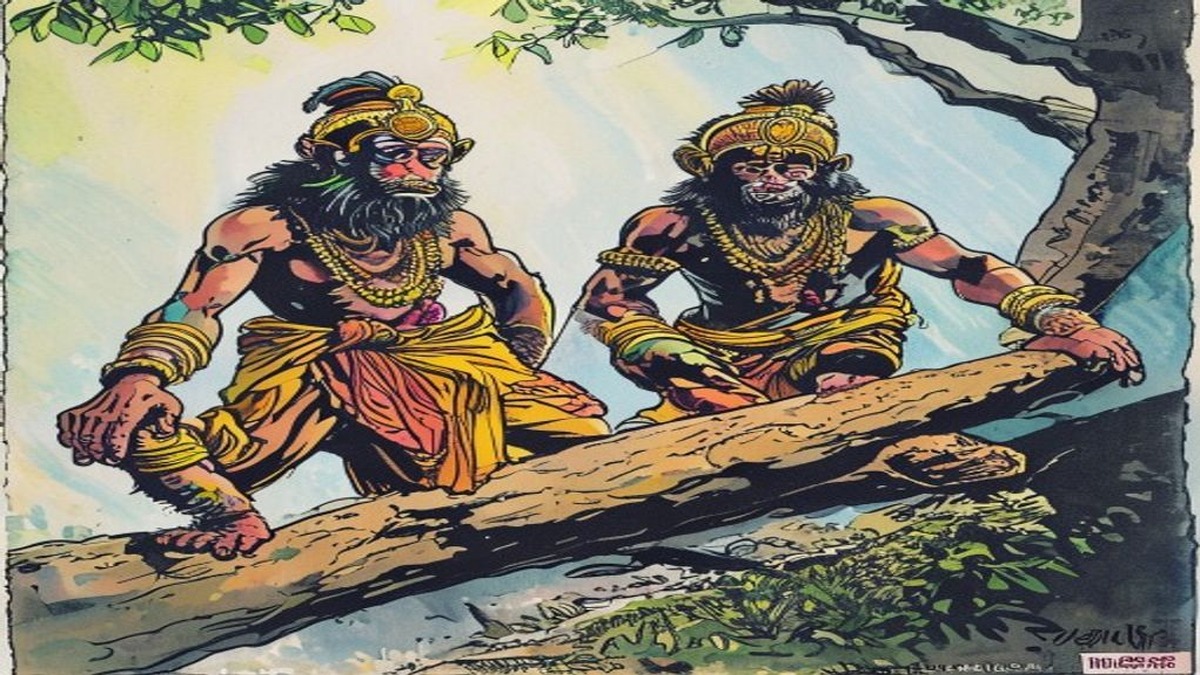
The Log Closes
The log, no longer held open by the wedge, snapped shut. The monkey, straddling the gap, was caught. The carpenters returned from their meal to find the work interrupted, the wedge on the ground, and the monkey held fast. Vishnu Sharma does not describe the resolution in detail; the point has been made and further elaboration would dilute it.
What matters to Vishnu Sharma is the structure of the event rather than the outcome. The monkey did not intend to be caught. It was curious. Its curiosity led it to remove an object whose function it did not understand. The removal of that object had a physical consequence that the monkey did not anticipate because it had not performed the reasoning: This object is holding this gap open. If I remove it, the gap will close. I am sitting in the gap. Each step of that reasoning was available to the monkey in principle; it simply did not perform the reasoning before acting. It acted on impulse, on curiosity, on the immediate desire to pull the interesting thing free, and the consequence arrived precisely as it would have if the monkey had known exactly what it was doing and done it anyway.
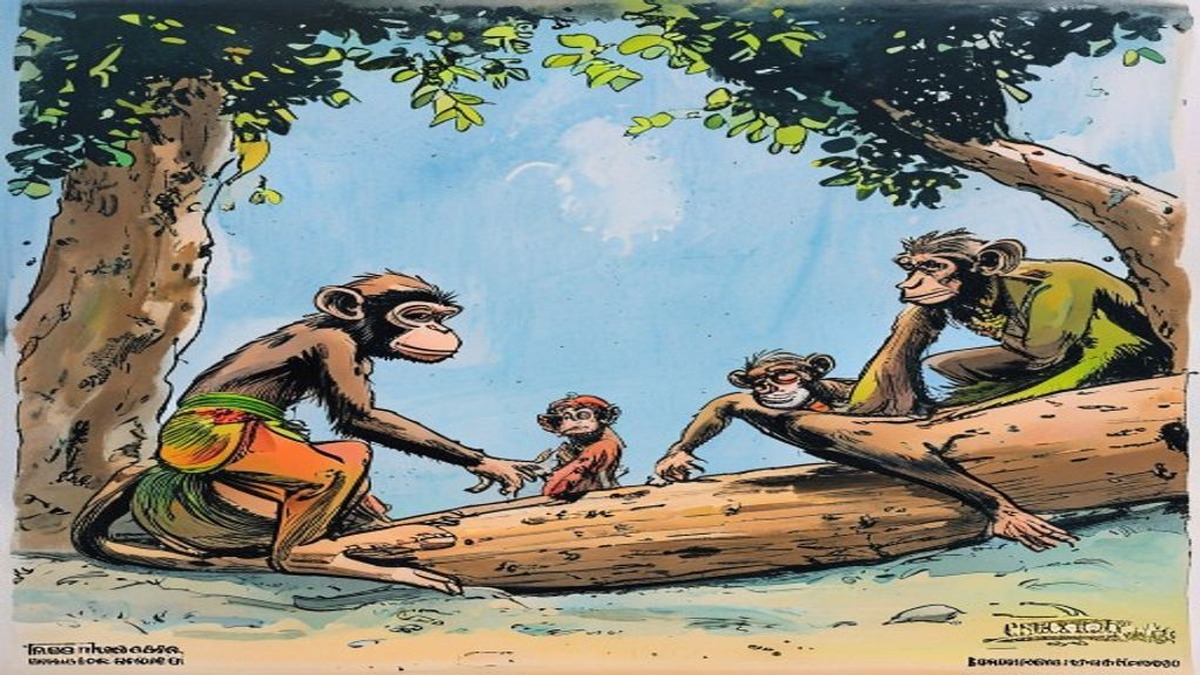
What Meddling Costs
Vishnu Sharma frames this story as an illustration of meddlesome interference — the third great category of unwise action in Book V, alongside acting under misapprehension and acting from greed without examining the means. Meddling is the interference with processes and systems that one does not understand, driven by curiosity, helpfulness, or the simple inability to leave alone what does not concern one.
The log was not the monkey’s business. The carpenters had not asked for assistance. The wedge was serving a function in a system the monkey had no knowledge of. A prudent creature, seeing a mechanism whose purpose it did not understand, would observe but not touch. The monkey touched, and the mechanism responded. The carpenters’ intentions in constructing the mechanism were entirely irrelevant to the physical consequences of removing the wedge. This is the hardest part of Vishnu Sharma’s lesson: physical systems operate according to their own logic, not according to the intentions of those who interfere with them.
The tale is brief precisely because its lesson requires no elaboration. Once the wedge is out and the log is closed, there is nothing more to say. The monkey’s fate follows from its action with the same inevitability as the log’s movement followed from the removal of the wedge. The Panchatantra trusts its reader to complete the moral without being told: do not meddle in the workings of systems you do not understand, because those systems will respond to your action regardless of your reasons for taking it.
Moral and Sanskrit Wisdom
परकार्येषु न हस्तं निक्षेपेत्
Parakaryeshu na hastam nikshepet — “Do not put your hand into others’ affairs.”
— Sanskrit proverbial tradition, Panchatantra V
The Sanskrit principle at the centre of this tale is aparikshitakaraka in its specific form of interference without understanding. The monkey’s error is not curiosity per se — curiosity is a faculty — but curiosity acted upon without the prior question: do I understand what will happen if I do this? In the Panchatantra’s epistemology, action taken without that question is not intelligent curiosity; it is impulsive meddling, and impulsive meddling in systems one does not understand produces consequences calibrated to the system’s logic, not the meddler’s intentions.
Why This Story Has Lasted 2,300 Years
The Monkey and the Log endures because it captures something universally recognisable: the moment of interference with a mechanism one does not understand, followed by a consequence one did not intend. Every culture has its version of this experience, and every tradition has tried to name and discourage it. What Vishnu Sharma adds to the universal recognition is the analytical precision of the Panchatantra: the problem is not that the monkey was curious, but that it acted before asking the question that curiosity should prompt — What will happen?
The story is particularly relevant to institutional and political contexts, which is one reason Vishnu Sharma included it in his curriculum for princes. Governance is full of mechanisms — legal, economic, administrative, social — that have been placed in their current configuration for reasons that may not be visible to someone looking at them for the first time. The impulse to remove a wedge that appears unnecessary, to simplify a process that seems over-complicated, to interfere with an arrangement that looks arbitrary, is entirely natural. What the Panchatantra asks is that the impulse be preceded by the question: do I understand why this is here? If not, observe rather than touch.
The brevity of the story is part of its design. Vishnu Sharma gives us the minimum required to make the point — the log, the wedge, the monkey, the consequence — and trusts the reader’s intelligence to complete the inference. The restraint of the telling mirrors the restraint the monkey should have practised. A longer version, with more explanation and more elaboration, would itself enact a kind of meddling: adding to a mechanism that works perfectly well with what it already contains. The story knows when to stop, which is one thing the monkey did not know.
Frequently Asked Questions
What is the moral of the Monkey and the Log?
Do not interfere with mechanisms you do not understand. Physical systems respond to actions, not intentions — the log closed because the wedge was removed, with complete indifference to why it was removed.
Which Panchatantra book contains this story?
The tale is in Panchatantra Book V (Aparikshitakaraka — Acting Without Thinking), compiled by Vishnu Sharma around the 3rd century BCE. The entire fifth book documents catastrophes that follow from unexamined action.
What is the Sanskrit concept of aparikshitakaraka?
Aparikshitakaraka means acting without prior examination — specifically, taking action before asking what will happen as a result. It is the Panchatantra's name for the cognitive failure that connects curiosity to harm: not the curiosity itself, but the failure to precede action with consequence-tracing.
Why does Vishnu Sharma not name the monkey in this story?
The nameless monkey represents a type rather than an individual — the meddler who acts without understanding. Naming it would particularise the lesson and reduce its universality. The unnamed monkey is every person who has ever pulled out a wedge without asking why it was there.
What does this story teach about institutional and governance contexts?
Governance is full of mechanisms placed in their current configuration for reasons not immediately visible. The impulse to simplify what appears over-complicated, or to remove what looks unnecessary, should always be preceded by the question: do I understand why this is here? If not, the Panchatantra counsels observation rather than action.
You May Also Like
 Panchatantra Stories
Ages 9-12
Panchatantra Stories
Ages 9-12
The Story of the Merchant’s Son
The Story of the Merchant's Son: Do your best but leave it to destiny.” Sagardatta was a merchant who had a handsome young son. One day, he observed that his
 Panchatantra Stories
Ages 3-5
Panchatantra Stories
Ages 3-5
The Dog who went Abroad
Read 'The Dog who went Abroad' — a classic Panchatantra story about nature and animals. The Dog who went Abroad is a beloved Panchatantra tale featuring...
 Panchatantra Stories
Ages 6-8
Panchatantra Stories
Ages 6-8
Shandili and Sesame Seeds
Shandili's endless greed for sesame seeds transforms a magical gift into the agent of her doom.