The Dog who went Abroad
Read 'The Dog who went Abroad' — a classic Panchatantra story about nature and animals. The Dog who went Abroad is a beloved Panchatantra tale featuring...
The Dog Who Could Not Stay Home
“The Dog who went Abroad” is one of the most psychologically acute tales in the Pañcatantra‘s fifth book, Aparīkṣitakārakaṃ — “Of Ill-Considered Actions” — which is devoted to the dangers of acting without sufficient thought or self-knowledge. A dog living in a land of famine and hardship emigrates to a foreign country where food is plentiful. He eats well, grows fat, and prospers. But the habits of his home — its familiar routes, its particular smells, its community of strays — pull at him until he can resist no longer. He returns home. Asked by his companions what the foreign land was like, he praises it effusively. They immediately ask: then why did you come back? The dog has no good answer. He came back because he could not help it — because the pull of the familiar is not a rational force but a biological and emotional one that operates beneath the level of deliberate choice.
The tale’s target is nostalgia, or more precisely the irrational power of home — what the Greeks called nostos — over creatures who are perfectly capable of intellectually grasping that their situation has improved but emotionally incapable of inhabiting the improvement. The dog is not stupid. He knows the foreign country is better. He chose to return anyway, and then discovered that he could not explain his choice in terms that satisfied even himself. The Pañcatantra presents this not as a touching feature of loyalty but as a cautionary illustration of the failure of reason to govern desire.
The Story: Abundance, Return, and the Unanswerable Question
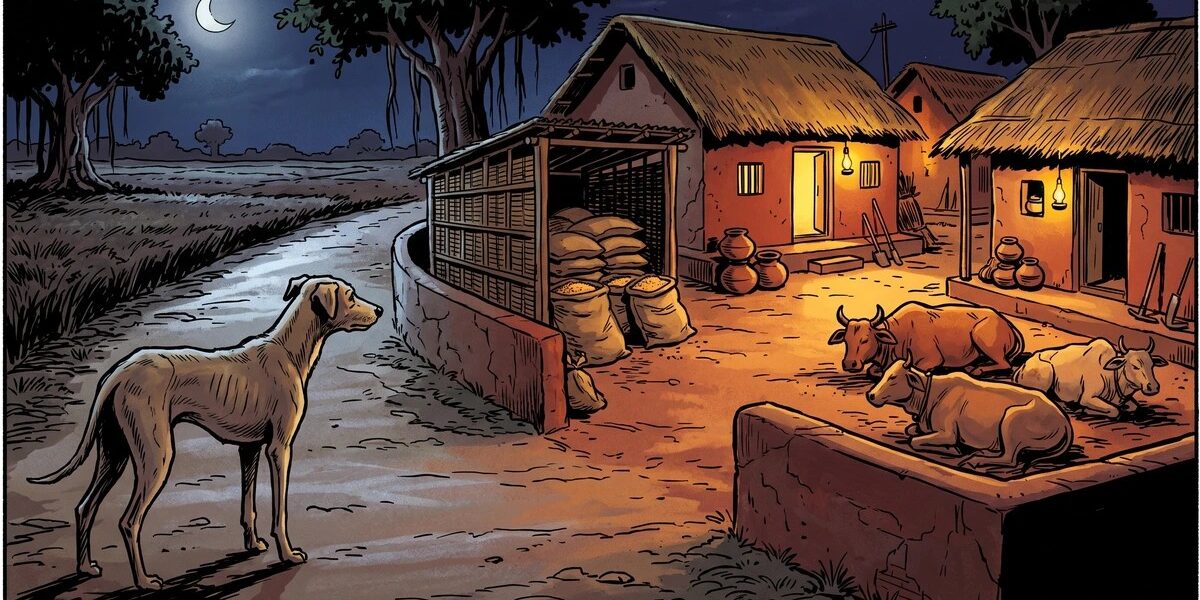
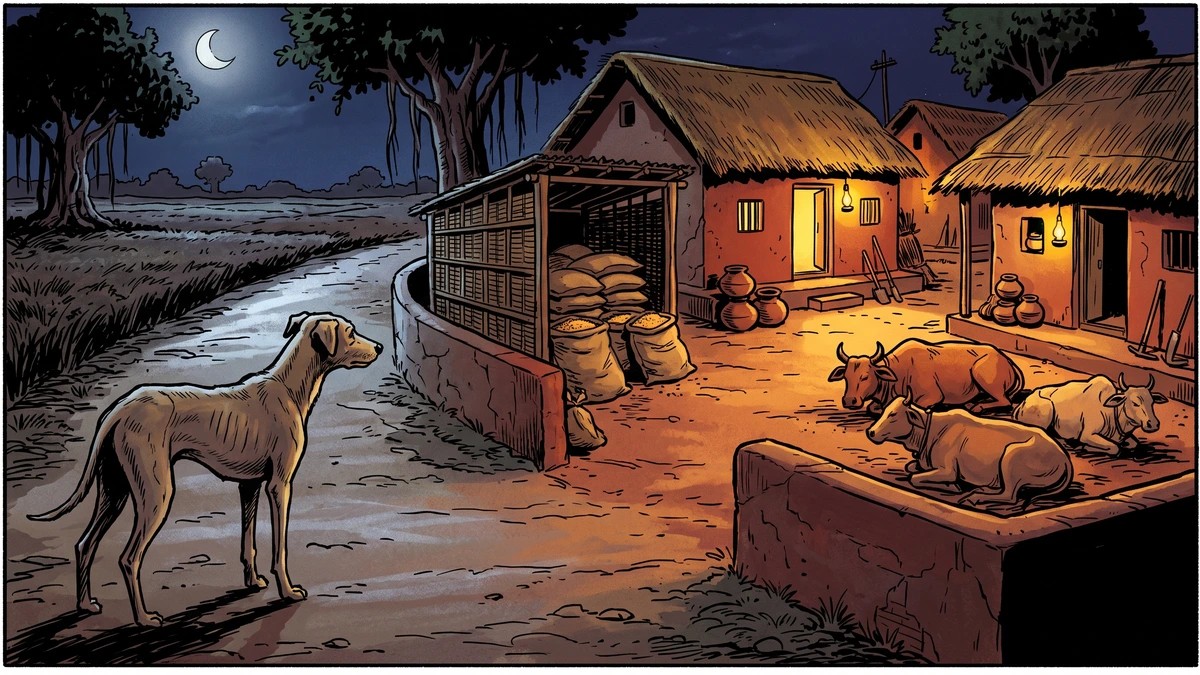
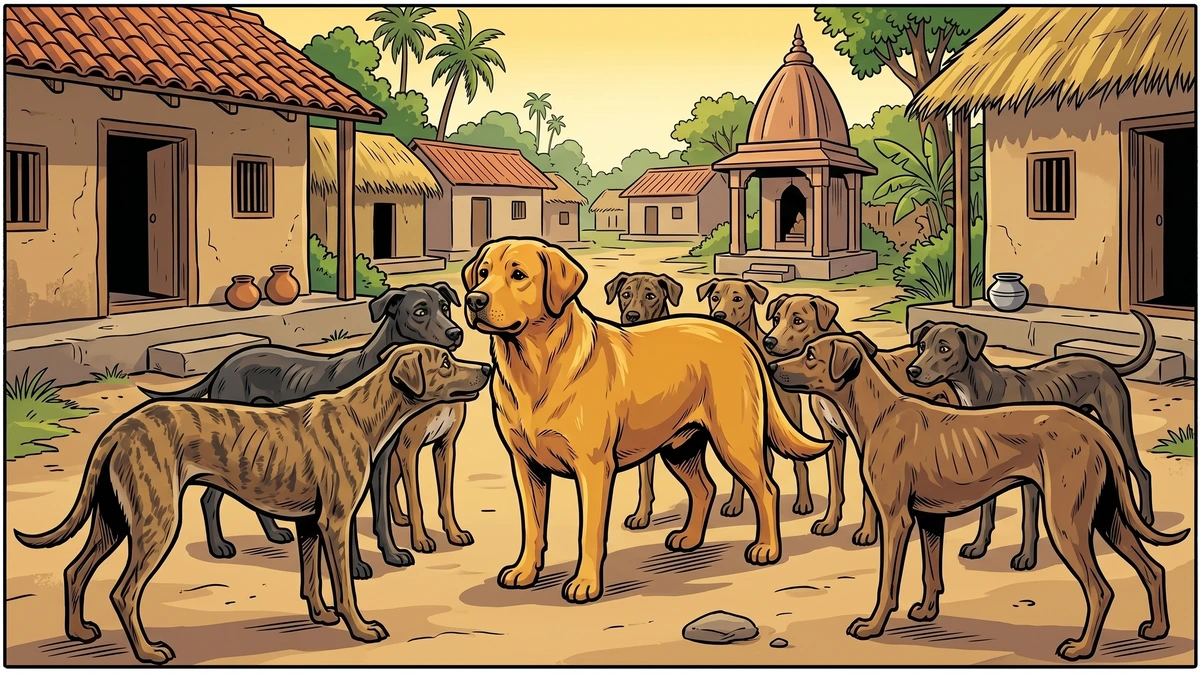
The narrative is set in a specific economic context that the Sanskrit compiler takes care to establish: the land where the dog lives is experiencing severe scarcity. Crops have failed, and the village dogs — always at the bottom of the food chain in Indian village life — are the first to suffer. The protagonist dog, whose name varies between recensions but is sometimes given as Chitrāṅga (“Marked Body”), decides to emigrate. This is itself a significant narrative choice: the Pañcatantra frames emigration as a rational response to adverse conditions, not as disloyalty or restlessness. The dog exercises sound economic judgment.
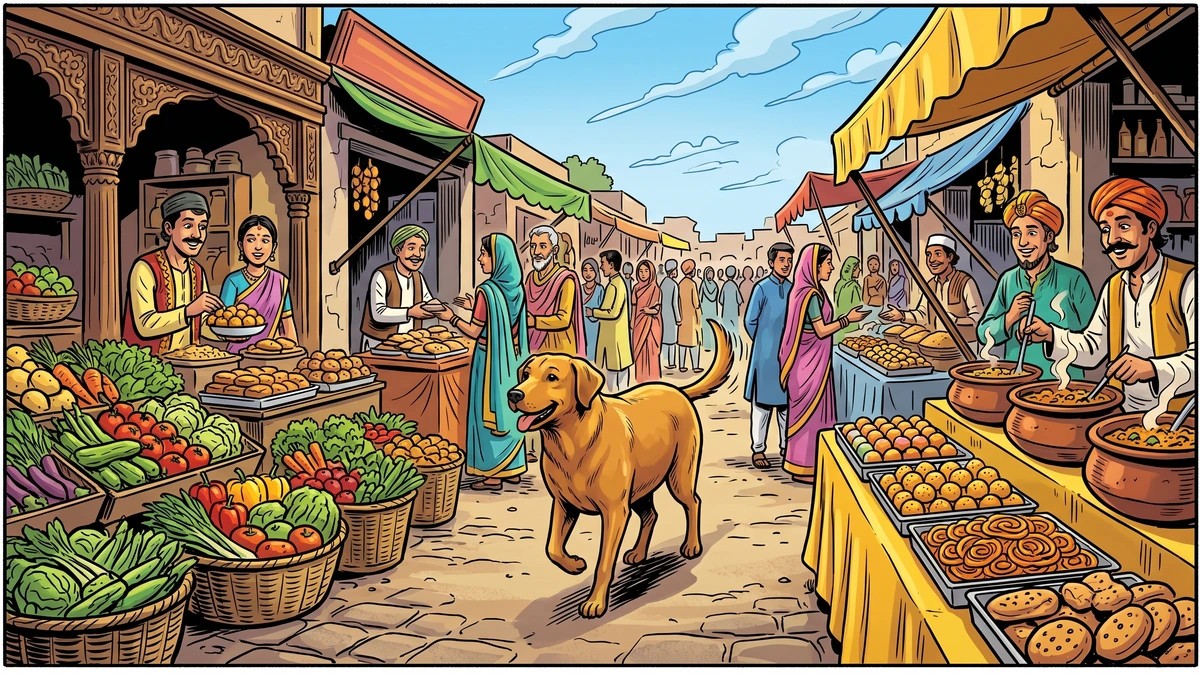
In the foreign land — the text leaves the destination vague, which is deliberate — food is plentiful. The dog finds a generous household whose residents leave scraps and leftovers in abundance. He eats regularly, sleeps safely, and grows sleek and well-fed. The text describes his improved physical condition in some detail: his ribs no longer show, his coat becomes glossy, his movements lose the furtive urgency of hunger. He is, by every material measure, better off than he has ever been in his life. Yet something gnaws at him that is not hunger — a formless restlessness, a recurring memory of particular smells and sounds, a longing not for any specific thing but for the texture of a place.
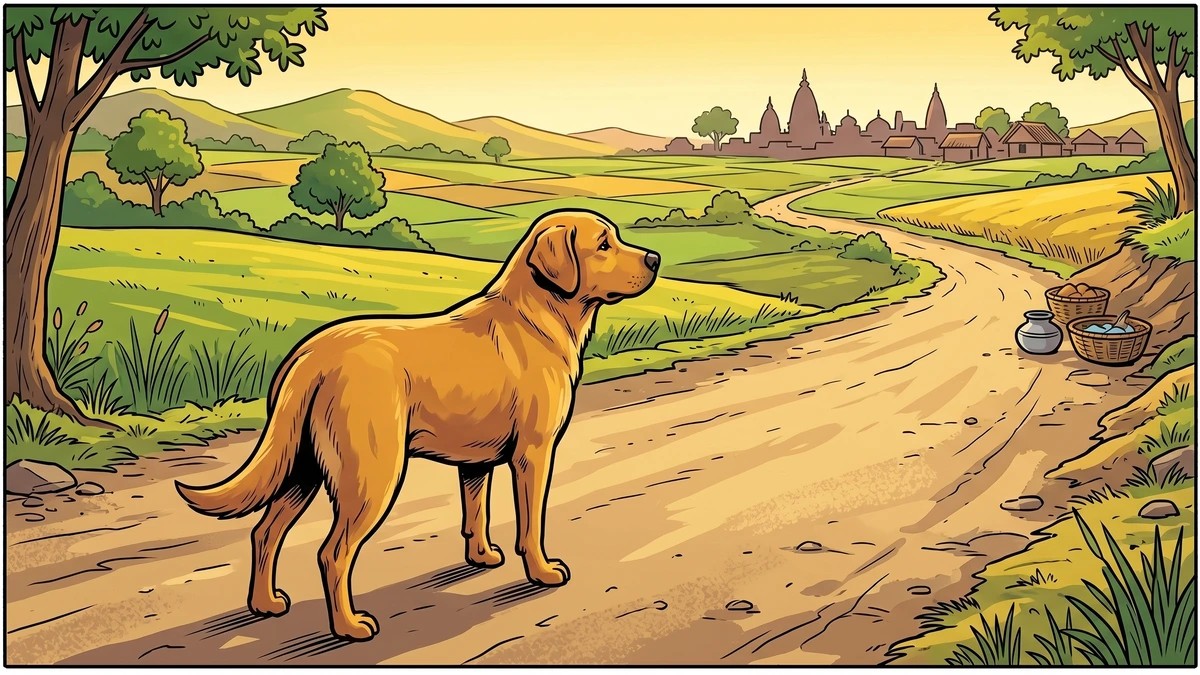
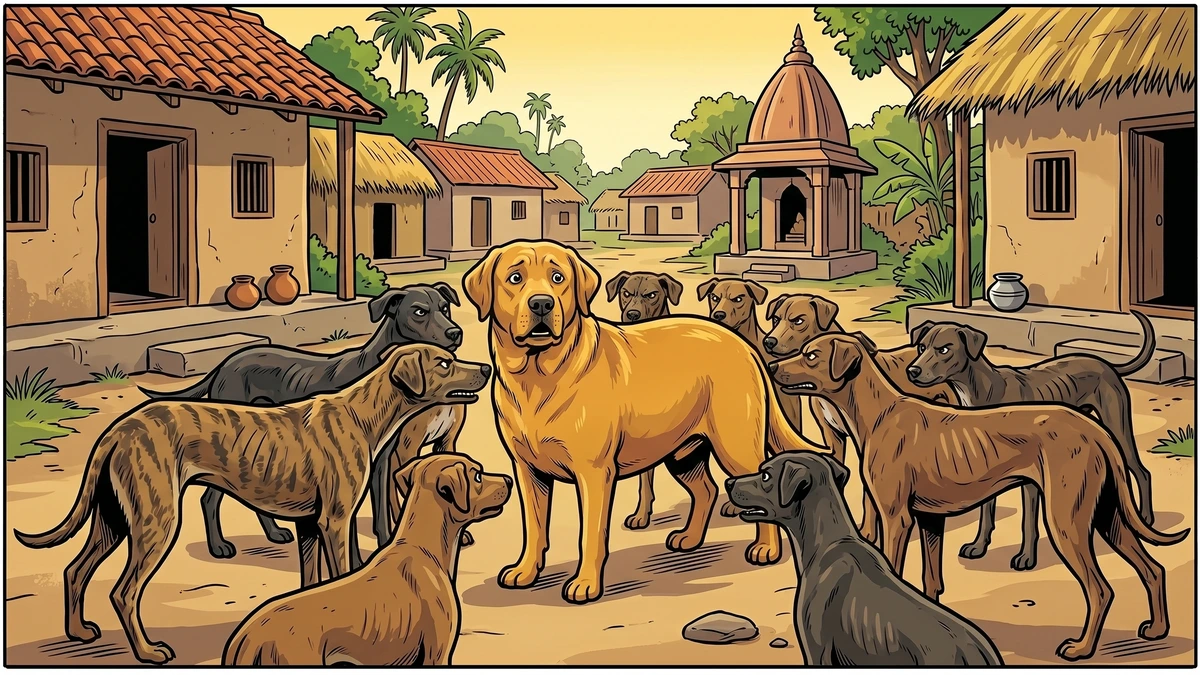
One day he simply turns around and walks home. The narrative presents this decision with remarkable economy — no agonised deliberation, no careful weighing of options, no dramatic crisis. He just goes. When he arrives, his former companions cluster around him. They are thin; he is fat. The disparity is stark. They ask him about the foreign land, and he answers honestly and with enthusiasm: the food is plentiful, the people are generous, the living is easy. His account is so compelling that they immediately ask why he came back. The dog pauses. He opens his mouth. He has no answer — or rather, the only true answer is one he cannot quite formulate: I do not know. I could not help it.
The Fifth Book: Aparīkṣitakārakaṃ and the Costs of Unreflective Action
The fifth book of the Pañcatantra is the shortest of the five but arguably the most philosophically compressed. Its central concern is aparīkṣita — “unexamined” or “ill-considered” — action: decisions made without adequate reflection on consequences, on the nature of the actor’s own desires, or on the difference between what one wants and what one needs. The frame story involves a series of cautionary examples, and “The Dog who went Abroad” is among the most subtle because the dog’s action — returning home — is not obviously foolish in the way that, say, a Brahmin’s castle-in-the-air fantasies are foolish. The dog has not made a catastrophically wrong decision in any conventional sense. He has simply returned to an objectively worse situation because he was constitutionally unable to remain in a better one.
This is the fifth book’s most sophisticated insight: the failure of reason to govern the emotions is not always dramatic. It does not always manifest as wild fantasy or immediate gratification-seeking. Sometimes it manifests as the quiet, inexorable pull of the familiar — as homesickness, as habit, as the body’s memory of a particular place. The Pañcatantra is asking its reader to recognise this pull, name it honestly, and understand that it operates beneath the level of deliberate choice. The dog who cannot explain his own return is the emblem of a failure of self-knowledge: not knowing why you do what you do is presented as a significant intellectual and moral deficiency.
Cross-Cultural Parallels: Emigration, Nostalgia, and the Failure of Reason
The tale belongs to the broad category of narratives about emigration and return that appear in virtually every literary tradition. In the Western canon, the paradigmatic text is Homer’s Odyssey, whose entire plot is driven by Odysseus’s desire to return home to Ithaca — a desire so powerful that he risks and sacrifices everything to satisfy it, including the offer of immortality from the goddess Calypso. The Pañcatantra and the Odyssey treat the same emotional reality but in diametrically opposed moral registers: Homer celebrates the desire to return home as the supreme expression of identity and loyalty; the Pañcatantra diagnoses it as an irrational impulse that prevents rational actors from optimising their lives.
This difference in moral register is not accidental but reflects deep structural differences between the two literary traditions’ views of the relationship between reason and desire. The Greek tradition, as elaborated in tragedy and philosophy, tends to treat powerful desire as dignified even when it is destructive: Odysseus’s nostos is heroic even in its catastrophic dimensions. The Sanskrit didactic tradition, by contrast, treats uncontrolled desire — of any kind, including apparently benign desire for home — as a cognitive failure that diminishes the actor. The dog’s inability to explain his choice is, in the Pañcatantra‘s moral universe, an indictment of his rationality.
In the Arabic Kalīla wa-Dimna tradition, the tale is preserved with its didactic framing intact, and the commentary makes explicit what the Sanskrit source leaves implicit: the dog’s return illustrates the proverb that a man who abandons a good situation for a familiar bad one deserves neither. The Persian and Hebrew adaptations similarly emphasise the irrationality of the return rather than its emotional comprehensibility. It is only in the European literary tradition — where sentiment and emotion receive greater moral credit — that versions of this tale tend to treat the return sympathetically.
The Dog in Indian Narrative: A Complex Symbol
The dog (śvān in Sanskrit) occupies a peculiarly complex symbolic position in Indian literature and religious thought. In the Vedic tradition, dogs are associated with both Indra’s messengers and with Yama, the god of death, whose two dogs guard the path to the underworld. In the epics, the dog that accompanies the Pāṇḍavas on their final journey in the Mahābhārata reveals itself at the gates of heaven to be Dharma in disguise — an image of unexpected nobility concealed within apparent lowliness. In everyday village life, however, stray dogs occupied the lowest social position: scavengers, tolerated but not valued, fed scraps but not kept as companions in the Western sense.
The Pañcatantra‘s use of a dog as the protagonist of a tale about irrational attachment to home is therefore not neutral. The dog is chosen precisely because its social position — marginal, dependent, scavenging — makes the irrationality of its attachment most legible. A Brahmin who returned from prosperity to poverty out of nostalgia might be praised for his ascetic indifference to material comfort; a dog who does so has no such defence. The dog’s return is purely irrational, and the tale’s framing ensures the reader cannot romanticise it. The dog is not being loyal; he is being constitutionally unable to transcend his habits.
Reception and Enduring Relevance
In the Indian oral and literary tradition, “The Dog who went Abroad” has been cited across centuries as a parable about the dangers of nostalgia and the difficulty of genuine self-improvement. The tale speaks to a perennial human experience: the immigrant who succeeds abroad but cannot stop comparing everything to home; the person who leaves a destructive relationship and finds themselves inexplicably drawn back; the professional who escapes a bad situation only to recreate it in the next job. The Pañcatantra‘s insight is that these failures of rational self-interest are not mysterious — they reflect the power of habit, sensory memory, and social identity over deliberate choice.
In modern Indian children’s literature and television, the tale is often told with comic affection: the dog is endearing precisely because he is so recognisably, so humanly, incapable of doing what he knows to be best for himself. But the original Sanskrit compiler’s intent was diagnostic, not affectionate. The dog’s inability to answer the question “why did you come back?” is meant to unsettle, not to charm. Self-knowledge — knowing why you do what you do — is presented as a prerequisite for wise action, and the dog’s failure of self-knowledge is as cautionary as any of the more spectacular failures in the other four books.
Frequently Asked Questions
Textual History: Versions and Variants Across Traditions
The story’s transmission through manuscript traditions reveals significant variation in emphasis. The Northwestern Sanskrit recension — which served as the basis for the Pahlavi translation from which the Arabic Kalīla wa-Dimna descends — gives the tale a sharper didactic edge: the dog’s companions, after hearing his description of the foreign country, explicitly ridicule him for his inability to stay. His social shame is part of the story’s moral mechanism. The Tantrākhyāyikā (the older Southern recension) is more restrained, letting the unanswered question — “why did you come back?” — do the moral work without editorial commentary.
This difference in presentation reflects a genuine disagreement about didactic method that runs through the Pañcatantra‘s manuscript tradition. The Northwestern approach — explicit shaming and commentary — is effective for immediate instruction but risks narrowing the tale’s resonance to a single lesson. The Southern approach — presenting the situation and letting the reader supply the judgment — is more literarily sophisticated but depends on the reader’s willingness to perform the interpretive work. Modern scholars generally prefer the Southern recension as the more “original” of the two, though the distinction is complicated by the impossibility of dating the various branches with certainty.
The tale also appears in variant forms in the Buddhist Jātaka collection, where the protagonist is sometimes a dog, sometimes a human labourer, and the moral lesson is refracted through a Buddhist lens: attachment to the familiar is a manifestation of the more general attachment (upādāna) that the Dhammapada identifies as the root of suffering. In these Buddhist versions, the protagonist’s failure to remain in the better situation is not merely a cognitive error but a spiritual one — an instance of the craving for continuity of self that binds beings to the wheel of rebirth.
The Unanswerable Question as Literary Device
The tale’s climactic moment — the dog’s inability to answer “why did you come back?” — is a masterclass in narrative economy. The question functions simultaneously as plot resolution (the dog is home; his companions want to understand), characterisation (the companions are practical and unsentimental; the dog is emotionally complex but cognitively limited), and moral vehicle (the inability to answer a simple question about one’s own motives is the story’s final and most damning judgment). The narrative does not need to editorialize; the unanswered question does everything.
This technique — ending a didactic tale on an unanswerable question rather than a maxim — is relatively unusual in the Pañcatantra‘s repertoire. Most tales conclude with a stated moral or a character who articulates the lesson the reader should draw. “The Dog who went Abroad” instead leaves the reader with the dog’s silence, which is more unsettling and more memorable than any explicit lesson could be. The silence invites the reader to complete the tale’s thought: do you know why you do what you do? Can you answer the question the dog cannot?
You May Also Like
 Panchatantra Stories
Ages 6-8
Panchatantra Stories
Ages 6-8
Shandili and the Sesame Seeds
A Panchatantra tale about a poor Brahmin's wife Shandili, a suspicious trader, and why something too good to be true usually isn't. A classic lesson in caution.
 Panchatantra Stories
Ages 3-5
Panchatantra Stories
Ages 3-5
5 Panchatantra Stories About Animals That Kids Love
5 Panchatantra Stories About Animals That Kids Love: Kids love stories with animals in them. Stories of dense forests, strange birds and animals, beautiful
 Panchatantra Stories
Ages 3-5
Panchatantra Stories
Ages 3-5
The Brahmin’s Dream of Pots of Rice
A hungry Brahmin dreams of turning one pot of rice into a kingdom — and loses it all with a single careless kick.