The Story of King Chandra
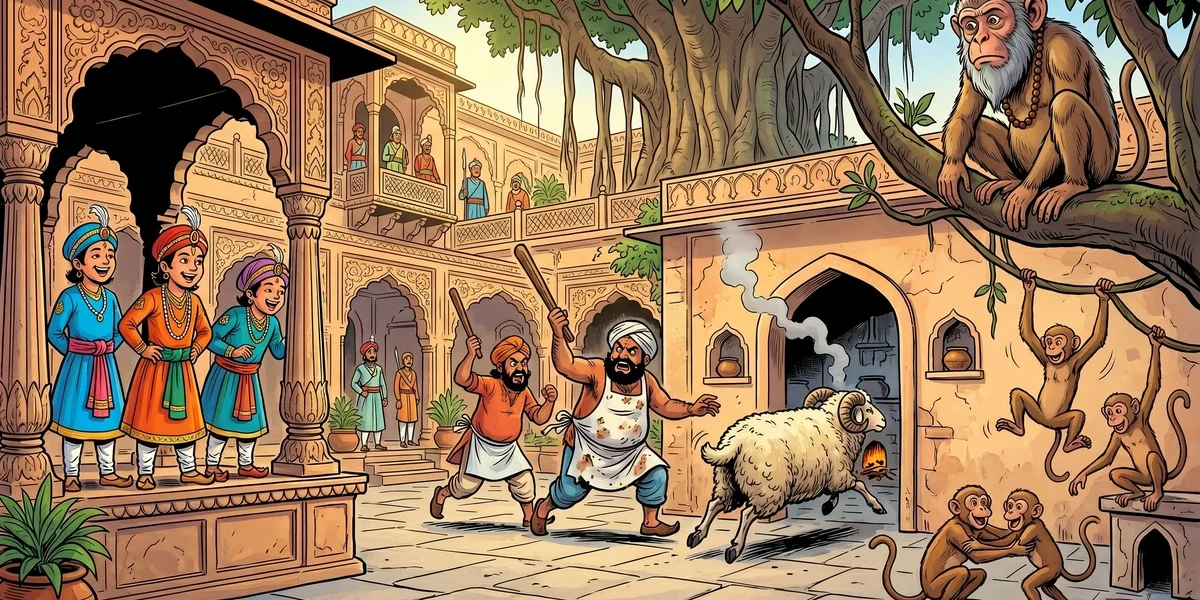
The Story of King Chandra: In a certain city, there lived a king, by the nameof Chandra. His sons kept a troop of monkeys. Theyal ways fed them on a variety of
Origin & Canonical Placement
“The Story of King Chandra” is a tale of royal virtue, the responsibilities of power, and the testing of a king’s character by circumstances that reveal whether his generosity and justice are performances or genuine commitments. It belongs to Vishnu Sharma’s Pancatantra (c. 300 BCE–300 CE) and resonates with the broader tradition of niti-shastra exemplary-ruler narratives found in the Hitopadesha, the Arthashastra, and the Mahabharata’s Shanti Parva. The tale is aligned with Book II: Mitra-samprapti (“The Gaining of Friends”), which concerns the qualities that attract genuine alliance and loyalty — qualities that must be demonstrated under pressure, not merely proclaimed.
“Paropakaro hi dharmah; raja-dharmasya mulatvam.”
“Service to others is the highest virtue; it is the very root of the king’s duty.”
— Sanskrit maxim, Panchatantra / raja-dharma tradition
Beat I — The Kingdom of King Chandra: Prosperity Built on Justice
King Chandra ruled a prosperous kingdom whose abundance was attributed by his subjects not to geographical fortune but to the quality of his governance. He had established regular and efficient tax collection that was neither so light as to leave the treasury empty nor so heavy as to impoverish the agricultural families who formed the kingdom’s productive base. He held court without favouritism, settling disputes on the basis of evidence and established dharma rather than on the basis of family connections or the wealth of the petitioner. Merchants came from distant regions because they trusted that contracts made in his kingdom would be enforced; farmers stayed because they trusted that the produce of their labour would not be arbitrarily taken.
The king’s court was known for one quality above all others: accessibility. Any citizen — farmer, artisan, widow, child — could request audience with the king on the days designated for public petitions, and the king would hear each case personally. This was not merely political theater; the king genuinely believed that justice delayed or filtered through intermediaries was justice corrupted, and that the only way to know what was actually happening in his kingdom was to hear from its inhabitants directly.
Beat II — The Test: A Petitioner Who Asks the Impossible
One day, at public court, an old woman approached the king with a petition that he had never encountered before. Her only son had been killed — struck down, she said, by the king’s own horse as the royal cavalcade passed through the market district at speed. The horse was royal property; the king’s officials had chosen the route and the pace. She was asking for justice: for acknowledgment of the loss and for redress that would allow her to live out her remaining years without destitution.
The court fell silent. The king’s advisors calculated rapidly: to acknowledge the crown’s responsibility was to set a precedent that could generate countless future claims; to deny it was to tell a grieving mother that the king’s horse was above the law that protected all other horses. The king listened to the woman’s account carefully and asked his officials to verify the facts. They were verified. He then turned to the court and announced that the crown bore responsibility for the incident, that the woman would receive a pension sufficient for her maintenance from the royal treasury for the remainder of her life, and that henceforth the royal cavalcade would travel at reduced speed through market districts. The court observed, and drew its conclusions about the kind of king it served.
Beat III — The Analysis: Justice as the Foundation of Political Legitimacy
Vishnu Sharma’s account of King Chandra’s ruling encodes one of the niti-shastra tradition’s most fundamental propositions: that political legitimacy rests not on military power or hereditary right alone but on the consistent application of justice to all subjects regardless of the power differential between claimant and defendant. A king who is just toward the powerful but not toward the weak has purchased the loyalty of one class at the cost of the security of all others — a bad trade in both moral and practical terms.
The case that tests King Chandra is specifically designed to impose the maximum cost on justice: the defendant is the crown itself, the precedent is potentially expensive, and the petitioner is the least powerful member of society. The advisors’ silent calculation — the instinct to find a way around the claim — represents the permanent temptation of power to exempt itself from the rules it enforces for others. King Chandra’s refusal of this exemption is what the text identifies as the foundation of his kingdom’s genuine prosperity: subjects who trust that justice applies to all parties, including the most powerful, will behave differently — more honestly, more productively, more loyally — than subjects who know that power protects itself from accountability.
Kautilya’s Arthashastra makes this point with characteristic precision: a king who is unjust loses the hearts of his subjects before he loses any military engagement, and a kingdom whose subjects have withdrawn their loyalty from the crown is far more vulnerable to external threat than one whose military force is smaller but whose citizens are genuinely invested in its survival.
Beat IV — Moral Dimension & Enduring Relevance
King Chandra’s story is one of the Panchatantra’s clearest statements of what the classical tradition calls raja-dharma — the duty of a king — which differs from the dharma of other stations precisely because it is the king’s role to be the guarantor of the dharmic order for everyone else. This is not a merely ceremonial function; it requires real cost, real constraint on the king’s convenience and interest, and real accountability to standards that the king did not set but is obligated to maintain.
The pension for the old woman and the reduced speed of the royal cavalcade are small acts in absolute terms. Their significance is entirely symbolic — but the Panchatantra tradition consistently treats symbolic acts by those in power as among the most consequential things they do, because symbols communicate the actual rules of a social order far more reliably than formal proclamations. The citizens of King Chandra’s kingdom did not need to be told that the king was just; they saw what he did when it was costly to be just, and they knew.
For contemporary organisations and political systems, the lesson is direct: institutional credibility is built in the cases where doing the right thing is most inconvenient — where power must genuinely constrain itself, must acknowledge error, must pay a real price for accountability. The cases where it costs nothing to be just do not define a leader’s character. The cases where it costs something do.
Moral: The just ruler is tested not by how he treats the powerful but by how he treats the weakest petitioner when justice is most costly to himself.
For other Panchatantra tests of judgment and responsibility, compare The Wedge-Pulling Monkey, The Washerman’s Donkey, and The Potter Who Became a Warrior.
Why This Story Has Lasted 2,000 Years
The story of King Chandra endures because the question it poses — will the powerful accept the same standards of accountability that they impose on the weak? — is among the most perennially consequential questions in any social order. The Panchatantra’s contribution is to frame this question through a specific, manageable narrative rather than through abstract exhortation: a grieving mother at a public court, a silent calculation by advisors, a decision made before witnesses. The specificity makes the principle concrete; the concrete case makes the principle transferable; and the transferability is why the story has been read with recognition by audiences in every cultural context through which the Panchatantra has passed across two thousand years.
About the Panchatantra
The Panchatantra (“Five Treatises”) was composed in Sanskrit by the scholar Vishnu Sharma around 300 BCE–300 CE as a niti-shastra — a guide to wise conduct and statecraft — framed as animal fables for the instruction of young princes. Its five books cover the dissolution of allies, the winning of allies, war and peace, the dangers of naivety, and the hazards of rashness. The text spread westward through Pahlavi and Arabic translations to become the most widely translated secular book of the ancient world after the Bible.
You May Also Like
 Panchatantra Stories
Ages 3-5
Panchatantra Stories
Ages 3-5
The Brahmin’s Dream
Read 'The Brahmin’s Dream' — a classic Panchatantra story about wisdom. The Brahmin’s Dream is a beloved Panchatantra tale featuring a ant and a brahmin...
 Panchatantra Stories
Ages 3-5
Panchatantra Stories
Ages 3-5
5 Panchatantra Stories About Animals That Kids Love
5 Panchatantra Stories About Animals That Kids Love: Kids love stories with animals in them. Stories of dense forests, strange birds and animals, beautiful
 Panchatantra Stories
Ages 6-8
Panchatantra Stories
Ages 6-8
The Origin of Panchatantra Stories – A Story in History
The Origin of Panchatantra Stories – A Story in History: The Panchatantra is an ancient Indian collection of inter-related animal fables in Sanskrit verse and