The Story of the Heron And’ the Crab
An ancient Panchatantra tale teaching timeless wisdom about virtue and character.

The Story of the Heron and the Crab
Origin and Manuscript Tradition
This tale is among the most widely disseminated fables in world literature, appearing in the Sanskrit Panchatantra, in the Pali Jataka collection (as the Baka Jataka, no. 38), in the Persian Kalila wa Dimna, and ultimately in European collections through Arabic transmission. Vishnu Sharma composed it for Panchatantra Book I, Mitra-bheda (The Separation of Friends), as an illustration of how the cunning manipulator meets his end not through external force but through the vigilance of a single clear-eyed victim. The crab’s role as the instrument of justice appears consistently across all manuscript families, suggesting it belongs to the story’s original core.
The Heron’s Lament and the Lie
In a pond ringed by mango trees an old heron had fished for many years. His eyes were still sharp but his legs ached and his reflexes had slowed; standing in the shallows for hours no longer yielded the harvest it once had. He sat on the bank one morning and appeared to weep, and his tears were noticed by a large crab who approached from the mud.
“Why do you not fish today?” the crab asked. The heron sighed with theatrical heaviness. “What is the use? I have just heard from a reliable traveller that a twelve-year drought is coming. This pond will be a dust bowl within the season. I am too old to find a new home, so I sit here and grieve for all of us.”
The fish overheard this exchange and were thrown into panic. They clustered at the surface, their mouths opening and closing in distress, and begged the heron to advise them. The heron allowed a long pause to pass before speaking. “There is a large, deep lake over the hills, fed by underground springs that no drought can touch. I could carry you there, one or two at a time. It is a difficult journey for an old bird like me, but I would undertake it out of compassion.” The fish discussed it among themselves and concluded that the heron, who had never harmed them, must be acting in good faith.

The Rock Beneath the Hill
Each morning the heron carried two or three fish over the hill, landed on a flat rock on the far side where no one could observe him, ate them, cleaned his beak on the stone, and returned looking mournful and slightly tired. He told the remaining fish that the journey was taxing but the lake was indeed beautiful and their friends were thriving. The fish queued willingly for what they believed was salvation.
Days passed and the pond grew noticeably emptier. The crab, who had watched all of this with the quiet attention that crustaceans have in abundance, asked to be included in the next transfer. The heron hesitated. A crab was awkward cargo and its claws were not to be underestimated. But refusing might invite suspicion, and besides, the crab was a substantial meal. He agreed.
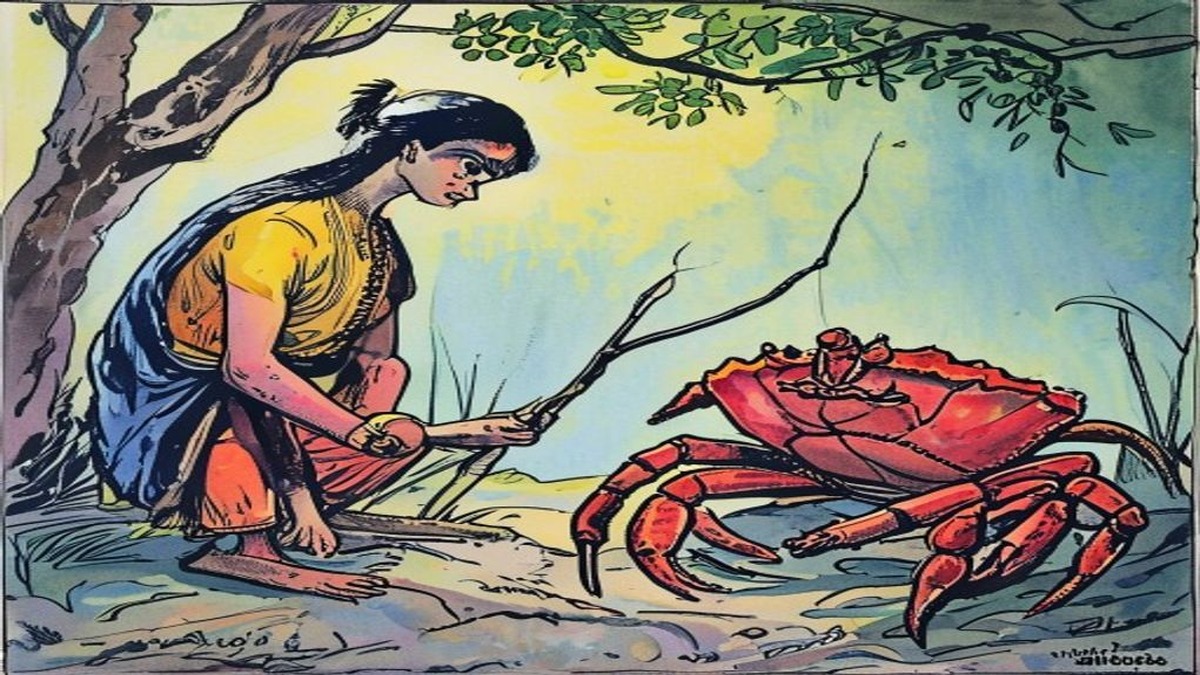
The crab gripped the heron’s neck with its claws as the bird took flight. As they cleared the hill, the crab saw the flat rock below, white with scales and scattered fish bones, gleaming in the afternoon sun. The crab understood in an instant everything that had happened and everything that was about to happen. Without releasing its grip it tightened its claws around the heron’s neck with the precise and unhurried pressure of a creature that has already decided.

Justice Delivered and the Crab’s Return
The heron tried to cry out but could not; it tried to land but the crab steered it back toward the pond. When the heron’s legs went limp, the crab descended carefully, walking back along the shore and into the shallows of the pond it had never left. The remaining fish gathered, and the crab told them everything: the drought story was false, the lake over the hill did not exist, and their companions had been eaten on a flat rock that still bore the evidence.
The fish were silent for a long time. Then one of them asked: “How did you know to grip so tightly?” The crab replied: “I did not know. I suspected. And when I saw the bones, suspicion became certainty, and I acted on certainty rather than waiting for further proof. A second’s delay would have cost me the only advantage I had.”
The pond settled back into its ordinary rhythms, now smaller in population but free of the predator that had dressed itself in the language of compassion. The fish that remained had learned two things: that emergency claims made by those who stand to benefit from them deserve scrutiny, and that survival sometimes depends on acting at the precise moment when uncertainty resolves into knowledge.

Moral and Sanskrit Wisdom
विश्वासं नैव कर्तव्यु विना परीक्षात्
Vishvasam naiva kartavyam vina parikshaat — “Trust should never be extended without examination.”
— Panchatantra I, Mitra-bheda
Vishnu Sharma frames this tale as a lesson in epistemology as much as ethics. The fish are not foolish by nature; they are simply unable to verify the heron’s claim about the drought or the lake. In the absence of verification, they default to trust — a reasonable heuristic in ordinary circumstances but a lethal one when the informant is also the proposed solution. The crab survives not because it is more intelligent but because it defers commitment until it has evidence. That single difference in cognitive strategy determines who lives and who becomes bones on a rock.
Why This Story Has Lasted 2,300 Years
The Heron and the Crab endures because it dramatises what modern behavioural scientists call the false urgency heuristic — the tendency to suspend critical evaluation when a message combines scarcity (the drought), authority (the elder heron who has never harmed us), and a ready solution (I will carry you there). Every element of the heron’s pitch is calibrated to foreclose deliberation. The drought creates time pressure. The heron’s apparent suffering establishes credibility. The offered solution removes the need for the victims to do anything but comply. Vishnu Sharma recognised this pattern millennia before psychology named it.
The crab represents a cognitive type that appears rarely in folklore: the figure who neither panics nor immediately trusts, but waits for observable evidence before committing to action. It does not argue with the heron’s story, which it cannot disprove; it simply withholds full trust until the flight over the hill provides data. When the data arrives in the form of fish bones on a rock, the crab acts without deliberation — not rashly, but because the moment of certainty is also the moment of maximum leverage. Waiting longer would have been fatal.
The tale’s resonance with the Baka Jataka (in which the Buddha in a former life appears as the crab) extended its reach across the Buddhist world from Sri Lanka to Japan. In each cultural context the story emphasises a different virtue — patience in one, decisiveness in another, clear sight in a third — but the structural core remains identical. The universality suggests that the cognitive trap Vishnu Sharma identified is not culturally specific: anywhere that fast-talking intermediaries offer urgent solutions to frightened communities, the bones on the rock are waiting just over the hill.
Frequently Asked Questions
What is the moral of the Heron and the Crab story?
Never extend trust without evidence, especially when the messenger also benefits from your compliance. The crab survives by deferring commitment until observable proof arrives.
What is the Baka Jataka?
The Baka Jataka (no. 38) is a Pali Buddhist parallel to this story in which the Buddha, in a former life as a crab, kills a deceitful heron. It confirms the tale predates Vishnu Sharma and was part of wider oral tradition across the Indian subcontinent.
Why did the fish trust the heron?
The heron combined three persuasion elements — artificial scarcity (the drought), established credibility (he had never harmed them), and a ready solution that required no effort from the fish. Together these foreclosed critical deliberation.
What cognitive lesson does this story teach?
The story illustrates the false urgency heuristic: claims that combine time pressure, apparent authority, and a pre-packaged solution should trigger extra scrutiny, not less. The crab's method — observe, withhold judgment, act on evidence — is the antidote.
Is this story related to the previous heron tale in the Panchatantra?
Yes. Panchatantra Book I groups several heron stories together to explore different dimensions of deception and vigilance. The Heron and the Crab complements the Foolish Heron story by showing what happens when at least one potential victim retains critical detachment.
You May Also Like
 Panchatantra Stories
Ages 3-5
Panchatantra Stories
Ages 3-5
The Intelligent Merchant – Hindi Folktales from India
The Intelligent Merchant – Hindi Folktales from India: Long ago, there was a king who was very unjust and cunning. He used to look for opportunities to tax his
 Panchatantra Stories
Ages 3-5
Panchatantra Stories
Ages 3-5
The Story of the Lion, the Camel, the Jackal and the Crow
The Story of the Lion, the Camel, the Jackal and the Crow: In a ertain part of the jungle, there lived a lionking, by the name of Madotkata. His retinue
 Panchatantra Stories
Ages 3-5
Panchatantra Stories
Ages 3-5
The Crane and the Mongoose
The Crane and the Mongoose: The solution of the problem should not be worse than the problem itself. That is, while trying to solve the problem, you should not