The Rescue of a Deer
The Rescue of a Deer: The crow then advised Hiranyaka, “Listen to what the turtle is saying. Elders have said that it is easier to get friends who talk sweetly
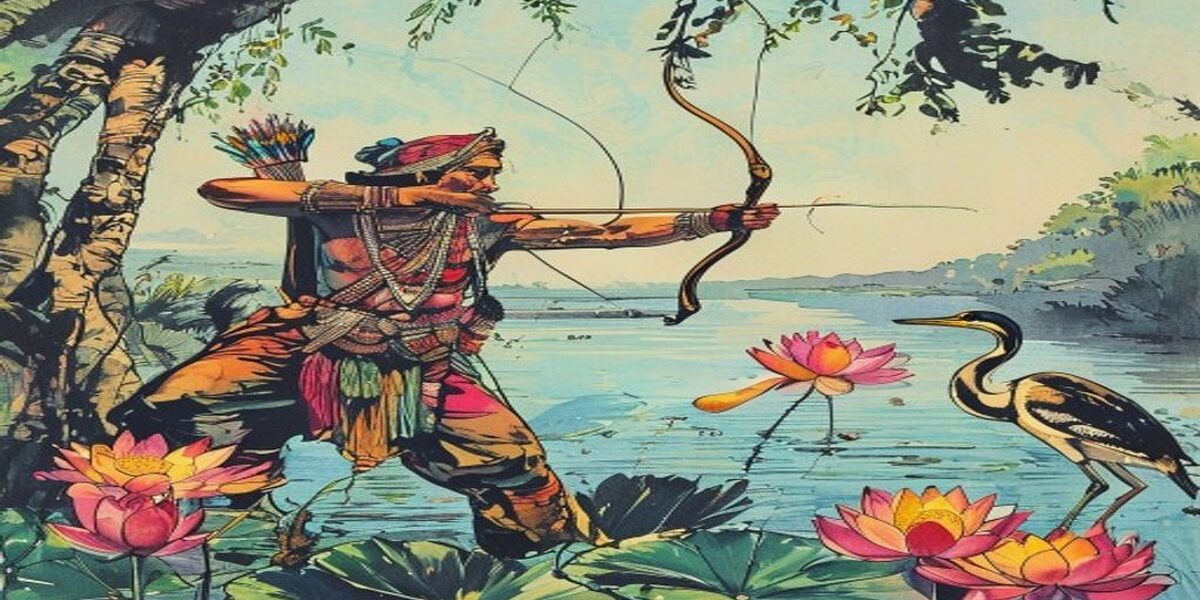
The Rescue of a Deer
Canonical Attribution and Manuscript Tradition
This tale is preserved in the major Sanskrit recensions of the Pancatantra including the Tantrakhyayika (c. 200 BCE, Kashmir) and appears in the Hitopadesha and related didactic collections. A deer, member of a group of animal friends including a crow, a rat, and a tortoise, is caught in a hunter’s net. The tale becomes a demonstration of coordinated practical action under time pressure, with each member of the group contributing what they can do best: the crow provides intelligence, the rat gnaws through the net, the deer escapes. The tortoise, arriving late and being caught by the hunter, is in turn rescued by the deer. The tale is a sustained argument for the practical value of friendship: not the sentiment of friendship but its expression in costly, coordinated action when a friend is in danger.
Beat I — The Crisis and the Intelligence
A deer belonging to a group of animal friends was caught in a hunter’s net. The crow, aloft and mobile, saw the deer’s capture and immediately calculated the best response: not direct confrontation with the hunter, which was beyond the crow’s capacity, but the rapid communication of intelligence to the rat, who had the specific capability — sharp teeth, small body, the ability to work close to the ground undetected — to address the problem at its source. The crow flew directly to the rat.
The Pancatantra establishes in this opening movement one of its central arguments about the nature of effective group action: different members contribute different capabilities, and the value of the group lies in the complementarity of those capabilities rather than in the uniformity of what each member can do. The crow cannot free the deer; the rat cannot see what the crow can see. Together they can achieve what neither could achieve alone. The Pancatantra is presenting the group not as a collection of loyal sentiments but as a system of complementary practical capacities.
Beat II — The Rat’s Action and the Rescue
The rat, informed of the deer’s situation, moved immediately to the net and began gnawing through the ropes. The action required the rat to approach the site of the hunter’s trap — a situation with genuine risk — without hesitation. The Pancatantra records no deliberation, no calculation of personal cost, no negotiation of what the rat would receive in return. A friend was in danger; the rat had the capacity to address the danger; the rat acted.
The deer was freed. The coordinated response — crow providing intelligence, rat providing the specific physical capability to address the problem — had worked because each member of the group applied their particular capability fully and without reservation. The Pancatantra’s account of the rescue is deliberately unrhetorical: the emphasis is not on the heroism of the action but on its practical effectiveness, which is the product of the group’s complementary capabilities applied without delay and without reservation.

Beat III — The Tortoise’s Peril and the Return Rescue
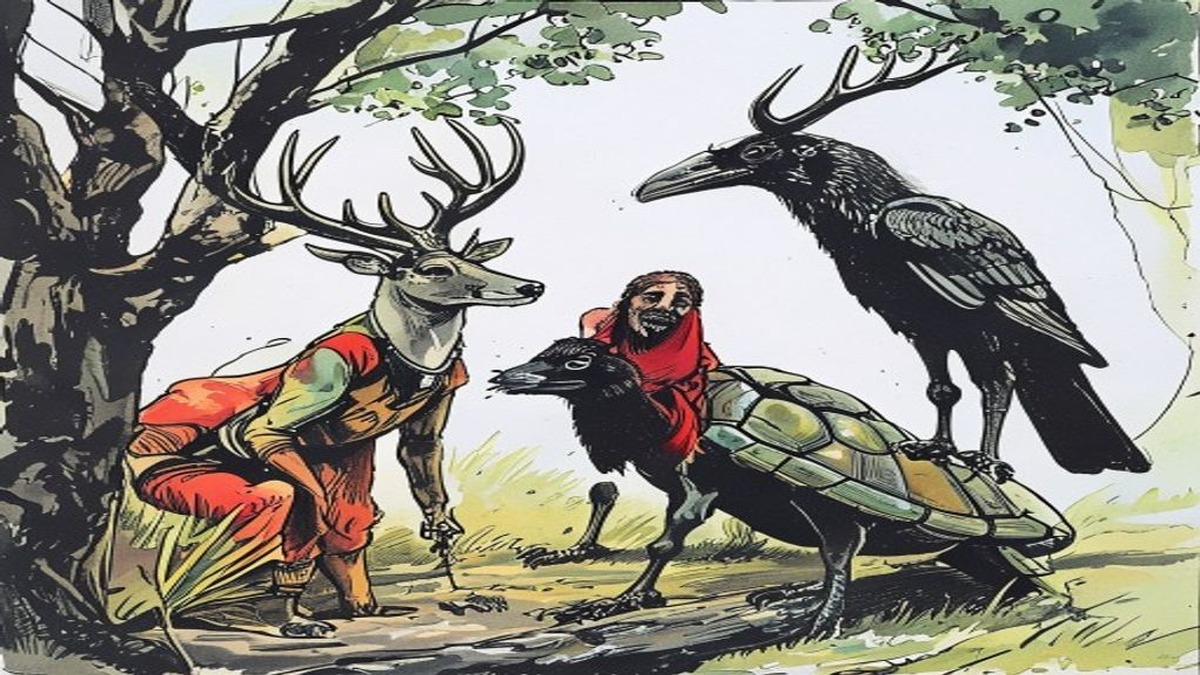
The tortoise, slow and curious, had followed the others to the scene of the rescue and was caught by the hunter as the group fled. Now the situation was reversed: the tortoise was in the hunter’s hands, and the deer, rat, and crow had to respond. The deer acted immediately: it presented itself to the hunter at a distance, limping convincingly, drawing the hunter’s attention and pursuit. The hunter, seeing the deer — a far more valuable prize than the tortoise — set down the tortoise and followed. The rat, seizing the moment, freed the tortoise. The group was whole again.
The Pancatantra’s account of the reverse rescue is the tale’s philosophical centrepiece. The deer had just been rescued by the group; it was now in a position of safety; the tortoise’s peril was not the deer’s fault. The deer nonetheless acted immediately, at genuine personal risk, to rescue a member of its group. The reciprocity of rescue — the group rescues the deer, the deer rescues the tortoise — is not presented as a transaction or an obligation but as the natural expression of what genuine friendship actually is.

Beat IV — What the Rescue of a Deer Teaches About Practical Friendship
Vishnu Sharma’s argument in this tale is that friendship is a practical system, not a sentiment. The group of friends — crow, rat, deer, tortoise — is valuable not because they feel warmly toward each other but because each is willing to apply their specific capability, at genuine personal cost, when a member of the group is in danger. The sentiment without the capability and the willingness to act is worthless in a crisis; the capability without the sentiment that motivates its application is equally worthless. What the tale demonstrates is the combination: genuine mutual concern expressed in immediate, capable, coordinated action under pressure.
For Vishnu Sharma’s royal pupils the application is direct and extends to the structure of the court and the army. A minister who is loyal but incompetent cannot help the ruler in a crisis; a minister who is competent but will not act at personal cost is equally useless when the crisis requires genuine risk. The Arthashastra’s treatment of ministerial selection emphasises both capability and character precisely because crisis conditions require both. The deer rescue demonstrates this combination in action: each animal has both the relevant capability and the willingness to apply it without reservation.

Moral and Sanskrit Wisdom Tradition
“Friendship is not what one feels but what one does; and what one does when action is costly is the only true measure.”
— Moral of The Rescue of a Deer, Pancatantra Book I (Mitra-bheda)
This moral engages the Sanskrit tradition’s sophisticated treatment of mitra (friend) as a practical rather than merely sentimental category. The Arthashastra defines the qualities of a reliable ally in functional terms: the ally who will act at personal cost when the ruler needs them, who has the capability to make their action effective, and who does not deliberate when speed is required. The Mahabharata’s treatment of friendship in the Udyoga Parva similarly emphasises demonstrated action over expressed sentiment. Vishnu Sharma’s contribution is the narrative demonstration through a rescue that tests and proves the friendship of each member of the group.
Why This Story Has Lasted 2,300 Years
The Rescue of a Deer endures because it presents the most concrete possible answer to the question: what is friendship actually worth? Not in ordinary circumstances, where the expression of friendship costs nothing, but in crisis, where acting for a friend costs something real. The Pancatantra’s answer — that the group of friends with complementary capabilities, each applied without reservation when needed, is among the most valuable things a being can have — is permanently true. The tale’s four animals have become canonical illustrations of this truth precisely because the rescue they perform together is so specific, so practical, and so clearly dependent on each of them doing what they can do, fully, without hesitation.
Sanskrit Tradition: Tantrakhyayika (c. 200 BCE, Kashmir); Hitopadesha
Key Concept: Friendship as practical system of complementary capabilities; mitra demonstrated through costly action; coordinated rescue under time pressure
Author: Vishnu Sharma (attributed, c. 3rd century BCE)
Arthashastra Parallel: Allied selection based on capability and willingness to act at cost; crisis reveals the true value of alliances
Frequently Asked Questions
What is the moral of the Rescue of a Deer in the Panchatantra?
The moral is that friendship is not what one feels but what one does, and what one does when action is costly is the only true measure. The Pancatantra presents the group of friends — crow, rat, deer, tortoise — as a practical system of complementary capabilities, each applied without reservation when a member is in danger. Genuine friendship is the willingness to act at personal cost combined with the capability to make that action effective.
What happens in the Rescue of a Deer in the Panchatantra?
A deer in a group of animal friends is caught in a hunter's net. The crow sees the capture and alerts the rat, who gnaws through the ropes and frees the deer. Then the tortoise, following slowly, is caught by the hunter. The deer immediately distracts the hunter by presenting itself as an injured prey animal, drawing pursuit while the rat frees the tortoise. The whole group escapes, each having contributed their specific capability when another needed it.
What does the Panchatantra teach about the value of a group with complementary capabilities?
The Pancatantra argues that the group of friends with complementary capabilities — each applied fully and without reservation when needed — is among the most valuable things a being can have. The crow can see and communicate; the rat can gnaw; the deer can deceive the hunter; together they achieve what none could achieve alone. The tale demonstrates that the value of an alliance lies in the complementarity of capabilities, not in the uniformity of what each member can do.
Why does the deer risk itself to rescue the tortoise after already being rescued?
The deer's immediate action to rescue the tortoise is the Pancatantra's central demonstration that genuine friendship means acting at personal cost without calculation of return. The deer had just been rescued and was now safe; the tortoise's peril was not the deer's fault. The deer nonetheless acted immediately, at genuine risk, because a member of the group was in danger. The Pancatantra presents this not as heroism but as the natural expression of what friendship actually is when it is genuine.
How does this Panchatantra story relate to the Arthashastra's treatment of ministerial selection?
The Arthashastra emphasises that reliable ministers must have both capability and the character to apply it at personal cost when the ruler needs them. A loyal but incompetent minister cannot help in a crisis; a capable but self-protective minister is equally useless when genuine risk is required. The deer rescue demonstrates this combination in action: each animal has both the relevant capability and the willingness to apply it without reservation or delay. This is the Pancatantra's practical model for the ideal ally or minister.
You May Also Like
 Panchatantra Stories
Ages 3-5
Panchatantra Stories
Ages 3-5
The King’s Choice
The King's Choice: Long ago a lion lived in a dense forest. He was big, fierce and strong and thus all the other animals accepted him as their king. He was
 Panchatantra Stories
Ages 9-12
Panchatantra Stories
Ages 9-12
Home (far) away from home!!!
The famous Efik folk tale from southern Nigeria — Sun and Moon were old friends with the great Water, and they built a house big enough to welcome him in. But Water brought every fish and every wave with him, and the friends had to learn that some friendships are honored best across a great distance. A West African pourquoi tale, first written down in English by Elphinstone Dayrell in 1910 — and the gentle origin of why the Sun and Moon live in the sky.
 Panchatantra Stories
Ages 9-12
Panchatantra Stories
Ages 9-12
The Wedge-Pulling Monkey
The Wedge-Pulling Monkey: In a great forest of central India, where enormous trees grew close together and the undergrowth formed an intricate maze of paths