The Tortoise and The Geese
A tortoise and geese become best friends. When the geese offer a journey to the mountains, pride and anger lead to a tragic fall.
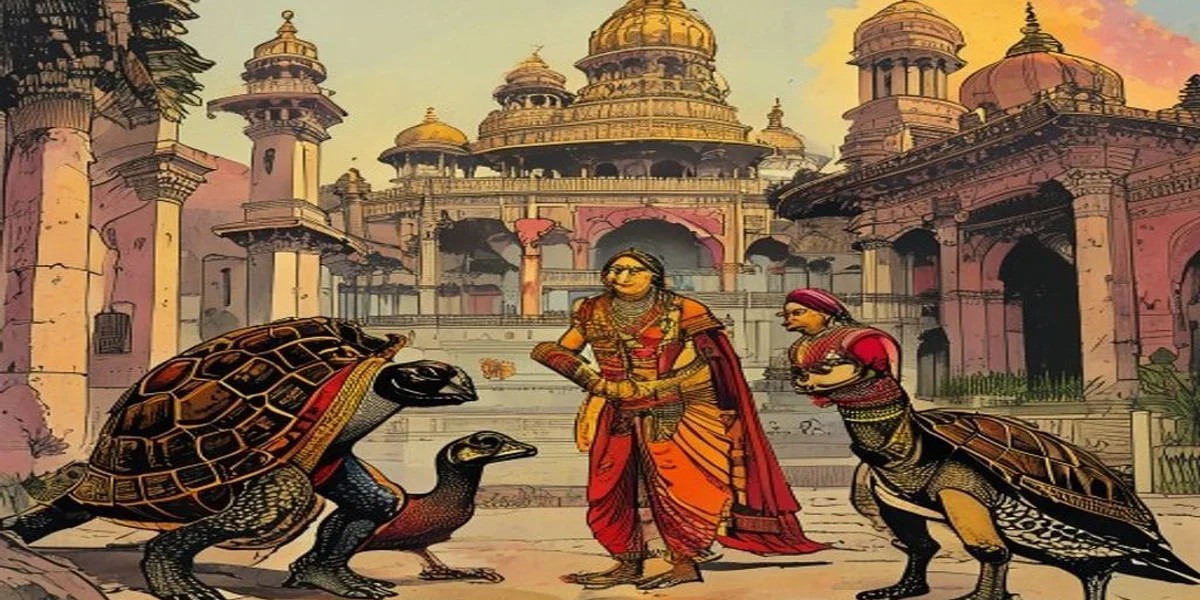
The Tortoise and the Geese — Panchatantra, Book V: Aparīkṣitakāraka (Ill-Considered Action)
This tale appears in the fifth book of the Panchatantra, compiled by Vishnu Sharma around 300 BCE, and also in the Jātaka tales of the Buddhist canon — one of the few fables that circulated simultaneously in both Brahminic and Buddhist pedagogical traditions, suggesting it addressed something of universal recognition in Indian moral thought. Book V — Aparīkṣitakāraka, “Ill-Considered Action” — is dedicated to stories about how inability to govern one’s own impulses at critical moments leads to catastrophic self-destruction. The Tortoise and the Geese is the tradition’s most economical illustration of this principle: a single failure of self-discipline at a single critical moment, and everything is lost.
Beat I — Friendship and the Plan of Migration
A tortoise lived in a lake that he had known all his life — good water, good mud, a comfortable depth for summer heat and winter cold. Two geese had settled near the same lake and over many seasons had become genuine friends with the tortoise: daily company at the water’s edge, long conversations about the world, the easy intimacy of creatures who have chosen each other’s company without practical necessity.
When drought came to the region and the lake began to shrink, the geese made their plans to migrate. They came to the tortoise with a proposal: they would carry him. They had worked out the mechanics — a strong stick, bitten firmly by the tortoise at its centre, one goose holding each end in its bill. They would fly him to a better lake in a well-watered region they knew from previous migrations. The journey would take most of a day.
There was one condition, they told him carefully. It was absolutely necessary that the tortoise not open his mouth during the flight. If he released his bite on the stick for any reason — to speak, to exclaim, to respond to anything he saw or heard below — he would fall. The instruction was simple, the danger was clear, and the tortoise agreed immediately. He understood completely. He bit the stick.
Beat II — The Flight and the Fatal Moment
The geese lifted him smoothly. The tortoise, biting hard on the stick, found himself experiencing something no tortoise had experienced before: the world from above. The lake shrank to a bright oval below him. The forest spread out in patterns. Villages appeared — small collections of buildings with smoke rising from cook-fires, cattle moving between fields, children playing in courtyards.
The children were the problem. They saw the extraordinary spectacle — two geese carrying a tortoise on a stick — and ran beneath it, pointing and shouting. The news spread quickly, and soon a crowd of villagers had gathered below, craning their necks, calling to each other, debating loudly about what they were seeing. Some called it a wonder. Some laughed. Some offered interpretations. One man called out with particular clarity: “Look at that foolish tortoise, letting himself be carried like baggage!”
The tortoise heard this. He had been calm through the height and the cold wind and the disorienting strangeness of flight. He had held his bite through all of it. But being called foolish — being publicly mocked by a crowd of villagers who did not understand what they were seeing, who had no knowledge of his friendship with the geese or the drought or the careful planning that had produced this flight — this he could not endure in silence.
He opened his mouth to respond. One syllable. It was enough. He fell.
Beat III — What One Word Costs
The Panchatantra presents the moment with surgical economy: the tortoise bit the stick; the tortoise held the stick through genuine difficulty; the tortoise released the stick for a trivial provocation at the worst possible moment. The entire logic of the story turns on the disproportion between the cost (his life) and the trigger (a stranger’s careless remark).
The story does not argue that the villager’s comment was deserved. It doesn’t matter whether it was. The tortoise’s survival depended not on whether the comment was fair but on whether he could sustain his self-discipline through the moment of its landing. He could not. The instruction had been perfectly clear, the necessity had been perfectly understood, and at the moment of maximum importance the habit of responding overrode the knowledge of consequence.
This is the Panchatantra’s most precise analysis of a specific failure mode: not ignorance, not malice, not stupidity, but the failure of impulse-control at exactly the moment when impulse-control is the only thing that matters. The tortoise knew he must not speak. He chose not to remain silent. The distinction between knowing and doing — between understanding a rule and actually following it when the emotional provocation arrives — is the story’s entire subject.
Beat IV — Self-Mastery as the Foundation of Everything Else
The Panchatantra returns repeatedly across all five books to a single underlying principle: that external circumstances — drought, enemies, accidents of birth, the scheming of rivals — are less reliably destructive than self-generated failure. The tortoise was not destroyed by the drought or by the height or by inadequate geese. He was destroyed by his inability to govern his own tongue for the duration of a single flight. Everything else had been arranged and was working perfectly.
Vishnu Sharma’s royal students — young princes being educated for kingship — would have understood the political application immediately. A ruler who cannot hold his tongue at a critical diplomatic moment, who responds to a provocation at exactly the wrong instant, who allows irritation or pride to override the requirements of the situation, loses far more than a debate. The Arthashastra of Kautilya devotes an entire section to indriya-jaya — conquest of the senses — because Kautilya understood that a king who cannot govern himself cannot reliably govern anyone else. The tortoise is a king’s cautionary mirror.
The Buddhist Jātaka version frames the lesson through the Bodhisattva’s commentary: the tortoise had wisdom enough to make the right arrangements and self-knowledge enough to agree to the condition. What he lacked was the capacity to hold that agreement in the moment of actual temptation. This gap — between understanding what is required and actually doing it when it costs something — is the gap in which most failures occur.
“He who cannot hold his tongue at the critical moment will find that the moment does not wait for him to finish speaking.”
Why This Story Has Lasted 2,300 Years
The Tortoise and the Geese endures across Brahminic, Buddhist, Arabic, Persian, and European traditions because its central failure — speaking when silence is the only viable option — is so universally recognisable. Every person has experienced the moment when something is said that should have remained unsaid, and the consequences followed immediately. The tortoise’s fall is compressed into one instant but echoes across every tradition that has told this story: the critical moment does not announce itself as critical until after the impulse has already acted. The stick is always in your mouth. The question is whether you can keep it there.
About the Panchatantra
The Panchatantra (“Five Treatises”) was composed by Vishnu Sharma circa 300 BCE as a manual of nītiśāstra — statecraft, ethics, and worldly wisdom — expressed through interlocking animal fables. The Tortoise and the Geese appears in both the Panchatantra tradition and the Buddhist Jātaka canon, one of the few tales shared between the two great Indian narrative traditions. It was translated into Arabic in the Kalīla wa-Dimna, into Persian, Hebrew, Latin, and all major European vernacular languages, and remains one of the most widely recognised fables in the world.
Frequently Asked Questions
**Q: Why is this story important?**
You May Also Like
 Panchatantra Stories
Ages 9-12
Panchatantra Stories
Ages 9-12
The Crane and the Crab
The Crane and the Crab: When things go wrong, use your wit to overcome the situation.” A heron lived near a big lake, which was full of fishes and other water
 Panchatantra Stories
Ages 3-5
Panchatantra Stories
Ages 3-5
The Young Greedy Bird – A Panchatantra Tale from India
The Young Greedy Bird – A Panchatantra Tale from India: Long ago, a flock of birds stayed on the trees near a lake. The flock was ruled by an old queen bird.
 Panchatantra Stories
Ages 9-12
Panchatantra Stories
Ages 9-12
Stories of Param Veer Chakra Awardees of 1971 Indo-Pak War
Stories of Param Veer Chakra Awardees of 1971 Indo-Pak War: 1971 Indo-Pak war was the second direct confrontation between India and Pakistan. Lasting 13 days