Stories of Param Veer Chakra Awardees of 1971 Indo-Pak War
Stories of Param Veer Chakra Awardees of 1971 Indo-Pak War: 1971 Indo-Pak war was the second direct confrontation between India and Pakistan. Lasting 13 days
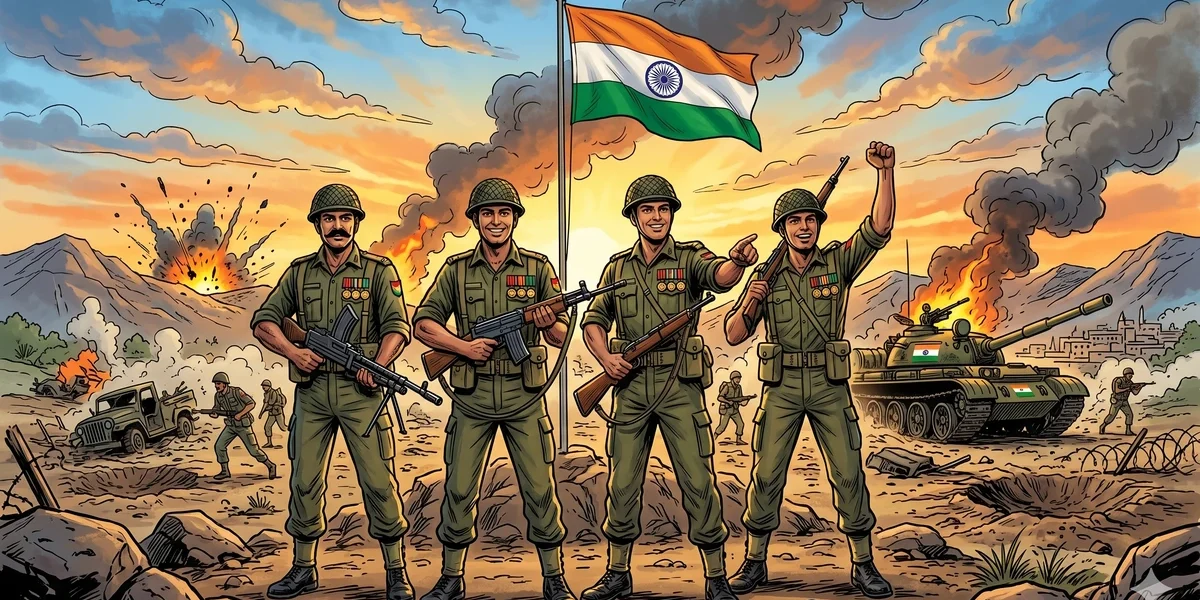
Param Veer Chakra Awardees of the 1971 Indo-Pakistan War — India’s Highest Military Honour
The Param Veer Chakra (PVC) is India’s highest military decoration, awarded for the most conspicuous acts of bravery or self-sacrifice in the face of the enemy. The Sanskrit name means “Wheel of the Ultimate Brave” — parama (supreme), vīra (brave), chakra (wheel or disc, here signifying the medal’s form). The 1971 Indo-Pakistan War — fought from December 3 to December 16, 1971, resulting in the creation of Bangladesh — produced some of the most celebrated acts of individual heroism in Indian military history. Four soldiers received the Param Veer Chakra for their actions in this conflict, three of them posthumously. Their stories belong to the living tradition of Indian heroic narrative — vīra-kathā — that the Panchatantra and the Mahābhārata both draw upon and exemplify.
Beat I — The War of 1971 and Its Stakes
The 1971 war was a conflict of profound moral and strategic significance. The immediate cause was the Pakistani military’s brutal suppression of the Bengali nationalist movement in East Pakistan — a campaign that produced mass atrocities and drove approximately ten million refugees across the border into India. The Indian government under Prime Minister Indira Gandhi, after months of diplomatic effort and preparation, recognised the situation’s necessity and intervened militarily in early December 1971.
The war lasted thirteen days. In that time, the Indian Armed Forces conducted operations across multiple fronts — in the east (East Pakistan, which became Bangladesh), on the western front with Pakistan, and on sea. The Pakistani military surrendered on December 16, 1971 — the largest military surrender since the Second World War — with 93,000 Pakistani soldiers becoming prisoners of war. Bangladesh was established as an independent nation.
Within those thirteen days, and in the months of fighting that preceded them on the western front, four soldiers performed acts of heroism so exceptional that they received the Param Veer Chakra. Three gave their lives in the performance of those acts.
Beat II — The Heroes and Their Acts
Second Lieutenant Arun Khetarpal of the Poona Horse cavalry regiment was twenty-one years old when he led his tank troop against a superior Pakistani armoured force at the Battle of Basantar River on December 16, 1971. His tank was hit and he was wounded, but he continued to fight, destroying multiple enemy tanks before his tank was struck again and he was killed. His commanding officer later said: “No Parking — he just kept going forward.” He was awarded the Param Veer Chakra posthumously. He is remembered as one of the youngest recipients in the decoration’s history and as a symbol of the offensive courage that defines its spirit.
Flying Officer Nirmal Jit Singh Sekhon of the Indian Air Force was the only officer of the Air Force to receive the Param Veer Chakra. On December 14, 1971, when Srinagar Air Base was attacked by Pakistani F-86 Sabre jets, Sekhon took off alone in his Folland Gnat fighter — his wingman’s aircraft had a technical problem — and engaged six enemy aircraft by himself. He shot down one and damaged others before being shot down himself. His body was never recovered. The Param Veer Chakra was awarded posthumously. He remains the only Indian Air Force recipient of India’s highest military honour.
Lance Naik Albert Ekka of the Brigade of Guards performed a remarkable act of individual heroism during the capture of Gangasagar on the eastern front on December 3, 1971. When his column came under heavy machine-gun fire that was pinning down the entire advance, Ekka charged the enemy position alone, silencing the gun and allowing the advance to continue. He was mortally wounded in the act but lived long enough to know the position had been taken. He was awarded the Param Veer Chakra posthumously — the only recipient of this decoration from the state of Jharkhand.
Second Lieutenant Hoshiyar Singh of the Grenadiers was the sole living recipient of the 1971 Param Veer Chakra. During the Battle of Basantar, he led his platoon in repeated assaults against heavily defended Pakistani positions across the Basantar River, was wounded twice, continued to fight, and ultimately led the capture of the objective. His leadership at a critical moment of the battle was cited as decisive.
Beat III — Vīra-dharma: The Hero’s Code in Living Form
The Indian heroic tradition that the Panchatantra draws upon — vīra-dharma, the code of the brave — identifies several qualities as essential to genuine heroism: action in the face of overwhelming odds without calculation of personal survival; the willingness to advance when retreat would be safer and more rational; the subordination of self-preservation to the accomplishment of an objective whose value exceeds any individual life; and the quality of śaurya — martial courage that does not diminish under pressure but intensifies as the situation requires.
Each of the four 1971 Param Veer Chakra awardees demonstrated these qualities in ways that align precisely with the tradition’s ancient articulation of heroism. Arun Khetarpal’s refusal to withdraw despite being wounded, his forward momentum even after the first tank hit — this is the Panchatantra’s dhīra, the steady brave man who does not lose resolution under fire. Nirmal Jit Singh Sekhon’s decision to take off alone against six enemy aircraft — this is atula-bala, incomparable strength, the willingness to face asymmetric odds because the objective requires it. Albert Ekka’s lone charge against the machine gun that was holding his entire unit — this is the action of a man who has calculated that his life costs less than the lives of his comrades if he does not act.
Beat IV — What These Stories Preserve
The vīra-kathā tradition — heroic narrative — in India serves the same function that the Panchatantra’s animal fables serve: it makes abstract values visible in specific human action. Courage is an abstraction until Arun Khetarpal is twenty-one years old, wounded, in a burning tank, choosing to stay and fight. Sacrifice is a word until Albert Ekka is moving alone toward a machine gun that everyone else is pinned down by. The narrative preserves not just the biographical facts of what happened but the living shape of the values those facts embody — the specific texture of heroism as it actually appears in a human body, in a specific moment, under fire.
The Panchatantra and the Indian story tradition it draws from understood this function of narrative precisely: stories do not merely transmit information about events. They transmit the felt experience of values — the understanding of what courage actually feels like from the inside, what it costs, what it looks like in the moment of its expression. The Param Veer Chakra awardees of 1971 belong to this tradition as surely as Arjuna at Kurukshetra or the heroes of the Ramayana. The tradition is long. The debt to these soldiers is specific and current.
“The brave do not calculate their survival before they act — they calculate what the situation requires, and then act accordingly.”
Why These Stories Must Be Told
The stories of Arun Khetarpal, Nirmal Jit Singh Sekhon, Albert Ekka, and Hoshiyar Singh must be told because they are true and because the values they embody are not self-sustaining without the narratives that carry them. Abstract values decay when they are not regularly made concrete and specific through the lives of people who have lived them in their most demanding form. These four men — three of whom gave their lives — demonstrated what the Indian heroic tradition has always held: that the individual willing to subordinate personal survival to collective necessity is not merely brave but is performing one of the highest acts available to a human being. Their stories belong to every generation that follows, because every generation faces the question of what it will do when the situation requires everything.
About the Param Veer Chakra
The Param Veer Chakra was established by the Government of India on January 26, 1950. It is awarded for the most conspicuous bravery or some daring or pre-eminent act of valour or self-sacrifice in the presence of the enemy, whether on land, at sea, or in the air. As of 2024, twenty-one Param Veer Chakras have been awarded; fourteen recipients gave their lives in the actions for which they were honoured. The medal depicts the thunderbolt of Indra on the obverse and the national emblem on the reverse, with the words Param Vir Chakra in Hindi and English. It ranks above all other Indian military decorations.
Frequently Asked Questions
**Q: Why is this story important?**
You May Also Like
 Panchatantra Stories
Ages 3-5
Panchatantra Stories
Ages 3-5
The Merchant and the Bullock
A bullock left behind in the forest befriends a mighty lion - until a jealous jackal whispers lies.
 Panchatantra Stories
Ages 9-12
Panchatantra Stories
Ages 9-12
The Story of the Brahmin, the Thief and the Rakshasa
The Story of the Brahmin, the Thief and the Rakshasa: In a certain town, lived a Brahtnin named Drona. He gave up wearing fiqe lothes, using perfumes andall
 Panchatantra Stories
Ages 9-12
Panchatantra Stories
Ages 9-12
The Unforgiving Monkey
The Unforgiving Monkey: Chandra was a king, whose sons kept a group of monkeys as pets. These monkeys were treated as royal pets, and were provided with the