The Story of Chakradhara.
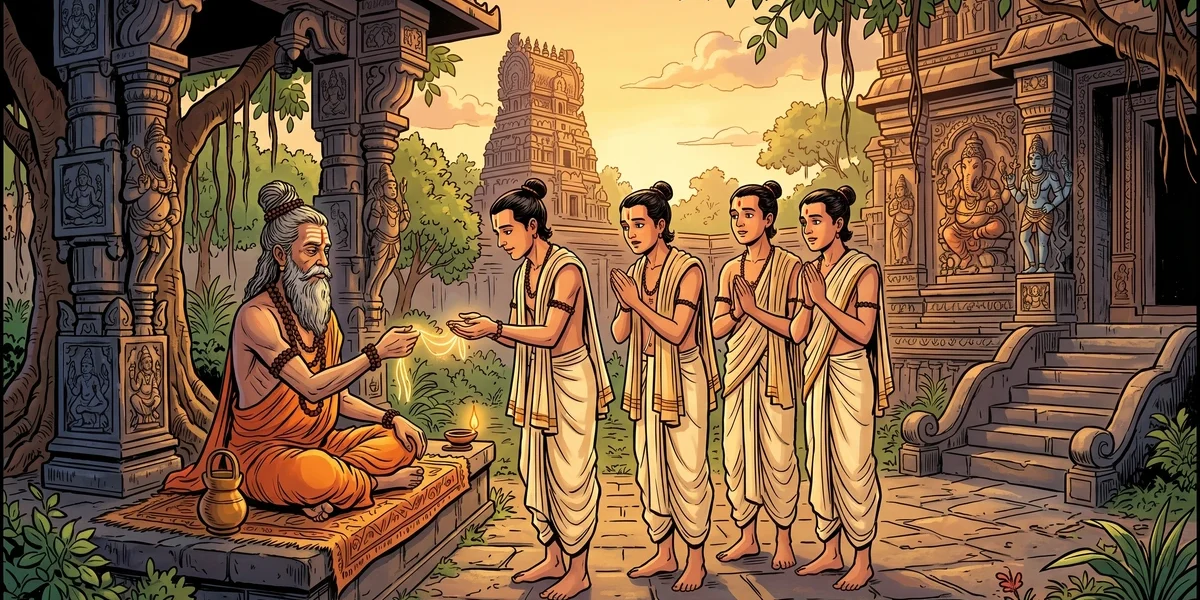
The Story of Chakradhara.: In a certain town, there lived four young fellows, who were the sons of Brahmins They were very friendlywith each other. But they
Origin & Canonical Placement
“The Story of Chakradhara” is a fable of greed, improvident action, and the catastrophic gap between what one possesses and what one is compelled by appetite to pursue. It belongs to the Panchatantra tradition attributed to Vishnu Sharma (c. 300 BCE–300 CE) and is situated within the thematic territory of Book V: Aparikshitakaraka (“Ill-considered Action”), which documents the many ways in which unexamined desire leads intelligent people and creatures to destroy the very foundations of their wellbeing. The name Chakradhara — “bearer of the wheel” — carries an ironic resonance in the classical Indian tradition: the wheel (chakra) is a symbol of fortune and dharmic order, while this protagonist’s wheel becomes the instrument of his own undoing.
“Santushto lobhitah samrad asantushto daridravat.”
“The contented man is a king; the discontented, though rich, is a pauper.”
— Sanskrit maxim, Panchatantra tradition
Beat I — The Gift and the First Temptation
Chakradhara was a weaver who, through extraordinary luck, came upon a large iron wheel — perhaps fallen from a merchant’s cart, perhaps left by travellers — lying in the road near a crossroads. He took it home as a found object and, not knowing quite what to do with it, kept it. Some time later he heard from a travelling merchant that the king of a distant region was paying extraordinary sums for large iron wheels to use in his palace construction. Chakradhara set off at once with his wheel, certain that fortune had delivered him the instrument of his prosperity.
The journey was long, but he arrived at the king’s court and was paid well for the wheel — more than he had ever held in his hands at one time. He was pleased, and set off for home. On the road, however, he passed through a market town where he saw a merchant displaying an even larger iron wheel, finer-made and more valuable. The sight of it triggered an immediate and consuming desire: if one wheel had brought him this fortune, a better wheel would bring him more. He spent nearly everything he had received on the new wheel and continued home, already planning the second journey.
Beat II — The Escalation: A Wheel for a Wheel, Fortune Spent for Fortune
Chakradhara made the second journey, sold the second wheel at a profit, and came home with more than before. The pattern was established in his mind as a reliable method: wheels purchased, wheels sold, fortunes accumulated. He reinvested each return in a larger wheel; each transaction produced a larger absolute profit; and the profits themselves were immediately reinvested rather than banked, secured, or used to improve his family’s actual condition.
His wife and children saw little of the money. His house remained in disrepair. His children ate no better than before. He was perpetually in motion — purchasing, transporting, selling — and perpetually convinced that the next wheel would be the one that finally justified the accumulation of risk he had been running. Then on one journey, carrying a wheel of exceptional size and value, he miscalculated the load balance. The wheel slipped. In the accident that followed, Chakradhara was struck by the wheel he had spent his fortune acquiring and was killed.
Beat III — The Analysis: The Mechanics of Compulsive Acquisition
Vishnu Sharma’s analysis of Chakradhara’s story focuses on the internal logic that makes compulsive acquisition self-sustaining and self-defeating simultaneously. The initial transaction was sound: Chakradhara found an object of genuine value, sold it at a fair price, and profited. The error was in the inference he drew from the success: that the strategy was indefinitely scalable, that more of the same input would produce proportionally more of the same output, and that the appropriate response to profit was to reinvest everything rather than to secure any of it.
This is what the Panchatantra identifies as the logic of lobha — greed — distinguished from legitimate ambition by its total subordination of present security and wellbeing to a perpetually deferred future satisfaction. Chakradhara was never at any moment enjoying his profits; he was always one transaction away from the point at which he would begin to enjoy them. This structure — satisfaction perpetually deferred in favour of the next acquisition — is precisely what makes greed self-sustaining: the point of sufficiency is always one step further than wherever one currently stands.
The wheel itself is the tale’s central symbol: a tool of commerce that becomes, through Chakradhara’s relationship with it, an object of obsessive pursuit, and finally the literal instrument of his death. The wheel of fortune — bhavachakra in Buddhist cosmology, kalachakra in broader Hindu usage — turns without regard for the wishes of those attached to it. Chakradhara’s name is thus an ironic commentary on his fate: the “bearer of the wheel” was ultimately borne down by it.
Beat IV — Moral Dimension & Enduring Relevance
The tale’s moral addresses the distinction between using good fortune well and being consumed by it. Chakradhara’s first sale was good fortune; his decision to reinvest everything and continue indefinitely transformed good fortune into an engine of self-destruction. The Panchatantra tradition consistently endorses ambition that is bounded by santosha — contentment, the capacity to recognise when one has enough — and treats the inability to experience this recognition as among the most dangerous of human failings.
Kautilya’s Arthashastra discusses the importance of treasury management — the ratio between what is invested in productive enterprise and what is held in reserve — as one of the king’s most consequential responsibilities. A treasury that is perpetually fully invested, with no reserve against contingency, is as vulnerable to a single adverse event as Chakradhara was to his final miscalculated load. The discipline of holding back a portion of every gain, of building a cushion against the inevitable bad day, is a discipline that the Arthashastra encodes as political wisdom and the Panchatantra encodes as personal wisdom through exactly this kind of story.
In contemporary financial and organisational terms, Chakradhara’s pattern is recognisable in every individual or institution that reinvests all profits perpetually, maintains no reserve against risk, and dies in a single adverse event that any adequate reserve would have survived. The wheel that kills him is the risk he was carrying all along, made suddenly concrete.
Moral: Know when you have enough; the inability to recognise sufficiency transforms good fortune into an engine of self-destruction.
Why This Story Has Lasted 2,000 Years
Chakradhara’s story endures because the logic of compulsive reinvestment — “just one more transaction” — is among the most consistently renewable patterns in human economic behaviour. The specific vehicle changes — wheels, land, grain, stocks — but the internal structure is invariant: a first success that generates a rule (“this works”), the rule generalised beyond its valid range (“more of this works more”), and the generalised rule applied without reserve until a single adverse event removes everything that was never secured. The story’s brevity and precision — the wheel that kills is the exact same wheel that brought the fortune — give it the quality of a perfectly made instrument: small, hard, and capable of opening almost any lock to which it is applied.
About the Panchatantra
The Panchatantra (“Five Treatises”) was composed in Sanskrit by the scholar Vishnu Sharma around 300 BCE–300 CE as a niti-shastra — a guide to wise conduct and statecraft — framed as animal fables for the instruction of young princes. Its five books cover the dissolution of allies, the winning of allies, war and peace, the dangers of naivety, and the hazards of rashness. The text spread westward through Pahlavi and Arabic translations to become the most widely translated secular book of the ancient world after the Bible.
You May Also Like
 Panchatantra Stories
Ages 3-5
Panchatantra Stories
Ages 3-5
The Story of the Jackal and the Sanyasi
The Story of the Jackal and the Sanyasi: Once upon a time, in a lonely matha, there lived a Sanyasi called Dev Sharma. Many people sed to visithim and present
 Panchatantra Stories
Ages 3-5
Panchatantra Stories
Ages 3-5
The Monkey and the Log
A restless monkey pokes at what he does not understand — and pays a painful price that has lasted thousands of years in the Panchatantra.
 Panchatantra Stories
Ages 3-5
Panchatantra Stories
Ages 3-5
Pride Goeth Before A Fall
Pride Goeth Before A Fall: In a certain village there lived ten cloth merchants, who always went about together. Once upon a time they had travelled far