The Brahmin, the Thief, and the Demon
The Brahmin, the Thief, and the Demon. A scholar meets a demon that was once cruel. This tale teaches us about forgiveness, understanding, and seeing good.
Three Ways to Ruin a Plan
Among the many short comic tales in the Pañcatantra, “The Brahmin, the Thief, and the Demon” stands out for its elegant triangular structure: three characters who each want something from the same source, whose individual plots cancel one another out, and whose target — the Brahmin — escapes entirely unscathed simply because his enemies cannot coordinate. The tale is attributed to the fifth book, Apariksitakārakam (“Rash Actions”), and its lesson is a natural companion to “The Brahmin’s Dream”: where that story warns against individual self-delusion, this one warns against collective incompetence born of mutual suspicion.
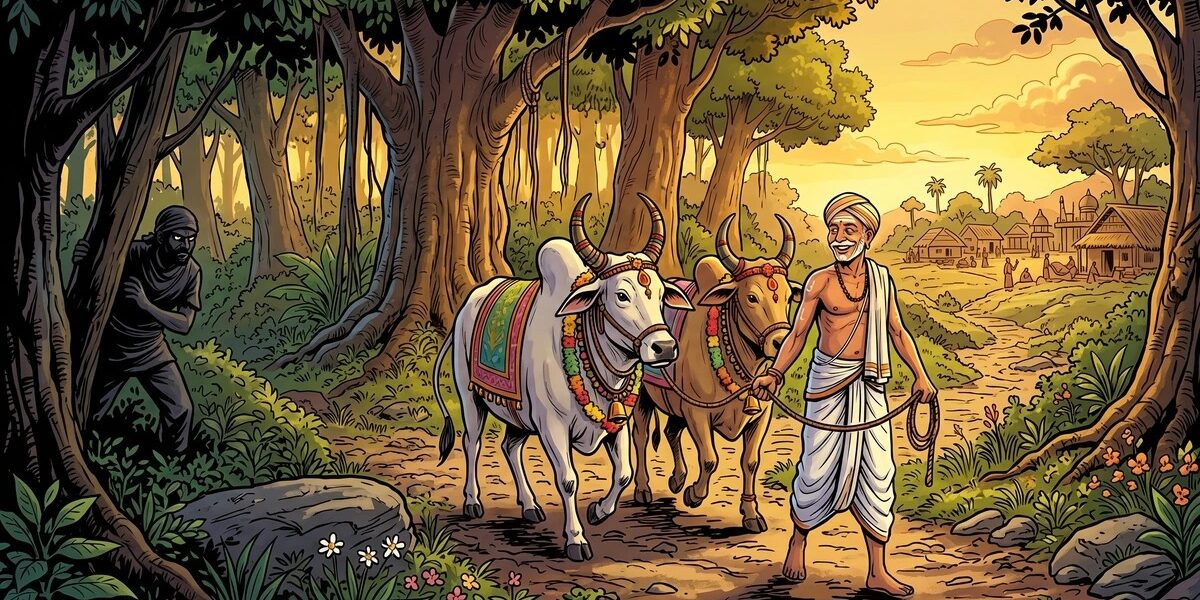
A poor Brahmin named Drona (in some versions, simply “a devout Brahmin”) receives a magnificent gift: two strong bulls, given to him by a prosperous householder as a reward for his priestly services. Drona is overjoyed — the bulls represent a sudden reversal of fortune, a chance to farm, to prosper, to rise above poverty. He leads them home through the forest. Unknown to him, he is being followed by two separate parties. A thief has seen the gift and wants to steal the bulls. A demon (rākṣasa) has sensed human flesh and wants to devour the Brahmin himself. Each follows in secret; each discovers the other. And that discovery is the beginning of the end for both their plans.
The Triangular Standoff
In the forest, out of earshot of the Brahmin, the thief and the demon confront each other. Each identifies himself and states his intention. The demon says: “I intend to eat this Brahmin tonight when he sleeps.” The thief says: “I intend to steal those two bulls tonight when he sleeps.” Each immediately sees the other as an obstacle. The demon cannot eat the Brahmin until the thief has withdrawn; the thief cannot steal the bulls until the demon has withdrawn. Each therefore proposes that the other go first — and each, equally, refuses.
The demon argues that he has prior claim: flesh is more valuable than bulls; let the thief wait. The thief argues the reverse: cattle are wealth a man cannot replace quickly; let the demon wait. The argument escalates. Neither party is willing to yield, because each knows that once the Brahmin is roused by the noise of either the demon eating or the thief stealing, the whole plan collapses. Each is therefore simultaneously sabotaging the other’s plan while insisting on priority for his own. The logical impasse is perfect: they can only proceed together, which is impossible, because their goals require the Brahmin to remain undisturbed — and their dispute is beginning to make that impossible.
Finally the dispute turns physical. The thief and the demon scuffle — some versions say they began shouting abuse at each other. The Brahmin wakes. He sees the demon, grasps what is happening, seizes a stick or a torch, and drives both intruders away. Then he leads his bulls safely home. The thief and the demon each return empty-handed, their partnership of greed having produced nothing but mutual failure.
Textual Sources and Variants
The tale appears in the Pañcatantra in an unusually compact form — just a few verses plus a prose frame — which suggests it was intended as a quick illustrative anecdote rather than a developed narrative. The Hitopadesha includes a closely related version. The Kathāsaritsāgara (“Ocean of Story”) preserves a fuller elaboration in which the demon and the thief exchange increasingly elaborate philosophical arguments before their quarrel erupts.
The tale has a clear Sanskrit moral tag: mitho virodhe svaarthaḥ hanyate — “mutual conflict destroys one’s own purpose.” This is one of the Pañcatantra‘s most aphoristic moments: the moral is stated as a general principle applicable to politics, commerce, military alliances, and any cooperative endeavour that founders on internal disagreement. Viṣṇuśarman, the text’s frame narrator, presents this tale to princes who must one day manage coalitions; the lesson is that a divided camp always loses to a unified opponent, even an opponent as numerically weak as a single Brahmin with a stick.
ATU Classification and Cross-Cultural Cognates
The triangular structure places this tale in the broad family of stories classified under ATU 1525A and related types involving thieves who undermine each other, or the wider category of “villains who foil themselves.” The specific motif — an evildoer’s plan defeated by a second evildoer’s interference rather than by the hero’s strength — is extremely common in South Asian narrative. The Jātaka tales include several parallel structures in which two robbers quarrel over loot and a third party benefits or the loot is lost to both.
In European tradition, the closest structural parallel is found in tales where two suitors competing for the same woman both lose her, or where two thieves arguing over stolen goods alert the owner who reclaims them. These cognates entered the Western narrative tradition partly through the Arabic Kalīla wa-Dimna (8th century CE), which adapted the Pañcatantra and transmitted it to Persian, Hebrew, Syriac, and eventually Latin European readerships. By the 13th century, versions of Pañcatantra anecdotes were circulating in Spain and France, and the triangular-conflict motif was well established in European fabliaux.
The Rākṣasa in Indian Folk Narrative
The demon (rākṣasa) in this tale represents a recurring figure in South Asian narrative: the supernatural predator who is undone not by divine intervention but by its own inability to cooperate with human criminal partners. Rākṣasas in Sanskrit literature are typically portrayed as powerful, cunning, and shape-shifting — capable of great violence but also susceptible to greed, pride, and poor judgment. Their presence in a tale is a signal that the protagonist faces genuine mortal peril; their defeat is correspondingly satisfying because it is achieved through intelligence (or in this case, fortuitous noise) rather than brute strength.
The juxtaposition of demon and thief is itself narratively pointed. The thief is a human criminal pursuing material gain — rational, comprehensible, operating within the logic of the economy. The demon is a supernatural predator pursuing the most primal appetite — hunger for human flesh. That these two radically different kinds of menace are foiled by the same mechanism (their mutual jealousy) suggests the tale’s deepest claim: that self-interest, unchecked by any willingness to cooperate or defer, is self-defeating regardless of whether its possessor is human or demonic. The failure mode is structural, not individual.
Pedagogical Use and Legacy
In the Pañcatantra‘s original pedagogical frame, this tale would have been particularly valuable for instruction in the art of coalition management (sandhi — alliance — is one of the six classical principles of statecraft in the Arthaśāstra). A king whose generals quarrel, whose ministers compete rather than cooperate, or whose allies undermine one another in the field replicates the thief-and-demon dynamic on a national scale. The Brahmin’s bulls — modest wealth, quietly earned, almost accidentally protected — stand for the peace and prosperity that an internally divided enemy cannot threaten.
The story’s comic lightness makes its political lesson more palatable: we laugh at the demon and the thief, and in laughing we absorb the principle without resistance. This is characteristic of the Pañcatantra‘s pedagogical genius — the most serious propositions are delivered through the most entertaining vehicles. Modern readers encountering this tale through English translations by Arthur Ryder (1925) or Patrick Olivelle (2006) consistently note its freshness: the triangular standoff between two evildoers is as recognisable in the modern era of competitive markets, dysfunctional coalitions, and geopolitical standoffs as it was in ancient India’s kingdoms.
Frequently Asked Questions
Narrative Economy and the Art of the Short Tale
One of the distinguishing features of this tale within the Pañcatantra corpus is its extraordinary narrative economy. Most Pañcatantra tales unfold across multiple embedded sub-stories, digressions, and verse commentaries. This one drives straight to its point: introduce three parties, set up the conflict, resolve it in a single beat. There are no sub-narratives, no digressions, no moral debate among the characters. The tale works because its structure is the argument — the triangular standoff does not need to be explained because the audience grasps its logic immediately.
This structural elegance reflects an advanced understanding of what rhetoricians call brevitas — compression as a rhetorical virtue. The Pañcatantra‘s compiler(s) understood that some moral propositions are best illustrated by a skeleton, not a fully fleshed narrative. The Brahmin, the thief, and the demon are not developed characters; they are functional types whose interaction makes a single logical point about self-defeating competition. The tale’s brevity is therefore not a limitation but a deliberate artistic choice: it trusts the audience to fill in the blanks.
The Brahmin as Passive Hero
What is particularly noteworthy about this tale is the Brahmin’s role: he is entirely passive throughout the central conflict. He does not outwit the thief, does not confront the demon with divine knowledge or priestly power, and does not receive supernatural assistance. He simply wakes up, grasps the situation, grabs a stick, and makes noise. His survival is entirely a function of his enemies’ stupidity rather than his own cleverness.
This passive-hero structure is relatively rare in world folk narrative, where protagonists typically succeed through some combination of intelligence, courage, virtue, or divine aid. The Pañcatantra uses the passive hero here to make a specific point: you do not always need to be clever to survive; sometimes your enemies’ conflicts will protect you. This is simultaneously reassuring and deeply political. For the princes Viṣṇuśarman is educating, the lesson is that a wise ruler cultivates divisions among his enemies — and that a ruler whose enemies are united faces a far more dangerous situation than one whose enemies quarrel among themselves.
The Story in Performance and Visual Tradition
The triangular confrontation in the forest between the demon and the thief has lent itself naturally to theatrical and visual adaptation across Indian traditions. Shadow puppet theatre (tolu bommalata) in Andhra Pradesh and Tholu Bommalata in Karnataka have long featured this tale as a comic interlude, with the demon typically portrayed as a grotesque, large-headed puppet and the thief as a nimble, quick-eyed figure — the visual contrast between them underscoring their incompatibility as partners. The Brahmin’s sudden appearance and victory is usually played for maximum comic effect: he bursts in with a torch, the demon recoils in terror, the thief flees, and the bulls stand magnificently unperturbed throughout.
In the illustrated manuscript tradition of the Panchatantra — the earliest surviving illustrated versions date from Mughal-period India (16th–17th century CE) — this scene is typically represented as a nocturnal image: the forest rendered in deep blues and purples, the demon in red or black, the thief crouching, and the Brahmin’s torch the brightest element in the composition. The visual vocabulary emphasises the reversal of power: the supernatural figure that should dominate the composition is driven back by the humblest possible weapon — a burning stick held by a frightened priest.
You May Also Like
 Panchatantra Stories
Ages 9-12
Panchatantra Stories
Ages 9-12
The Monkey and the Crocodile
Read 'The Monkey and the Crocodile' — a classic Panchatantra story about nature and animals. The Monkey and the Crocodile is a beloved Panchatantra tale...
 Panchatantra Stories
Ages 6-8
Panchatantra Stories
Ages 6-8
The Rat that ate Iron
The Rat that ate Iron: Tit for tat’ is the best policy in life.” Jveernadhana was a merchant’s son who was not successful. He faced a loss in his business and
 Panchatantra Stories
Ages 3-5
Panchatantra Stories
Ages 3-5
Light Makes Prosperity
Light Makes Prosperity: There is a Tamil proverb dîpam lakshmîkaram, meaning, “light makes prosperity,” and the following story is related to explain it: The