The Story of the Frogs and the Black Snake
The Story of the Frogs and the Black Snake: Near Varuna mountain, there lived an old snake, by the name of Mandavishya. One day, he thought toh imsdf, ‘I am

The Story of the Frogs and the Black Snake
Canonical Attribution and Manuscript Tradition
This tale is among the Pancatantra’s most politically concentrated: the king of the frogs, frustrated with his rival faction within the frog community, invites a black snake into the well where all the frogs live, offering the snake a reliable food supply (the rival frogs) in exchange for the snake’s service as an instrument of intra-community political competition. The snake agrees, eats the rival frogs, and then, having exhausted his immediate food supply, eats the frogs who invited him, including eventually the king himself. The tale is preserved in all major Sanskrit recensions of the Pancatantra including the Tantrakhyayika (c. 200 BCE, Kashmir) and is one of the most frequently cited examples in the Sanskrit political tradition of the danger of inviting a natural enemy inside one’s own defences to serve as a weapon against internal rivals. The Pancatantra uses this tale to make one of its most important strategic arguments: the enemy of your internal enemy is not your ally but your next victim.
Beat I — The Intra-Community Conflict and the Invitation
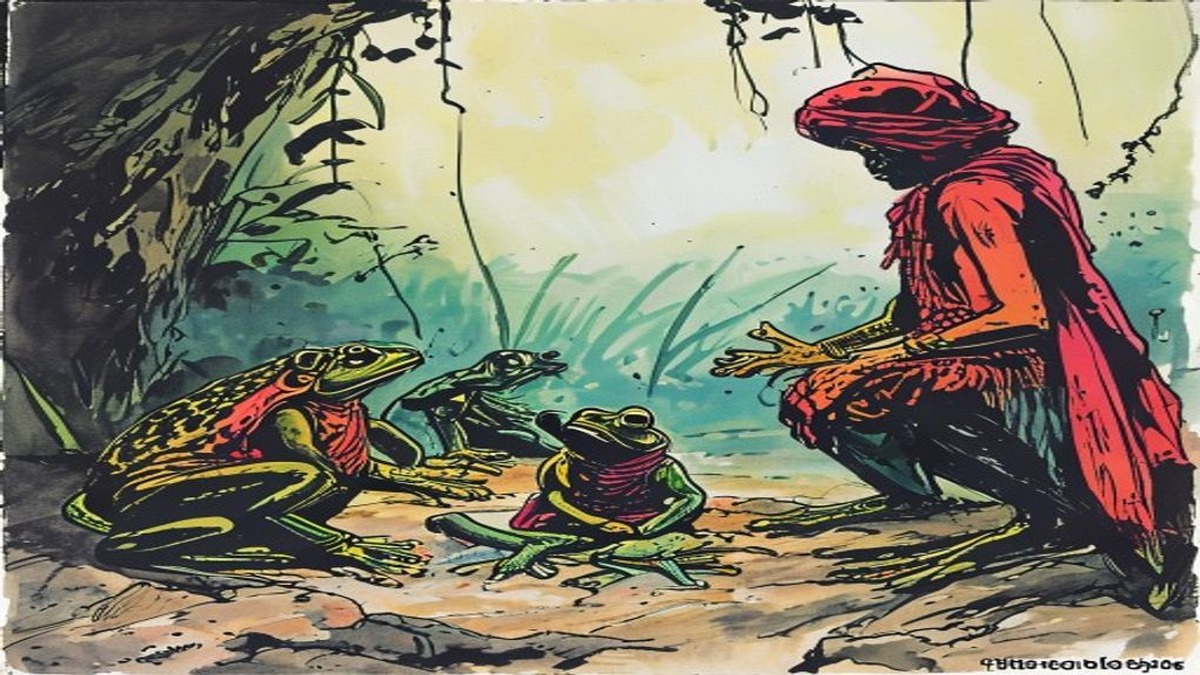
The frog king was engaged in a political conflict with a rival faction within his well. The conflict had reached a point where the king felt he needed external power to resolve it in his favour: his own resources were insufficient to defeat the rival faction through internal political means. He looked for an ally — and found, in the black snake, a being of extraordinary destructive power who was outside the frog community and therefore available as an external lever.
The Pancatantra’s account of the king’s reasoning is precise and damning. The king understood that the snake was a natural enemy of frogs; he understood that the snake ate frogs. He made his calculation: the snake could be offered the rival frogs as food, which would serve the snake’s interests while serving the king’s interest in eliminating his rivals. The alliance appeared to be mutually beneficial. The king did not ask what would happen when the rival frogs were gone and the snake was still hungry, still inside the well, and still a natural enemy of frogs.
Beat II — The Snake’s Operation
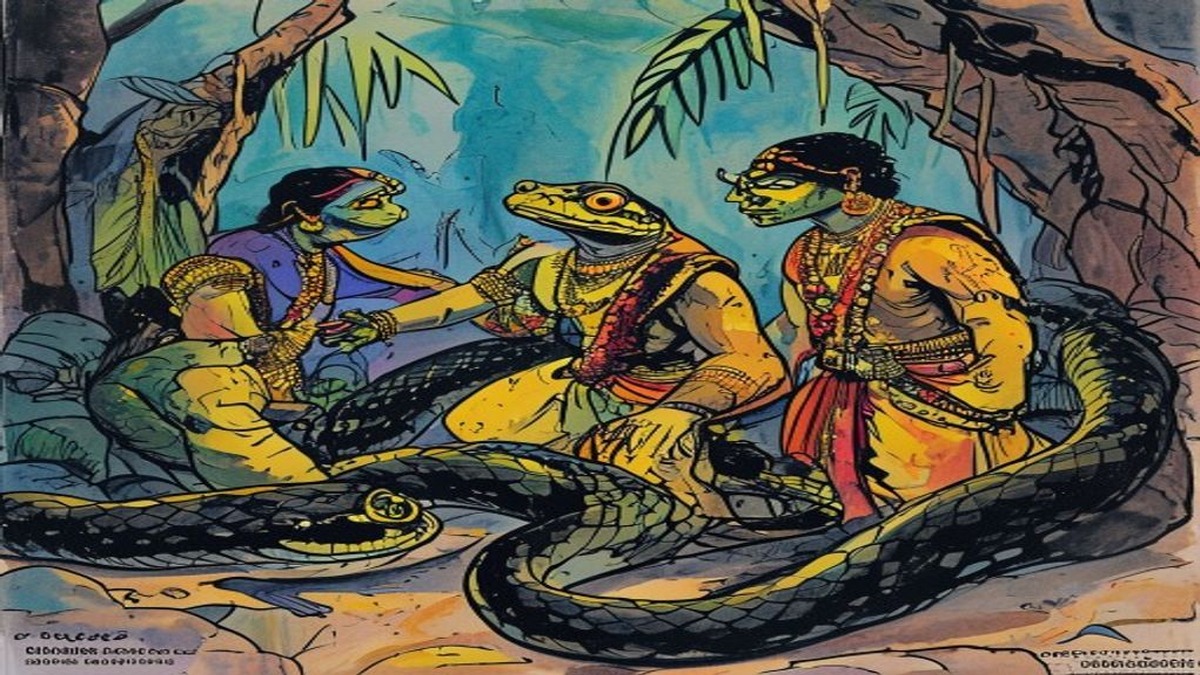
The snake entered the well and, as agreed, ate the rival frogs. The king’s immediate political problem was solved: his rivals were eliminated, his position was secure within the now-depleted community. The snake had performed exactly the service the king had contracted for. The king, in this moment, had achieved his objective.
The Pancatantra’s observation at this point is devastating in its economy. The king had achieved his objective and lost everything he was protecting when he achieved it. The rivals were gone; so was most of the community that constituted the king’s kingship. And the snake was still in the well, still hungry, and still a natural enemy of frogs. The king had not asked what would come next because the short-term problem had absorbed all his strategic attention. The next was now arriving.

Beat III — The Consequence
The snake, having consumed the rival frogs, continued eating. There was no mechanism within the terms of the alliance that would stop him: he was inside the well, the frogs could not remove him, and the contract had been for a food supply, not for a limited engagement. He ate the frogs who had supported the king. He ate the king’s courtiers. He ate the king himself. The well that had been home to a thriving frog community was emptied.
The Pancatantra’s account of the king’s end is without sentiment. The king had made a catastrophic error of strategic reasoning, and the error had its natural consequence. He had brought a natural enemy inside his own defences, given that enemy a reliable food supply, and provided no exit mechanism when the immediate contract was fulfilled. The snake had behaved exactly as a natural enemy of frogs would behave in a well full of frogs. The king’s error was in his reasoning, not in the snake’s conduct.

Beat IV — What the Frogs and the Black Snake Teaches About Internal Enemies and External Allies
Vishnu Sharma’s argument in this tale is among the Pancatantra’s most concentrated political lessons: inviting a natural enemy inside your community’s defences to use as a weapon against internal rivals is the most dangerous possible response to internal political conflict. The reasoning errors the frog king made are identifiable and instructive. First, he treated the natural enemy’s interests as aligning with his own because their immediate interests aligned on the specific question of the rival frogs; he did not consider what the natural enemy’s interests were once that specific alignment was exhausted. Second, he brought the natural enemy inside his defences without an exit mechanism. Third, he solved his immediate problem without asking what would come next.
The Arthashastra’s treatment of internal dissension (kopa) and external alliance addresses exactly this situation: the ruler who resolves internal dissension by inviting external power has solved the internal problem by creating an existential one. The Arthashastra prescribes that internal dissension must be resolved through internal means — conciliation, division, gifts, or as a last resort punishment — and that external power should never be invited into one’s own territory to serve as an instrument of internal political competition. The frog king’s error is the canonical illustration of why.
Moral and Sanskrit Wisdom Tradition
“He who invites the natural enemy inside his own defences to defeat his internal rivals has solved one problem by creating one far worse; the snake who eats your enemies will eat you next.”
— Moral of The Story of the Frogs and the Black Snake, Pancatantra Book III (Kakolukiyam)
This moral engages the Sanskrit political tradition’s most direct prescription against the use of external enemies to resolve internal political conflicts. The Arthashastra devotes a full section to the treatment of internal dissension and explicitly prohibits the invitation of external power into one’s own territory for this purpose. The Mahabharata’s treatment of the Kaurava-Pandava conflict includes multiple examples of exactly this error: factions within a kingdom inviting external power to resolve internal competition, with consistently destructive results. Vishnu Sharma’s frog-king tale provides the concentrated narrative demonstration of the principle.
Why This Story Has Lasted 2,300 Years
The Story of the Frogs and the Black Snake endures because the error it demonstrates — inviting a natural enemy inside your defences to serve as a weapon against internal rivals — is among the most consequential and most repeated in political history. The pattern repeats across every scale: the faction that invites foreign intervention to resolve a domestic political dispute; the institution that brings in an external disruptor to eliminate internal rivals; the individual who uses a dangerous ally to destroy a personal enemy. The Pancatantra’s analysis is clear: the ally whose interests align with yours only on the specific question of your current rivals will pursue their own interests once those rivals are gone. The snake will always eat you next.
Sanskrit Tradition: Tantrakhyayika (c. 200 BCE, Kashmir)
Key Concept: Natural enemy invited inside defences; short-term alignment vs. structural interest; internal dissension resolved through external power; exit mechanisms for external allies
Author: Vishnu Sharma (attributed, c. 3rd century BCE)
Arthashastra Parallel: Treatment of internal dissension (kopa); prohibition on inviting external power into one’s territory for internal political purposes
Frequently Asked Questions
What is the moral of the Story of the Frogs and the Black Snake in the Panchatantra?
The moral is that he who invites a natural enemy inside his own defences to defeat internal rivals has solved one problem by creating one far worse. The snake who eats your enemies will eat you next. The frog king eliminated his rivals by inviting the snake in, but the snake remained inside the well with the same hunger and the same nature once the rivals were gone, and ate the king himself. Inviting a natural enemy inside your defences is the most dangerous response to internal political conflict.
What happens in the Story of the Frogs and the Black Snake in the Panchatantra?
The king of the frogs, frustrated by a rival faction within his well, invites a black snake inside, offering the rival frogs as food. The snake eliminates the rivals as agreed, solving the king's immediate problem. But having exhausted his initial food supply, the snake continues eating — the king's supporters, his courtiers, and finally the king himself. The entire frog community is destroyed. The king achieved his political objective at the cost of everything he was trying to protect.
What strategic errors does the frog king make in this Panchatantra story?
The frog king makes three identifiable strategic errors: First, he treated the snake's interests as aligning with his own because they aligned on the specific question of the rival frogs, without considering what the snake's interests would be once that alignment was exhausted. Second, he brought the snake inside his defences without any exit mechanism to remove him when the contract was fulfilled. Third, he solved his immediate problem without asking what would come next. These three errors together produced the catastrophic outcome.
What does this Panchatantra story teach about resolving internal political conflict?
The Pancatantra teaches that internal dissension must be resolved through internal means — conciliation, division among rivals, gifts, or as a last resort direct confrontation. External power should never be invited inside one's territory to serve as an instrument of internal political competition. The Arthashastra makes the same prescription: the ruler who resolves internal dissension by inviting external power has solved the internal problem by creating an existential one, because the external power's interests extend beyond the specific conflict they were invited to resolve.
How does this story relate to the Arthashastra's treatment of internal dissension (kopa)?
The Arthashastra's treatment of internal dissension (kopa) explicitly prohibits the invitation of external power into one's own territory to resolve internal political conflicts, on exactly the grounds the frog-king tale demonstrates: the external power's interests do not end with the resolution of the specific conflict they were invited to address. The Arthashastra prescribes the four means of resolving internal conflict (sama, dana, bheda, danda — conciliation, gifts, division, punishment) as alternatives to external alliance, precisely because external alliance always creates the problem the frogs experienced.
You May Also Like
 Panchatantra Stories
Ages 3-5
Panchatantra Stories
Ages 3-5
The Story of the Jackal and the Sanyasi
The Story of the Jackal and the Sanyasi: Once upon a time, in a lonely matha, there lived a Sanyasi called Dev Sharma. Many people sed to visithim and present
 Panchatantra Stories
Ages 6-8
Panchatantra Stories
Ages 6-8
The Story of the Foolish Heron, the Black Snake and the Mungoose
The Story of the Foolish Heron, the Black Snake and the Mungoose: In a jungle, there was a banyan tree. A number ofherons had built their nes ts in it. The
 Panchatantra Stories
Ages 6-8
Panchatantra Stories
Ages 6-8
The Origin of Panchatantra Stories – A Story in History
The Origin of Panchatantra Stories – A Story in History: The Panchatantra is an ancient Indian collection of inter-related animal fables in Sanskrit verse and