The Origin of Panchatantra Stories – A Story in History
The Origin of Panchatantra Stories – A Story in History: The Panchatantra is an ancient Indian collection of inter-related animal fables in Sanskrit verse and

The Story Behind the Stories
The Panchatantra is one of the oldest and most widely distributed books in world history — a collection of Sanskrit animal fables and wisdom tales that has been translated into more languages, and reached more cultures, than virtually any secular work before the modern era. But the Panchatantra itself contains a story about its own origin: how it came to be written, why, and for whom. This origin story is not merely biographical background; it is the book’s first lesson, embedded in its own framing narrative, about the nature of education, the responsibilities of teachers, and the extraordinary power of story as a vehicle for wisdom.
“Idam shastra samuddhritya nitishastra-mahodadheh; tantre panchatantrakhye prakatyate balabodhinam.”
“Drawn from the great ocean of the science of statecraft, this text called the Five Treatises is revealed for the instruction of the young.”
— Panchatantra, opening verse, attributed to Vishnu Sharma
Beat I — The King and His Three Sons
The story is set in the ancient city of Mahilaropya, where a king named Amarashakti ruled with prosperity and wisdom. He had three sons — Bahushakti, Ugrashakti, and Anantashakti — who were the exact opposite of their father in every intellectual quality. They were disinclined to learning, incapable of sustained attention, and entirely uninterested in the sciences of statecraft, diplomacy, economics, and military strategy that a prince was expected to master before inheriting a kingdom. The king consulted his ministers in despair: his sons were fully grown but educationally negligible, and the kingdom’s future — which depended on competent succession — was at serious risk.
Various advisors proposed various remedies: a more rigorous curriculum, stricter tutors, incentive structures, travel to foreign courts. None of these proposals satisfied the king, partly because they all required the princes to be willing participants, and the princes had demonstrated over many years that their willingness could not be assumed. Then a minister named Sumati made a different kind of suggestion: instead of forcing the princes through the standard curriculum, find a teacher brilliant enough to teach them what they needed to know through a medium they would voluntarily engage with. The medium Sumati proposed was stories.
Beat II — Vishnu Sharma and His Extraordinary Offer
The king summoned the most learned scholars and teachers in his kingdom and presented the challenge: could any of them make his sons capable of governing within a reasonable period of time? Most scholars demurred — the princes’ reputation was known. Then an aged Brahmin named Vishnu Sharma came forward. He was, by all accounts, the most learned man in the kingdom — a grammarian, logician, rhetorician, and statesman of extraordinary depth. He was also old enough to have nothing to prove and nothing to lose.
Vishnu Sharma made an offer that astonished the court: he would make the three princes competent in the science of statecraft — niti-shastra — within six months. He asked for no payment, no land, no titles. His only condition was that the king should grant him complete freedom in his methods. The king, who had exhausted conventional approaches, agreed. Vishnu Sharma took the princes to his ashram and set about the most consequential educational experiment in the history of Indian literature.
His method was simple and unprecedented: instead of teaching statecraft directly — through lectures, memorisation, and formal examination — he taught it entirely through stories. He composed a sequence of interconnected animal fables, each embedding a lesson about alliances, betrayal, intelligence, caution, greed, and the many other qualities that determined whether a ruler would flourish or fail. The princes, who could not attend a grammar lecture for twenty minutes, listened to stories for hours. Within six months, they had absorbed more practical wisdom about the conduct of political life than most conventionally educated princes learned in years.
Beat III — The Analysis: Why Story Works Where Instruction Fails
The framing story of the Panchatantra is itself a lesson about pedagogy — the science of how people actually learn. Vishnu Sharma’s insight was that the princes’ resistance to learning was not a deficiency of intelligence but a mismatch between the form of instruction and the form of attention available to young minds. Abstract principles presented as abstract principles require the learner to do all the work of application — to imagine the situations in which the principle matters and supply the emotional stakes that make the principle feel real and important. Stories reverse this: they supply the situation, the emotional stakes, and the outcome, and require the learner only to extract the principle — a natural and almost irresistible cognitive operation.
The Panchatantra’s animal fables work because animals provide a safe distance from which to observe the consequences of human choices. A reader who might resist a direct instruction (“do not trust flatterers”) will readily observe a crow’s destruction at the hands of a flattering fox and draw the conclusion himself — a conclusion that, having been self-drawn, is held with more conviction and remembered with more clarity than any taught proposition. Vishnu Sharma understood that the most durable education is the kind that makes the learner feel that he has discovered the lesson himself, rather than received it from a teacher.
This is an insight that modern educational psychology has confirmed through extensive research: the generation effect (knowledge generated by the learner is retained longer than knowledge received passively), the testing effect (knowledge applied in context is more durable than knowledge memorised in isolation), and the narrative transportation effect (stories engage cognitive and emotional resources simultaneously, producing deeper encoding than abstract exposition). Vishnu Sharma preceded these discoveries by two thousand years, arriving at the same conclusions through observation and practice rather than experimental method.
Beat IV — The Text and Its Journey Through the World
The Panchatantra that Vishnu Sharma composed for the three princes became, over the following centuries, one of the world’s most extensively distributed texts. It was translated into Pahlavi (Middle Persian) in the 6th century CE by the physician Borzuy under the patronage of the Sassanid emperor Khosrow I. From the Pahlavi translation, the Syrian scholar Simeon Seth produced a Syriac version; the Arabic scholar Ibn al-Muqaffa⇻ produced the Arabic Kalila wa Dimna in the 8th century. From the Arabic, the text moved into Persian, Hebrew, Greek, Latin, Spanish, Italian, German, French, and eventually every major European language through the medieval period. The Fables of Bidpai — as the European version was known — was among the most widely read secular books of the medieval world.
The Panchatantra’s global journey is among the most remarkable in the history of literature: a Sanskrit text composed for three inattentive princes in an ancient Indian kingdom reached the courts of medieval Europe, the libraries of the Islamic world, the oral traditions of Southeast Asia, and the folk cultures of the Persian-speaking world — all while maintaining the essential structural insight of its framing story. The wisdom that Vishnu Sharma embedded in animal tales for the benefit of three specific princes proved to be wisdom that every culture, in every period, found relevant to its own questions about power, friendship, intelligence, and the conduct of a good life.
Moral: The most durable education makes the learner feel that she has discovered the lesson herself; story is the technology that enables this discovery across every age and culture.
The Living Tradition
The Panchatantra’s journey did not end in medieval Europe. In India, it continued generating vernacular retellings in every regional language — Tamil, Telugu, Malayalam, Kannada, Bengali, Marathi, Hindi, and dozens of others — each adapting the stories to local contexts while preserving the core narrative architecture. In the 20th century, the stories were adapted into illustrated books for children, animated films, comic series, and eventually digital formats. The three princes of Mahilaropya, for whom the entire edifice was originally constructed, have had billions of successors — children and adults across two thousand years and dozens of cultures who received Vishnu Sharma’s lesson about alliance, wisdom, caution, and the conduct of a good life, packaged in the form that he first identified as uniquely capable of delivering it: a story about animals that know exactly how human beings behave.
About the Panchatantra
The Panchatantra (“Five Treatises”) was composed in Sanskrit by the scholar Vishnu Sharma around 300 BCE–300 CE as a niti-shastra — a guide to wise conduct and statecraft — framed as animal fables for the instruction of young princes. Its five books cover the dissolution of allies, the winning of allies, war and peace, the dangers of naivety, and the hazards of rashness. The text spread westward through Pahlavi and Arabic translations to become the most widely translated secular book of the ancient world after the Bible.
Frequently Asked Questions
**Q: Why is this story important?**
You May Also Like
 Panchatantra Stories
Ages 9-12
Panchatantra Stories
Ages 9-12
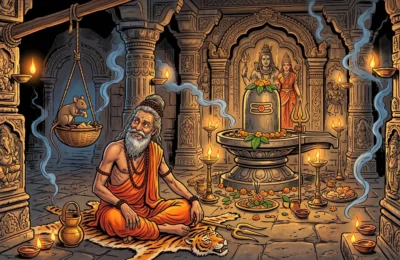
The Story of the Sadhu and the Mouse
The Story of the Sadhu and the Mouse: In the southern part of the country, there is a citycalled Mahilaropyam. Not far from the city, there wasa temple
 Panchatantra Stories
Ages 9-12
Panchatantra Stories
Ages 9-12
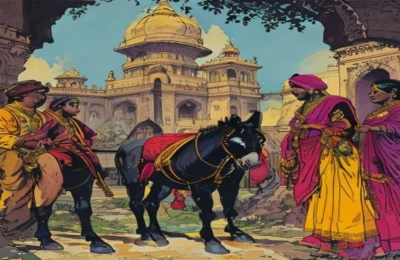
The Washerman’s Donkey
The Washerman's Donkey: In a village that existed on the boundary between civilization and wilderness, there lived a washerman named Hari who owned a donkey
 Panchatantra Stories
Ages 6-8
Panchatantra Stories
Ages 6-8
The Foolish Sage And The Jackal
The Foolish Sage And The Jackal: In a monastery far away from human habitation lived a saint called Deva Sarma. He amassed a lot of wealth by selling clothes