A Three-in-One Story
Some Panchatantra tales are simple. A Three-in-One Story is not. It is a tale that hides three little stories inside one bigger story — and each of the three teaches the same surprising lesson: even the wisest grown-ups become foolish when love asks them to be. King Nanda neighs like a horse for his queen, his prime minister Vararuchi shaves his head for his wife, and a third nested tale shows how this folly travels far beyond the palace walls.
Some folk tales are simple. One king, one trick, one lesson. A Three-in-One Story is not one of those. It is a Panchatantra tale that hides three little stories inside one bigger story, and each of the three teaches the same surprising lesson: even the wisest grown-ups become foolish when love asks them to be.
This tale comes from the fourth book of the Panchatantra, called Labdhapranasam — “Loss of Gains”. It was set down in writing more than two thousand years ago by the scholar Vishnu Sharma, who used these tales to train three young princes in how the world really works. Read it slowly. The story you think you are reading at the start is not the story you finish at the end.
Where this story comes from
The Panchatantra is a collection of eighty-four fables grouped into five books. Vishnu Sharma is said to have written it around 200 BCE for the three sons of a king who had despaired of teaching them anything by ordinary means. The fourth book, Labdhapranasam — sometimes translated as Loss of Gains — gathers stories about people and animals who already had what they wanted and then lost it through their own folly. A Three-in-One Story is a perfect fit: every character in it begins with dignity, and every one of them gives that dignity away in exchange for a moment’s peace from someone they love.
The same tale has travelled far. Bookstruck, Tales of Panchatantra, and many older anthologies all carry shorter versions. The retelling below is the long, full version — nothing trimmed, written in plain language for any reader, young or old.
The story
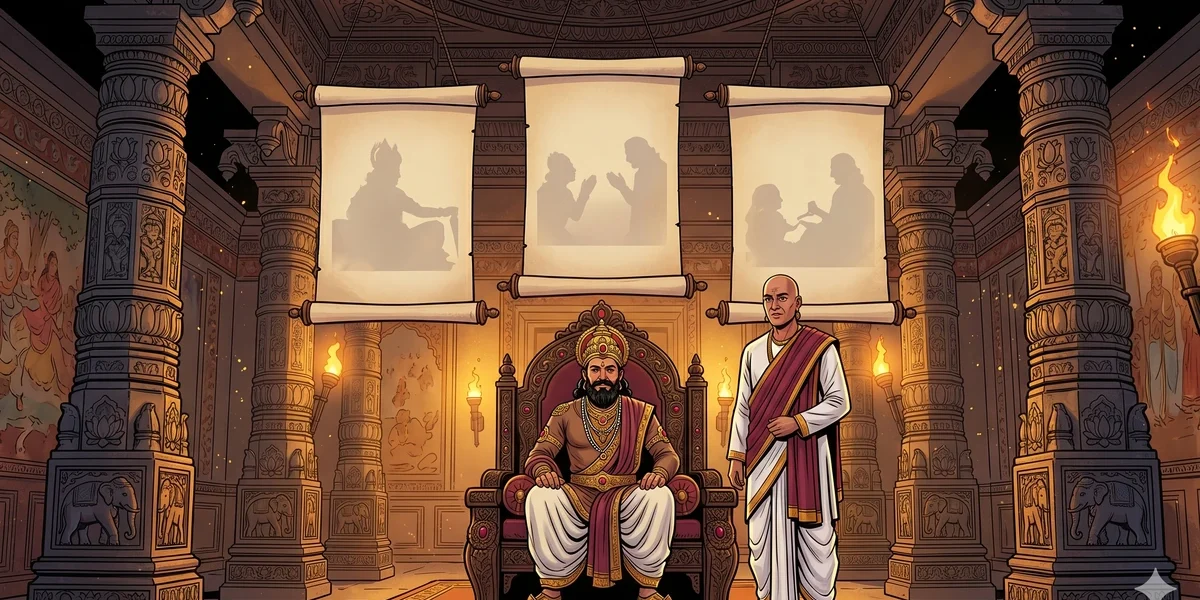
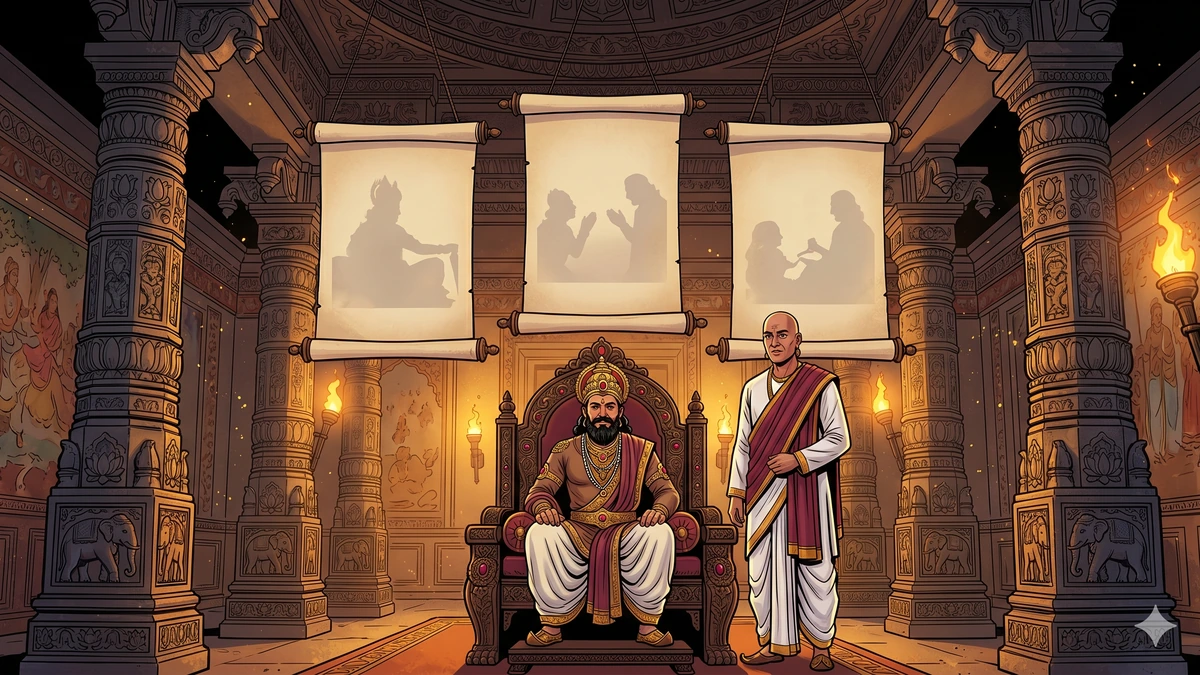
Once upon a time, there was a popular king called Nanda. His people respected him for his learning and his courage. Beside him stood his prime minister, Vararuchi, a man known across the kingdom for his skill in diplomacy and statecraft. Together they ruled wisely. Or so it seemed from the outside.
Tale one: The shaved head
One day, Vararuchi’s wife was angry with him. She would not speak to him, would not eat with him, would not even look at him. Vararuchi loved her dearly and could not bear the silence. He pleaded with her to forgive him, but she stayed cold.
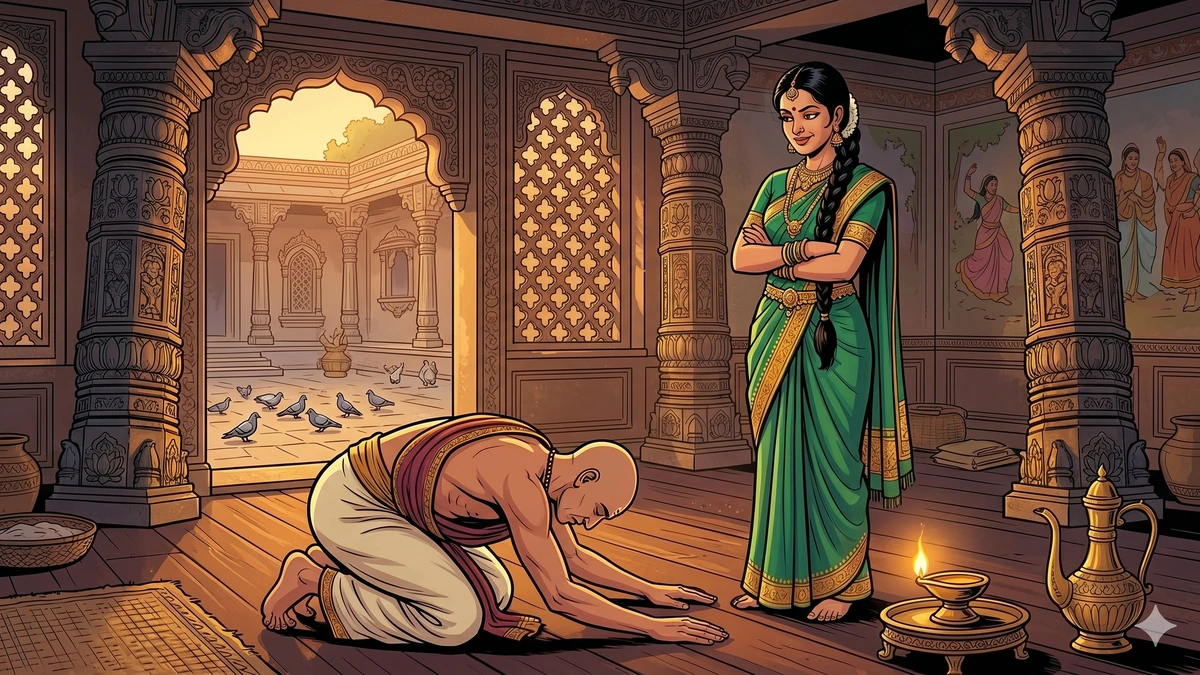
At last she opened her mouth and said, “Shave your head completely. Then come to me and prostrate yourself on the floor at my feet. Do that, and I will love you again.”
Now, in the kingdom of Nanda, shaving one’s head was something a man did only on certain holy days, or when he was in deep mourning. To do it on any other day was an embarrassment that the whole town would notice. But Vararuchi loved his wife more than he loved his dignity. He shaved his head smooth, walked to her, and lay flat on the floor before her. She forgave him at once.
Tale two: The royal horse
Around the same time, the queen of King Nanda played the very same game with her husband. She refused to speak to him. She turned her face to the wall when he entered her chamber. The king, who could rally an army with a single word, could not move his own wife to a smile.
He tried gifts. He tried songs. He tried the old jokes that used to make her laugh when they were young. Nothing worked. At last, in desperation, he knelt at her feet and said, “My darling, tell me what to do. I cannot live with your silence even for one more day.”
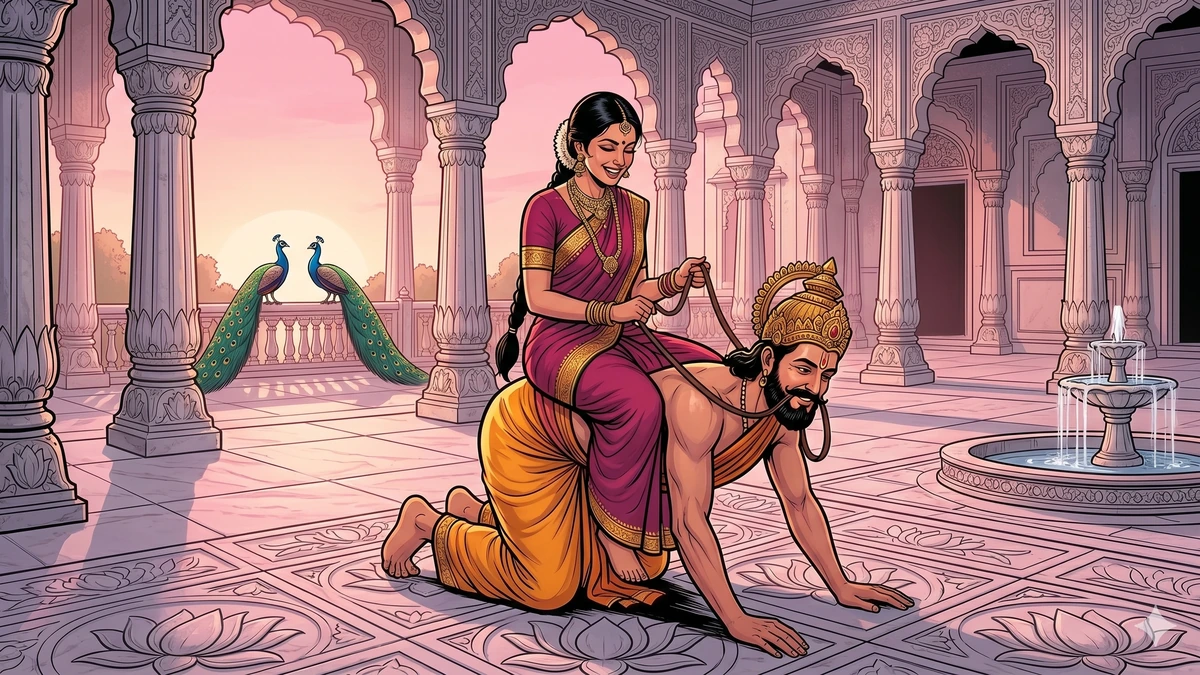
The queen looked at him slowly and said, “Very well. I will be happy if you pretend to be a horse. You will let me put a bridle in your mouth. You will let me climb on your back. You will let me ride you around the courtyard while you neigh. Will you do that for me?”
“Yes,” said the king. And he did. The next morning, before the courtiers arrived, the queen rode the king around the palace courtyard like a child rides a pony, and the king of Nanda neighed.
The king sees the prime minister
Later that day, the king received Vararuchi at court and saw at once that the prime minister’s head was shaved. He was puzzled.
“Vararuchi,” said the king, “why have you shaved your head on a day when shaving is forbidden? Have you lost a relative? Are you in some kind of holy distress?”
Vararuchi answered with a small, tired smile. “Oh king,” he said, “is there anything that a woman does not demand, and a man in love does not readily give? A loving husband will shave his head. A loving husband will neigh like a horse. There is no folly that love will not lead a wise man to commit.”
The king said nothing. He understood at once what Vararuchi was telling him — and what Vararuchi could not possibly know. Both men, the wisest in the kingdom, had been led into the same foolishness on the same morning, by women they could not refuse.
Tale three: The three merchants and the inn
The story does not end there. While the king and his minister were learning their lesson, three merchants arrived at a village far from the capital. They were exhausted from a long journey and asked the village innkeeper for a single room and a hot meal.
The innkeeper welcomed them and brought them to a comfortable room with three beds. He promised them a fine supper. But as evening fell, the merchants noticed the innkeeper’s son and a serving girl in the courtyard, quarrelling loudly — about a spilled cup of wine, a careless word, nothing very important. The shouting carried all the way through the inn.
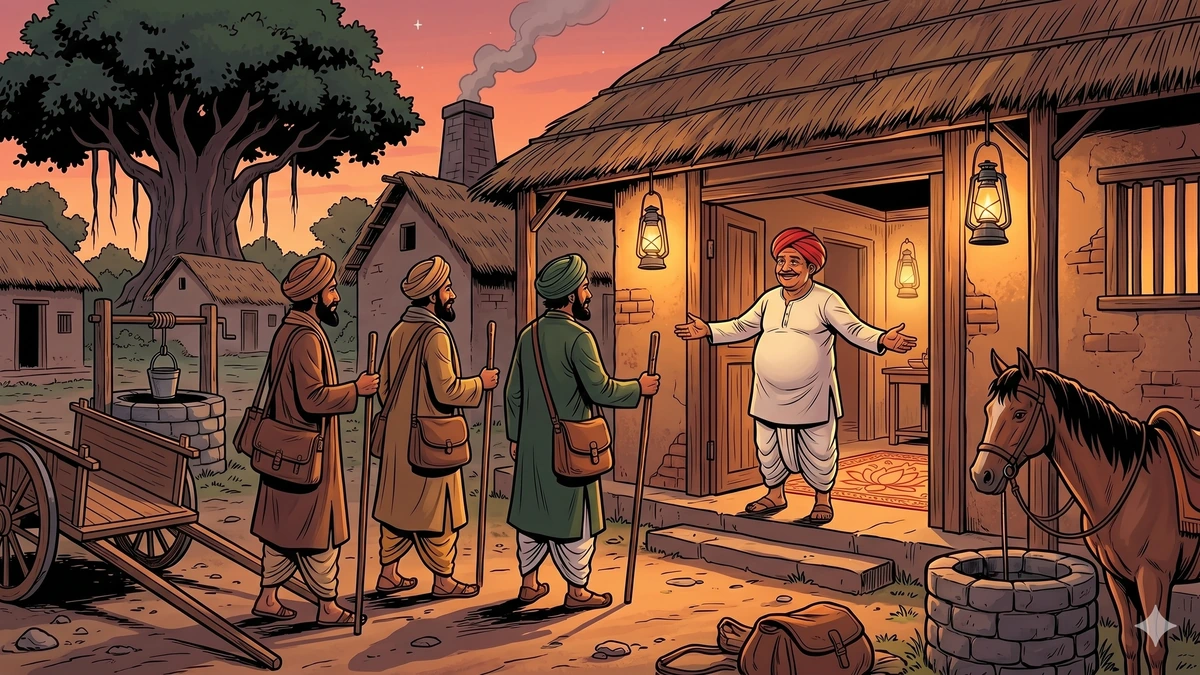
The first merchant lost his temper. He stepped to the doorway and shouted at the boy and girl to be silent. He used the weight of his name and his money. They obeyed him. They served the meal in cold silence. He ate with quiet annoyance, and they served him with quiet resentment, and nothing in either of them changed.
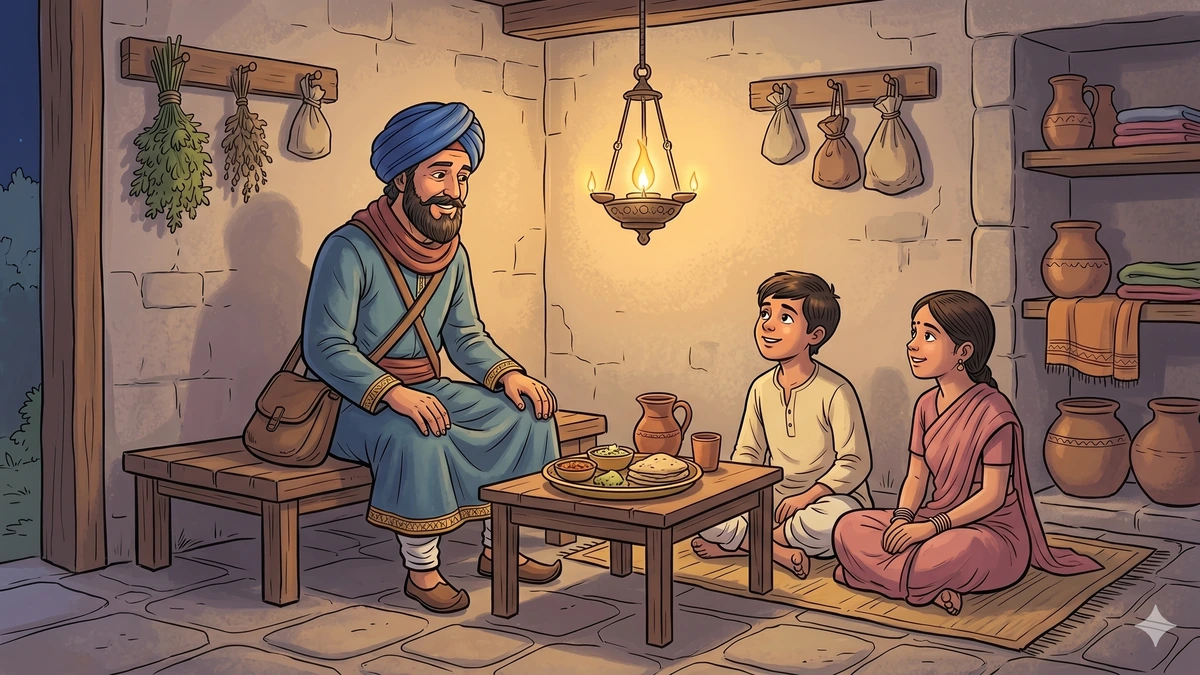
The second merchant tried something different. He called the boy and girl over and asked them, gently, why they were fighting. Slowly the truth came out. The girl was lonely and missed her family. The boy was frightened because his father’s small business was failing. The merchant listened without rushing them. He said a few wise words, neither too sharp nor too sweet. By the end of the night, the boy and girl were speaking with civility, because someone had finally treated them as human beings.
The third merchant did something simpler still. He asked the boy to help him carry his bags upstairs. He asked the girl to show him the village — the temple, the well, the old banyan tree at the crossroads. He treated them as guides and helpers. By the end of the evening, both children were walking taller. They had been treated as useful people, and they had become useful people, and their quarrel was already half-forgotten.
That night, the three merchants slept under the same roof. But only the second and third woke wiser than they had lain down. The lesson they carried away was clear: authority forces obedience, wisdom brings understanding, but kindness creates real change.
The characters at a glance
King Nanda — A wise and respected king who is brought low by his love for his queen.
Vararuchi — The king’s prime minister, a learned man, equally helpless in front of his own wife.
Vararuchi’s wife — The first to test how much a husband will surrender for love. She is not cruel, only proud.
The queen — Plays the same game on a grander stage and goes further than Vararuchi’s wife dared.
The three merchants — Three travellers who arrive at the same problem and choose three different ways to solve it.
The innkeeper’s son and the serving girl — Two unhappy young people whose argument becomes a small classroom for the merchants.
The moral of the story
The Panchatantra puts the moral plainly: even the wisest of men become slaves to love. But there is more in the tale than that one line.
The first two stories — the shaved head and the royal horse — are funny on the surface. They show two great men reduced to silliness because they cannot bear to be loved less. Underneath the humour is a quieter warning: when affection becomes the price of obedience, neither the lover nor the loved one is truly happy. The wife who demands a shaved head still does not respect her husband at the end of it. The queen who rides her king does not love him more for the ride.
The third story turns the lesson sideways. The three merchants face a much smaller problem — two young people quarrelling at an inn — and they show three ways a person might handle anyone whose feelings have grown tangled: with force, with understanding, or with kindness. Force gets the surface. Understanding gets the truth. Kindness, alone, gets the change.
Put the three tales together and the meaning is whole: love is powerful enough to make wise people foolish, and kindness is powerful enough to make foolish people wise. Both are stronger than authority. Both are stronger than wealth. The story is two thousand years old, and it has not aged a day.
Why this story still matters today
Modern readers sometimes laugh at the picture of a great king pretending to be a horse. We tell ourselves we would never be that foolish. But every adult who has been deeply in love knows the feeling of doing something a little undignified to keep the peace at home. The names change. The shaved head becomes a missed work meeting. The royal horse becomes an apology for a thing one did not do. The shape is the same.
The third tale is the one that has aged best. Anyone who has managed people — at work, in school, on a sports team, in a family — has met the same choice the three merchants faced. There is always someone whose mood is making everything harder. We can shout them quiet. We can listen to them. Or we can give them something useful to do. Two thousand years later, the third option still works the best.
For young readers, the lesson is simpler and just as important: when somebody around you is upset, asking them to help with something is often a kinder thing than telling them to stop being upset. It works on classmates. It works on younger siblings. It even works on parents.
Frequently asked questions
What is the moral of A Three-in-One Story?
The Panchatantra version of the moral is that even wise men become foolish when love demands it. The fuller meaning, taken across all three nested tales, is that love makes wise people silly, but kindness makes silly situations wise. Force commands obedience, understanding earns trust, and kindness changes hearts.
Who wrote the Panchatantra?
The Panchatantra is traditionally attributed to Vishnu Sharma, a learned scholar who is said to have composed the collection around 200 BCE in ancient India. He wrote it to teach three young princes about life, leadership, friendship, and folly using engaging stories about people, animals, and gods.
Why is it called A Three-in-One Story?
Because three smaller stories live inside the larger one. The first is about Vararuchi shaving his head. The second is about King Nanda becoming a horse for his queen. The third is about three merchants at an inn discovering three different ways to handle a quarrel. Each small story stands on its own, but together they teach a single, three-sided lesson about love, dignity, and kindness.
Which book of the Panchatantra is this story from?
It is from the fourth book, called Labdhapranasam — usually translated into English as Loss of Gains. The fourth book gathers tales about people and animals who already had what they wanted and lost it through their own foolishness. A Three-in-One Story fits the theme exactly: every character begins with dignity and trades part of it away.
What can children learn from this story?
Children learn three things at once. First, that grown-ups, even very smart ones, can do silly things when their feelings get loud. Second, that the way you ask someone to do something matters more than how loudly you ask. Third, that kindness is not weakness — it is the strongest tool any of us have for getting along with other people.
Related folk tales you may enjoy
If you liked this Panchatantra tale, you will love these other stories from the same tradition:
- 📖 The Story of the Blue Jackal — A jackal becomes a king for the wrong reasons.
- 📖 The Talkative Tortoise — What happens when a tortoise cannot keep his mouth shut.
- 📖 The Clever Monkey and the Crocodile — Friendship, betrayal, and a quick-witted escape.
- 📖 Tale of the Three Fish — Three fish, three plans, three very different fates.
- 📖 The Musical Donkey — A donkey learns the cost of singing in the wrong place.
Did you know?
- The Panchatantra has been translated into more than fifty languages, making it one of the most widely translated works in human history.
- Many of Aesop’s Fables are believed to share roots with Panchatantra stories — the same lessons, dressed in different cultures.
- A version of the Panchatantra reached Europe as early as the eleventh century, where it shaped European fable traditions long before children’s books existed.
- The fourth book, Labdhapranasam, is sometimes the funniest of the five — many of its stories are about clever creatures who outsmart themselves.
Thank you for spending time with this Panchatantra tale. The next time you see a friend doing something a little foolish for someone they love, remember King Nanda and his horse, and be kind. We have all neighed for somebody once.
Frequently Asked Questions
What is the moral of A Three-in-One Story?
Who wrote A Three-in-One Story?
Which book of the Panchatantra is this story from?
Why is it called A Three-in-One Story?
What can children learn from this story?
You May Also Like
 Panchatantra Stories
Ages 3-5
Panchatantra Stories
Ages 3-5
The Dog who went Abroad
Read 'The Dog who went Abroad' — a classic Panchatantra story about nature and animals. The Dog who went Abroad is a beloved Panchatantra tale featuring...
 Panchatantra Stories
Ages 3-5
Panchatantra Stories
Ages 3-5
Pride Goeth Before A Fall
Pride Goeth Before A Fall: In a certain village there lived ten cloth merchants, who always went about together. Once upon a time they had travelled far
 Panchatantra Stories
Ages 3-5
Panchatantra Stories
Ages 3-5
Tale of The Golden Droppings
Tale of The Golden Droppings: On a big tree in the lap of a mountain lived a bird named Sindhuka. His droppings used to turn into gold as soon as they hit the