The Clever Monkey and the Crocodile
The dual-rooted Indian fable of Raktamukha — "Red-Faced," the rhesus macaque of the jambū tree — and his crocodile friend Karālamukha, "Hideous-Mouthed," who carries him out into the river to be eaten on his wife's orders. The tale comes to us through two ancient traditions at once: the Buddhist Pali Canon as Suṃsumāra-Jātaka 208 (with two further variants, Vānarinda 57 and Vānara 342), and the Hindu Panchatantra as the FRAME story of Book IV, Labdhapraṇāśam. It is not, as is often claimed, a tale of Aesop. The Sanskrit names are restored, the Buddhist Devadatta frame is explained, the jambū rose-apple tree replaces the modern misattributed mango, and the story's two-thousand-year journey through Pahlavi, Arabic (where the crocodile becomes a tortoise), Persian, Hebrew, Latin, and finally into European folklore is traced. ATU 91.
Foolish friend — no creature carries his heart outside his body. You have lost a friend, you have lost a feast, and you have lost the only sweet fruits you will ever taste.
This is one of the most widely-travelled stories in the history of human storytelling. Like its sister-tale of the Talkative Tortoise, it comes down to us through two ancient Indian roots — one Buddhist, one Hindu — and from those twin roots it has migrated across the entire Old World, surfacing in Korean folklore as the rabbit and the dragon-king, in Swahili tradition as the monkey and the shark, in Japanese tradition in the saru kani gassen cycle, and in the European exempla tradition through Latin translations of the Arabic Kalīla wa Dimna. Folklorists today catalogue the motif as ATU 91, “The Monkey/Cat Who Left His Heart at Home.” It does not appear in the Perry Index of Aesop’s fables.
The Hindu version is told by Vishnu Sharma in the Panchatantra, where it is not merely an embedded tale but the frame story of Book IV — Labdhapraṇāśam (लब्धप्रणाशम्, “The Loss of What Has Been Gained”). The verse Vishnu Sharma attached to Book IV is labdhasya rakṣaṇam uttamam — loosely, “the keeping of what one has gained is the highest skill.” Every other story in Book IV is told as a digression inside this one. The crocodile in the canonical Sanskrit text is named Karālamukha (कराल-मुख, “Hideous-Mouthed” or “Frightful-Mouthed”); the monkey, in many Sanskrit recensions, is Raktamukha (रक्तमुख, “Red-Faced,” referring to the pink-red face of the rhesus macaque). The tree is not a mango tree, as modern English retellings often have it — the Sanskrit text is unambiguous: it is a jambū (जम्बू, the Indian rose-apple, Syzygium cumini), a tree so beloved in Indian tradition that the entire subcontinent is called Jambūdvīpa in classical cosmology, “the Continent of the Rose-Apple.”
The Buddhist version is older still. It is told in the Pali Canon as the Suṃsumāra-Jātaka, Birth-Story No. 208 (and there are two further variants, Vānarinda-Jātaka 57 and Vānara-Jātaka 342, on the same motif — three independent Buddhist versions of the same story, which is itself testimony to the antiquity of the tale). The Buddha tells the Suṃsumāra-Jātaka at Veḷuvana to expose his cousin Devadatta, the only person who ever tried to kill him: the future Buddha was once a great monkey on the banks of the Ganges, and the crocodile who tried to deceive him was, in that life, Devadatta. The lesson, in the Buddhist frame, is that betrayal between friends is not a new thing under the sun — it has been going on, in particular cases, for many lifetimes.
Here is the story as the Indian tradition has held it for two and a half thousand years.
By the bank of a great river — the kind of river that flows southward through India in a wide silver curve, slow and deep and full of secrets — there grew a magnificent jambū tree. Its fruit was famous. The jambū-phala in autumn hung in heavy clusters of deep purple-pink, smooth as wax, sweet as honey-water, with a single small stone at the centre of each fruit. The whole tree, in season, smelled like a temple. In its branches lived a monkey — a clever rhesus macaque called Raktamukha for the red of his face — and he had grown fat and content on the fruit, and on the long warm afternoons, and on the slow southern wind that moved the leaves around him.
One morning a crocodile came up out of the river. He was old, his green-grey scales encrusted with the marks of many seasons, his eyes a yellow-grey, calm and thoughtful. He climbed onto the bank and lay there in the shade of the jambū tree, and looked up.
“Friend monkey,” called the crocodile, his voice surprisingly mild for so massive a creature, “I have been watching you for some time. You live in abundance. The river feeds me what it can spare, but it is always hungry, and what it spares is never sweet. Would you, in your generosity, share some of your fruit?”
Raktamukha was good-natured by disposition. He plucked a handful of the deep-purple jambū fruits from the highest branches, where the sweetest grew, and dropped them down. The crocodile caught them carefully on his long snout and tasted one. His eyes closed for a moment in surprise. He had never tasted anything so sweet.
“Friend,” he said, “this is no ordinary fruit. This is the fruit of paradise. I am in your debt.”
“Come back tomorrow,” said the monkey. “I will save the best ones for you.”
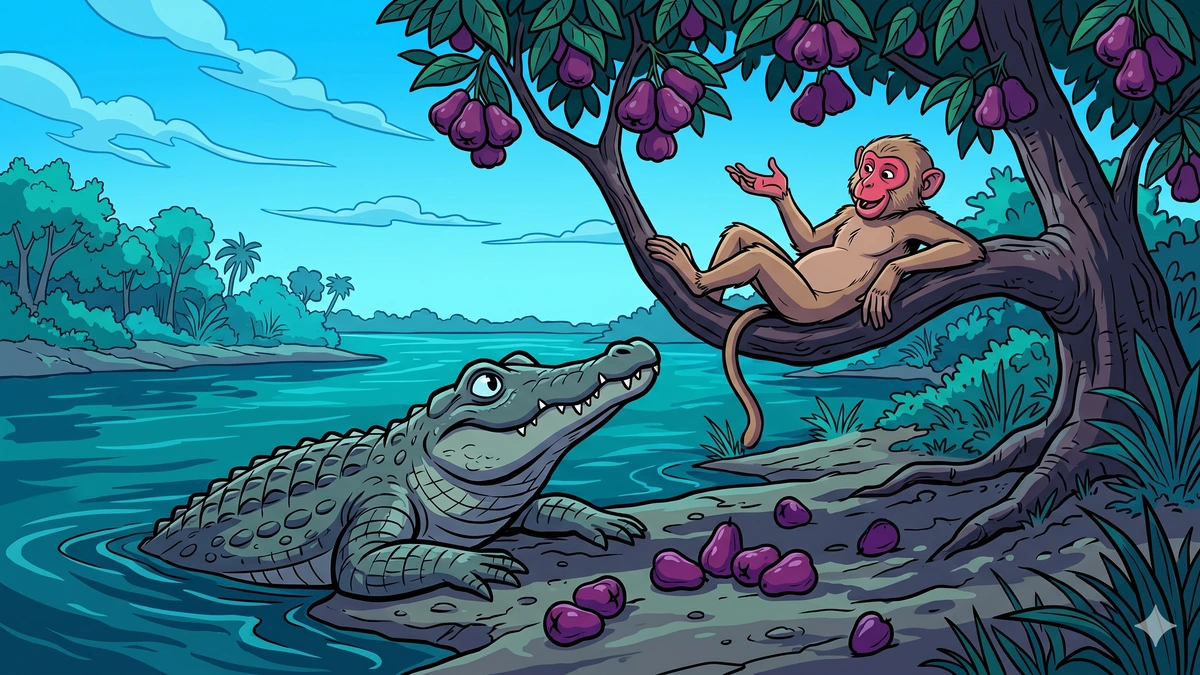
And so a friendship began. Day after day the crocodile — whose name, in the Sanskrit, was Karālamukha, “Hideous-Mouthed,” though only because of his teeth, not because of his manner — came up out of the river, and Raktamukha dropped him jambū fruits, and the two of them spoke the long slow conversations that two creatures from different worlds can have when they have nothing to fear from each other. They spoke of the river and its currents, of the seasons and the rains, of the small philosophies that monkeys and crocodiles have arrived at independently across the ages. The monkey believed he had found a true friend.
One afternoon Karālamukha asked, almost shyly, if he might take a few of the jambū fruits home to his wife. The monkey laughed. “Take all you like,” he said. “There is more on this tree than I could eat in many lifetimes.”
The crocodile carried home a cluster. His wife — a creature of strong opinions and longer silences — tasted one. She tasted another. She lay very still in the green water of their underwater home, and a cold thought crystallized in her, the way a thought sometimes crystallizes in a person who has been hungry too long.
“Husband,” she said at last, “if these fruits are this sweet — what must the heart of the creature who eats them be like?”
“What do you mean?” said Karālamukha.
“I mean,” said his wife, “that I want it. I want the heart of your monkey friend. Bring it to me, and I will be well; refuse, and I shall die of longing for it before the next moon.”

Karālamukha refused. He pleaded with her — the monkey was his friend, the monkey was the kindest creature he had ever met, the monkey had fed him for half a year. The wife would not hear it. She turned her face to the wall of their den and refused food, and the next day she refused water, and Karālamukha, who loved her in the slow tireless way that crocodiles love, began to fear for her life. By the end of the third day he had decided. The monkey was his friend, and his wife was his wife, and a man with two loves under pressure must choose one.
He surfaced near the jambū tree the next morning with a face he hoped looked like an ordinary face.
“Friend,” he called up, “today is a great day. My wife — whom I have spoken of often — has asked at last to meet you. She has prepared a feast in our home in the river. Will you come? Climb onto my back, and I will carry you safely across to our island.”
Raktamukha was flattered, as the kind so often are. He had heard so much about the wife. He had never been across the river. He came down from the tree and leapt onto the broad green back of his friend, and they set out across the water.
The river was wide, and they were halfway across — the jambū tree behind them now a small dark shape on the receding shore, the far bank still a long blue line — when Karālamukha could no longer bear the silence of his own betrayal. He spoke.
“Friend,” he said, “before we reach the island, I must tell you the truth. My wife is not preparing a feast for you. My wife is preparing a feast of you. She wants your heart. She believes that a creature who eats jambū fruit must have a heart sweet beyond all medicine. I am sorry. I have tried to refuse her, but I cannot.”
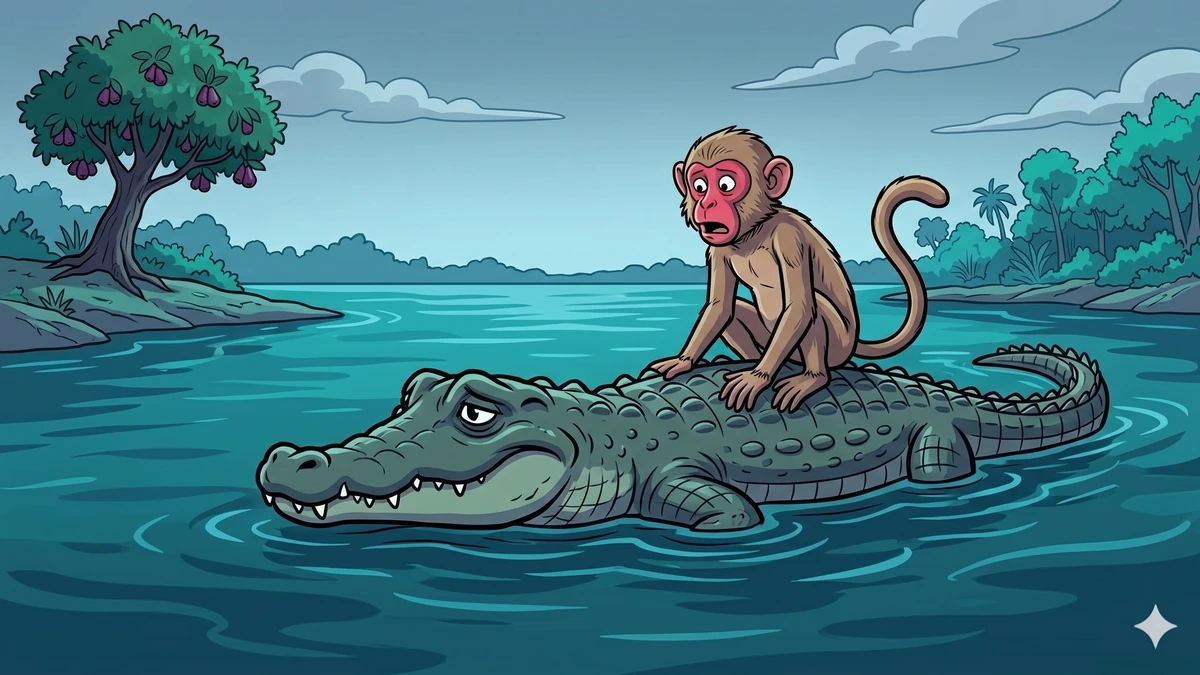
For a long moment the monkey said nothing. The water beneath them was deep and cool and slid past in dark coils. The jambū tree on the far shore was the size of a coin. The monkey was not a swimmer; the monkey was a creature of branches; the monkey was, mid-river, on the back of a crocodile, an absolute width away from any tree in the world.
And then — because intelligence, when it is sharp enough, comes to a creature precisely at the moment when intelligence is the only weapon left — Raktamukha laughed.
“Oh, my friend,” he said, lightly, “is that all? Why didn’t you tell me before we left? You have made a small mistake — but it is easily fixed.”
“What do you mean?” said the crocodile.
“Why, friend,” said the monkey, “we monkeys never carry our hearts with us when we go visiting. It is a custom of our kind. A monkey’s heart is a delicate thing — too tender to carry between the branches when one is leaping from tree to tree. We hang our hearts on the highest branch of our home tree before we go out, and we pick them up again on returning. My heart is on the topmost branch of the jambū tree at this very moment. If only you had told me earlier, I would have brought it. Take me back, and I will fetch it for your wife with my own hands. It would be ungenerous of me to refuse her, after all the kindness you have shown me.”
The crocodile, who was a slow and trusting creature in matters of the heart, considered this. It seemed to make sense. He had never, after all, seen the inside of a monkey. Perhaps it was true. He turned in the water and began to swim back to the jambū tree.
The moment the monkey’s foot touched a low branch he sprang. He went up the trunk like fire goes up a wick, and from the highest branch he looked down at the crocodile in the water and laughed — the long, clear, untroubled laugh of a creature who has just understood that he is going to live.
“Foolish friend,” he called down, “no creature carries his heart outside his body. You have lost a friend, you have lost a feast, and you have lost the only sweet fruits you will ever taste. Go home to your wife empty-handed. And tell her this from me — that the next time she sends her husband to do her killing, she should at least send him with a better lie.”
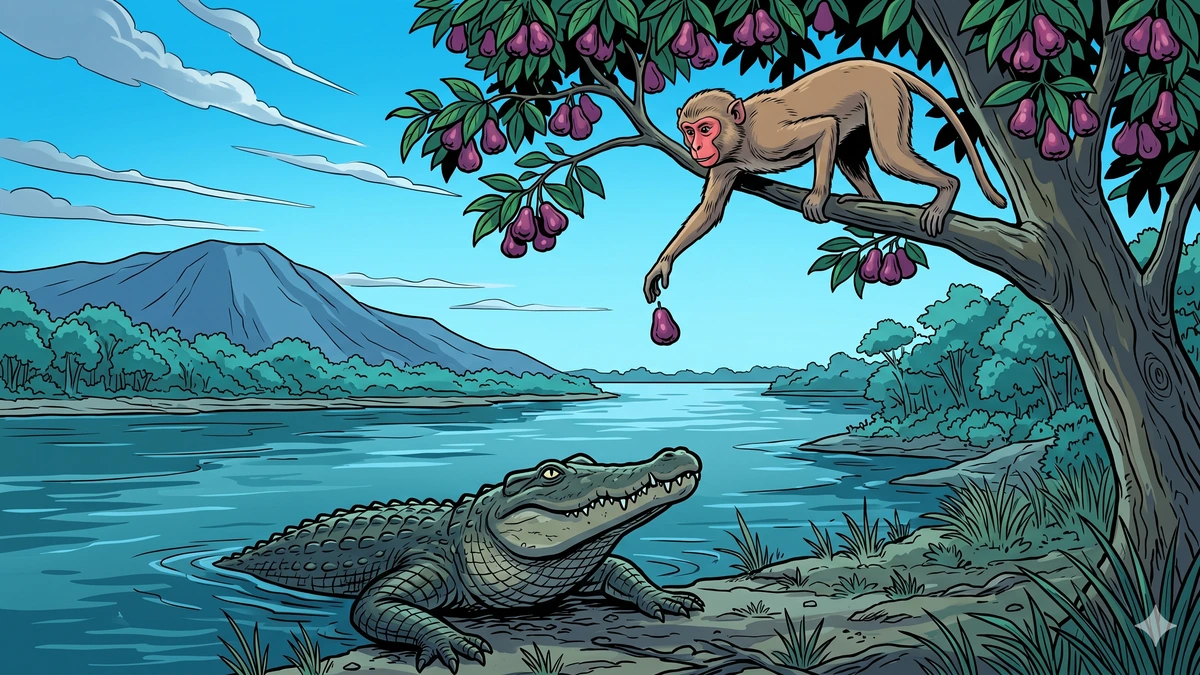
Karālamukha thrashed in the water for a long while. Then he sank, defeated. He did not surface that day, or the next, and the monkey never saw him again. Sometimes, in the long warm afternoons that followed, Raktamukha would look at the river beneath his tree and remember the conversations they had shared — the small philosophies, the talk of the seasons — and he would wonder if any of it had been true; if there had been, somewhere in his old friend, a real affection that had been overruled by a wife and a hunger; or whether it had all been calculation from the beginning. He never knew. The river kept its silences as rivers always do.
What the story is really about
The surface lesson is the one storytellers have spoken for two and a half thousand years: intelligence is a survival tool, and a friendship built on usefulness rather than affection cannot withstand pressure. Quick thinking — the Sanskrit buddhi (बुद्धि), the practical, on-its-feet kind of intelligence the Panchatantra most prizes — is what saves the monkey, and Vishnu Sharma’s verdict is unsentimental: a creature who survives by trickery in this situation is not a liar, he is a wise man. This is, in fact, one of the rare Panchatantra tales that explicitly endorses deception in self-defence. Vishnu Sharma is gentle with the monkey here in a way he is not gentle elsewhere; the lie is not a moral failing but an act of self-preservation.
The deeper Panchatantra reading is harder, and it is the reading that has kept the tale alive across so many cultures. The monkey is not killed by an enemy. The monkey is nearly killed by a friend — a friend who has been pressured by his wife. The crocodile’s wife is, in the canonical Sanskrit, never given a name, never directly seen by the monkey, never present in any scene the monkey witnesses. She is the most powerful character in the story, and she is invisible. The Panchatantra is noticing, two thousand years ahead of its time, that we are most often hurt by people who are themselves under pressure from people we have never met. A friend who cannot say no to a third party is no longer your friend, no matter how warm his words. The story does not call the crocodile evil. It calls him henpecked, slow, and weak — categories that cover a great many of the people who, across our lives, end up wounding us. And the lesson of the jambū tree is not do not have friends; it is know whose voices your friends carry inside their heads.
How the story travelled
From its twin Indian roots — Pali Suṃsumāra-Jātaka 208 and the Sanskrit Panchatantra Book IV — this tale moved out of India in the 6th century CE through the Persian physician Borzūya, who translated the Panchatantra into Pahlavi for the court of Khosrow I. From Pahlavi it passed in the 8th century into Arabic, in Ibn al-Muqaffaʿ’s Kalīla wa Dimna, where the crocodile underwent a fascinating transformation: in the Arabic version he became a tortoise, because crocodiles were unfamiliar to the Arab reading public and the tortoise was a more recognisable river creature. From Arabic the tale moved into Persian as the Anvār-i Suhaylī, into Hebrew in the work of Rabbi Joel, into Latin as the Directorium Humanae Vitae of John of Capua, into Spanish, Italian, and German, and from there into the European exempla tradition.
It travelled east, too. In Korean folklore it became the tale of the rabbit and the dragon-king’s daughter (the dragon-king’s daughter is dying and demands a rabbit’s liver; the rabbit, lured beneath the sea, escapes by claiming his liver is hung in a tree on the shore). In Swahili tradition it is the monkey and the shark. In Japanese tradition a related motif appears in the saru kani gassen stories. There is a Native American Coyote variant. The motif index gives this entire family the name ATU 91, “The Monkey/Cat Who Left His Heart at Home” — and it is one of the most widely distributed motifs in human folklore, surfacing in over forty distinct cultures.
The persistent claim, repeated in many older Western anthologies, that this story passed through Aesop on its way west is incorrect. The motif is not in the Perry Index; the path west was Borzūya → Kalīla wa Dimna → Anvār-i Suhaylī → Latin, and the European tradition received it directly from the Arabic, not from the Greek.
For thoughtful readers — a small reflection
The most moving thing about this story is its unwillingness to call the crocodile a villain. He is described as old, slow, and tired; he is not bloodthirsty; he was, by every indication, a real friend in the early part of the tale. He is broken not by his own malice but by his loyalty to the wrong loyalty. This is, in a way, the most honest piece of moral observation in the entire Panchatantra: the people who hurt you most are not, usually, the people who hate you. They are the people who have someone else’s voice ringing louder in their heads than yours. The monkey’s lesson, if you read the story carefully, is not that the world is full of monsters — it is that the world is full of friends with priorities, and that an honest friend will tell you what those priorities are before you climb on his back to cross the river.
Frequently Asked Questions about The Clever Monkey and the Crocodile
- Where in the Pañcatantra does The Clever Monkey and the Crocodile appear, and what is the original Sanskrit title?
- The story is the frame-tale of the fourth book of the Pañcatantra, Labdhapranāśa — usually translated ‘The Loss of What Has Been Gained’ — and the monkey-and-crocodile narrative itself is normally cited as Vānara-Nakra-Kathā (‘Tale of the Monkey and the Crocodile’). The oldest surviving Sanskrit recension is the Tantrākhyāyikā of Kashmir, reconstructed by the American Sanskritist Franklin Edgerton in The Panchatantra Reconstructed (American Oriental Society, Volume 2, New Haven, 1924), where this tale opens Book IV with the title nakra-vānara-kathā. The most accessible modern English translation directly from a Sanskrit critical edition is Patrick Olivelle’s Pañcatantra: The Book of India’s Folk Wisdom (Oxford World’s Classics, 1997, reissued 2009), pages 152–169, in which the tale is presented as IV.0 with the inset stories IV.1–IV.13. Arthur W. Ryder’s older verse-and-prose rendering, The Panchatantra (University of Chicago Press, 1925), places it on pages 320–342, also as the opening frame of Book IV. The crocodile is called Karālamukha (‘Hideous-Mouthed’) and the monkey Raktamukha (‘Red-Faced’); the jambu tree under which they meet is Syzygium cumini, the Indian rose-apple.
- Does The Clever Monkey and the Crocodile appear in the Pali Jātakas as well, and how does the Buddhist version differ?
- Yes — the same plot is preserved twice over in the Pali canonical Jātaka collection of the Khuddaka Nikāya, edited by V. Fausbøll (London, 1877–1897) and translated under E. B. Cowell as The Jātaka, or Stories of the Buddha’s Former Births (Cambridge University Press, 1895–1907). The first parallel is the Suṁsumāra Jātaka (No. 208, Cowell Volume II, pages 110–112), in which the antagonist is a crocodile (suṁsumāra) and the bodhisatta is born as a monkey-king (vānara-rāja) who tricks the crocodile by pretending his heart hangs in a fig tree on the shore. The second and structurally closer parallel is the Vānara Jātaka (No. 342, Cowell Volume III, pages 88–89), with the same trick. In both Pali versions the antagonist’s wife is the instigator — she has a craving (dohaḷa) for monkey-heart while pregnant — exactly as in the Pañcatantra. The substantive difference is theological rather than narrative: in the Buddhist versions the monkey is identified as a previous birth of the Buddha himself, and the closing gāthā (‘Whoso, my friend, like thee can wisely choose / In every place he wins where others lose’) is spoken by the Bodhisatta. Folklorist Heinrich Lüders argued in Buddhistische Märchen aus dem alten Indien (Düsseldorf, 1921) that the Pali and Sanskrit versions go back to a common pre-Mauryan oral source older than either text.
- What is the Aarne–Thompson–Uther classification, and which world tales is this story related to?
- The tale is the type-specimen of ATU 91 ‘Monkey (Cat) who left his heart at home’ in Hans-Jörg Uther’s revised The Types of International Folktales: A Classification and Bibliography (Folklore Fellows Communications 284–286, Helsinki, 2004), Volume 1, pages 75–76, with principal motifs K544 (‘Escape by pretending heart is at home’), K1715.4 (‘Weak fish frightens strong by reference to absent friend’), J1391.3 (‘Heart left at home’) and Q433.2 (‘False friend punished’). Uther lists attestations from forty-two oral traditions across South Asia, Tibet, Mongolia, China, Korea, Japan, Madagascar, East Africa, and the African-American Gullah tradition of the Sea Islands. The closest African cognate is the Swahili tale ‘Sungura na Papa’ (‘The Hare and the Shark’) collected by Edward Steere in Swahili Tales as Told by Natives of Zanzibar (London, 1870), in which the protagonist is a hare and the antagonist a shark. The closest Japanese cognate is the Mukashi-banashi ‘Sarukani Gassen no Mae’ (‘Before the Monkey-Crab Battle’), and in classical Japan the tale of the jellyfish and the monkey (kurage no o-tsukai) in Aston’s translation of the Nihon Shoki. The closest North American cognate is the Gullah ‘Bruh Rabbit and Bruh Alligator’ recorded by Charles Colcock Jones in Negro Myths from the Georgia Coast (Houghton Mifflin, Boston, 1888).
- Why does the Pañcatantra place this tale at the head of Book IV, and what does Labdhapranāśa mean in context?
- Labdhapranāśa (labdha ‘what has been obtained’ + pranāśa ‘destruction, loss’) is the technical Sanskrit term for the fourth of the five tantras (treatises) that make up the Pañcatantra, and it is conventionally translated ‘The Loss of What Has Been Gained’ or ‘Loss of Gains’. The Pañcatantra is a nīti-śāstra — a manual of practical statecraft — composed, according to its prologue, by the Brahmin Viṣṇuśarman for the three idle sons of King Amaraśakti of Mahilāropya. Each of the five books illustrates one principle of rāja-nīti (royal policy): Book I, the breaking of friendships; Book II, the winning of friends; Book III, war and peace; Book IV, the loss of what has been gained; Book V, hasty action. The monkey-and-crocodile story heads Book IV because it perfectly dramatises labdhapranāśa: the crocodile has gained an extraordinary friendship — daily rose-apples, daily wisdom, the trust of a creature outside his own element — and he loses it, irrevocably, in a single mid-river sentence. The traditional commentary attributed to Pūrṇabhadra (1199 CE) glosses the moment thus: yo labdham parityajati sa mūḍhaḥ, ‘he who throws away what he has obtained is a fool.’ The Olivelle translation gives the verse-summary as: ‘Friends, money, kingdoms — once gained, once lost, never come back the same.’ The whole architecture of Book IV is therefore a meditation on irreversibility, and the monkey’s last words to the crocodile — that he will not climb on his back a second time — are the structural keystone of the entire fourth tantra.
- What is the moral of The Clever Monkey and the Crocodile, and how does it compare to the morals of other Pañcatantra animal frame-tales?
- The closing Sanskrit śloka, given in Edgerton’s reconstructed text (1924, Volume 2, page 396), reads: utpannāpadām asti yeṣām buddhiḥ pravartate / te tarantī apadaṁ ghorāṁ vānaraś ca yathā nakraḥ, conventionally translated ‘Those whose intelligence keeps working even when danger has arrived — they cross the terrible peril, as the monkey did the crocodile.’ Olivelle (1997) renders the same verse as ‘When trouble comes, the man whose mind / Keeps moving, gets across; / The fool who freezes is the kind / Who pays with total loss.’ The moral is therefore double-edged: it is partly about the crocodile (do not throw away a friend on someone else’s hunger) and partly about the monkey (when the river is below you and the bank is far, do not stop thinking). Compared to the other four frame-tale morals — Book I’s ‘flatterers separate friends’, Book II’s ‘true friends are the only real wealth’, Book III’s ‘never make peace with one who has wronged you’, Book V’s ‘never act in haste’ — Book IV’s moral is the only one of the five that praises a single mental quality (buddhi, presence of mind) rather than a relationship or a policy. A. K. Ramanujan, in his introduction to Folktales from India (Pantheon, New York, 1991), observed that the Vānara-Nakra-Kathā is the moment in the Pañcatantra where the text stops teaching young princes how to manage their courtiers and starts teaching them how to manage their own minds — and that, he wrote, is why the story has survived for two thousand years in every Indian language and crossed three oceans.
Frequently Asked Questions
What is the moral of The Monkey and the Crocodile?
Which Panchatantra book contains The Monkey and the Crocodile?
How did the monkey escape the crocodile?
What are the names of the monkey and crocodile in the Panchatantra story?
Is The Monkey and the Crocodile a good story for kids?
You May Also Like
 Indian Folk Tales
Ages 3-5
Indian Folk Tales
Ages 3-5
Chandralekha And The Eight Robbers
Chandralekha And The Eight Robbers: There was an ancient city named Kaivalyam, in the Pânḍiya country, and in that city there lived a dancing girl named
 Indian Folk Tales
All Ages
Indian Folk Tales
All Ages
The Ass in the Lion’s Skin
The Ass In The Lions Skin: In a dense forest near a small Indian village, there lived a washerman named Dhobi who owned a tired old donkey. The poor donkey had
 Indian Folk Tales
All Ages
Indian Folk Tales
All Ages
The Royal Thief-Catcher
The Royal Thief-Catcher: In a bustling town in ancient India, A king appointed a clever man to catch thieves, but the methods were unconventional. This tale