The Four Brahmins and the Lion
The Four Brahmins and the Lion: In the city of Vikramapura, not far from the banks of the Godavari River, there lived four Brahmin scholars who had been

The Four Brahmins and the Lion
Sanskrit: चत्वारो ब्राह्मणाः सिंहश्च |
Source: Hitopadesha (Nārāyaṇa Paṇḍita, c. 1200 CE), drawing on Pancatantra tradition |
ATU Type: 1681B (The Fools who Revive a Dead Animal and Are Killed by It) |
Motifs: J21.5, J10, W195 |
Oral Tradition: pan-Indian didactic storytelling, from court to village
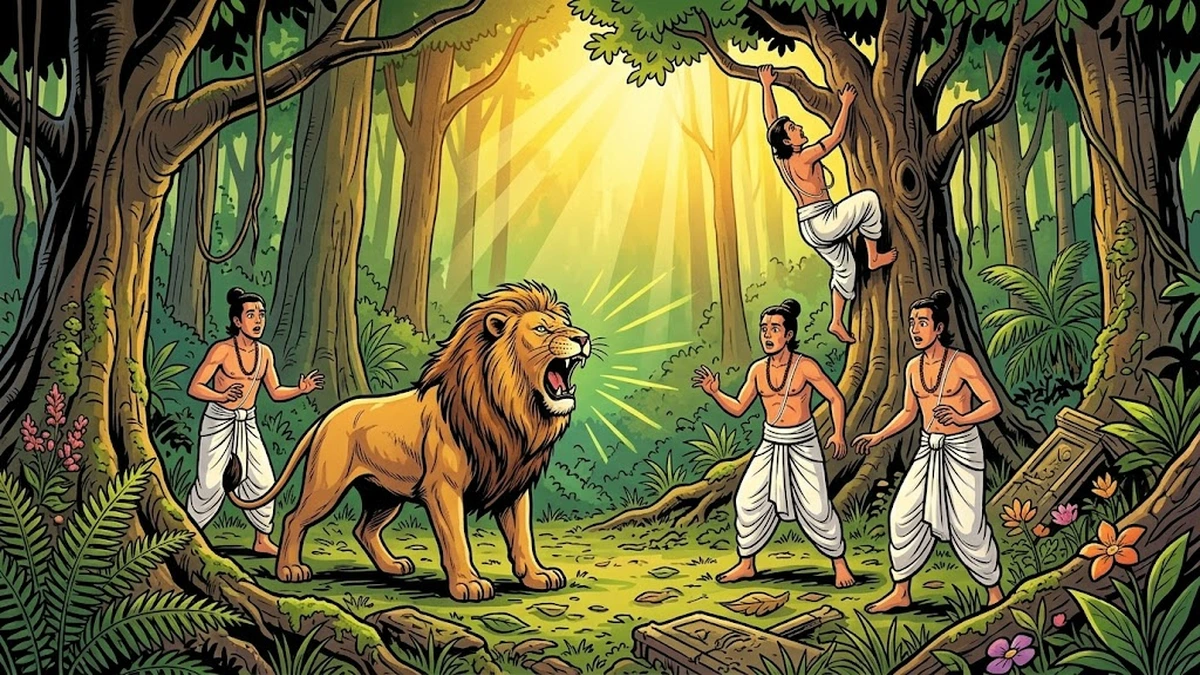
The fable of the Four Brahmins and the Lion stands as one of the most precisely targeted parables in the Sanskrit didactic tradition: a surgical argument, delivered through narrative, that book-learning detached from practical wisdom is not merely useless but actively dangerous. Its home is the Hitopadesha — the “Beneficial Advice” compiled by the poet Nārāyaṇa Paṇḍita for a young prince of Dhavalacandra’s court around 1200 CE — though its roots reach deeper into the Pancatantra, the great anthology assembled by the brahmin Viṣṇuśarman perhaps fifteen centuries earlier. That the story appears in both traditions, and is attested in Tamil, Kannada, and Malayalam retellings from the 8th century onward, tells us something important: the lesson it teaches is one that every generation of literate Indian society has felt the need to relearn.
The Sanskrit word the tradition uses for the man who escapes is prajñā — insight, practical intelligence, the wisdom that comes from watching the world rather than reading about it. The three who die are described as vidvāṃsaḥ (learned men) but also, pointedly, as men lacking laukika jñāna (knowledge of worldly affairs). The fable is not anti-intellectual. It is precisely calibrated: it argues not against learning but against learning that has been severed from humility and observation.
I. Four Friends and a Fatal Debate
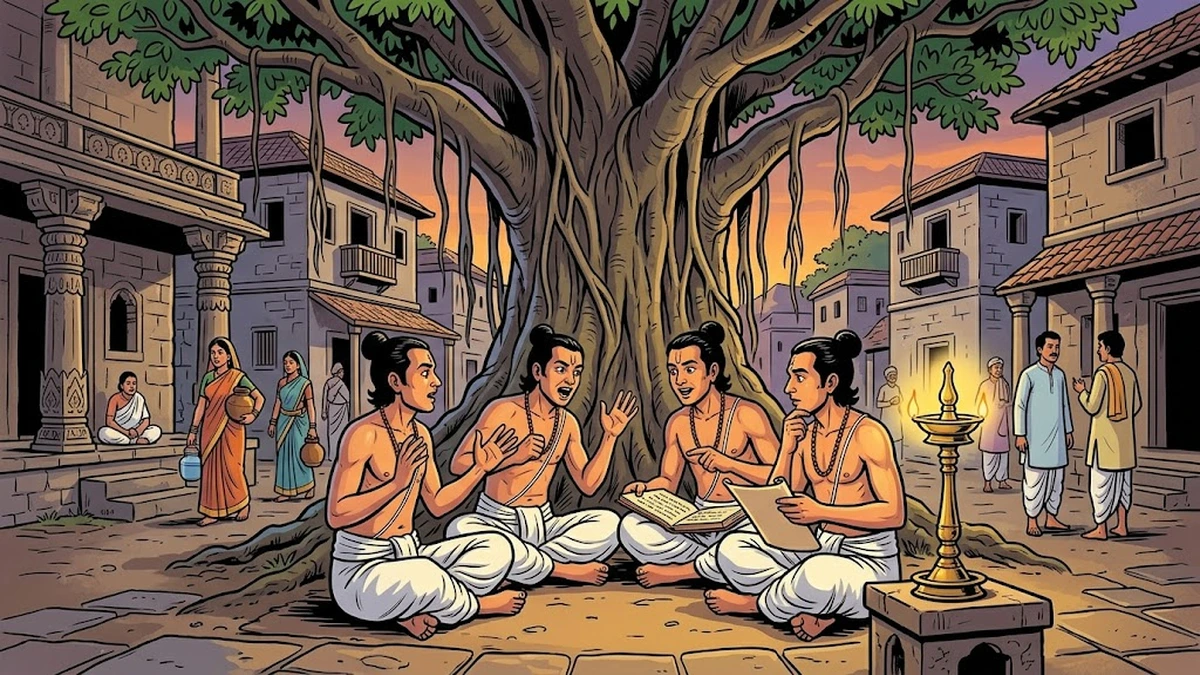
In the prosperous town of Vikramapura on the Godavari’s banks, four Brahmin scholars grew up as close as brothers. Sampad mastered the Vedas and the six darśanas; he could debate theology from sunrise to midnight and never lose the thread. Kartik was trained in the practical sciences — śilpaśāstra and engineering — and could construct any mechanism described in the ancient texts. Vivek had developed the rarer gift of synthesis: he could take disparate forms of knowledge and weave them into coherent wholes. Only Bholanath, the fourth, had studied lightly. He had spent his youth not in the Gurukula but watching river boatmen, market traders, and forest-dwelling tribals, absorbing the wordless curriculum of lived experience. His companions teased him about this. Bholanath accepted the teasing with equanimity. He had his own reasons for valuing what he knew.
The crisis that set the story in motion was a disagreement about prestige. Word reached Vikramapura that the king of the neighboring state was lavishly rewarding scholars who demonstrated extraordinary learning. The three learned Brahmins decided they would travel to the royal court and exhibit their knowledge. They invited Bholanath, more out of old affection than expectation. Sampad, however, barely concealed his reluctance: “A man who knows no Sanskrit and has read no shastra will embarrass us before the king.” Kartik and Vivek wavered. Bholanath said nothing. He packed his bundle and joined the journey, walking a few paces behind the others.
II. The Bones in the Forest
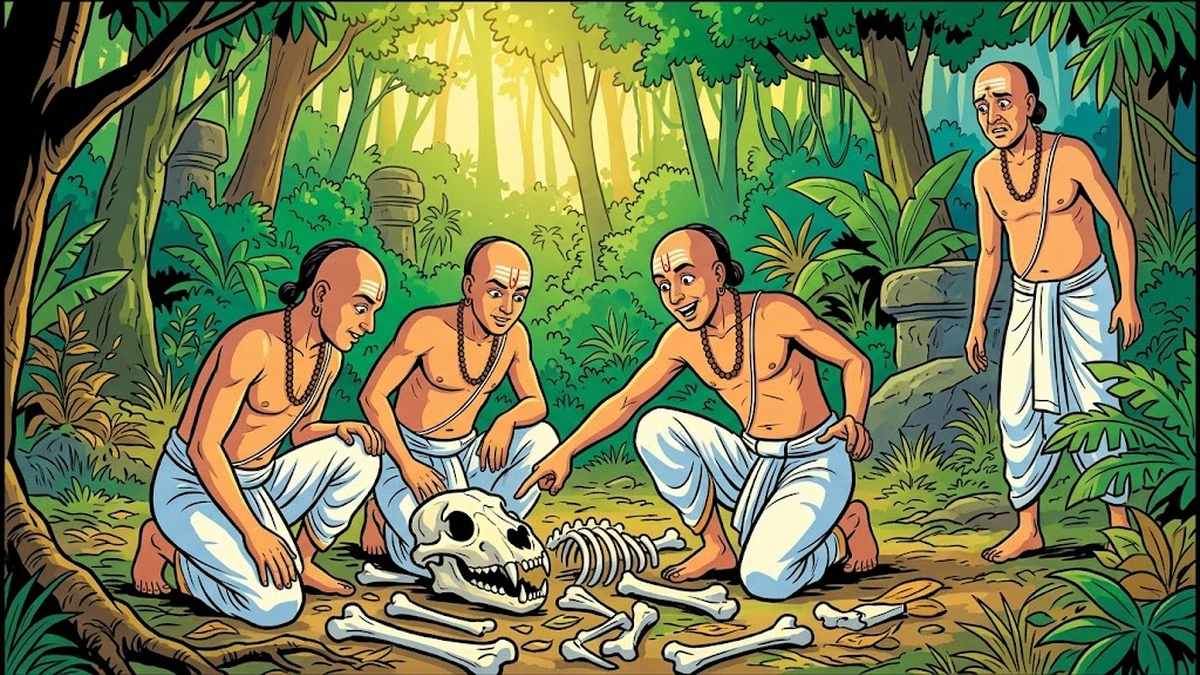
Three days into their journey, the road passed through a thick forest. The air smelled of wild jasmine and old rain. The travelers came upon the scattered bones of a large animal, white with age, lying in a clearing where grass had grown up around them. Sampad, who had studied the texts of prāṇavidyā (the science of vital breath), knelt to examine the skeleton. Kartik, who had studied the craft texts on animal anatomy, joined him. Vivek studied both, synthesizing their observations. Within minutes, all three were animatedly comparing notes.
“These are the bones of a lion,” said Sampad. “The shape of the skull is unmistakable. Look at the jaw — classic siṃha architecture.” Kartik agreed and added, “And they are intact. Every bone is here. With the right knowledge, these bones could be assembled into a complete skeleton.” Vivek said, slowly, “And if the skeleton were complete, and the right mantras were applied in sequence…” He left the thought unfinished, but all three knew where it led.
The Hitopadesha and Pancatantra traditions contain a specific body of lore about mṛtasaṃjīvanī — the science of reviving the dead. Some texts describe it as a mantra; others as an elaborate ritual involving herbs, fire, and sacred breath. The three learned Brahmins had each, in their different ways, studied this lore. Now, alone in a forest clearing with a complete lion skeleton, they faced the most irresistible of academic temptations: the chance to prove in practice what they knew in theory.
Bholanath watched from the edge of the clearing. He said, very quietly, “Friends, that is a lion skeleton. If you revive it, it will eat you.” Sampad turned and looked at him with the patient condescension of a scholar addressing someone who has just said something too obvious to be worth analyzing. “Bholanath,” he said, “everything in creation has the right to live. Are we to be afraid of our own learning?”
“यस्य नास्ति स्वयं प्रज्ञा शास्त्रं तस्य करोति किम्”
“What can scripture do for one who does not possess wisdom himself?” — Hitopadesha, Prastāvanā v.1 (traditional attribution)
III. The Revival and Its Consequence
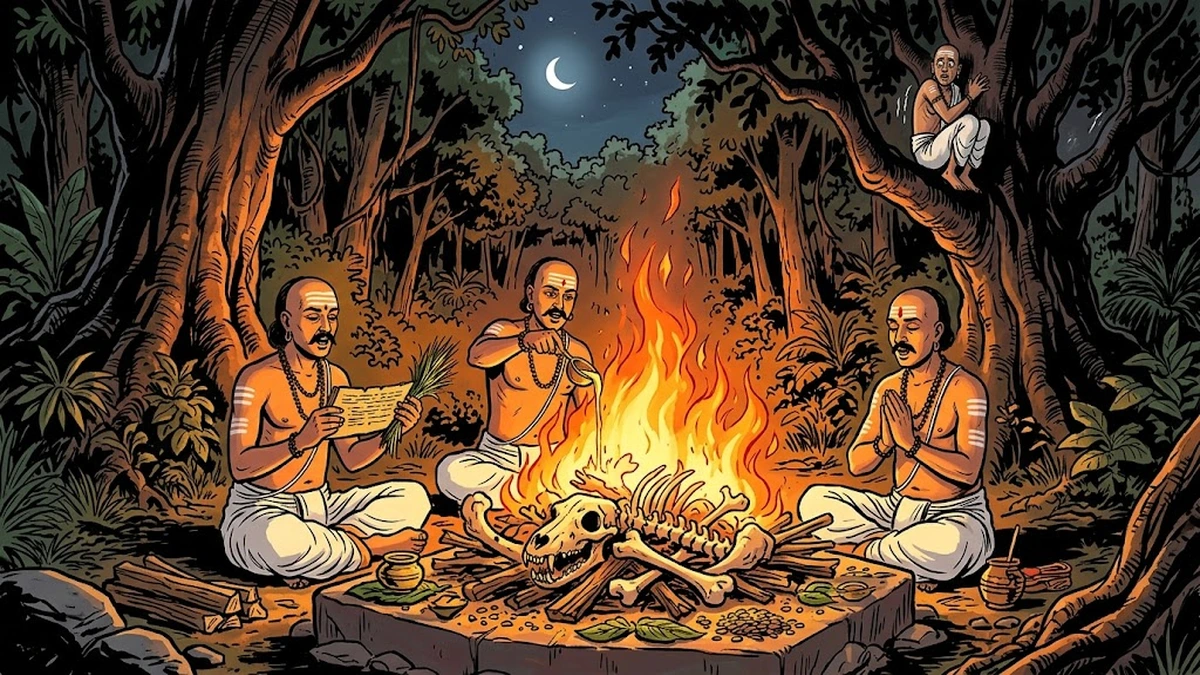
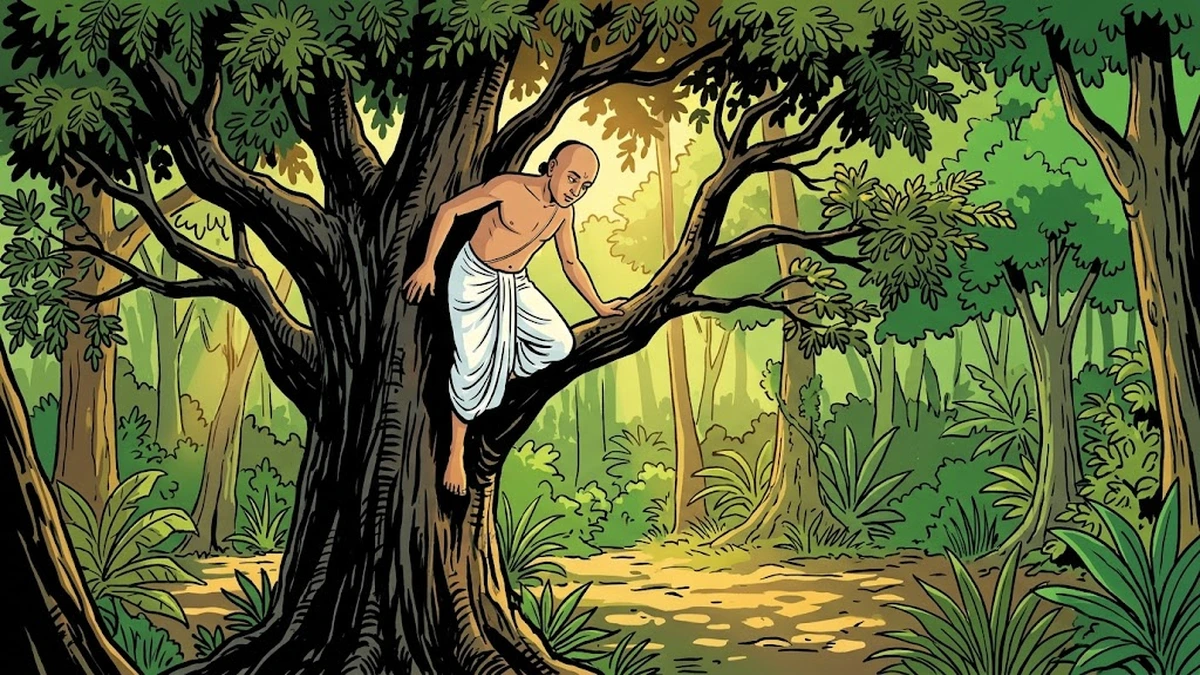
Bholanath thought for a moment. Then he said: “Very well. But allow me to climb this tree first.” The three scholars found this both amusing and mildly embarrassing, but they had no objection. Bholanath climbed the nearest large tree — a sturdy old tamarind — and settled in its fork, watching from above.
What followed is described in the Sanskrit texts with almost academic precision, as if the authors wished to make clear that the process itself was correct. Sampad assembled the bones into their proper order, reciting the identification mantras for each as he placed it. Kartik applied his knowledge of musculature and sinew, recreating the physical architecture of the body. Vivek, who had studied the synthesis of vital and material sciences, invoked the prāṇa-pratiṣṭhā rites that the tradition associates with the restoration of life. The ritual took perhaps half an hour. It was performed precisely and with genuine expertise.
The lion opened its eyes. It lay still for a moment, as if gathering its senses. Then it rose to its feet, and the movement was unmistakable — not the tentative rise of an animal newly confused, but the immediate, confident posture of a predator in its natural state. It looked at the three scholars standing before it in the open clearing. It killed all three with the rapid efficiency of a creature operating exactly as its nature required.
Then it looked up at the tamarind tree, saw Bholanath motionless in the branches, and after a moment padded away into the deep forest. The Hitopadesha’s narrator notes that the lion showed no malice; it was simply doing what lions do. The malice — if the word applies — was in the decision to revive it.
IV. What the Tree Preserved
Bholanath came down from the tree when the sound of the lion’s movement had faded completely. The Hitopadesha, typically, does not linger on his grief. It moves quickly to the lesson, as if emotional processing were a private matter between the reader and the text. What it does record is Bholanath’s walk home — alone, and considerably wiser about the gap between knowledge and judgment than he had been when he set out.
The structural point of the story, as generations of Sanskrit commentators have observed, is not that the three scholars were stupid or evil. They were genuinely learned, technically proficient, and acting from a recognizable academic impulse — the desire to demonstrate that what one knows actually works. Their catastrophic error was not in the execution of the revival but in the refusal to perform a simple cost-benefit analysis. Bholanath’s question — “if you revive it, it will eat you” — was not a sophisticated philosophical argument. It was what the tradition calls vyāvahārika satya: practical truth, the truth that operates at the level of daily survival.
The Sanskrit didactic tradition places enormous weight on this concept. The Arthaśāstra of Kauṭilya opens with the observation that all sciences (vidyā) ultimately serve ānvīkṣikī — critical inquiry, the capacity to examine situations directly. Without that capacity, all other learning is a sword in the hands of a child. The Hitopadesha makes the same point through story rather than treatise, and the story form — because it activates the imagination and creates empathy before it delivers the argument — may be the more effective vehicle.
Moral
“विद्या विवादाय धनं मदाय शक्तिः परेषां परिपीडनाय। खलस्य साधोर्विपरीतमेतत् ज्ञानाय दानाय च रक्षणाय।।”
“Learning is for argument, wealth for arrogance, power for oppressing others — that is the way of the wicked. The good man uses the same things for knowledge, for giving, and for protection.” — Subhāṣitāvalī, traditional. The four Brahmins represent the first list; Bholanath embodies the second. Learning without the humility to observe the actual world is not knowledge at all — it is a more elaborate form of ignorance.
Why This Story Has Lasted 2,000 Years
The story’s durability rests on its universality. Every society produces specialists whose deep expertise in one domain blinds them to obvious considerations from another domain. The Hitopadesha’s lion-reviving scholars are a 12th-century Indian version of a failure pattern that appears in organizational psychology, in the history of technology disasters, and in the daily decisions of individuals who have spent so long studying a problem that they have forgotten what a non-specialist would immediately notice.
Comparative folklorists note that ATU 1681B appears in parallel forms across Eurasia — in Armenian folktales, in Turkish didactic literature, and in European fables about scholars who release dangerous spirits from bottles through technically-correct ritual while ignoring the obvious danger. The variant detail changes (a lion, a bear, a demon, a plague), but the structure is invariant: three or four experts, one practical outsider, a fatal demonstration of the limits of expertise.
The fact that the Pancatantra was translated into Pahlavi (Middle Persian) in the 6th century, then into Arabic as Kalīla wa-Dimna in the 8th century, then into Hebrew, Latin, Spanish, and eventually 50+ languages by the 14th century, means that this specific story and its variants percolated through medieval Eurasian intellectual culture for over a millennium. When La Fontaine composed his fables in 17th-century France, he was drawing on a tradition that ultimately derived, in significant part, from the same Sanskrit source-pool that produced this tale.
What makes the Indian version particularly durable is its tonal precision. Bholanath is not smarter than his companions. He simply knows something they don’t: that the question “can this be done?” must always be preceded by the question “what happens if it is?” That two-step sequence — possibility before desirability — is the foundational move of practical wisdom in every culture, and the story’s gift is that it renders it unforgettable.
You May Also Like
 Indian Folk Tales
Ages 3-5
Indian Folk Tales
Ages 3-5
The Lambikin 2
The Lambikin 2: Once upon a time there was a wee wee Lambikin, who frolicked about on his little tottery legs, and enjoyed himself amazingly. Now one day he
 Indian Folk Tales
Ages 3-5
Indian Folk Tales
Ages 3-5
Good Will Grow Out Of Good
Good Will Grow Out Of Good: In a certain town there reigned a king named Patnîpriya, to whose court, a poor old Brâhmiṇ, named Pâpabhîru, came every morning
 Indian Folk Tales
Ages 6-8
Indian Folk Tales
Ages 6-8
Birbal’s Khichdi: The Emperor’s Lesson in Logic
Birbal's Khichdi: The Emperor's Lesson in Logic: The Wager of the Freezing Night In the imperial court of Emperor Akbar, the greatest Mughal ruler of India