The Golden Deer of the Forest
The Golden Deer of the Forest: In the ancient kingdom of Ayodhya, there ruled a king named Devendra, whose palace stood white and gleaming against the backdrop

SCHOLARLY ATTRIBUTION
| Sanskrit Title | Suvarṇa-Mṛga Kathā (सुवर्ण-मृग कथा) — “The Story of the Golden Deer” |
| Oral Tradition | Pan-Indian; documented variants in Rajasthan, Uttar Pradesh, and Punjab (19th-c. collector notes) |
| Literary Parallels | Vālmīki Rāmāyaṇa, Araṇyakāṇḍa 37–45 (Mārīca assumes golden-deer form); Jātaka No. 482 (Ruru Jātaka) — Bodhisattva as compassionate golden deer |
| ATU Classification | ATU 550 (“Search for the Golden Bird”) / Motif B100.1 (Treasure animal) + H1233 (Quest assigned by extraordinary creature) |
| Category | Indian Folk Tale — Royal Hunt / Enchanted-Animal / Sage Encounter cycle |
Beat I — The Hunting King and the Restless Forest
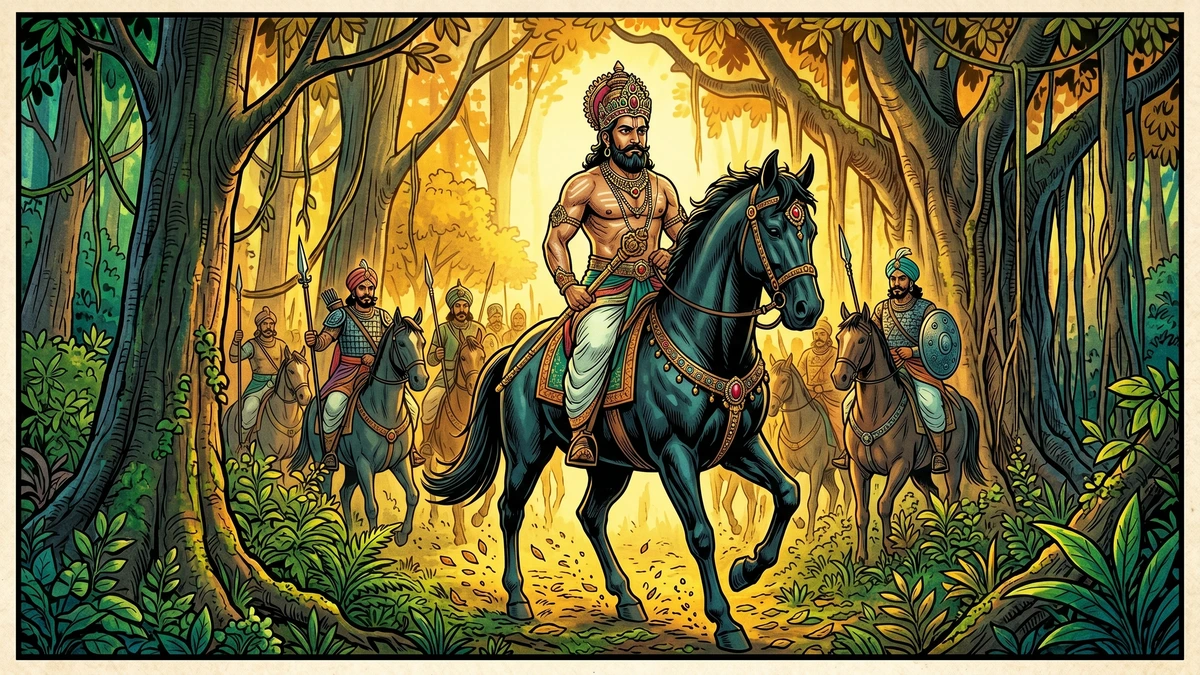
In the ancient kingdom of Ayodhyā, there ruled a king named Devendra whose palace gleamed white against the Vindhya ranges. He was celebrated throughout the Gangetic plain for his archery — no deer had ever outrun his arrow, no boar escaped his lance — yet within his polished halls he felt an unnameable hollowness that festivals and conquest alike could not fill. Every autumn, when the monsoon retreated and the sāl forests turned amber-golden, Devendra rode out with his retinue of a hundred horsemen, his dhoti of silk knotted at the waist and his quiver slung across a bare shoulder oiled with sandalwood paste, determined to bring back a trophy worthy of the season.
On the morning that would change everything, the forest spoke first. Devendra’s black stallion, Ashok, shied at nothing visible; the mahout’s elephant refused to advance past a certain neem grove; even the hunting hounds circled back, whimpering. “My lord,” urged Vikram, the king’s most trusted minister, his white uttarīya (shawl) drawn tight against the pre-dawn chill, “the forest elders say this tract belongs to rishis. Let us turn east.” Devendra laughed and spurred Ashok forward. A king who heeded every omen would never rule; a king who heeded none would never learn — but Devendra did not yet know which type he was.
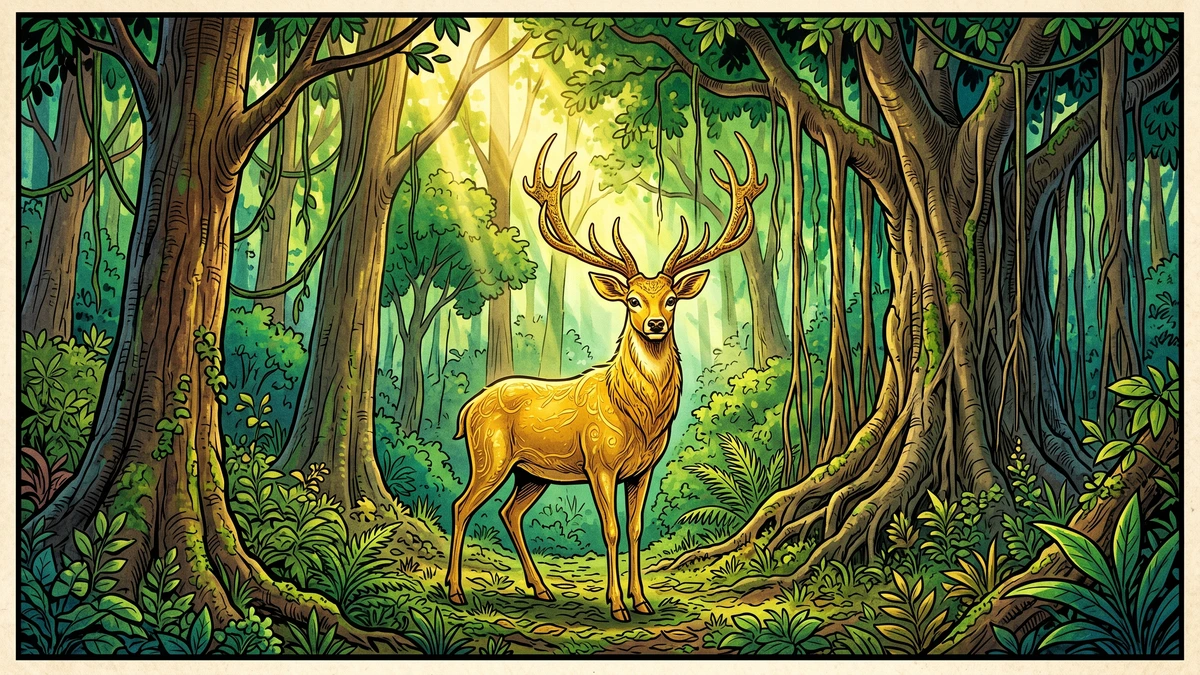
The sāl canopy closed overhead like cathedral vaulting, dappled sunlight painting shifting mandalas on the leaf-litter floor. Then, between two enormous banyan trunks, the deer emerged. Its coat did not merely catch light — it was light, each hair a filament of hammered gold, antlers branching like the sacred fig tree, eyes the colour of still tank-water reflecting the sky. In its gaze lived the composed intelligence that the Upaniṣads ascribe to the ātman itself. The entire hunting party fell silent, breath suspended, arrows half-nocked and forgotten.
Beat II — The Chase That Unmakes the Chaser
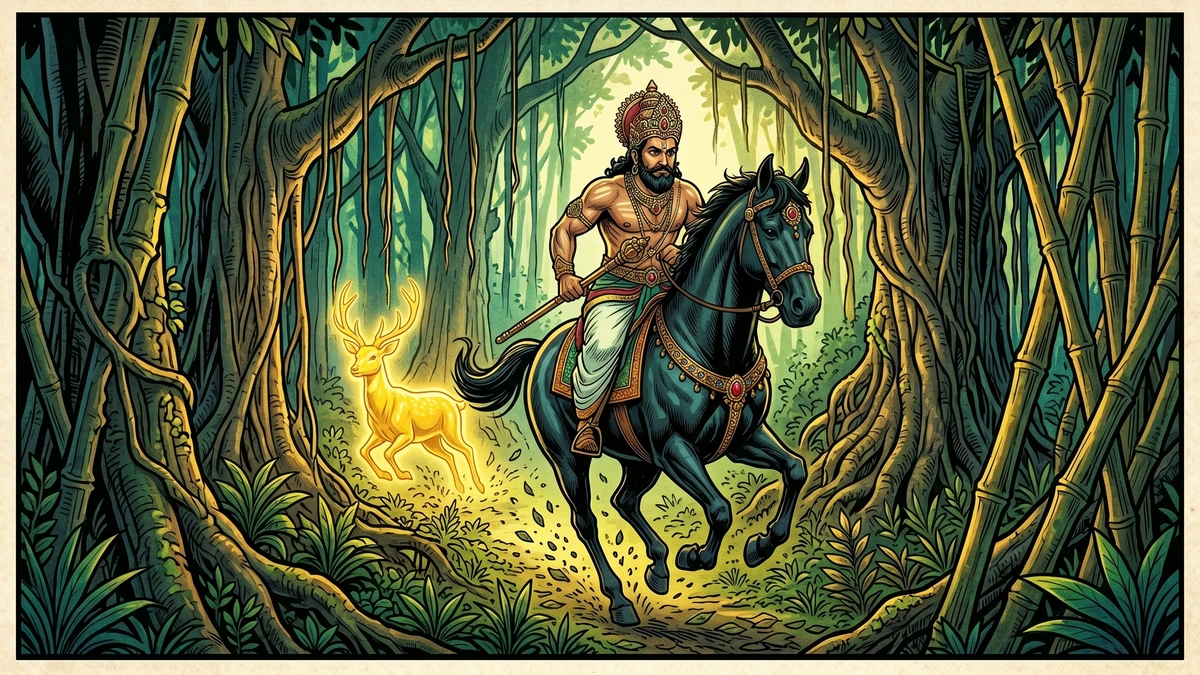
Devendra’s pride made the decision before his mind did: such a creature must be his. He drove Ashok at full gallop, and the golden deer moved — not in panicked flight but in unhurried, deliberate leading, always a bowshot ahead. This was no ordinary quarry. Sāl gave way to teak, teak to bamboo groves whose hollow stems sang in the wind like the drone of bīn pipes. Clear hill-streams crossed the path, their pebbles polished turquoise and ochre. The king leaped every obstacle, sending his hundred companions scattering in all directions until he rode alone through terrain no Ayodhyā court map had ever charted.
By noon his quiver was untouched — every time he raised his bow, something stayed his hand: a quality in the deer’s backward glance that was neither fear nor cunning but rather a patient summons. By midafternoon Devendra realized with cold clarity that he was lost. The landmarks he knew — the twin black rocks at the forest’s eastern margin, the crow-haunted peepul he used as a waypoint — had vanished behind uncountable miles of ancient wood. Pride warred with unease; the hollow feeling in his chest deepened. Still he followed, because the alternative was admitting he had no idea where he was or what he truly wanted.
In the Jātaka tradition, the golden deer of compassion never flees in earnest; it leads the blundering seeker toward their own salvation by exhausting their aggression and their pride until something softer can surface. Whether Devendra knew this lore or not, he was living it — stripped of retinue, map, and certainty, reduced at last to a single human being in an immense and indifferent forest, following a creature he could not catch and could not stop following.
Beat III — The Clearing of the Sages
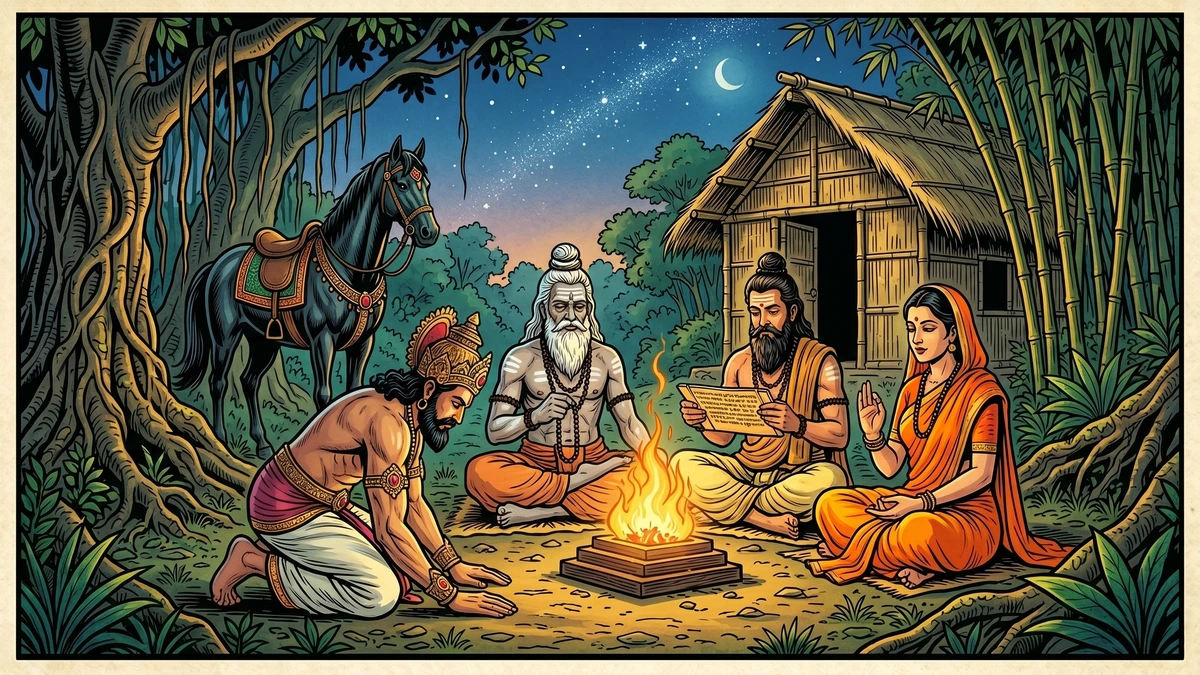
Dusk painted the sky in the colours of sindoor and turmeric when the trees opened onto a clearing. At its heart stood a kuṭī (forest hermitage) — four posts of bamboo, a roof of woven palm frond, walls of dried grass, the whole structure no larger than a bullock-cart but radiating a completeness that Devendra’s marble palace somehow lacked. Before it sat three figures: an old man with a white beard cascading to his waist, his body smeared with ash in the manner of Śaivite renouncers; a middle-aged man cross-legged over a palm-leaf manuscript; and a woman of serene bearing whose orange sari was the single brightest note in the grey-green clearing. Between them a small fire of pipal wood burned without smoke, filling the air with the faint camphor of sacred kindling.
The elder — who named himself Brahmadev, a student of the eternal truths — looked up without surprise. “Great king, we have been expecting you. Sit; eat.” There was lentil soup in a clay bowl, rice, wild honey on a banana leaf: the food of renouncers, utterly plain, utterly nourishing. Devendra wanted to demand explanations, to invoke his royal authority, but the atmosphere of the clearing held him as gently and irresistibly as the deer had. He sat. He ate. The fire murmured.
Through the long night, Brahmadev and his companions taught. They did not lecture in the didactic manner of court pandits but rather pointed — at the fire consuming its own fuel to give warmth, at the peepal whose roots dove deeper the taller it grew, at the river whose patience carved gorges through granite. They asked the king questions he had never been asked: What is it that you are hunting? When you have caught everything you have ever hunted, what remains unfilled? Devendra, who had crushed rebellions with iron, found he could not answer these questions without trembling.
Beat IV — Release, Return, and the Kingdom Transformed
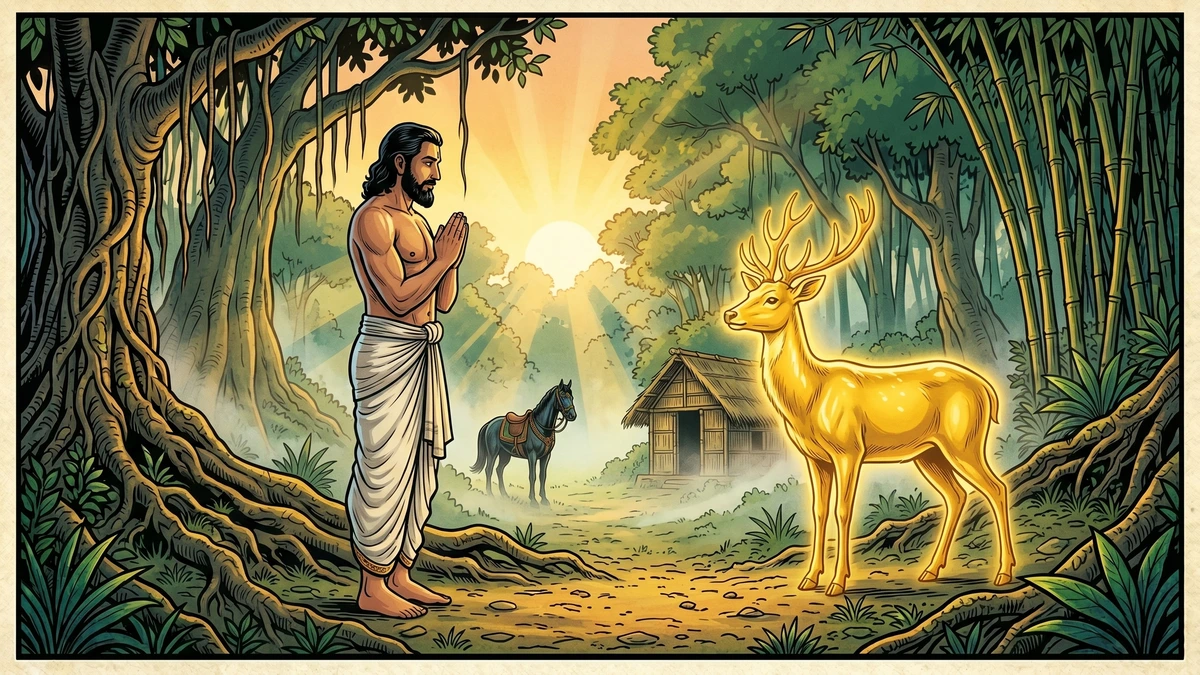
On the third dawn the golden deer reappeared at the clearing’s edge. Now Devendra saw it differently: not as quarry, not even as an animal, but as a mirror. Its extraordinary coat simply reflected back the extraordinary nature of the forest — and of himself — that his hunter’s eye had never learned to see. The deer stood for a long moment, its breath visible in the cool air, then turned and walked without haste into the shadows of the sāl. It did not look back. It did not need to.
Brahmadev placed both palms together in añjali mudrā: “You need repay nothing, Rājan. The forest repays itself. Go now, and rule from that quieter place inside you that you discovered here.” The king touched the elder’s feet in the ancient gesture of discipleship — a king bowing to a ash-smeared renouncer — and led Ashok back toward the sunrise.
When Devendra emerged from the forest, his hundred companions wept with relief. In the weeks that followed, Ayodhyā’s subjects noticed changes: the king listened longer before judging; he spent evenings in the palace garden rather than the armoury; he issued a proclamation protecting the Vindhya forest tracts from clearing and hunting. Years later, when greybearded storytellers were asked which of his acts they admired most, they named neither a battle won nor a treasury filled but that proclamation — the act of a man who had followed a golden deer into his own interior and returned changed enough to change the world around him.
“यत्र नार्यस्तु पूज्यन्ते रमन्ते तत्र देवताः।” (Yatra nāryastu pūjyante ramante tatra devatāḥ.)
— Manusmṛti 3.56: “Where beings worthy of reverence are honoured, there the divine takes pleasure.” Applied here to the deer: the moment Devendra stopped hunting what was sacred and began honouring it, divinity entered his kingdom.
The Moral
The golden deer cannot be caught. Every culture that has invented it — the Rāmāyaṇa‘s Mārīca, the Jātaka’s Ruru, the golden stag of European heraldic quest — encodes the same insight: the luminous thing you are chasing with all your skill and hunger is a projection of your own deepest longing, not an object external to yourself. The chase is necessary; exhausting yourself in it is necessary; arriving lost in an unfamiliar clearing is necessary — because only then are you ready to receive what was available all along. Pride must be run to ground before wisdom can be encountered. The deer is the grace that ensures the chase goes far enough.
Why This Story Has Lasted
The golden deer tale endures across three thousand years of Indian storytelling because it speaks to the permanent human condition of wanting: the gap between desire and satisfaction, between grasping and holding. In the Rāmāyaṇa the golden deer is a trap that destroys a marriage and precipitates an epic war — Sītā’s longing for its beauty sets the catastrophe in motion. In the Jātaka the golden deer is a Bodhisattva who rescues a drowning man and is then betrayed to a king by that same man — only to respond with compassion that converts the king. Both traditions are aware that the luminous animal can lead toward ruin or toward wisdom depending entirely on the quality of attention the pursuer brings to the chase.
In an age saturated with algorithmic golden deer — curated feeds, viral perfectly-lit lives, the next product that promises to complete us — the story’s lesson lands harder, not softer. The deer always leads away from the crowd and into the interior. The forest it inhabits is uncomfortable. The sages it delivers us to ask questions we have been avoiding. The story remains alive because we keep needing its instruction.
You May Also Like
 Indian Folk Tales
Ages 3-5
Indian Folk Tales
Ages 3-5
The Soothsayers Son
The Soothsayers Son: A soothsayer when on his deathbed wrote out the horoscope of his second son, whose name was Gangazara, and bequeathed it to him as his
 Indian Folk Tales
Ages 3-5
Indian Folk Tales
Ages 3-5
The Two Brothers Indian Folktale
The Two Brothers Indian Folktale: Once upon a time there lived a King who had two young sons; they were good boys, and sat in school learning all that kings’
 Indian Folk Tales
Ages 6-8
Indian Folk Tales
Ages 6-8
Vikram and the Vampire: The King’s Ultimate Test
Vikram and the Vampire: The King's Ultimate Test: The Night of Impossible Riddles In the ancient kingdom of Ujjain, there ruled a king named Vikramaditya