Punchkin
Punchkin: Once upon a time, there was a Raja who had seven beautiful daughters. They were all good girls; but the youngest, named Balna, was more clever than
Once upon a time, there was a Raja who had seven beautiful daughters. They were all good girls; but the youngest, named Balna, was more clever than the rest. The Raja’s wife died when they were quite little children, so these seven poor Princesses were left with no mother to take care of them.
The Raja’s daughters took it by turns to cook their father’s dinner every day, whilst he was absent deliberating with his Ministers on the affairs of the nation.
About this time the Prudhan died, leaving a widow and one daughter; and every day, every day, when the seven Princesses were preparing their father’s dinner, the Prudhan’s widow and daughter would come and beg for a little fire from the hearth. Then Balna used to say to her sisters, “Send that woman away; send her away. Let her get the fire at her own house. What does she want with ours? If we allow her to come here, we shall suffer for it some day.”
But the other sisters would answer, “Be quiet, Balna; why must you always be quarrelling with this poor woman? Let her take some fire if she likes.” Then the Prudhan’s widow used to go to the hearth and take a few sticks from it; and whilst no one was looking, she would quickly throw some mud into the midst of the dishes which were being prepared for the Raja’s dinner.
Now the Raja was very fond of his daughters. Ever since their mother’s death they had cooked his dinner with their own hands, in order to avoid the danger of his being pois oned by his enemies. So, when he found the mud mixed up with his dinner, he thought it must arise from their carelessness, as it did not seem likely that any one should have put mud there on purpose; but being very kind he did not like to reprove them for it, although this spoiling of the curry was repeated many successive days.
At last, one day, he determined to hide, and watch his daughters cooking, and see how it all happened; so he went into the next room, and watched them through a hole in the wall.
There he saw his seven daughters carefully washing the rice and preparing the curry, and as each dish was completed, they put it by the fire ready to be cooked. Next he noticed the Prudhan’s widow come to the door, and beg for a few sticks from the fire to cook her dinner with. Balna turned to her, angrily, and said, “Why don’t you keep fuel in your own house, and not come here every day and take ours? Sisters, don’t give this woman any more wood; let her buy it for herself.”
Then the eldest sister answered, “Balna, let the poor woman take the wood and the fire; she does us no harm.” But Balna replied, “If you let her come here so often, maybe she will do us some harm, and make us sorry for it, some day.”
The Raja then saw the Prudhan’s widow go to the place where all his dinner was nicely prepared, and, as she took the wood, she threw a little mud into each of the dishes.
At this he was very angry, and sent to have the woman seized and brought before him. But when the widow came, she told him that she had played this trick because she wanted to gain an audience with him; and she spoke so cleverly, and pleased him so well with her cunning words, that instead of punishing her, the Raja married her, and made her his Ranee, and she and her daughter came to live in the palace.
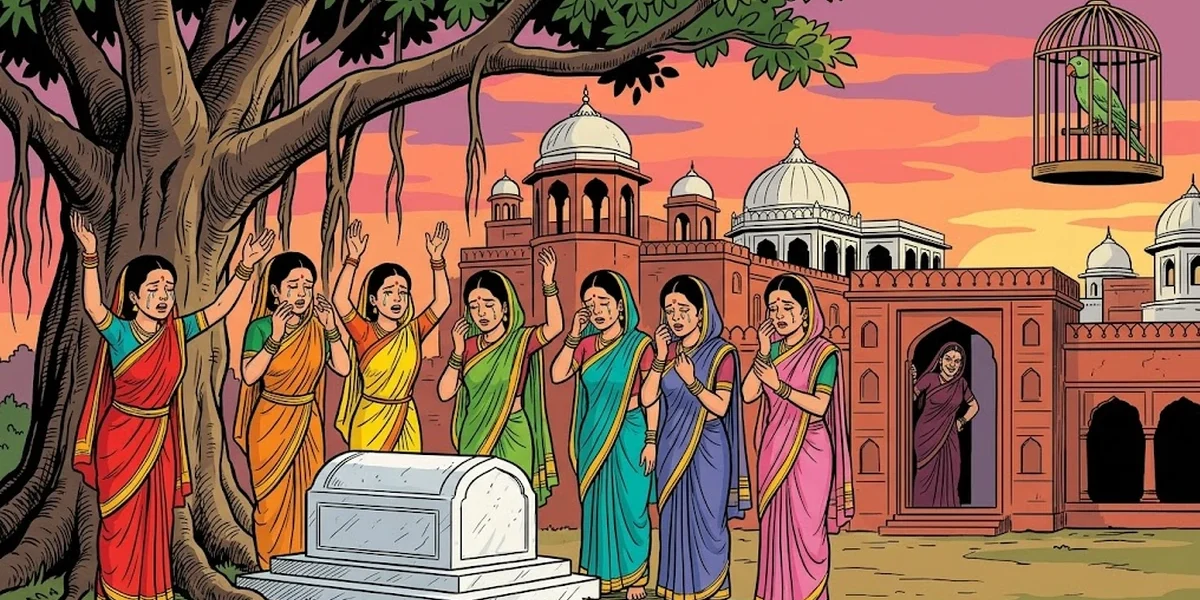
Now the new Ranee hated the seven poor Princesses, and wanted to get them, if possible, out of the way, in order that her daughter might have all their riches, and live in the palace as Princess in their place; and instead of being grateful to them for their kindness to her, she did all she could to make them miserable. She gave them nothing but bread to eat, and very little of that, and very little water to drink; so these seven poor little Princesses, who had been accustomed to have everything comfortable about them, and good food and good clothes all their lives long, were very miserable and unhappy; and they used to go out every day and sit by their dead mother’s tomb and cry – and say:
“Oh mother, mother, cannot you see your poor children, how unhappy we are, and how we are starved by our cruel step-mother?”
Moral
Punchkin demonstrated that genuine love prioritizes another’s freedom over possession. The father’s sacrifice and trust taught his daughters that love liberates rather than enslaves.
Historical & Cultural Context
India’s regional folk tale tradition is a vast oral inheritance carried by grandmothers, wandering bards and village storytellers, preserving moral wisdom, social commentary and cultural memory long before any of it was written down.
Punchkin, collected in the Kathasaritsagara tradition, exemplifies the parent-child bond celebrated throughout Hindu dharma-literature. The gourd-guardian motif recalls magical-object narratives in Jataka tales and Sanskrit court literature, where objects embody duty and care. The seven-daughters trope echoes the Ramayana’s themes of family loyalty and the Panchatantra’s emphasis on dharma within kinship. The Raja’s trust in his daughters’ judgment invokes Hindu concepts of vatsalya (parental love) and putra-sneha (filial affection). The sacrifice-for-freedom theme aligns with Vedic philosophy and appears throughout Tenali Rama tales and Krishnadevaraya’s moral narratives. Regional epics – from Tamil Silappatikaram to Rajasthani Khyal performances – celebrate such selfless parenthood.
Reflection & Discussion
- Why did the father let his daughters leave if he loved them?
- What does true love mean in the story?
- How does trust strengthen family bonds?
Did You Know?
- India has one of the richest oral storytelling traditions in the world, with tales dating back thousands of years.
- Many Indian folk tales were passed down through generations before being written down.
- Indian folk tales often blend real-life wisdom with magical elements to teach moral lessons.
What This Tale Teaches Us Today
Old stories keep their power because their lessons never stop being useful. Here is how this one still applies:
- Shared stories are one of the strongest bonds within any community – families, cultures, or whole nations.
- Stories that have survived for centuries have done so because their lessons still work.
- Reading folk tales aloud to children builds vocabulary, imagination, and a sense of cultural inheritance.
Why This Story Still Matters
Punchkin joins a vast global library of folk tales that human beings have been telling one another for thousands of years. Every culture has produced its own stories, but the deepest themes – courage, kindness, cleverness, loyalty, the cost of greed – appear again and again in different clothes. Modern readers who spend time with folk tales inherit something precious: a sense that people have always wrestled with the same basic questions, and that good stories can still help us find good answers. That is why these tales persist. Each one is a small tool for living, handed down quietly through generations.
Cultural Context and Continuing Influence
Folk tales like this one survived for hundreds of years through oral storytelling before any scholar thought to write them down. Grandparents told them to grandchildren, travelers traded them along roads and rivers, and mothers repeated them to babies who would one day repeat them to their own children. Each small retelling sharpened the story, discarded unnecessary parts, and polished the essential lesson. That long process of refinement is why a good folk tale feels so weighty – it has been shaped by thousands of listeners across generations, each contributing something small to the story we read today.
Modern readers sometimes wonder whether folk tales are still relevant in an age of apps and smartphones. The answer is yes, perhaps more than ever. The technology changes, but the underlying questions – about kindness, courage, loyalty, greed, family, fear, love – do not. These are the same questions that children asked around a fire in ancient India, around a hearth in medieval Ireland, around a campfire in 19th-century Korea. And they are the same questions children ask their parents today, just phrased differently. That is why a family that reads folk tales together is doing real cultural and emotional work, not simply entertaining itself.
Reading Folk Tales With Children
Reading folk tales aloud to children is one of the oldest and most effective forms of moral education. Unlike a lecture or a rule, a story slides past a child’s natural resistance and plants its lesson in the imagination, where it quietly grows. Years later, when the child meets a real situation that resembles the story – a bully at school, a dishonest coworker, a moment of temptation – the old tale rises to the surface of memory and offers guidance. That is why parents and teachers across every culture have trusted stories to do the work of raising good humans, long before formal schools or textbooks existed.
When reading this story with a young listener, try pausing at key moments and asking what the child thinks will happen next. Let them guess, even if they are wrong. That small act of prediction turns a passive listener into an active thinker. After the story ends, a simple open question – “What would you have done?” or “Who do you think was the smartest character?” – invites the child to connect the tale to their own life. Those conversations are where real learning happens, not during the reading itself but in the quiet moments that follow.
Older children and teenagers sometimes think they have outgrown folk tales. In reality, the best tales only deepen with age. A ten-year-old hears the surface plot; a fifteen-year-old notices the irony; a twenty-year-old sees the economic and political pressures on the characters; a forty-year-old understands the parents in the story for the first time. A good folk tale is a gift that keeps unfolding for decades. Families who read and reread the same stories across the years discover this naturally, and pass the discovery down.