The Demon With The Matted Hair
The Demon With The Matted Hair: A Story of Cunning and Greed Long ago in ancient India, there lived a fearsome demon whose hair was matted and wild...
The Demon with the Matted Hair is one of the oldest and most internationally consequential tales in the entire South-Asian Buddhist canon. Its earliest recoverable form is the Pañcāvudha-Jātaka (Jātaka No. 55, Ekanipāta of the Jātaka-a&t.&t.&hacek;akathā), preserved in the Pali commentarial collection traditionally attributed to Buddhaghosa’s school in fifth-century Sri Lanka, with much earlier oral antecedents. The Sanskrit-Pali story tells of a young Bodhisatta-prince named Pañcāvudha-kumāra (“Five-Weapons Prince”) who, returning home through a great forest from his teacher at Takkasilā, encounters an ogre named Silesaloma (“sticky-hair”, from Pali silesa, “glue”, and loma, “hair”) — a demon whose entire body, but most especially his vast matted mane, is covered in a substance like resin. The Bodhisatta’s five weapons — bow and arrow, sword, spear, club, and dagger — one by one strike the demon and stick fast. His own two hands, then his two feet, then his head, also stick. With his entire body bound to the demon, the prince still does not panic; instead, he tells Silesaloma that within him is a sixth, invisible weapon — a vajira, a thunderbolt — that will tear the demon apart from inside if he is eaten. The demon, in dread, lets him go. The Bodhisatta then teaches the demon the Five Precepts, and the ogre becomes a virtuous protector-spirit of that forest road. The demon’s name in some Sinhala recensions is Pi&t.hιla or Silesa-loma yakkha; the prince in the Sanskrit Bodhisattvāvadāna-kalpalatā is called Pañcabhīta.
The English-language reading of the tale that has reached the largest readership in the last century is the version retold by Ellen C. Babbitt for American children in Jātaka Tales (New York: Century Company, 1912, pp. 41–47), under exactly the title used here, “The Demon with the Matted Hair”, with line drawings by Ellsworth Young. Babbitt drew her text directly from The Jātaka, or Stories of the Buddha’s Former Births, edited by E. B. Cowell and translated by Robert Chalmers (Cambridge University Press, 1895, vol. I pp. 134–136), itself based on the Pali text in V. Fausbōll’s critical edition (London: Trūbner, 1877, vol. I pp. 272–275). The story had also been retold by Joseph Jacobs in Indian Fairy Tales (London: David Nutt, 1892, story No. XXII “The Demon with the Matted Hair”, pp. 161–165, with notes pp. 250–253), where Jacobs first made the comparative-folklore observation that has since defined the tale’s scholarly afterlife: that the Pañcāvudha-Jātaka is the demonstrable Indian source of the famous American “Tar-Baby” story, popularised in the United States by Joel Chandler Harris in Uncle Remus: His Songs and His Sayings (New York: D. Appleton, 1880, pp. 25–28). The connection was confirmed and elaborated in detail by Aurelio M. Espinosa in his definitive paper “Notes on the Origin and History of the Tar-Baby Story” (Journal of American Folklore 43, 1930, pp. 129–209) and is accepted today as one of the clearest known transmission lines in world folklore. Catalogued in the Aarne-Thompson-Uther index as ATU 175 “The Tarbaby and the Rabbit” (Hans-Jörg Uther, The Types of International Folktales, FFC 284–286, Helsinki 2004, vol. I pp. 124–125), the tale is among the most widely diffused of all human stories, with versions catalogued in over one hundred and fifty national traditions, all of them — on Espinosa’s reading, supported by Stith Thompson’s The Folktale (New York: Holt, 1946, pp. 226–231) — descended in a single migratory line from the Pañcāvudha-Jātaka of pre-Buddhist northern India.
The Stith Thompson motifs activated in the tale are K741 “Capture by tar-baby”, K581.2 “Brer Rabbit’s briar-patch trick” (in some recensions), D1273.1 “Magic stick”, F420.5.2.3 “Water-spirit’s house”, G500 “Ogre”, J1118.1 “Wisdom of the small captive”, K1716 “Weak-overcomes-strong by deception”, and Q325 “Wickedness corrected by counsel”. In the Pali Jātaka tradition the tale belongs to a small but significant group of birth-stories that close not with the death of the antagonist but with his religious conversion — companion-pieces include the famous A&t.&t.hána-Jātaka No. 425 (the conversion of the man-eating Yakkha by the Bodhisatta) and the Mahisa-Jātaka No. 278. The deeper background is the same long South-Asian tradition Wendy Doniger has called the “dharma of the converted ogre” (The Hindus: An Alternative History, New York: Penguin, 2009, pp. 184–187), whose Indian roots are visible in the Rāmāyana’s submission of Vibhī&s.ana, the Mahābhārata’s conversion of the Yaksha at the lake (Vana-parvan 297), and the still earlier Atharvaveda spell-traditions in which malevolent spirits (rāk&s.asas, piśācas, yak&s.as) are not destroyed but bound by speech and reabsorbed into the moral order of the village. The story’s peculiar gentleness is one of its most ancient and characteristic features.

Beat 1 — The Young Prince Who Studied with a Hundred Teachers
The Bodhisatta was born, according to the Pali frame, as the son of King Brahmadatta of Benares, in the kingdom whose royal seat at Kāśι lies at the heart of so many Jātakas. At sixteen he travelled to Takkasilā, the great university-city in the north-west whose ruins lie today in the Punjab near Rawalpindi, and there studied for some years under a world-famous teacher (disapā-mokkha, the “world-renowned brahmin teacher of all four corners”) the eighteen branches of learning — the four vedas, the six vedangās, archery, swordsmanship, dialectic, astronomy, and the rest. At the conclusion of his apprenticeship the teacher gave him five weapons of war (the pañca-āyudha, hence the prince’s name) — bow and quiver of arrows, two-handed sword, javelin or spear, mace, and dagger — and dismissed him with the customary blessing of the guru to return to his father’s capital and rule justly when his time came. The road from Takkasilā to Benares passed through a great forest known to be haunted by an ogre, and the people of the last village before the forest begged the young man to wait until the next caravan, or to take an armed escort, or to turn south by the long road. The Bodhisatta refused all three.
The opening of the Jātaka is, for all its brevity, a remarkably precise sociological miniature of pre-Buddhist northern Indian elite education. Takkasilā was an actual place, and a real centre of learning visited by Pa&n.dits and princes from as far away as Magadha, Avanti, Gandhāra, and the Indo-Greek courts of the north-west; the eighteen branches of learning are listed in the same order in the Milinda-pañha (c. second century BCE) and in the much later Vinaya commentaries; the institution of the parting gift of weapons from teacher to royal pupil is preserved in the Manusm&r.ti X.78 and in the Greek accounts of Megasthenes (c. 300 BCE) describing Indian princely education. The young Pañcāvudha is, in other words, not a folk hero of the imagination but a precisely period-typical figure: a Ksatriya prince of high education, drilled in arms and in dialectic, returning to his patrimony armed against the empirical dangers of the road. The forest he is about to enter is the same forest of tapasvins and ogres, sages and dangers, that ringed every northern Indian river-valley before the Iron Age clearings of the Mauryan period. The story is set, in other words, at the precise historical moment when the forest was ceasing to be the rule and the village was beginning to be the rule. The Bodhisatta, walking confidently into the trees, walks at the meeting-point of two worlds.

Beat 2 — The Ogre Whose Hair Was Like Glue
The forest is described in the Pali in formulaic language — tall sāl trees, intertwined creepers, the cries of unseen birds, the absence of any sign of human path — and at the centre of it lives the demon Silesaloma. The name itself is a wonderful piece of folkloric onomatopoeia: silesa, the Pali word for the resin or pitch with which fowlers in northern India trapped birds and which (the Cowell-Chalmers note observes) was traditionally manufactured from the sap of the Calotropis gigantea shrub by boiling and skimming; loma, the ordinary word for body-hair. The demon, in other words, is named for his sticky-haired-ness exactly as a fowler’s decoy is named for its function. Some Sanskrit recensions in the Bodhisattvāvadāna-kalpalatā of K&s.emendra (eleventh century) call him simply Lepa-keshin — “the smear-haired one” — and the Sinhala Jātaka-pota of the fourteenth century preserves the lovely descriptive epithet kele-saa-loma yakshā, “the ogre with hair like the glue of the salmon-tree”.
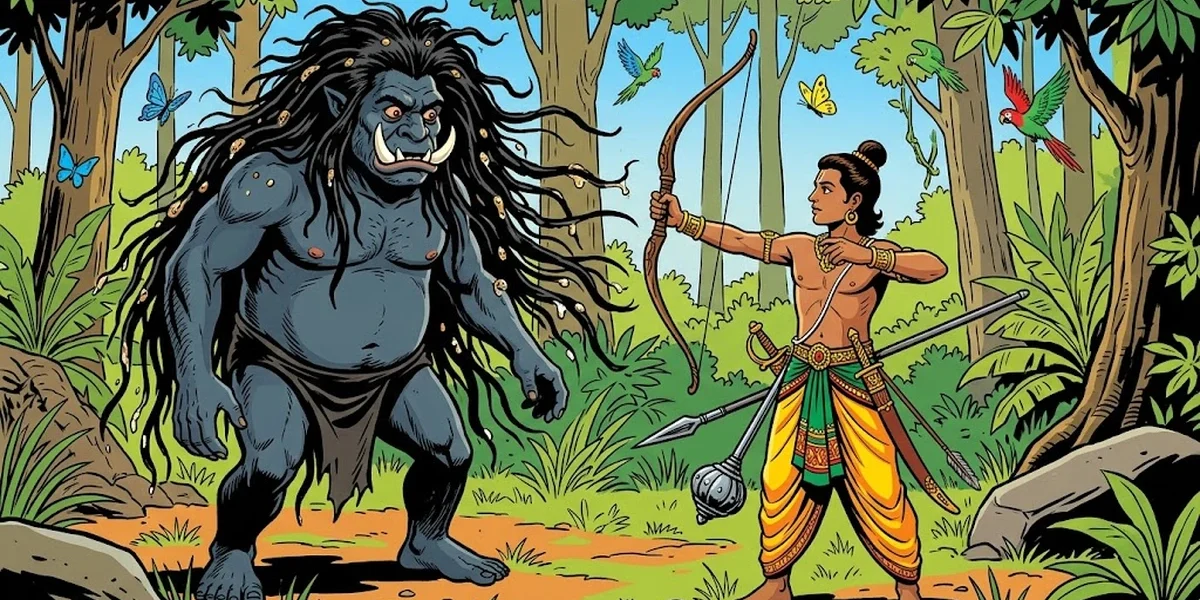
The ogre’s appearance, in the Cowell-Chalmers translation, is famously vivid: he is “tall as a young palmyra-tree”, with two tusks like ploughshares, eyes like bowls of red copper, a mouth in which a man could lie at full length, a belly “as broad as a temple drum”, and a long mane of matted hair “like the dripping of treacle in monsoon, that caught and held the limb of any creature that touched it”. The Bodhisatta sees him standing across the path. The ogre roars. The Bodhisatta, in the Jātaka, does not run. Instead he calls back, in the precise self-introduction characteristic of Ksatriya warrior etiquette: “I am Pañcāvudha-kumāra of Benares, son of King Brahmadatta. I have come into your forest with my full purpose to slay you. Make ready, ogre.” What follows is the structural heart of the Jātaka and one of the most copied set-pieces in world folklore: the Bodhisatta unstrings his bow and shoots his fifty arrows one after another at the ogre, and every arrow strikes the matted hair and sticks fast. He draws his sword, and the sword strikes and sticks. He hurls his javelin, and the javelin strikes and sticks. He lifts his mace, and the mace strikes and sticks. He thrusts with his dagger, and the dagger strikes and sticks. He punches with his right hand, and the hand sticks. He punches with his left, and that hand also sticks. He kicks with his right foot, and the foot sticks. He kicks with his left, and that foot also sticks. He butts with his head, and the head also sticks. The Bodhisatta is now bound to Silesaloma at six points, with all five of his named weapons fastened beside him, and the whole composite trap of weapons-and-warrior dangles from the ogre’s shoulders like a curious ornament.

Beat 3 — The Sixth, Invisible Weapon
The pause that follows is, structurally, the great pivot of the tale. In every later derivative — the Tar-Baby of Joel Chandler Harris, the “wax doll” of Brazilian folktale, the “butter-baby” of Jamaican Anansi tradition — the captured trickster panics, weeps, or pleads. The Bodhisatta does none of these. He is silent for a moment; then he laughs. Silesaloma, in honest astonishment, asks why a man whose body and weapons are all bound and who is about to be eaten should laugh. The Bodhisatta replies, in language that the Jātaka has preserved with formulaic precision and that the Cowell-Chalmers translation gives in this beautiful line: “I do not fear you, ogre, because within me is a thunderbolt-weapon (vajira-āyudha) more powerful than the five with which I struck you. If you eat me, that thunderbolt will rend you to pieces inside, and we shall both perish together. I therefore have nothing to lose by my present situation.”
The ogre, the Jātaka tells us, “was much astonished”. He had killed and eaten innumerable travellers; he had heard fear, defiance, prayer, lament, threat, insult, bribery, and every variety of human appeal; he had not before heard a confident promise of mutual annihilation made by a young man dangling helpless from his beard. He looked at the Bodhisatta. The Bodhisatta looked back. Silesaloma considered the matter, and reasoned with the slow logic that the Jātakā ascribes to ogres: “If this prince has indeed got such a weapon within him, then he speaks the truth, and I shall die. If he has not, then he is the most fearless mortal I have yet encountered. Either way I shall not eat him today.” And so — in a deliberate counter-violation of the entire genre of trapping tales, in which the trapped victim ordinarily perishes — the ogre lifted his great hand and pulled the Bodhisatta loose from his hair, and set him down upon the path, and stepped back. The five weapons were unstuck and given back. The two looked at each other in the morning sun.
What the Jātaka means by the prince’s “thunderbolt within” has been a great commentarial question. In the literal reading of the early commentary the vajira is read as the prince’s magical inner weapon — a divine assurance bestowed by the gods on Bodhisattas at this point in their long career through previous births. In the much more famous reading developed in the Theravāda commentaries, however, the “thunderbolt within” is read figuratively as the Bodhisatta’s knowledge — his accumulated pāññā, his dhamma-grounded fearlessness, the particular bright clarity of mind that a long career of wisdom has carved into the Bodhisatta’s person and that no ogre can ingest without being himself transformed. Read this way the Jātaka becomes a parable about the unique invulnerability of trained intelligence to physical predation: the body of the prince can be bound, but his understanding cannot, and any ogre who consumes a wise man finds a wise man inside himself afterwards. This is the reading developed at length by Buddhaghosa in the Visuddhimagga Book XII (c. 430 CE) and revived in modern scholarship by Bhikkhu Ñā&n.amoli (The Path of Purification, Colombo 1956, p. 348) and Steven Collins (Selfless Persons, Cambridge University Press 1982, pp. 154–156). The thunderbolt within is the trained mind. The ogre, sensing this, withdraws.

Beat 4 — The Demon Becomes a Forest-Spirit of the Five Precepts
The closing movement of the Jātaka is one of the gentlest in the entire collection. The Bodhisatta, having been released, does not draw a hidden weapon and slay the ogre, as the audience perhaps expects. He sits down on a fallen log on the forest path and offers, instead, to teach. He explains to Silesaloma the moral cost of his present way of life: that ogres who feed upon humans are reborn after long ages in the dreadful Avici-hell described in the Maha-niddesa; that the matted-hair body and sticky aura that make him so terrifying are themselves karmic fruit of unwholesome past actions; and that the wheel of his rebirths can be turned, by the steady cultivation of the Five Precepts, away from the predator-yakkha cycle and toward the cycle of the kindly forest-spirits who guard travellers, accept offerings of milk-rice at wayside shrines, and are themselves reborn in the lower deva-realms. Silesaloma listens, and at the end agrees. The Bodhisatta administers the Five Precepts — abstinence from killing, stealing, sexual misconduct, lying, and intoxicants — with the standard Pali formula pānātipātā veramani sikkhā-padam samādiyāmi, the ogre repeating each line. The transformation is immediate. Silesaloma becomes — in the Pali phrase — a dhammιko yakkha, a “dharma-keeping spirit”, and is established by the Bodhisatta as the protective devatā of that forest road, with a small wayside shrine where future travellers will leave him rice-balls and milk and where his offered hand will guard them rather than seize them.
The Bodhisatta then continues home to Benares, where his father makes him crown prince and, in due course, the king. The story closes with the standard Jātaka samodhāna, in which the Buddha — who is telling this story, in the frame, to the monks at Jetavana — identifies the past characters with their later selves: “The ogre of that time was Ā&l.avι — the ogre I converted at Ā&l.avι in this very life-time. The Bodhisatta of that time was I myself.” Ā&l.avι is the man-eating yakkha whose late-life conversion by the Buddha is recorded in the famous Ā&l.avaka-Sutta (Sutta-Nipāta I.10), in which the same teaching is given over the course of a single night and the same outcome — the conversion of the predator-spirit into a guardian — is achieved. The two stories, the Jātaka tells us, are the same drama played out across two lifetimes; the figure of the converted ogre is one of the great single recurrences of the entire Pιli canon, and constitutes the canonical Buddhist statement that no being, however terrible, is permanently beyond the reach of the Dharma.
Moral — “The Sixth Weapon Is the Thing You Cannot Take Off”
The closing wisdom of the Jātaka has been preserved across many recensions in slightly varying form, but the canonical Pali gāthā — the verse-summary that the Jātaka commentary appends — runs in Fausbōll’s edition (1877, vol. I p. 275) as follows:
“Yι pañcāvudha-bha&t.&t.hι-bhιto vιccι-vajira-balι samupιgato,
na so āyudha-rahito hoti, ñιn.avι eva tassa ιyudham.”
“He who has lost his five outward weapons but holds the thunderbolt of speech-and-knowledge within, he is not a man without weapons; his knowledge itself is his sword.”
— Pañcāvudha-Jātaka, closing gāthā, in V. Fausbōll, ed., The Jātaka, vol. I, London: Trūbner, 1877, p. 275
The verse compresses the entire moral structure of the Jātaka into a single Pali couplet. The five outward weapons are removable; matter can always be taken from a man. The sixth weapon — the trained mind, the “thunderbolt of speech-and-knowledge” — cannot be removed without destroying the man himself, and is therefore the only weapon that any wise prince ever truly possesses. The deeper Buddhist point is that all the apparatus of warfare and of worldly accomplishment, all the wealth and force and station that a young man inherits, are upādisesa: detachable. What he has cultivated in his own mind is not. The ogre, who can strip him of bow and sword and spear and mace and dagger by the simple expedient of letting them stick, cannot strip him of the cool inward awareness that allows him to laugh, to speak, and to choose his own response. That awareness, the Jātaka argues, is the only equipment a Bodhisatta carries that is properly his own. Everything else is borrowed. Everything else can be taken.
This is also why the tale ends with the conversion of the ogre and not his death. The Bodhisatta’s sixth weapon is, finally, not a power to wound but a power to teach: the same trained mind that allowed him to face the ogre without flinching is what allows him to see, on the far side of his fear, that Silesaloma is himself a sufferer — a being trapped in his own predatory karma, weighed down by the very stickiness of his own hair. The thunderbolt within turns out to be compassion. It is the whole programme of the Jātaka collection that the Bodhisatta’s past lives demonstrate, life by life, the slow ripening of this single insight: that the highest weapon a moral being can carry into the world is the knowledge that even his enemies are sufferers in need of release.
Why This Story Has Lasted
The endurance of The Demon with the Matted Hair — from its first oral form in pre-Mauryan northern India to Ellen Babbitt’s American kindergartens of 1912 — is one of the great natural experiments in folkloric transmission and is the result of three superimposed strengths. The first is the simple structural beauty of the “sticking” sequence, which is one of the most kinaesthetically vivid set-pieces in world folklore: arrow, sword, spear, mace, dagger, right hand, left hand, right foot, left foot, head — ten progressive bindings — produce in any listener of any age the unmistakable rising tension of a child’s game (touch the tar, you stick; touch with the next thing to free yourself, that sticks too) and resolve into the moment of perfect immobilisation that the entire downstream tradition would recognise as the climactic gesture of every Tar-Baby tale. Joel Chandler Harris, who certainly never read the Pali, reproduced the same ten-stage sequence in his Brer Rabbit version of 1880 with the difference of a single substitution: the prince becomes a rabbit and the ogre becomes an inert wax-and-tar effigy. The structural skeleton is unaltered. Aurelio Espinosa traced the same sequence through Spanish, Portuguese, Cape Verdean, West African, Caribbean, Brazilian, Bahamian, Cherokee, and Navajo versions and showed that the stickings ranged from seven (Cherokee) to twelve (Cape Verdean) but always preserved the canonical order: weapons first, then limbs, then head.
The second strength is the moral inversion at the centre. Tar-Baby tales of the African and Caribbean lineage tend to end with the trickster escaping by a second deception (the famous “Don’t throw me in the briar-patch” line in Harris) — that is, by replacing one trick with a better one. The Pañcāvudha-Jātaka does the precise opposite: the Bodhisatta escapes not by deception but by absolute moral truth, and the ogre is changed not by being out-tricked but by being out-loved. The Buddhist version, in other words, is the only version of the entire ATU 175 family in which the trickster does not remain a trickster — in which the protagonist demonstrates that the highest possible response to entrapment is not cleverness but compassion. This inversion is so striking that scholars have argued it represents the “original” Buddhist twist on a much older Indo-European trapping-tale, and that the Tar-Baby cycle as Africans and Americans came to know it represents a partial de-conversion — a reversion of the Jātaka’s ethical pivot back to the older trickster-shape that lies beneath it. Stith Thompson argued this view explicitly in The Folktale (1946, p. 230). A. K. Ramanujan (Folktales from India, New York: Pantheon, 1991, pp. xxv–xxvii of the introduction) read the same point as a special case of his more general argument that “Indian tales argue with their world tradition by ending differently from what the world tradition expects”.
The third strength is documentary. The Jātaka collection of the Pali canon survived in continuous monastic recitation in Sri Lanka, Burma, Thailand, Laos, and Cambodia for over two thousand years, and the story has accumulated a remarkable iconographic afterlife: it appears as a stone bas-relief on the great northern torana of Sāñcā Stūpa I (first century BCE); on the Bharhut railing fragment now in the Indian Museum at Calcutta inscribed in Brιhmι Pañcavudha-Jātaka (mid-second century BCE, the earliest dated representation of any Jātaka in stone); on Gandhιran schist panels of the Ku&s.ιna period in Peshawar and Taxila; on the cave-temple murals of Aja&n.&t.ι Cave XVII (Vaιkιtιka period, c. 475 CE); on the ninth-century Borobudur reliefs in central Java; on the lacquer-and-mother-of-pearl panels of nineteenth-century Burmese parabaik manuscripts in the British Library; and, finally, in the Amar Chitra Katha studio’s Jataka Tales: Demons and Monsters (Bombay: India Book House, 1973, vol. 53, retold by Margie Sastry, illustrated by Pratap Mulick), where it is the lead story and the cover-image is the precise composition Babbitt’s readers would recognise: a long-haired ogre and a small calm prince standing in a forest clearing. The tale’s refusal to die is in part the refusal of the institutions that carry it — the Pali commentarial tradition, the stone-carving guilds, the ACK comic-book studios — to let it lapse.
Reading The Demon with the Matted Hair with Children
Read aloud, the Jātaka rewards a slow, ceremonious voice and a willingness to act out the ten progressive stickings with the listener’s own body. The traditional Burmese kindergarten reading — preserved in the modern Yangon-edition Jιtakι-pota primer of 1956 — pauses at each sticking long enough for the listening child to call out “and that one stuck too!”, building the cumulative comic horror that the tale specifically rewards. After the Bodhisatta is fully bound, pause for as long as the listener can bear before delivering his quiet laugh; the dramatic effect is identical at four years old and at eighty. Ask, after the laugh: “What is the prince’s sixth weapon?” Children answer this question in two interestingly different ways. The younger ones name a literal sixth weapon — a hidden knife, a magic sword, a dragon. The older ones, almost without exception, name the prince’s mind. The transition between the two answers, in any individual child, is one of the gentlest measurable indicators in the world of the developmental moment at which abstract moral reasoning supersedes concrete imagery; it is a moment that the Jātaka, with its remarkable instinct for cognitive psychology, was apparently designed to facilitate.
For older listeners, the tale opens out into the deeper Buddhist questions about the relation between cleverness and kindness. Why does the prince teach the ogre rather than kill him? What does the Jātaka mean by saying that “the thunderbolt within” is compassion? Is the moral logic of this story the same as the moral logic of the Tar-Baby story Joel Chandler Harris told, or has something fundamental been changed in the retelling? The conversation opens, as the best Indian wisdom-conversations do, into a long unhurried meditation on what it means to be armed in the world — what kinds of armament are detachable, and what kinds are not. R. C. Temple wrote in 1894 that the Jātakas “teach by enacting” rather than by lecturing, and the Pañcāvudha story is one of his clearest examples. The lesson is built into the experience of the listening, and stays for life.
The Demon with the Matted Hair remains, twenty-five centuries after its first telling, a small and complete work of moral architecture. Five weapons, two hands, two feet, one head, one ogre, one prince, one thunderbolt within. The story moves with the rhythm of a counting-rhyme and ends with the satisfaction of an embrace exchanged across what was once a battlefield. It is one of the irreducible inheritances of Indian Buddhist storytelling, the demonstrable source-spring of the world-wide Tar-Baby cycle, and a tale still doing its quiet work in every kindergarten and every monastery where a child or a novice hears it for the first time.