The Bear’s Bad Bargain
The Bears Bad Bargain: In a bustling town in ancient India, A bear struck a deal with a farmer but learned that greed leads to loss. This tale, beloved across
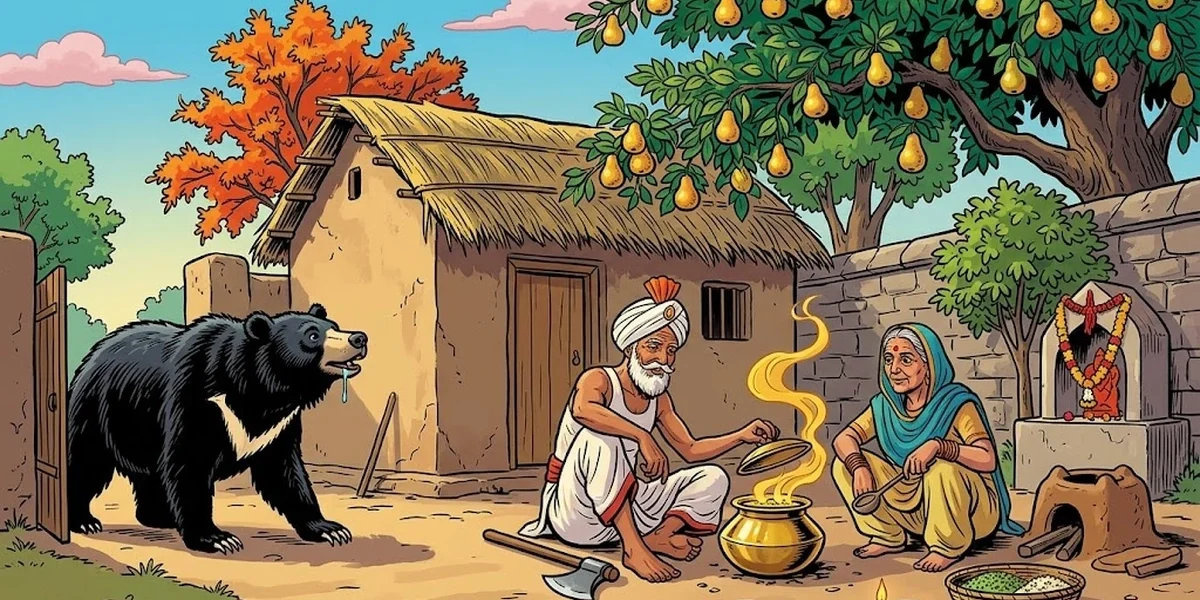
In a tiny mud-walled hut at the edge of a Punjabi orchard, an old woodman, his grumbling wife, and a saffron-scented pot of khichrî meet a hungry, greedy Himalayan bear — and three bargains are struck that the bear is destined to lose every single time. Collected at the close of the nineteenth century from the village storytellers of the Bari Doab, this Punjabi trickster tale is a quietly devastating lesson on how greed feasts only on its own appetite.
A Punjabi Trickster Cycle from the Bari Doab
The Bear’s Bad Bargain stands as Tale IV of Tales of the Punjab Told by the People, the canonical 1894 Macmillan collection compiled by Flora Annie Webster Steel and edited with scholarly notes by Major Richard Carnac Temple, then a serving officer of the Punjab Frontier Force and the most active folklorist of the Anglo-Indian generation. Steel transcribed the story directly from the village women and grandmothers of the Bari Doab between 1880 and 1893, and the volume’s etched illustrations were drawn by John Lockwood Kipling — Principal of the Mayo School of Art at Lahore and father of Rudyard Kipling — whose intimate knowledge of Punjabi rural life lent the page-plates of the woodman, his wife and the bear a documentary precision unusual for the period.
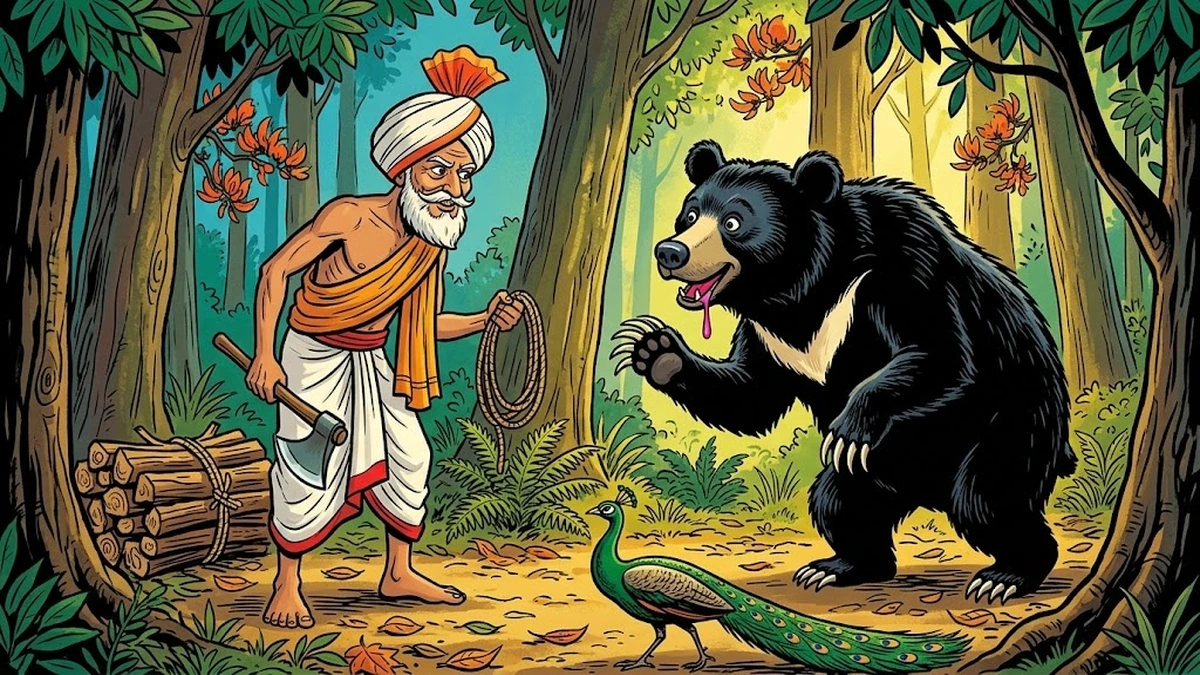
Steel was unusual among the colonial-era folklorists because she lived inside the village courtyards she described. Married to an Indian Civil Service officer posted across the Punjab and Kashmir, she ran a girls’ school at Kasur, walked dusty kos-roads between Sialkot and Ludhiana, and listened more than she dictated. Temple’s scholarly apparatus at the back of Tales of the Punjab places The Bear’s Bad Bargain in a wider Indo-European trickster cycle, classifying its kernel as a localised Punjabi reworking of the universal “deceiver-deceived” pattern — the same logical engine that drives the European Reynard cycle, the African Anansi tales, and the Native-American Coyote stories.
Within the Aarne–Thompson–Uther index, the tale gathers three deceptive-bargain types in sequence. The opening khichrî-for-firewood pact maps onto ATU 1641 (Doctor Know-All) and ATU 1535 (The Rich and Poor Peasant) in its structure of a poor mortal outwitting a powerful adversary through verbal cunning; the mid-story rampage scene parallels ATU 122F (Wait Till I Am Fatter / Smell Without Substance) in its motif of the empty pot offering only fragrance for reward; and the final pear-orchard reversal echoes ATU 47B (Wolf Tries to Eat Horse’s Tail) wherein the predator is left empty-pawed by a lesser creature’s quick-thinking. Stith Thompson’s Motif-Index of Folk-Literature catalogues the underlying narrative mechanics under K100 (Deceptive Bargain), K231.4 (Reward for service withheld), K341 (Owner’s attention distracted), K1957 (Bear deceived in bargain), J2199.4 (Empty pot left as decoy), and W125.1 (Excessive gluttony of bear).
The deeper Sanskritic ancestor lies in the Pañcatantra of Vishnu Sharma (Book III, Kakolukiyam and Book V, Aparīkšitakāraka), where the wolf-and-fox bargain motif appears in its classical form, and in the Pali Buddhist Sigāla Jātaka (No. 113) and Vānarinda Jātaka (No. 57) where a hungry beast is repeatedly outwitted by a smaller creature’s cleverness. The Punjabi tale strips away the courtly Sanskrit register and re-grounds the motif in mud-walled village reality: a brass khichrî pot, a half-ton bundle of shîsham firewood, ripe pears bending the bough into the cottage yard, and a bear so blinded by saffron-scented greed that he sells his labour for nothing but a smell.
Beat One — The Khichrî Bargain
The story opens in a tiny mud-and-thatch hut leaning against the high wall of a wealthy zamindar’s orchard, where a rich pear tree leans its branches over the cottage yard. By a long-standing village agreement, the old woodman and his old wife may eat any fruit the wind or the flying-foxes shake into their dust, and so they sit beneath the boughs through the long blue evenings, watching the green pears swell and ripen, willing the storm to come. But the autumn is still and dry, the pears cling stubbornly to their stems, and the old wife — Steel paints her with the unsentimental honesty of a woman who has heard her own grandmother grumble — turns her hunger into the household’s grievance. She gives her husband nothing but stale dry chapati for breakfast and dinner, drives him out at dawn to swing the axe in the sal forest, and contrives in a hundred small ways to make his life miserable until at last the old man rebels: he will not lift another faggot until she cooks him khichrî.
Khichrî in the Punjabi village imagination is the very perfume of plenty. It is rice and yellow split moong dāl simmered slow in clarified butter, salted, peppered, deepened with ginger and asafoetida, and — on a feast day or to coax a sick child or a sulking husband — finished with a pinch of golden Kashmiri saffron from the Pampore fields. The smell that rises from a covered brass handi when the lid is lifted is, in the village proverb, jis ke ghar khichri pakti hai, us ke ghar lakshmi vaste — “the goddess of fortune dwells in the house where khichrî cooks.” The old wife sets her brass pot on the three-stone chulha, scolding all the while, and the savoury steam drifts out across the yard, over the orchard wall, and into the muzzle of a bear who is at that moment swinging down the forest path with his black nose tilted up and his small bright eyes peering out of a face full of inquisitive greed.
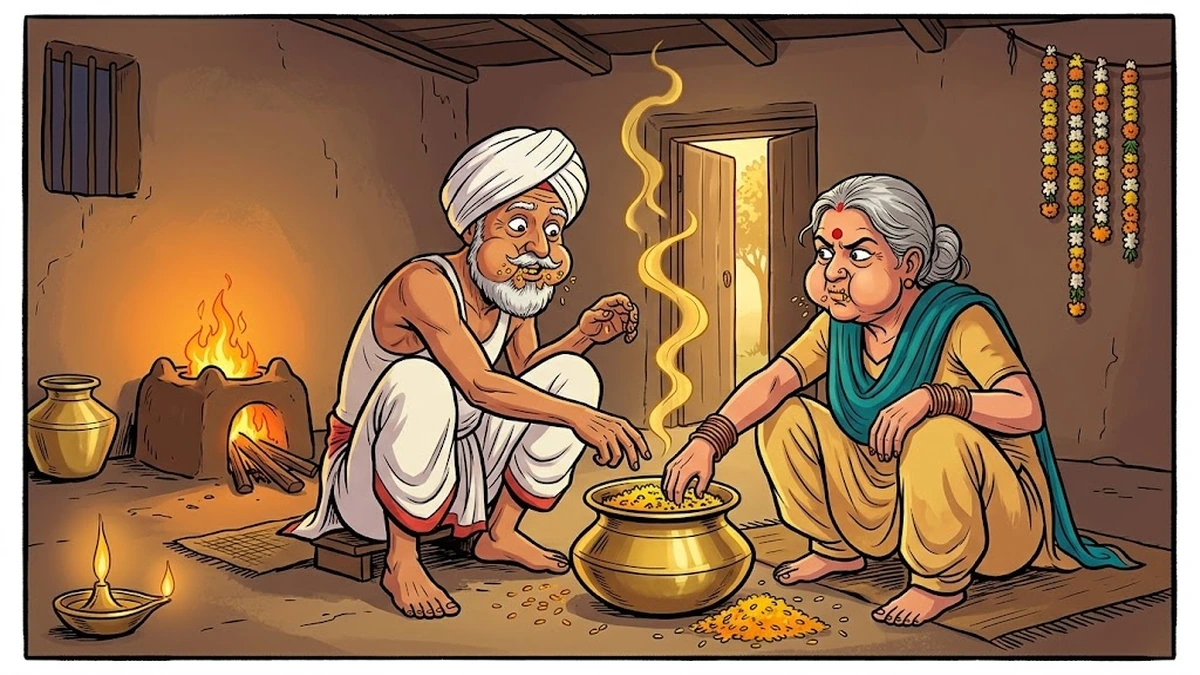
The bear of this tale is the Himalayan sloth bear (Melursus ursinus) of the Punjab foothills — shaggy, ink-black, with a curving cream-white V across his chest and the long curved claws of a termite-digger — though Steel and Kipling’s plate is slightly stylised toward the cinnamon-brown Himalayan brown bear (Ursus arctos isabellinus) that wandered down occasionally from the Kashmir slopes into the Bari Doab in hard winters. Either species was, in the village mythos, a creature of bottomless appetite and shallow cunning: strong enough to break down a mud wall, foolish enough to be talked into half a ton of firewood for the promise of a dinner.
The old woodman, who has spent his life learning to weigh out his wife’s groceries down to the last chittak, sees the bear’s mouth begin to water and reads him at once. “Khichrî is an expensive dish to make,” he murmurs casually, smacking his lips, “there is rice in it, and plenty of ghee, and pulse, and—” He lets a pause swell. The bear leans in. “And there is saffron in the khichrî.” The bear’s small eyes glitter with greed and delight. The bargain is struck on the spot: half a ton of cut firewood — shîsham, kikar, dhak — delivered to the cottage door in exchange for a share of the saffron-scented pot. The bear lumbers off into the forest in great glee, and the old man trots home in greater glee still, for he has just sold the smell of a meal for the labour of half a forest.
Beat Two — The Empty Pot
What happens next is the moral hinge of the story, and Steel renders it with the dry comedy of village marriage observed up close. The wife, hearing of the bargain, is naturally not pleased — being a grumbler by nature, she finds in every windfall some small grievance to nurse — and she points out, with the sharp logic of one who has lived among hungry husbands, that no bargain has been struck about the bear’s portion. “He will gobble the pot before we have finished our first helping,” she hisses. The old man’s face goes pale. The brass pot stands between them on the beaten-earth floor, the saffron steam curling up like a small golden snake, and without another word the two of them squat down on either side of it and begin to eat as fast as their old jaws can move.
The exchange that follows is one of the great miniature comic dialogues of Indian folk literature, and Steel preserves it in the dry, half-whispered cadence of village teasing:
“Remember to leave some for the bear, wife,” said the woodman, speaking with his mouth crammed full.
“Certainly, certainly,” she replied, helping herself to another handful.
“My dear,” cried the old woman in her turn, with her mouth so full she could hardly speak, “remember the poor bear!”
“Certainly, certainly, my love!” returned the old man, taking another mouthful.
So it goes, helping after greedy helping, until the brass pot is scraped to its empty bottom and the only thing left in the kitchen is the smell of saffron and the recriminations of a long marriage. “It is your fault, wife, for eating so much!” “My fault! Why, you ate twice as much as I did — men always eat more than women!” The squabble runs on until the old wife’s superior cunning surfaces: lock up every scrap of food, leave the empty khichrî pot beside the dead fire as if the host had stepped out, hide in the dark baranda garret above, and let the bear discover for himself that he has earned nothing but the perfume of a vanished meal.
The bear arrives at last, sweating and panting, dragging a half-ton bundle of forest wood that has taken him the whole afternoon to cut and tie. He drops the load in the courtyard, ducks under the low lintel of the hut, and finds — nothing. Not a grain of rice, not a yellow lentil, not the yellow stain of a single saffron filament. Only the empty pot and the cold ashes and the maddening, lingering, saffron-haunted air. He turns the hut upside down. He shakes the locked grain-cupboards. He sniffs into the dark corners where the cobwebs hang. He bellows. He flings the brass lota against the mud-plastered wall. And then, exhausted by his own anger and the long hour of his wood-cutting, he subsides — for the bear, like all gluttons, has no stamina for a sustained vengeance — and he turns to leave, half-thinking he will haul the firewood back into the forest just to spite them.
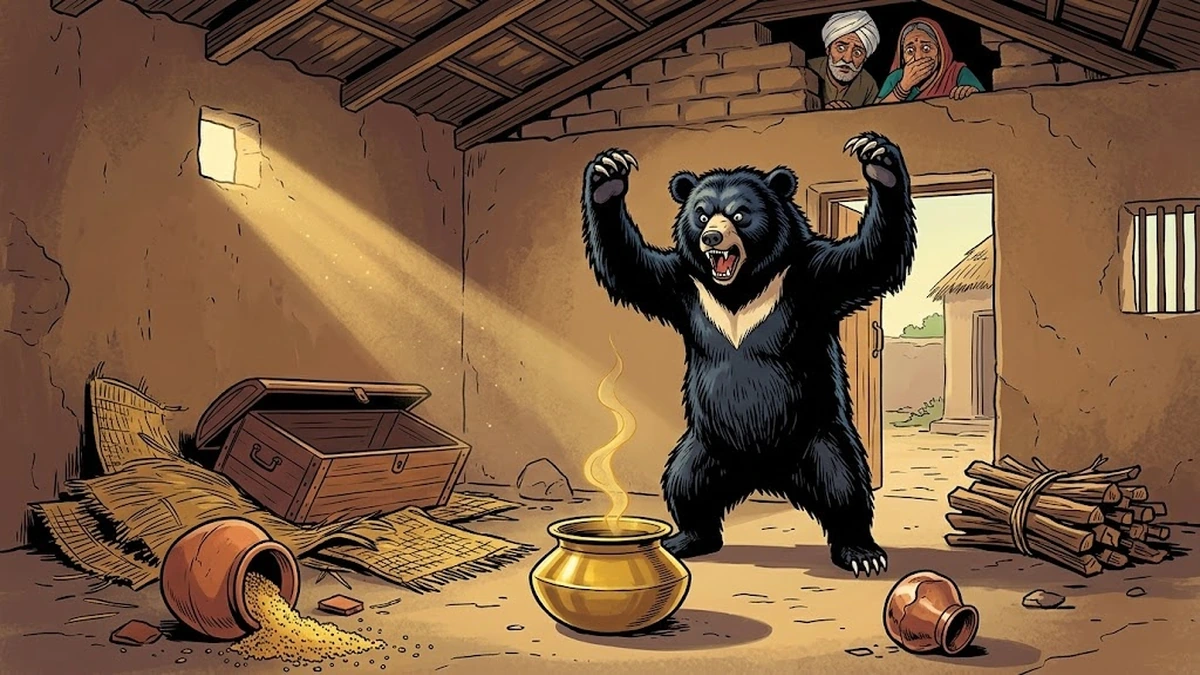
It is here that the bear’s gluttony betrays him a second time. The half-ton bundle is too heavy. He cannot face the long carry back through the dusk. “If I cannot take the taste,” he growls to himself, snatching up the empty khichrî pot, “I will at least take the smell.” And he tucks the brass pot under one furred arm and shambles out into the cottage yard. The wife, peering through a crack in the mud wall above, holds her breath; the old woodman holds his beside her; the smell of saffron lingers, and the pear-tree, heavy with its first golden ripe fruit of the season, leans its boughs over the wall above the bear’s head.
Beat Three — The Pear-Tree Reversal
The bear’s nose tilts up. The pears, which have hung tantalisingly out of reach for the old couple all autumn, are now dropping their golden weight against the tin sky. The bear’s mouth, never long un-occupied, begins to water afresh. In a trice he has scrambled up the orchard wall, hooked his long claws around the lowest bough, and hauled himself into the crown of the tree. He plucks a great ripe pear and lifts it to his teeth — and then a fresh thought visits him, the kind of greedy improvisation which the bear of folktale is forever incapable of resisting.
“If I take these pears home,” he reasons, peering at the orchard from the height of the bough, “I shall be able to sell them to the other bears for ever so much money — and with the money I shall buy a whole pot of khichrî for myself! I shall have the best of the bargain after all!” He fishes a half-eaten pear out of his teeth, drops it back in the brass pot, and sets to work. He picks every ripe golden pear within reach and drops it carefully into the empty khichrî pot. Whenever his paw closes on an unripe one — sour, hard, green — he shakes his head sorrowfully (“no other bear would buy that — and yet it would be a pity to waste it”) and he pops it into his own mouth, screwing up his face at the bitter astringent acid of the un-ready fruit.
Meanwhile, in the dark garret above the hut, the old woodman’s wife is watching this miracle through a crack in the mud wall, scarcely daring to breathe. The brass pot, plucked-pear by plucked-pear, fills with the very fruit she has watched and prayed for through the long dry autumn. Her hand is over her mouth. She is asthmatic, and she has a small cold in her head. She holds the breath. She holds it. She holds it. And then —
“A-h-chc-u!”
The sneeze cracks across the orchard like a musket-shot. The bear, certain in the marrow of his bones that some hidden hunter has fired upon him from the cottage roof, drops the brass pot with a great clattering crash into the dust of the cottage yard, scrambles backwards out of the pear-tree branches, and bolts headlong for the deep cover of the sal forest, his long claws ploughing furrows in the orchard dirt and his cinnamon shaggy haunches trembling at every imagined echo of the gunshot. He does not stop until he is half a kos deep in the trees, and even then he keeps on running through the indigo twilight until the empty stomach-ache of the green sour pears begins to overtake him.
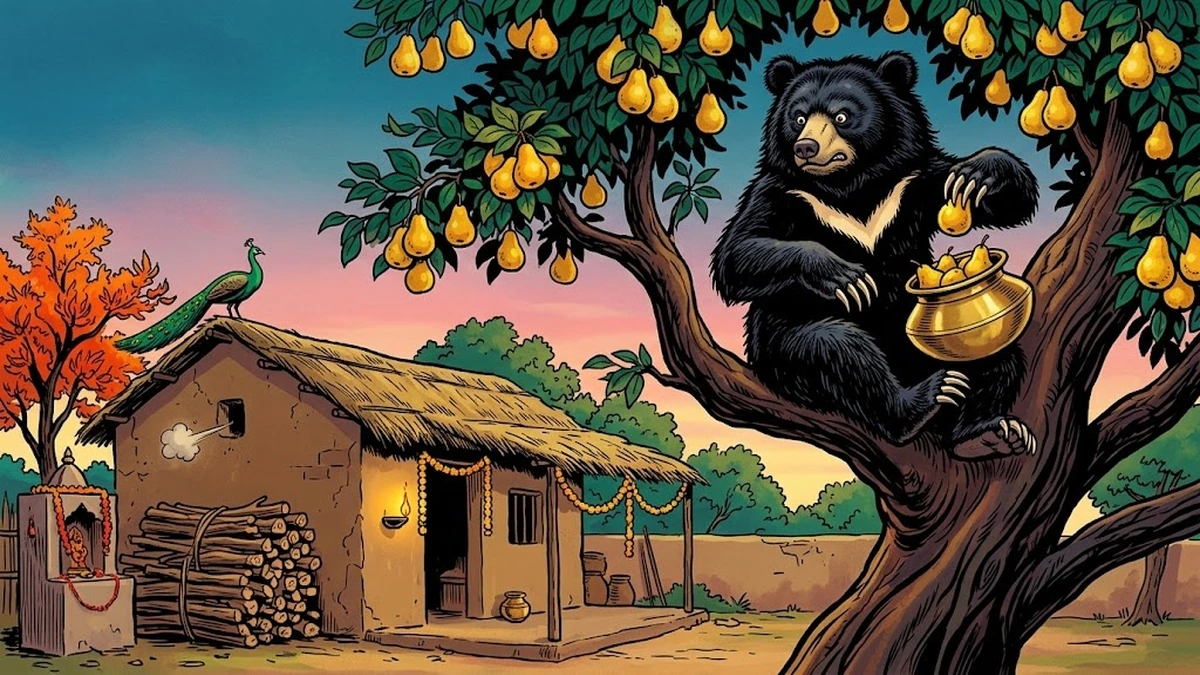
Down in the cottage yard, the old woodman and his wife emerge cautiously into the dust. The half-ton bundle of cut shîsham firewood lies stacked against the wall. The brass khichrî pot lies on its side, brimming with the season’s first golden pears. Not a single grain of rice has changed hands; not a copper paisa has been paid; the bear’s labour is theirs and his pears are theirs, and the saffron smell of the morning’s khichrî still drifts faintly out of the brass mouth of the abandoned pot.
Steel closes the tale with one of the most pungent one-line morals in the entire 1894 collection: “So the woodman and his wife got the khichrî, the wood, and the coveted pears, but the poor bear got nothing but a very bad stomach-ache from eating unripe fruit.“
The Moral — Greed Eats Only Itself
The Punjabi village proverb that has governed this tale’s recitation for three centuries is laid down plainly by the village storytellers Steel transcribes: lobh papa ka mool — “greed is the root of sin.” It is the same wisdom that the Bhagavad Gītā places on Arjuna’s lips at XVI.21, where Krishna names the three gateways to ruin:
त्रिविधं नरकस्येदं द्वारं नाशनमात्मनः &#xred; कामः क्रोधस्तथा लोभस्तस्मादेतत्त्रयं त्यजेत् ॥
tri-vidhaṁ narakasyedaṁ dvāraṁ nāśanam ātmanaḥ — kāmaḥ krodhas tathā lobhas tasmād etat trayaṁ tyajet
“Threefold is this gateway to hell, ruinous to the self — desire, anger, and greed; therefore one should abandon these three.” — Bhagavad Gītā XVI.21
The bear of the Bari Doab is undone three times in the course of an afternoon, and each time by the same single internal flaw: he cannot stop wanting more. He sells half a ton of cut firewood for the smell of saffron. He lingers around an empty pot for the lingering trace of butter. He climbs a tree and trades present pears for imagined other-bears’ rupees. The Pañcatantra diagnoses this exact pathology in Vishnu Sharma’s compact stanza at Mitra-Bheda 1.155: atilobhābhibhūtasya cakṣur na bhavati svāsthye — “the eyes of one possessed by excessive greed lose their good health.” The bear’s small bright eyes can see the saffron handi; they cannot see the wife at the crack in the wall.
The deeper Sanskritic teaching surfaces in the Hitopadeśa of Narayana Pandita, where in the Mitralābha book the wise minister Damanaka observes that lubdho hi vañcayaty arthe — “the greedy man is cheated of his very gain.” The bear’s khichrî goes uneaten; the firewood becomes the woodman’s; the pears, which the bear has himself harvested with his own paws, fall into the woodman’s pot at the bear’s own hand. Each fresh act of greed is the lever by which his previous gains are pried out of his grasp. And in the Manusmṛti at II.94 the verse runs even sharper: na jātu kāmaḥ kāmānām upabhogena śāmyati — “desire is never quenched by the enjoyment of desires; it grows the more it is fed.”
But Steel’s tale carries a second, less-noticed teaching, which is that of kṣaṇika cāturya — momentary cleverness — the wisdom of the small. The old woodman’s wife has no army, no treasury, no court of brāhmaṇa scholars; she has a brass pot, a crack in a mud wall, an asthmatic chest, and a willingness to stay quiet at the right moment and let the greed of her adversary do her work for her. The Pañcatantra‘s opening stanza calls this faculty buddhir yasya balaṁ tasya — “he who has wisdom has strength” — and the Bari Doab grandmothers’ phrase for it is the Punjabi akkal vadda dhan hai — “wit is the greatest wealth.” Across the courtyard from the Himalayan sloth bear’s brute strength, the old woman in her saffron-yellow shalwar-kameez owns the more durable currency.
Why the Tale Has Lasted
For one hundred and thirty years The Bear’s Bad Bargain has been carried out of the mud-walled hut of the Bari Doab and into nursery after schoolroom across the English-speaking world — first in Steel’s 1894 Macmillan edition, then in Joseph Jacobs’s 1892 Indian Fairy Tales companion volume, and onward through the Andrew Lang fairy-book series, through Pratham Books and Tulika and Children’s Book Trust readers in India, through the Project Gutenberg digital reissue of 1903, and through countless Punjabi grandmothers who have never read either Steel or Temple but who tell the tale to their grandchildren on the charpai in much the same words their own grandmothers used.
The tale lasts because it does three things at once that few stories manage simultaneously. First, it makes its moral concrete and physical — the punishment of the greedy is not abstract karmic weight but a literal stomach-ache from sour green pears, the absurdity of which lodges in a child’s memory long after the abstract stanza of the Gītā has faded. Second, it gives the smaller and weaker creature — a thin asthmatic old village woman with a cold in her head — the moral and tactical victory over a forest predator weighing forty stones, which is the great underdog wish-fulfilment that has powered trickster narrative since the Pañcatantra. Third, it preserves, almost photographically, the texture of nineteenth-century Punjabi village life — the brass khichrî pot, the chulha stove, the leaning pear bough, the half-ton of shîsham firewood, the sneeze in the dark garret — which now, a century and a quarter after the recording, has acquired the additional dignity of being one of the few intimate domestic portraits of pre-Partition rural Punjab that survives in widely-read English text.
It is, in the end, a tale about the household economy of attention. The bear pays attention only to his own appetite. The woodman pays attention to the bear’s appetite. The wife pays attention to her husband’s vanity, the bear’s gluttony, and the pear-tree’s ripening simultaneously. Whoever holds the most attention holds the most power; and the woman in the dark garret, with one hand over her mouth and one eye to the crack in the wall, holds them all at once. akkal vadda dhan hai — and the brass pot fills with golden pears.
Canonical attribution: Punjabi folk tale, collected from village informants in the Bari Doab between 1880 and 1893 by Flora Annie Webster Steel; published as Tale IV of Tales of the Punjab Told by the People, Macmillan and Co., London, 1894; folkloristic notes by Major Richard Carnac Temple; illustrations by John Lockwood Kipling. Reprinted in Joseph Jacobs, Indian Fairy Tales, David Nutt, London, 1892. Tale-types: ATU 1535 (Rich and Poor Peasant), ATU 1641 (Doctor Know-All), ATU 122F (Wait Till I Am Fatter), ATU 47B (Wolf Tries to Eat Horse’s Tail). Stith Thompson motifs: K100 (Deceptive Bargain), K231.4 (Reward Withheld), K341 (Owner’s Attention Distracted), K1957 (Bear Deceived in Bargain), J2199.4 (Empty Pot Decoy), W125.1 (Excessive Gluttony of Bear). Sanskritic ancestry: Pañcatantra of Vishnu Sharma, Books III and V; Hitopadeśa of Narayana Pandita, Mitralābha; Pali Sigāla Jātaka 113 and Vānarinda Jātaka 57. Doctrinal anchors: Bhagavad Gītā XVI.21 on the threefold gateway of desire-anger-greed; Manusmṛti II.94 on the unquenchability of kāma; Hitopadeśa Mitralābha 1.155 on the buddhi-greater-than-bala principle. Punjabi proverb: akkal vadda dhan hai — “wit is the greatest wealth.”
Related Indian Folk Tales
- The Barber’s Clever Wife — another Punjabi cunning-wife tale from Steel
- The Ass in the Lion’s Skin — Pali Sihacamma Jataka 189
- Sir Buzz — Steel’s Punjabi tale with a tiny magical helper
- The Tiger, the Brahman and the Jackal — the great Steel-Temple ATU 155 tale
- Brahma’s Wife and the Mongoose — the ATU 178A faithful-animal classic
You May Also Like
 Indian Folk Tales
Older Kids / Teens / Adults
Indian Folk Tales
Older Kids / Teens / Adults
Good Will Grow Out Of Good: Tamil Folk Tale of the Lime & the Blessing
Southern Indian folk tale — Brāhmin Pāpabhīru’s daily yellow lime, the Tamil blessing “if good is sown, good will grow,” and how sown good and sown evil return. Full story + FAQ.
 Indian Folk Tales
Ages 6-8
Indian Folk Tales
Ages 6-8
The Legend of the Durian Fruit: Why the King of Fruits Has a Pungent Crown
The Legend of the Durian Fruit: Why the King of Fruits Has a Pungent: Long ago, in the lush forests where the land meets the endless sky, there grew a magical
 Indian Folk Tales
Ages 6-8
Indian Folk Tales
Ages 6-8
Si Tanggang: The Ungrateful Son and the Curse of Stone
Si Tanggang: The Ungrateful Son and the Curse of Stone: In a small fishing village nestled along the Malaysian coast, where the sea whispered ancient secrets