Story of the Birth of Lord Krishna
The classic Indian mythological tale of Krishna's miraculous birth in Mathura — a story of tyranny, divine prophecy, and a father's courageous journey through stormy rain.
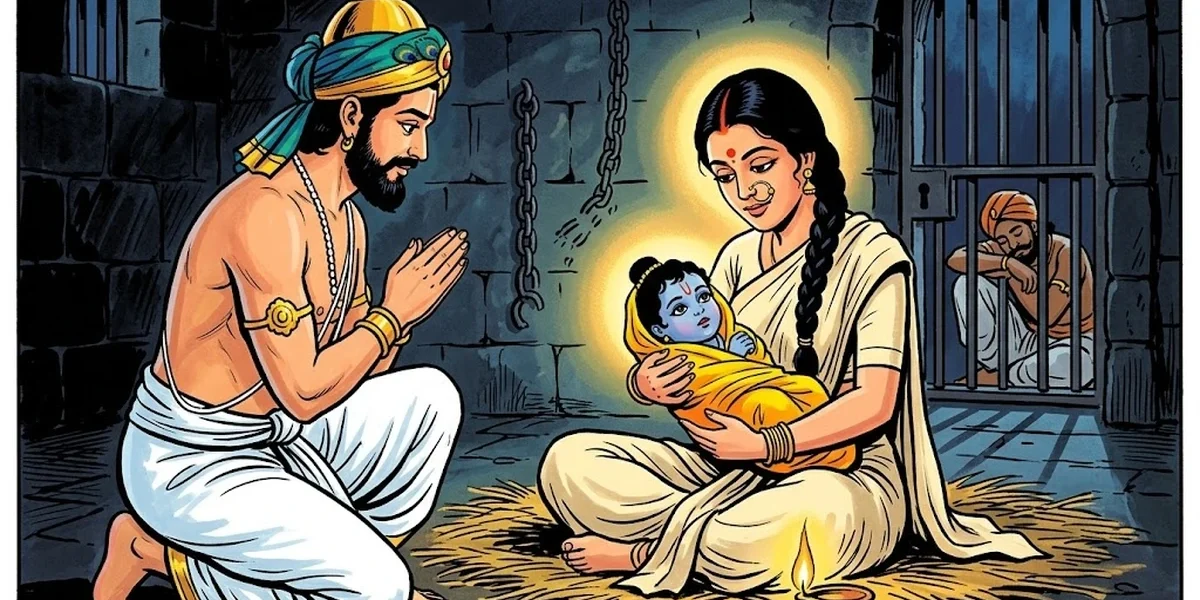
A cruel king. A frightened mother. A mighty river rising in the night. A serpent with seven hoods. And a tiny baby whose dark face, the songs say, lit up the dungeon like a small blue lamp. This is how Vrajavāsīs and grandmothers from Mathurā to Madurai have told the story of the birth of Lord Kṛṣṇa for more than two thousand years.
The tale lives at the meeting-point of scripture and folk memory. Its earliest Sanskrit recension survives in the Harivaṃśa (Viṣṇu-parvan ch. 4–5), an appendix to the Mahābhārata dated by most Indologists to the first or second century CE. By the time the Bhāgavata Purāṇa was redacted in southern India between the 9th and 10th centuries CE, the Janma-līlā had become its devotional centrepiece: the whole of the Tenth Book (Daśama Skandha) opens with it. Around the same Sanskrit core, an enormous oral tradition grew — bardic in Braj, sung in Tamil pāsurams by the Āḷvārs, painted on Pahari court walls, danced in Manipuri Rāsa, and retold by every grandmother who ever rocked a baby on Janmāṣṭamī night. The retelling below honours that double inheritance: scriptural in its bones, folk-tale in its breath.

I. The Voice from the Wedding Chariot
Long ago in the city of Mathurā, on the western bank of the river Yamunā, a young woman named Devakī was being given in marriage to a Yādava prince called Vasudeva. Devakī was the beloved sister of Mathurā’s king, Kaṃsa — a man so devoted to his sister that, on her wedding day, he himself took the reins of her bridal chariot to drive her home to her new husband’s house. The streets were strung with marigolds. Conches sounded. Brahmins chanted. The Yamunā glittered.
And then, just as the chariot rolled past the city gate, an unseen voice spoke out of the empty sky.
It was a single sentence, and only Kaṃsa heard it clearly. The voice told him that the eighth child of the woman whose chariot he was driving — his own beloved sister — would one day be the cause of his death.
The colour drained from Kaṃsa’s face. He stopped the chariot. He drew his sword. He seized Devakī by her hair and raised the blade above her. Vasudeva, calm even in that moment, stepped between them. “Brother,” he said gently, “the prophecy speaks of children, not of her. Spare her life. I promise you on my honour: every child she bears, I will deliver into your hands the moment it is born.”
The promise was monstrous. But it was the only one that fit. Kaṃsa’s hand shook. He lowered the sword. He let his sister live. But from that day onwards he kept Devakī and Vasudeva locked in a deep stone prison-cell at the heart of the palace, with iron chains on Vasudeva’s ankles and a guard at the door.
Six children were born to them in that cell. One after another, as he had promised, Vasudeva carried each newborn out and placed it in his brother-in-law’s hands. One after another, Kaṃsa killed them. The seventh pregnancy ended in what the Mathurā astrologers called a miscarriage; the village storytellers say the unborn child was secretly transferred by divine power to the womb of Vasudeva’s other wife Rohiṇī, far away in Gokul, and was later born there as Balarāma. Devakī was now, by any reckoning, eight times a mother and yet had no living child. And then she became pregnant for the eighth time.

II. The Eighth Birth
It was the eighth night of the dark fortnight of the month of Bhādrapada — Bhādrapada Kṛṣṇa Aṣṭamī — deep in the rainy season. The Yamunā outside was already in spate. Inside the prison cell, the air was heavy and still.
At the stroke of midnight Devakī gave birth.
The baby was a boy. He was very small, and his skin had the soft dark-blue colour of a monsoon rain-cloud. Vasudeva, looking down, felt his heart go quiet. The cell, the songs say, was suddenly full of a clean, cool light, as if a single oil-lamp had been multiplied a hundred times over. The chains on Vasudeva’s ankles slid off without a sound. The bolts of the iron door slid back of their own accord. And, beyond the door, Devakī and Vasudeva could hear that the guards had fallen into a deep, dreamless sleep.
A voice, gentle this time, spoke inside Vasudeva’s mind. Take the child to Gokul. To the cowherd Nanda’s house. Yaśodā has just given birth to a daughter. Lay him in her place. Bring the daughter back here. And then the voice was gone.
Devakī kissed the baby’s forehead. She did not cry. She had cried out all her tears in six earlier nights. She wrapped the baby in a piece of saffron-yellow cloth and placed him in a flat wicker basket. Vasudeva lifted the basket on his head. The cell-door opened before him as if a hand were pushing it. He walked out of Mathurā and turned east, towards the river.

III. Crossing the Yamunā in the Storm
The Yamunā that night was a wide brown roaring thing, swollen with monsoon water and white at its centre. The rain came in sheets. Lightning split the violet sky. No ferryman was on the bank. No raft. No bridge.
Vasudeva did not stop. He stepped down the muddy slope and waded straight in, with the wicker basket steady on his head and the newborn quiet inside it.
The water rose past his knees. Then past his thighs. Then past his waist. The river was very strong. And then — the songs say — two things happened at once. From under the dark water rose the great seven-hooded cobra Śeṣa, the cosmic serpent on whom Lord Viṣṇu reclines, and he opened his seven hoods like an enormous black-and-emerald umbrella above the basket on Vasudeva’s head, so that the rain that fell around them did not fall upon the child. And the river itself, which had risen perhaps to drown the newborn or perhaps to touch his tiny feet, opened a narrow path of dry pale sand right under Vasudeva’s steps, so that he walked the second half of the crossing without his ankles ever again going under.
On the far bank he climbed up into the village of Gokul.
IV. The Exchange in Gokul
The cowherd Nanda’s house was a modest mud-and-thatch cottage at the edge of the village. A single oil-lamp was burning. Inside, on a cotton mat, lay Yaśodā, a warm-brown young cowherd-woman in a blue ghagra and red choli, fast asleep beside her own newborn daughter. The girl had been born only an hour earlier. Yaśodā had sung her one short lullaby and slipped into a deep, exhausted, blessed sleep.
Vasudeva entered without knocking. He knelt beside the mat. He lifted his own son out of the wicker basket and laid the dark-blue baby boy down where Yaśodā’s daughter had been. Then, very gently, he lifted Yaśodā’s daughter into the basket, raised the basket again to his head, and walked out of Gokul into the receding storm. By the time he reached the prison-cell, the river had already shrunk back to its banks. The chains slipped onto his ankles by themselves. The guards woke up. And in Devakī’s arms, for the first time in eight births, lay a living baby — a little girl.
Kaṃsa, alerted by the guards, came running. He snatched the baby from Devakī’s arms and raised her by the foot to dash her against the stone floor. But the daughter slipped from his grip into the air, took the form of the goddess Yoga-māyā, and laughed at him from the corner of the ceiling. Your slayer is already born, she told the king. He is somewhere safe. He is far away. He will come for you when his time has ripened. Then she was gone.

The Moral — Mā ko bhay nahīṃ; bhagavān āyā hai
nityaṃ kīrtayato matto bhakti-saṃraktasya tu ·
nāhaṃ tyajāmi taṃ kānte kuto’nyatraiva gacchati //
“Of one who keeps remembering me with love, I, the Lord, never let go — how then could he wander into harm?”
— Bhāgavata Purāṇa XI.14.24
The lesson of the Janma-līlā is not the lesson of Hercules in the cradle. It is not that the hero is born already strong. The point is that the world into which the divine child arrives is, on the surface, completely against him — a tyrant uncle, a guarded prison, a flooded river, a thunderstorm at midnight. And yet, song by song, every obstacle becomes a helper. The chains open. The guards sleep. The cell-door swings back. The river makes a footpath. The cobra holds an umbrella. Even the storm itself falls quiet around the basket. The teaching is the small Hindi line that grandmothers still murmur into a cradle: mā ko bhay nahīṃ; bhagavān āyā hai — Mother, do not fear; God has come.
Why the Story Has Lasted
One reason the Janma-līlā has stayed alive across two millennia is that it works on two registers simultaneously. To the village child, it is a perfect adventure tale: a wicked uncle, a brave father, a mighty river, a magic snake, a switched baby. Every motif here has a recognisable folk-tale ancestor — the prophecy that calls forth its own fulfilment (compare Cyrus, Oedipus, Moses, Snow White), the substituted infant (Moses in the bulrushes, Karṇa in his basket on the Aśvanadī, Romulus and Remus, Heracles), the helpful river (Stith Thompson F1099.4, the Yamunā here in the role the Nile plays for Moses), the cobra-canopy (motif B91.5, attested already on 2nd-century BCE Bhārhut stūpa railings as the Mucalinda-coiling that shelters the meditating Buddha; later transferred to Kṛṣṇa), and the cosmic prophecy (motif M340).
To the adult listener, the same story unlocks the central Vaiṣṇava teaching of avatāra. The Bhagavad-gītā IV.7–8 puts it in the Lord’s own voice: yadā yadā hi dharmasya glānir bhavati bhārata · abhyutthānam adharmasya tadātmānaṃ sṛjāmy aham — “Whenever dharma falters and a-dharma rises, I emit my own self into the world.” Krishna’s birth is the moment that promise becomes a small wet baby in saffron cloth. The dungeon, the chains, the storm, the river are not background scenery; they are dharmasya glāniḥ — the world’s unrighteousness, made visible. The newborn carried across the Yamunā is the Lord’s answer.
The Vaiṣṇava commentators — Śrīdhara Svāmin (14th c.), Vallabhācārya (1479–1531), Sanātana Gosvāmī’s Bṛhad-Bhāgavatāmṛta (16th c.), and Jīva Gosvāmī’s Krama-sandarbha — read every detail of the night as a cipher for grace: the chains opening of their own accord = the unbinding of karma; the sleeping guards = the quieting of the sense-faculties; the parting Yamunā = the receding of māyā; the seven-hooded Śeṣa = the cosmic ground itself bending to shelter the soul; the substitution at Gokul = the final teaching, that the divine child does not stay in palaces but goes home with cowherds. The bhakti poets sang exactly the same theology in everyday words. Sūr-sāgar by Sūrdās (c. 16th c., Brajbhāṣā) and Cait Mahimā by Caitanya’s circle (Bengali, 16th c.) hold the bedrock of the Janmāṣṭamī devotional repertoire. Tamil Āḷvārs — especially Periyāḷvār and Āṇṭāḷ in the 8th–9th centuries CE — had already domesticated the story still earlier in Tiruppāvai and Tirumoḷi, addressing the new-born Krishna as a baby boy any mother would recognise.
Iconography Note
The visual canon of the Janma-līlā has remarkably stable elements. Vasudeva-crossing-the-Yamunā with the basket on his head is attested at Pāla-period Bengal manuscript leaves of the Bhāgavata (10th–12th c.), Hoysaḷa stone reliefs at Belur and Halebidu (12th c.), Vijayanagara temple ceiling-paintings at Lepakshi (16th c.), Mewar miniature albums under Sahibdin (mid-17th c.), Pahari Basohli sets of the Bhāgavata-daśama-skandha by Manaku and Nainsukh’s family workshop (mid-18th c.), and Kalighat scrolls of late-19th-century Calcutta. The seven-hooded Śeṣa shading the basket is the iconographic signature of the scene; the parting river is sometimes shown as a blue-veined goddess kneeling to touch the basket; Yaśodā is almost always shown asleep with her right hand still cupped towards her newborn. Modern visual culture — Raja Ravi Varma chromolithographs (Lonavla press, 1894–1906), Sivakasi calendar art of the 1960s–80s, Amar Chitra Katha No. 11 Krishna (Anant Pai, 1969, art by Pratap Mulick) and No. 525 Tales of Mahabharata, Ramanand Sagar’s television Shri Krishna (1993–96) — all draw directly on this same compositional frame.
Reading with Children
Three good questions to ask a child after the story: (1) Why did the cell door open by itself — because of magic, or because the guards were asleep, or because the story is telling us that nothing can imprison love? (2) The river could have drowned the basket but it parted instead: when have you been in a difficulty and someone or something quietly ‘parted’ to let you through? (3) Devakī never sees the baby grow up — Yaśodā does. Are both of them the baby’s mother, or only one? (The traditional answer is: both. Krishna in the texts is described as dvi-mātṛkaḥ, “the one with two mothers” — the womb-mother who carries danger for him, and the milk-mother who carries his childhood.)
Cross-Cultural Echoes
Folklorists have long noted that the prison-birth-and-river-rescue cluster — ATU 461/671 motif-bundle — appears with striking regularity around the world. Moses set adrift on the Nile in a basket of bulrushes (Exodus 2.3, c. 7th–6th c. BCE in its current form); Sargon of Akkad placed in a reed basket on the Euphrates (Akkadian autobiographical legend, c. 23rd c. BCE in tradition); Karṇa floated down the Aśvanadī by Kuntī in Mahābhārata Ādi-parvan 67; Cyrus the Great exposed in the Median mountains by Astyages (Herodotus I.107–130, c. 5th c. BCE); Romulus and Remus set adrift in the Tiber by Amulius (Livy I.4); Oedipus given to a shepherd of Cithaeron (Sophocles, Oedipus Tyrannus, c. 429 BCE); Snow White hidden by the huntsman in the wood (Grimm KHM 53). Anthropologists from James Frazer (The Golden Bough, 3rd ed. 1911–15) to Otto Rank (Der Mythus von der Geburt des Helden, 1909) read the cluster as the human imagination’s most natural way of saying: the great soul comes through the smallest possible door, and the door is always blocked by the strongest possible enemy. What gives the Indian recension its particular flavour is the cobra-canopy and the river-becoming-footpath — the world itself is not just neutral or hostile, the world cooperates.
Selected Sources
Primary Sanskrit: Bhāgavata Purāṇa X.1–4 (esp. X.3, the Janma-stuti), critical ed. Gita Press Gorakhpur 1962; Harivaṃśa Viṣṇu-parvan ch. 4–5, BORI critical edition (Vaidya 1969); Mahābhārata Sabhā-parvan 22, Ādi-parvan 67, BORI critical edition (Sukthankar et al. 1933–66); Viṣṇu Purāṇa V.3, ed. M.M. Pathak 1997; Brahma-vaivarta Purāṇa Kṛṣṇa-janma-khaṇḍa, Venkateśvara Press Bombay 1909. Bhakti tradition: Sūrdās, Sūr-sāgar, ed. Nāgarī Pracāriṇī Sabhā 1972–76; Periyāḷvār Tirumoḷi, Āṇṭāḷ Tiruppāvai, in Nālāyira-divya-prabandham ed. Annangaracharya 1971; Caitanya, Caitanya-Caritāmṛta by Kṛṣṇadāsa Kavirāja, ed. Edward C. Dimock with Tony K. Stewart, Harvard Oriental Series 56, 1999. Modern scholarship: Edwin F. Bryant (ed.), Krishna: A Sourcebook, Oxford University Press 2007; Friedhelm Hardy, Viraha-Bhakti: The Early History of Kṛṣṇa Devotion in South India, OUP 1983; John Stratton Hawley, Krishna’s Playground: Vrindavan in the 21st Century, OUP 2020; Wendy Doniger, The Hindus: An Alternative History, Penguin 2009, ch. 16; A.K. Ramanujan, “Where Mirrors are Windows”, History of Religions 28 (1989) 187–216. Folk-tale apparatus: Hans-Jörg Uther, The Types of International Folktales, FFC 284–286, Helsinki 2004 (ATU 461, ATU 671); Stith Thompson, Motif-Index of Folk-Literature, rev. ed. 1955–58 (M340, L111, R141, R143, B91.5, F1099.4, Z254, K1611); Otto Rank, Der Mythus von der Geburt des Helden, Vienna 1909; James G. Frazer, The Golden Bough, 3rd ed. 1911–15.
Frequently Asked Questions
**Q: Why is this story important?**
You May Also Like
 Indian Folk Tales
Ages 12+ / YA
Indian Folk Tales
Ages 12+ / YA
The Story Behind The Congress Party’s Hand Symbol – Story of Hemambika
The Pallassana goddess of two raised palms — Parashurama’s remorse, temple lore, and the debated link to the Congress hand symbol.
 Indian Folk Tales
Ages 3-5
Indian Folk Tales
Ages 3-5
The Snake Woman And King Ali Mardan
The Snake Woman And King Ali Mardan: Once upon a time King Ali Mardan went out a-hunting, and as he hunted in the forest above the beautiful Dal lake, which
 Indian Folk Tales
Ages 3-5
Indian Folk Tales
Ages 3-5
The Lambikin 2
The Lambikin 2: Once upon a time there was a wee wee Lambikin, who frolicked about on his little tottery legs, and enjoyed himself amazingly. Now one day he