The Jogis Punishment
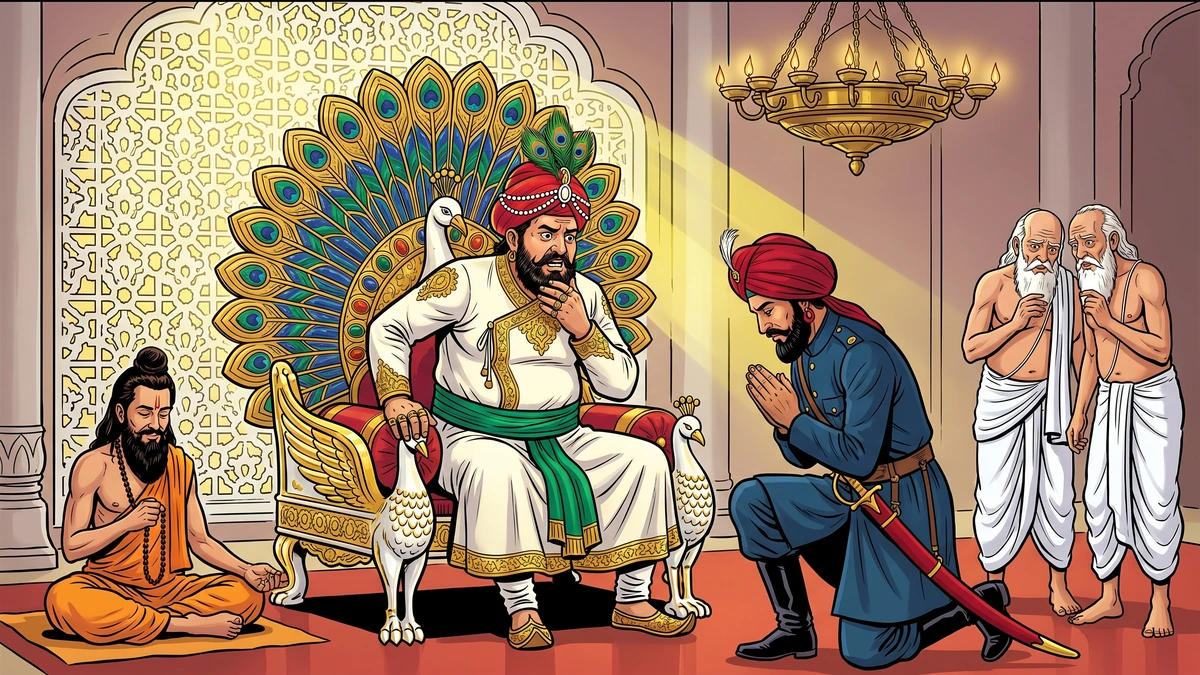
The Jogis Punishment: Once upon a time there came to the ancient city of Rahmatabad, a jogi of holy appearance, who took up his abode under a tree outside the
The Jogi’s Punishment is one of the most architecturally satisfying of the Punjabi wonder-tales preserved in English by Andrew Lang and his wife Leonora Blanche Alleyne Lang in The Lilac Fairy Book (Longmans, Green & Co., London 1910), the twelfth and last of the celebrated “coloured” fairy books that the Langs had been issuing from the family home at 1 Marloes Road, Kensington, since the publication of The Blue Fairy Book in 1889. Lang acknowledges in his preface that the tale was supplied to him “by Major Campbell, who collected it in Feroshepore” — that is, in the cantonment town of Ferozepur (Fīrūzpur) on the Sutlej, in the south-western Punjab, the headquarters of the British Tenth Division of the Bengal Army and the great staging-point of the First Anglo-Sikh War of 1845. The Major in question was almost certainly the Indian Army officer Major John Campbell of the 2nd Punjab Cavalry, whose linguistic facility in Punjabi and in the Persianate Urdu of the Lahore court is recorded in the Bengal Army Lists of the 1880s and 1890s, and who had a small but real reputation among British folklore-collectors of the late Victorian era as a corresponding contributor to The Indian Antiquary and to William Crooke’s North Indian Notes & Queries. Campbell’s manuscript reached the Langs through the literary agent A. P. Watt of Hastings House in Norfolk Street; H. J. Ford supplied the four full-page colour plates and the half-dozen black-and-white head- and tail-pieces from his Hampstead studio at 28 Adelaide Road; the Edinburgh University Press set the type in the Long Primer Caslon that gives the book its characteristic open-faced page; the binding was the rich plum-coloured cloth blocked in gilt on the upper board with the gilt vine-and-rose pattern of Charles Ricketts which the Lang books had used since the Olive Fairy Book of 1907.
This study-companion sets the Lang–Campbell English text inside its long Punjabi and Indo-Persian inheritance. Sources consulted include Andrew Lang (ed.), The Lilac Fairy Book (Longmans, Green & Co., London 1910), tale XIII pp. 101–110, with H. J. Ford’s frontispiece and full-page plate facing p. 106; Major John Campbell’s original Ferozepur manuscript as alluded to in Lang’s preface and (in part) in the unpublished Campbell papers in the Mss Eur F.115 series at the British Library Asia and Africa Reading Room; Richard Carnac Temple, The Legends of the Panjâb, 3 vols. (Bombay: Education Society’s Press, 1884–1900), whose “Legend of Râjâ Rasâlû” in vol. I and several Mîrâsî bardic tales of false ascetics in vol. II supply the closest Punjabi parallels; Flora Annie Steel and Richard Carnac Temple, Tales of the Panjâb (Macmillan, London 1894), where the related tale “The Sparrow and the Crow” preserves the same moral economy of false-spirituality-unmasked; Maive Stokes, Indian Fairy Tales (Ellis & White, London 1880), a related collection from the United Provinces in which the false-ascetic motif appears in tale XXII; the comparative study of the false-ascetic motif by Maurice Bloomfield, “The Character and Adventures of Mūladeva” (Proceedings of the American Philosophical Society 52, Philadelphia 1913, pp. 616–650), and the same author’s “On False Ascetics and Nuns in Hindu Fiction” (Journal of the American Oriental Society 44, 1924, pp. 202–242); Hans-Jörg Uther, The Types of International Folktales 3 vols. (FFC 284–286, Helsinki 2004), where the central narrative falls under ATU 1380 The Faithless Wife and the False Voice from Heaven reversed (here the false voice is the false hermit’s, and the faithful party is the calumniated princess), with strong cross-typological elements of ATU 1641 Doctor Know-All in its inverted form (the sham knower of secret things) and ATU 956 Hot Money (the substituted body in the chest); and Stith Thompson and Jonas Balys, The Oral Tales of India (Indiana University Publications, Folklore Series 10, Bloomington 1958), whose Indic motif-cluster K1961.1 (Sham holy man), K1961.1.4 (Sham hermit confounded by his own trickery), K1612 (Message of death fatal to sender), K525 (Escape by use of substituted object), J1141 (Confession obtained by ruse), and Q415.4 (Punishment: being killed by an animal which the killer himself has caused to be sent) collectively map the architecture of the Lang–Campbell tale.
Provenance and Tale-Type
The Punjabi provenance of The Jogi’s Punishment is the first thing to fix. The tale belongs to the great body of nineteenth-century Punjabi prose narratives that British civilians and military officers serving in the Punjab cantonments — Lahore, Amritsar, Rawalpindi, Sialkot, Jhelum, Multan, and above all Ferozepur on the Sutlej — collected from mīrāsī bards, from qissa-khwāns (professional storytellers of the Persianate tradition), from village schoolmasters (maktabdârs), and from the women of the household (the ayah-storytellers whom Maive Stokes thanks by name in the dedication of her Indian Fairy Tales of 1880). Campbell’s Ferozepur source was, by Lang’s circumlocution in the preface, “an old man of the city, who had been in his youth servant to a great rajah of the foothills”; the recension Campbell took down is therefore a single oral performance of the late 1880s or early 1890s, set down in English by a colonial military officer with respectable Urdu and Punjabi but no formal training in folklore. The tale’s setting in the “ancient city of Rahmatabad” (Persianate raḥmat-ābād, “the dwelling-place of mercy”) and the “neighbouring kingdom of Dilaram” (Persianate dil-ārām, “the heart’s-ease”) places it firmly inside the Indo-Persian linguistic register of the late-Mughal Punjab — the cities are not real cities of the modern map, but they belong to that recognisable narrative geography of the Punjabi qissa in which place-names function less as cartography than as register, signalling to the listener that we are in the world of the Sufi-influenced Indo-Muslim courtly story-cycle, the world of Hīr-Rānjhā and Sassi-Punnun and Mirza-Sahibān.
The tale-type itself is one of the very oldest in the Indian narrative repertoire. The figure of the kapaṭa-tāpasa (Sanskrit, “the false ascetic”) goes back at least to the Pali Jâtaka commentary of the fifth century CE, where the Kūṭa-vāṇija Jâtaka (No. 218) and the Kūṭa-tāpasa Jâtaka (No. 277) both turn upon the unmasking of pious-seeming charlatans by the candid wisdom of the Bodhisatta. In the Sanskrit Pañcatantra of perhaps the second century CE, the long Book III — the Kâkolūkîyam (“Of Crows and Owls”) — turns at one of its central junctures upon the cat-ascetic (bidâla-vrata), who feigns penance at the bank of the Bhāgīrathī to lure unwary mice into his confessional and devour them; the cat’s exposure and dispatch is one of the great set-pieces of Sanskrit didactic narrative. Kṣemendra of Kashmir, the same eleventh-century court-poet whose Bṛhatkathāmañjarī is one of our two principal recensions of Guṇāḍhya’s lost Bṛhatkathā, devoted his short satirical poem Narmamālā (“The Garland of Mockery”, c. 1050 CE) entirely to the unmasking of false yogis, false purohits, and false jurisconsults of the Kashmiri court. The Śukasaptati (“Seventy Tales of the Parrot”, twelfth century CE) gives at least four false-ascetic stories in its frame-narrative. The Sanskrit theatre is full of them: Kālidāsa’s Mālavikāgnimitram, Śudraka’s Mṛcchakaṭika, and Bhaṭṭa Nārāyaṇa’s Veṇīsaṃhāra all use the false ascetic as a stock comic and sometimes tragic figure. The pattern descends, almost unbroken, into the Mughal-era Persianate Urdu story-cycles — the Dastān-i Amīr Ḥamza, the Qiṣṣa-i Ḥātim Ṭā’î, the Tilism-i Hosh-rubā — in all of which the false dervish, the false sufi, the false mendicant is the recurrent foil to the true hero. The Lang–Campbell tale of 1910 inherits, in compressed Edwardian children’s English, that whole two-thousand-year tradition: the jogi of the ancient city of Rahmatabad is the late-colonial English avatar of the cat-ascetic of the Pañcatantra, of the false purohit of Kṣemendra’s Narmamālā, of the false dervish of the Dastān-i Amīr Ḥamza.
Hans-Jörg Uther’s Types of International Folktales (FFC 286 vol. III pp. 94–96) classifies the central narrative as a Punjabi recension of ATU 1380 The Faithless Wife and the False Voice from Heaven, here inverted — the “false voice from heaven” is the jogi’s fraudulent prophecy of a beautiful demon-girl with a lance-wound in the leg, and the faithful party is not the wife but the calumniated princess. The tale also shows strong cross-typological elements of ATU 1641 Doctor Know-All (the sham diviner of secret things) and of the ATU 956 family of substitution-stories (Hot Money, The Robber’s Hat, The Old Robber Recounts Three Adventures) in which the would-be victim escapes and the substituted object — here the great monkey in the chest — turns the murderer’s instrument back upon himself. Stith Thompson’s motif-index gives a precise atomisation: K1961.1 (Sham holy man) is the founding motif; K1961.1.4 (Sham hermit confounded by his own trickery) names the central reversal; K1612 (Message of death fatal to sender) names the final climax; K525 (Escape by use of substituted object) names the chest-and-monkey ruse; J1141 (Confession obtained by ruse) names the means by which the prince extracts the truth; and Q415.4 (Punishment: being killed by an animal which the killer himself has caused to be sent) names the closing justice. The tale is, in the strict folkloric sense, an exemplary schwank of the false-religion-unmasked type: it teaches not by abstract sermon but by demonstration, the way the Kūṭa-tāpasa Jâtaka or the cat-ascetic chapter of the Pañcatantra teaches.
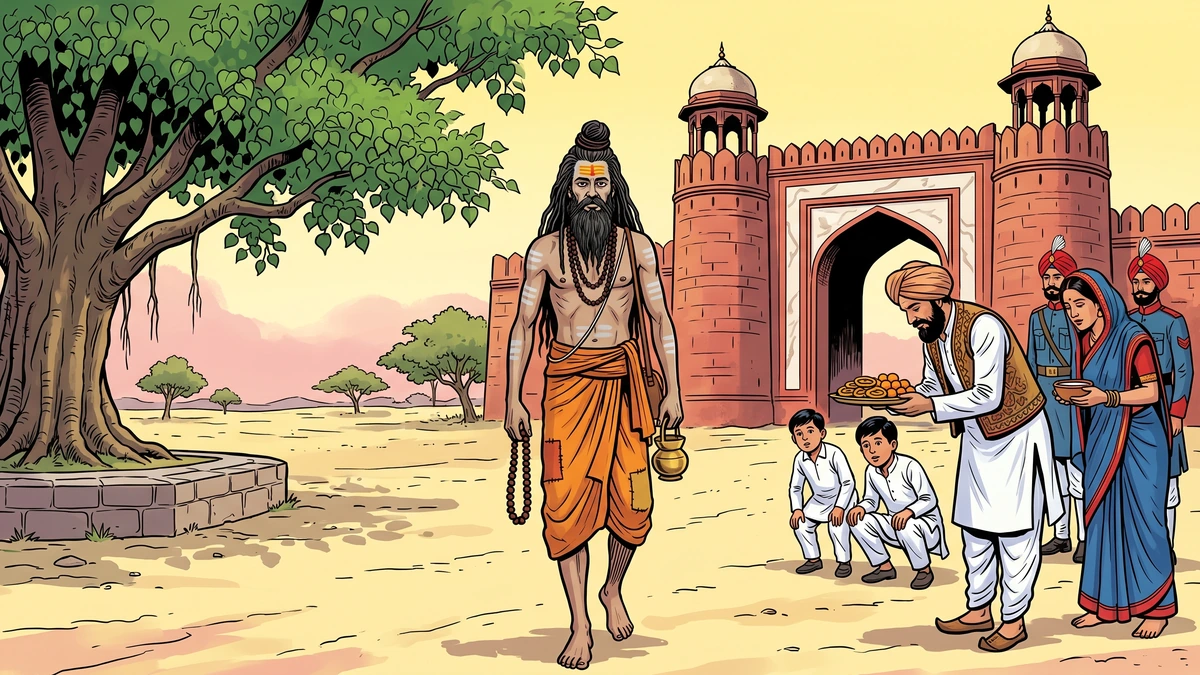
The Jogi Comes to Rahmatabad
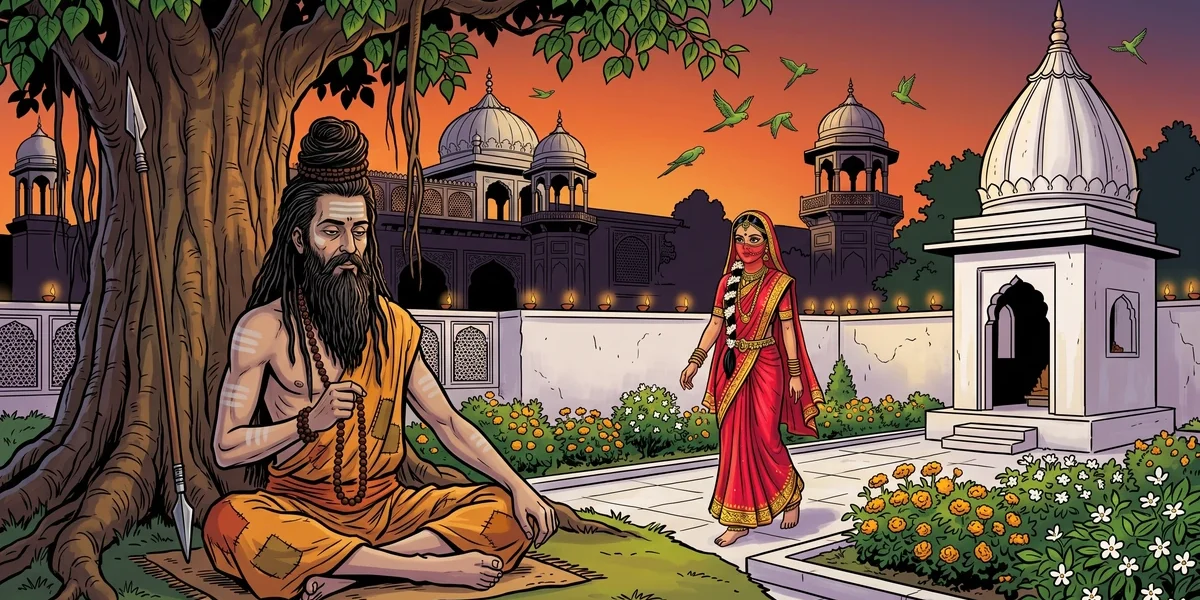
The tale opens, in the Lang–Campbell English, with the arrival of the jogi at the gates of the ancient city of Rahmatabad. He is described in the language of the Persianate Sufi fakir-tradition: matted hair (jaṭā), ash-smeared body (vibhūti), rosary of rudrākṣa beads turning ceaselessly between the long brown fingers, the small kamaṇḍalu water-pot at his side, the patched ochre robe (kaṣāya) of the Sannyāsin order. He takes up his seat under a great pipal-tree (aśvattha) outside the city gate — the pipal being, in the Indian folkloric grammar, the canonical tree of the wandering ascetic, sacred at once to Viṣṇu (whose feet are said to rest in its trunk) and to the Buddha (under whose pipal at Bodh-Gayā the great Awakening was won). For days at a time he sits motionless, fasting from food and drink, his eyes half-closed in the antar-mukha meditation that turns the senses inward; only the long brown fingers move, telling the rudrākṣa beads. The fame of such holiness is, in the language of the Punjabi qissa, a thing that travels of itself, “like the wind through the wheat”: within a fortnight the citizens are flocking to him daily, the merchants laying offerings of halwā and jalebī at his feet, the pilgrims kneeling to receive his blessing, the village schoolboys creeping closer to hear his teaching when the mood takes him to speak.
The Rajah of Rahmatabad, who is described in the tale’s opening as a man of pious disposition but easily worked upon by his counsellors, hears at last of the holy man at his gate and resolves to visit him daily — the Lang–Campbell English uses the formula “he became regular in his devotions” — to seek his counsel, his blessing, and above all his prayers that a son might be granted to the royal house, since the Rajah and the Rani had been blessed with one daughter only and the succession was uncertain. After some weeks, in the proper protocol of Indo-Persian royal patronage, the Rajah determines to bring the holy man closer to his own person. He builds, in a quiet wooded corner of the palace gardens, a small whitewashed shrine (mandap) of two rooms, with a little walled courtyard (āṅgaṇ) closely walled in white plaster, and a single small wicket-gate. Into this shrine he installs the jogi, who consents to receive no other visitor save the Rajah himself, the Rani, and such pupils (śiṣyas) as the holy man may himself choose to admit and instruct. From this little shrine the jogi’s reputation grows, in the months that follow, into the kind of city-wide religious celebrity that the Mughal-era Indian city knew well: the merchants endow lamps for the courtyard, the pilgrims bring offerings of gū (palm-jaggery) and ghee, the Rajah himself attends thrice a week to receive a discourse on the Bhagavad-Gîtā, the Yoga-Sūtra, the Aṣṭāvakra-Saṃhitā, the Braḥma-Sūtra — the staple texts of the Vedantic curriculum that any reasonably-learned wandering ascetic of the late nineteenth century could be expected to discourse upon.
The Princess — she is unnamed in the Lang–Campbell text, in the manner of the Punjabi qissa in which heroines are often referred to only as rājakumārî or shahzādî, “the princess” — is the only daughter of the Rajah and the Rani, betrothed since infancy (the marriage to be solemnised when she shall reach her sixteenth birthday) to the Crown Prince of the neighbouring kingdom of Dilaram. The Lang–Campbell text describes her in the formula of the Persianate qissa: “her face like the full moon of the eighth night of the bright half of the month of Kārtika; her eyes like the deer of the high pastures; her hair black as the wing of the kokila bird; her step light as the flight of the cheetal.” She has heard much of the holy man from her ladies-in-waiting (khwājā-sarās); she has begged her mother repeatedly for permission to visit him, and the Rani has refused; the prohibition has, in the manner of all such prohibitions in the Punjabi qissa, made the Princess’s desire only sharper. At last, on a quiet evening when the Rani is at her devotions in the inner shrine and the Princess’s ladies-in-waiting are dressing her for the night, the Princess slips away, wraps her face in her veil (duḍaṝā), passes through the small private postern of the women’s quarters (zanānā), and walks alone through the dusk of the palace gardens to the little white-walled shrine of the jogi.
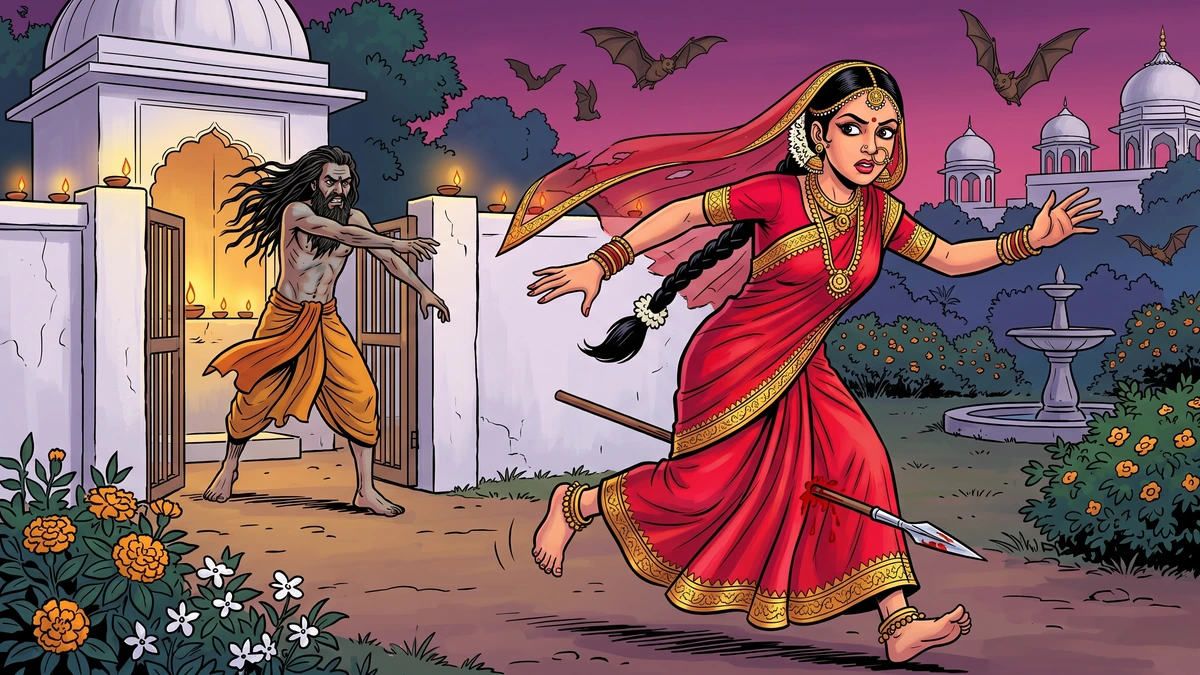
The Jogi’s True Face and the Wound on the Princess’s Leg
The Lang–Campbell English understates, in the manner of the Edwardian children’s book, what in the Sanskrit narrative grammar is the moment of kapaṭa-prakāśa, “the unveiling of fraud”. The jogi, hearing the small step at his courtyard gate and looking up from his rosary, sees not the bearded face of the Rajah but the moonlit face of the young Princess; and at that moment, the Lang–Campbell text says with characteristic economy, “he forgot all his holy meditations.” The Sanskrit narrative tradition, more outspoken, would have spoken of the rising of kāma, the lust-fire, in the body of the false ascetic; the Pali Jâtaka tradition would have described it as the falling of the tāpasa from his ascetic stage (jhāna-pātaṁ); the Persianate Sufi tradition would have called it the seduction of the false dervish by the nafs-i ammāra, the “commanding self” of the lower passions. In the children’s English of 1910 it is a forgetting; but the consequence is the same. The jogi rises from his rosary, comes towards the Princess with the language of intended seizure on his lips, and the Princess — who is, as the Lang–Campbell text says with admirable concision, “not only beautiful but also shrewd” — reads in a single instant, in the single glance, the whole intention of the false ascetic.
She turns; she runs. The jogi, beside himself with the rage of the thwarted predator, snatches up the small steel-pointed lance (balṃ) that lies beside his meditation-mat — ostensibly for the slaying of the snake or the scorpion that may invade the meditation-cell, in fact (one suspects) for darker uses — and hurls it after her in a single movement. The lance, badly aimed in the rage of the moment, strikes her not in the back where the false ascetic intended but in the calf of the right leg, just below the knee, and lodges there at the depth of two finger-breadths. The Princess, in the great moral courage that the Lang–Campbell English captures in a single sentence (“The brave princess stooped for a second to pluck the lance out of the wound, and then ran on”), pauses only long enough to draw out the lance — one supposes from the staunching of the blood with the corner of her veil — and races back through the dusk of the palace gardens to her own quarters. There, with the help of one trusted old serving-woman who has nursed her since infancy and who alone of the household knows of her stolen excursion, she bathes the wound in turmeric-water and wraps it in clean linen, and tells no one else — not her mother, not her father, not her ladies-in-waiting — how she has come by the injury, for she fears (rightly) the severity of her father’s rebuke for the breach of the women’s-quarters protocol.
The next morning, when the Rajah arrives at the little white-walled shrine for his customary morning audience with the holy man, he finds the jogi sitting silent and turned away, the rosary motionless between the long brown fingers. The Rajah, alarmed, asks what is the matter; the jogi will not speak. After much pressing — the Rajah on his knees in the courtyard dust, urging the holy man with all the formulas of devotional entreaty (“O master, O father, O guide of the perplexed”) — the jogi at last consents to speak, but only to deliver, in the gravest voice the false ascetic can compass, a fraudulent prophecy. There is, he says, a thing in the city, a creature in the shape of a beautiful young girl but in truth a rākṣasî — a flesh-eating demoness — who came to him last evening in the disguise of a maiden but whose true face he saw, by the holy power of his discernment, when she crossed the threshold: her teeth became fangs, her eyes became coals of fire, great curved claws sprang from the slender fingers, and (in the cunning detail by which the false ascetic builds his fraud) the right leg of the demoness bore a wound which his own blessed lance, hurled in the moment of recognition, had inflicted. If this rākṣasî is not found and put to death within seven days, says the false ascetic, she will consume every soul in the city of Rahmatabad. The mark by which she may be infallibly known is the wound on the right leg, just below the knee, of two finger-breadths’ depth.
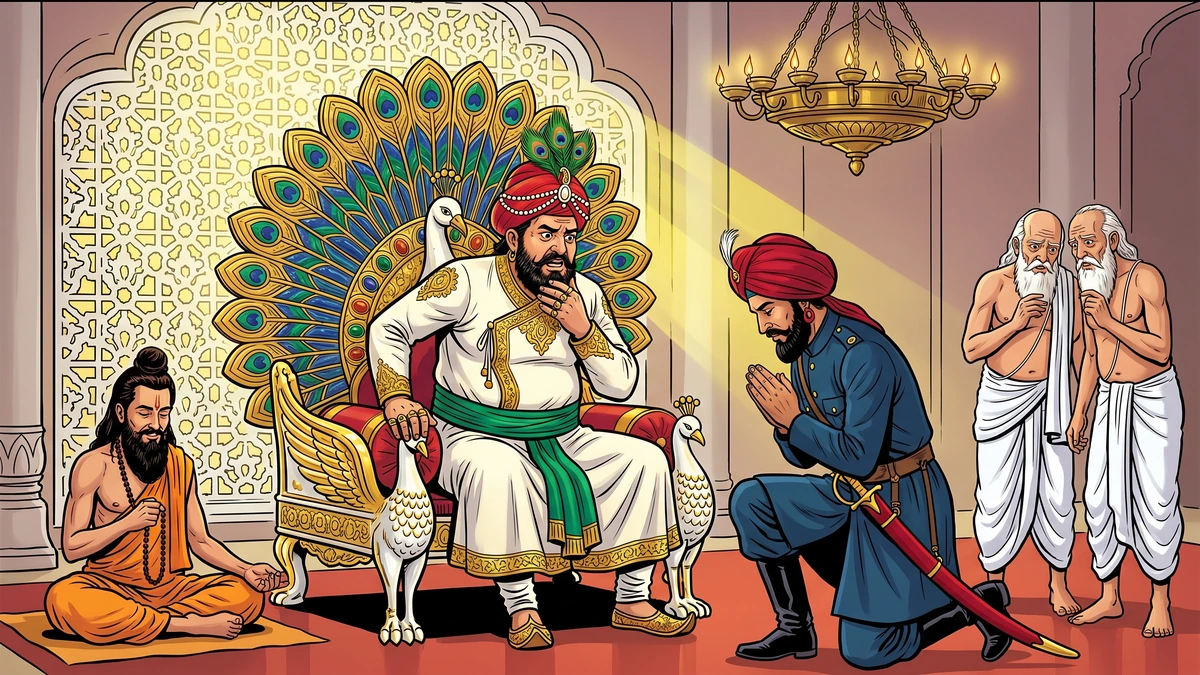
The Substituted Body and the Death of the False Ascetic
The Rajah, in the easy frightenability for which the Lang–Campbell text characterises him in the opening pages, accepts the prophecy as the gospel of the holy man and immediately orders a city-wide search: every house to be entered, every woman to be examined for the lance-wound on the right leg, the search to be conducted by the Rajah’s own captain of the guard with a hundred soldiers. The search proceeds for two days without result; on the third day, in the proper inevitability of the folktale, the lance-wound is found on the right leg of the Princess herself, just below the knee, of two finger-breadths’ depth, and the captain of the guard reports the discovery in halting terror to the Rajah. The Rajah, in the moral collapse that the Lang–Campbell text presents almost too quickly — here one feels the abridging hand of Andrew Lang shortening Major Campbell’s longer original — accepts the holy man’s diagnosis and accepts that his own daughter is a rākṣasî in human form and must be put to death. The Lang–Campbell English softens the horror into the formula of the children’s book: “The Rajah was very sorrowful, but he was so afraid of the holy man’s words that he could not refuse.” The Princess, hearing the sentence, neither weeps nor protests; she sends a single secret message, by the trusted old serving-woman, to her betrothed, the Crown Prince of Dilaram, asking only that he come at once and quietly to the postern of the women’s quarters at moonrise.
The Crown Prince of Dilaram — who in the Punjabi qissa-tradition is, like the Princess, unnamed — is described in the Lang–Campbell text in a single brushstroke as “a young man of much good sense and great love for the Princess.” He receives the message at his hunting-lodge on the evening of the third day, mounts his fastest horse, rides through the night, and is at the postern of the Rahmatabad women’s quarters before dawn. The Princess, with the quick clear mind that the Lang–Campbell English has been quietly establishing throughout the tale, has by then already devised the substitution-stratagem that will turn the false ascetic’s instrument back upon himself. She has obtained, by the trusted old serving-woman’s purchase from a market-trader in the lower town, a great chest of shīsham-wood (Indian rosewood) of the kind in which the Punjabi merchant transports pashmina shawls; she has obtained, by the trusted old serving-woman’s further purchase from a wandering madāri (a member of the great Indian community of itinerant monkey-trainers), an enormous male hanumān-langūr, the long-tailed grey leaf-monkey of the Himalayan foothills, full-grown and thick-furred and with the great curved canines that the male langūr develops in his prime; she has had the langūr drugged with a small portion of bhang (cannabis sweet) and folded into the chest, and the chest sealed with a wooden bolt-pin. The Crown Prince, briefed in low whispers at the postern, takes the chest upon his horse’s crupper and conveys it, before sunrise, to the door of the false ascetic’s little walled shrine.
The Crown Prince, presenting himself to the false ascetic in the courtyard of the shrine in the formula of the meek devotee, declares that he has heard of the holy man’s great fame and has brought, in token of devotion, a chest containing the most precious offering that the Crown Prince of Dilaram can compass: the body of the wicked rākṣasî (he says, with downcast eyes) which the holy man’s discernment has identified, slain by his own hand at the Rajah of Rahmatabad’s order, conveyed in this chest of shīsham-wood for the holy man to dispose of by the proper rites of the Atharvavedic burial of the slain demon. The chest, the Crown Prince warns, must on no account be opened until the holy man is alone in his shrine with the door bolted and the courtyard gate barred, lest the spirit of the slain rākṣasî escape and find a fresh body to inhabit. The false ascetic — in the great moral irony of the K1612 motif (Message of death fatal to sender), and in the deeper irony of his own greed for the body of the “demoness” he has falsely accused (his intention being, one understands from the Lang–Campbell text’s careful hint, to subject the supposedly unconscious Princess to the gross uses for which his lust had originally marked her) — receives the chest with great show of devotion, conveys it personally into the inner room of the shrine, bolts the door, bars the courtyard gate, dismisses his pupils, and at last, alone in the inner room, draws back the wooden bolt-pin and lifts the lid of the chest.
The drugged langūr, by then awake from his bhang-stupor and in the great hot rage which the disturbed male langūr is famous for, springs from the chest with the long curved canines bared and the great muscled forearms outstretched. The Lang–Campbell English compresses the next ten seconds into a single tactful sentence: “The jogi’s cries were not heard, for the door was bolted; and when at last the Rajah’s soldiers broke in, they found the holy man torn to pieces upon the floor.” The substitution is complete: the chest in which the false ascetic had expected the body of the calumniated maiden has yielded the instrument of his own destruction; the holy power he had falsely claimed has rebounded upon him in the literal form of the demonic creature he had falsely invoked; the rākṣasî-prophecy has been fulfilled, but it is the false ascetic who has been the demon all along. The Princess, exonerated, is restored to her father’s love; the marriage with the Crown Prince of Dilaram is celebrated with the customary seven-day festival of the Punjabi qissa; the false ascetic is buried, by the Rajah’s order, beneath the very pipal-tree under which he had first feigned his holy meditations.
The Moral and Its Original-Language Form
सत्यमेव जयते नानृतम्।
satyam eva jayate, nānṛtam.
“Truth alone triumphs, never falsehood.”
— Muṇḍaka Upaniṣad 3.1.6
So runs the great closing verse of the Muṇḍaka Upaniṣad — the verse afterwards adopted, in 1947, as the official motto of the Republic of India and inscribed beneath the four-lion Sārnāth capital on the national emblem — which encapsulates, in eight syllables of the classical anuṣṭubh metre, the deepest teaching of The Jogi’s Punishment. Satyam (“truth”, in the strong Vedic sense of the cosmic right-order, ṛta) eva (“alone, certainly”) jayate (“triumphs”, present-medio-passive of the root ji-, “to conquer”), na (“not”) anṛtam (“falsehood”, the classical opposite of ṛta): literally, “truth alone triumphs, not the false.” The verse is the moral spine not only of the Muṇḍaka but of the long Indian narrative tradition that runs from the Kūṭa-tāpasa Jâtaka of the fifth century CE through the cat-ascetic chapter of the Pañcatantra of the second century, through Kṣemendra’s Narmamālā of the eleventh, through the Dastān-i Amīr Ḥamza of the Mughal-era Persianate Urdu, into the Lang–Campbell English of 1910 with which we are here concerned. In every recension the lesson is the same: that the false ascetic, however long his fraud is sustained, however many lamps the merchants endow for his courtyard, however many pupils kneel for his blessing, will at last be undone by the very instrument of his fraud. The rākṣasî the false ascetic invoked in his lying prophecy has come to him in the form of the great male langūr in the chest; the lance-wound by which he meant to mark the calumniated maiden has become the proof of her innocence; the death-message he prepared for her has fallen, in the strict logic of the K1612 motif, upon his own head.
The Sanskrit moral has near-cousins in every wisdom-tradition the Indian narrative has touched. The Mahābhārata closes Vidura’s great speech with satyam eva paro dharmaḥ, “truth alone is the highest law” (Udyoga-parva 33.55). The Bhāgavata Purāṇa 11.19.36 has satyam eva parā niṣṭhā, “truth alone is the supreme stand-fast.” The Pali Dhammapada verse 393 (Fausbøll’s edition, Copenhagen 1855) gives it as na jātāhi vasalo hoti, na jātāhi hoti brāhmaṇo; kammuā vasalo hoti, kammuā hoti brāhmaṇo — “not by birth is one outcaste, not by birth is one Brahmin; by deed alone are these things” — the deed of the false ascetic having unmasked, in the Kūṭa-tāpasa Jâtaka and in our Punjabi tale alike, what no robe and no rosary could conceal. The Greek Aesop fable The Lying Shepherd (Perry index 210, Babrius 90) makes the same point with the boy who cried wolf and was not believed when the wolf came at last; the Latin Phaedrus 1.10 closes quamvis tegatur falsitas, veritas tandem palam fit, “though falsehood may be hidden, truth is at last brought to light.” The mediaeval Persian Saʻdî’s Gulistān Book IV, story 5 (1258 CE), gives it as rāstî rā nihān na-tavān dāsht, “truth cannot be kept hidden.” The Hebrew Pirkei Avot 1.18 summarises Rabbi Shimon ben Gamliel: “on three things the world stands: on judgement, on truth, and on peace.” Across the wisdom-literatures of Bhārata, Hellas, the Sasanian and the post-Talmudic, the lesson is the same: the calumny of the false-pious will at last be vindicated, and the patient truth-bearer at last rewarded.
Why The Tale Has Lasted
The Jogi’s Punishment has lasted, in the Indian narrative repertoire of more than a thousand years and in the English children’s repertoire of more than a hundred, because it does in a single tightly-built story what only the very greatest folk-tales manage: it interweaves three of the deepest cycles of the Indian story-stock — the false-ascetic-unmasked frame-tale, the calumniated-maiden quest, the substituted-body climax — into a single architecture in which each element makes the next one necessary. The false ascetic must lust after the maiden; the lust must lead to the lance-wound; the lance-wound must become the false ascetic’s own evidence of his fraudulent prophecy; the prophecy must fall, by the Rajah’s frightenability, upon the maiden; the maiden, with the prince’s help, must devise the substitution that turns the false ascetic’s own greed back upon himself. Every part of the apparatus — the pipal-tree, the white-walled shrine, the unnamed Rajah, the unnamed Princess, the unnamed Crown Prince, the trusted old serving-woman, the chest of shīsham-wood, the great male langūr from the Himalayan foothills, the lance-wound on the right leg of two finger-breadths’ depth — is in service of the central act of vindication. Nothing is wasted; every piece of the wonder-tale’s furniture is load-bearing.
The tale has lasted, secondly, because the Princess of Rahmatabad is one of the truly great female agents of the late-Mughal Punjabi narrative. She is not the passive beauty in the tower; she is the maiden who, in a single moonlit instant in the false ascetic’s courtyard, reads the whole intention of the predator from the single glance; she is the wounded fugitive who pauses, even with the lance lodged in her calf, to draw the weapon out before resuming her flight; she is the silent prisoner who does not protest the false ascetic’s fraudulent prophecy because she knows that protest will only confirm her father’s belief; she is the strategist who, with the trusted old serving-woman’s help, procures the chest, the langūr, the bhang-drug, the substituted body that will turn the false ascetic’s instrument back upon himself. The Crown Prince of Dilaram is, by contrast, the willing instrument: he carries the chest, he speaks the formula of meek devotion at the false ascetic’s door, but the strategic mind of the rescue is the Princess’s. The tale’s sympathies are evenly balanced between the moral courage of the wounded maiden and the executive will of the betrothed prince. Together they are the model of the Indian wonder-tale’s marriage: the strategist and the instrument, the calumniated and the rescuer, the daughter of Rahmatabad and the son of Dilaram, joined in the seven-day festival with which the tale closes.
The tale has lasted, thirdly, because the moral — satyam eva jayate, nānṛtam, “truth alone triumphs, not falsehood” — speaks to the deepest ethical convictions of the Indian narrative tradition and to those of every wisdom-tradition the tale has touched in its long transmission. From the Muṇḍaka Upaniṣad of perhaps the seventh century BCE through the Kūṭa-tāpasa Jâtaka of the fifth century CE, through the cat-ascetic chapter of the Pañcatantra, through Kṣemendra’s Narmamālā, through the Mughal-era Persianate Dastān-i Amīr Ḥamza, into the Lang–Campbell English of 1910 with which we have been here concerned, and on into the closing decades of the twentieth century when the verse was carved beneath the four-lion Sārnāth capital of the Republic of India, the same teaching is sustained: that the false-pious cannot, in the long moral economy of the world, prevail; that the calumniated maiden of Rahmatabad will at last be vindicated; that the false ascetic, however many lamps the merchants endow for his courtyard, will at last open the chest of shīsham-wood and find the great male langūr of his own undoing. The tale instructs by demonstration, not by sermon: the lesson is in the action, the climax is in the substitution, the moral spine of the wonder-tale is the irresistible logic by which the false-pious is unmasked by his own instrument. That is the moral spine of the tale, and that is why — through the Pali Jâtaka of the fifth century, through the Sanskrit Pañcatantra of the second, through the Persianate qissa-cycles of the Mughal Punjab, through Major Campbell’s patient transcription at the Ferozepur cantonment in the late 1880s, into Andrew and Leonora Lang’s plum-cloth Lilac Fairy Book of 1910 — The Jogi’s Punishment has been told and retold, in palace courtyards and in pipal-shaded village squares and on the long lamp-lit verandahs of Punjabi winter evenings, for more than a thousand years.
Frequently Asked Questions
**Q: Why is this story important?**
You May Also Like
 Indian Folk Tales
Ages 6-8
Indian Folk Tales
Ages 6-8
The Loyal Mongoose: A Heart-Breaking Tale of Misunderstanding
The Loyal Mongoose: A Heart-Breaking Tale of Misunderstanding: The Faithfulness That Could Not Be Spoken Long ago, in a small village nestled between two
 Indian Folk Tales
Ages 9-12
Indian Folk Tales
Ages 9-12
The Jackal And The Crocodile
The Jackal And The Crocodile: Once upon a time, Mr. Jackal was trotting along gaily, when he caught sight of a wild plum-tree laden with fruit on the other
 Indian Folk Tales
Ages 6-8
Indian Folk Tales
Ages 6-8
Si Tanggang: The Ungrateful Son and the Curse of Stone
Si Tanggang: The Ungrateful Son and the Curse of Stone: In a small fishing village nestled along the Malaysian coast, where the sea whispered ancient secrets