Prince Half A Son
Prince Half A Son: Once upon a time there was a King who had no children, and this disappointment preyed so dreadfully upon his mind that he chose the dirtiest
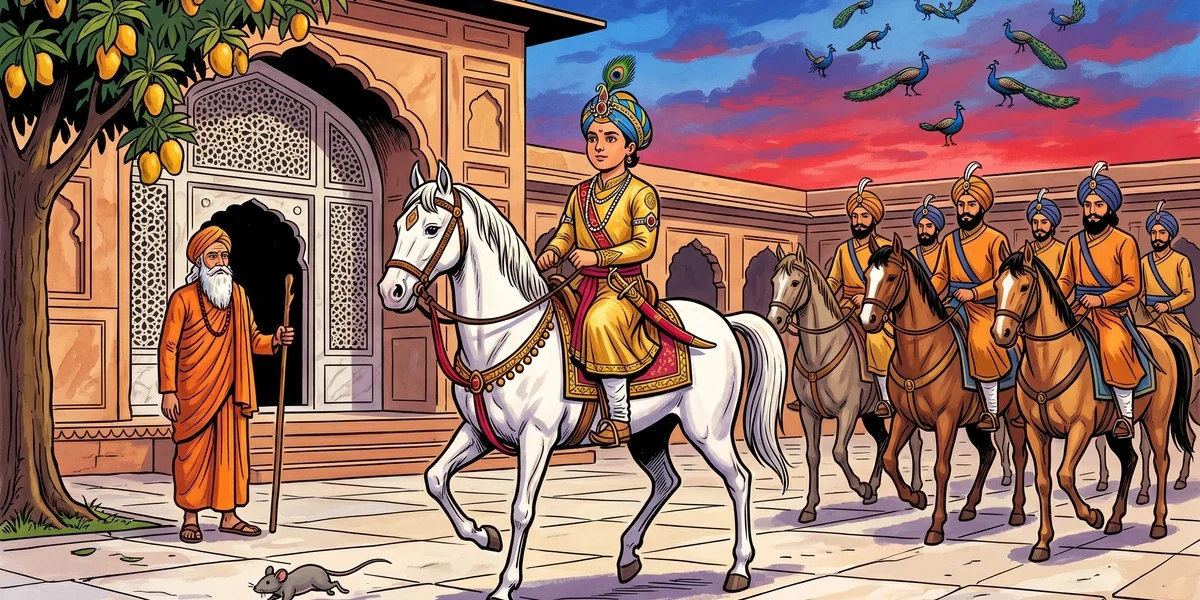
Prince Half-a-Son (Punjabi: Ḍoḍh Putrā or Ardhā Rājkumār) is one of the most quietly subversive of all the tales collected from rural Punjab in the late nineteenth century. It was first set down in English by the Anglo-Indian folklorist Flora Annie Steel (1847–1929) and the soldier-orientalist Captain Richard Carnac Temple (1850–1931) in their landmark collection Wide-Awake Stories: A Collection of Tales Told by Little Children, Between Sunset and Sunrise, in the Panjab and Kashmir (Bombay: Education Society’s Press, 1884), at pages 116–122. The expanded and re-illustrated edition, Tales of the Punjab Told by the People (London: Macmillan, 1894), prints the same tale as Story XLI at pages 263–266, with line drawings by John Lockwood Kipling (Rudyard Kipling’s father, then principal of the Mayo School of Art in Lahore) and a long ethnographic note on Punjabi folk-belief in the partial-bodied hero by Captain Temple at pages 343–346. The tale was collected from a Mirasi bardic informant in the Lahore-Kasur belt, almost certainly between 1880 and 1882, when Steel was the wife of the Indian Civil Service inspector of schools at Kasur and was systematically gathering household stories from her servants’ mothers and grandmothers. The Anglo-Indian folklorist William Crooke later confirmed parallel oral versions in The Popular Religion and Folk-Lore of Northern India (Westminster: Constable, 1896, vol. II, pp. 165–167) from Banaras and Mirzapur, and a third independent recension was recorded by the Bengali folklorist Lal Behari Day for Folk-Tales of Bengal (London: Macmillan, 1883, pp. 119–125) under the local title Sāhel Putrā, “the half-prince.”
What gives Prince Half-a-Son its peculiar power, and what almost certainly accounts for its survival across at least four Indian language regions, is the way it deploys an apparent physical deformity as a deliberate narrative trick. The half-formed body of the youngest prince is not, in the moral economy of the tale, a punishment or a tragedy. It is an inheritance — a literal half-share — produced by the king’s greed, transmitted through the queens by way of a small grey mouse, and converted, beat by beat, into the ground for an unmistakable virtue: the prince who is born of half a fruit becomes, in the end, the only one of seven brothers willing to confront the fear his complete brothers will not face. The tale belongs in folklore-classification terms to a complex of motifs catalogued by Stith Thompson in Motif-Index of Folk-Literature (Bloomington: Indiana University Press, 1955–1958, six volumes) under T540 (“miraculous birth from food eaten by mother”), T550 (“monstrous births”), F525.1 (“person consisting of one side of body”), L101 (“unpromising hero”), and P251.5.4 (“youngest of seven brothers as hero”); within the Aarne–Thompson–Uther tale-type index it sits at the crossing of ATU 461 “Three Hairs from the Devil’s Beard” and ATU 675 “The Lazy Boy”, with internal echoes of ATU 705 “Born from a Fish”. The Indian-specific analogues Captain Temple cites in the 1894 notes include the Sanskrit motif ardha-puruṣa (“half-man”) attested in the Mahābhārata’s description of the demon Hiraṇyakaśipu’s death at the hands of the Narasiṁha avatar — killed at twilight, neither inside nor outside, neither by man nor beast — and the Tamil arai-makan (“half-son”) figure who appears as the riddle-protagonist in the seventeenth-century Tamil Vikrama-cōḻan-ulā.
Beat I — The King, the Faqîr, and the Greedy Throw
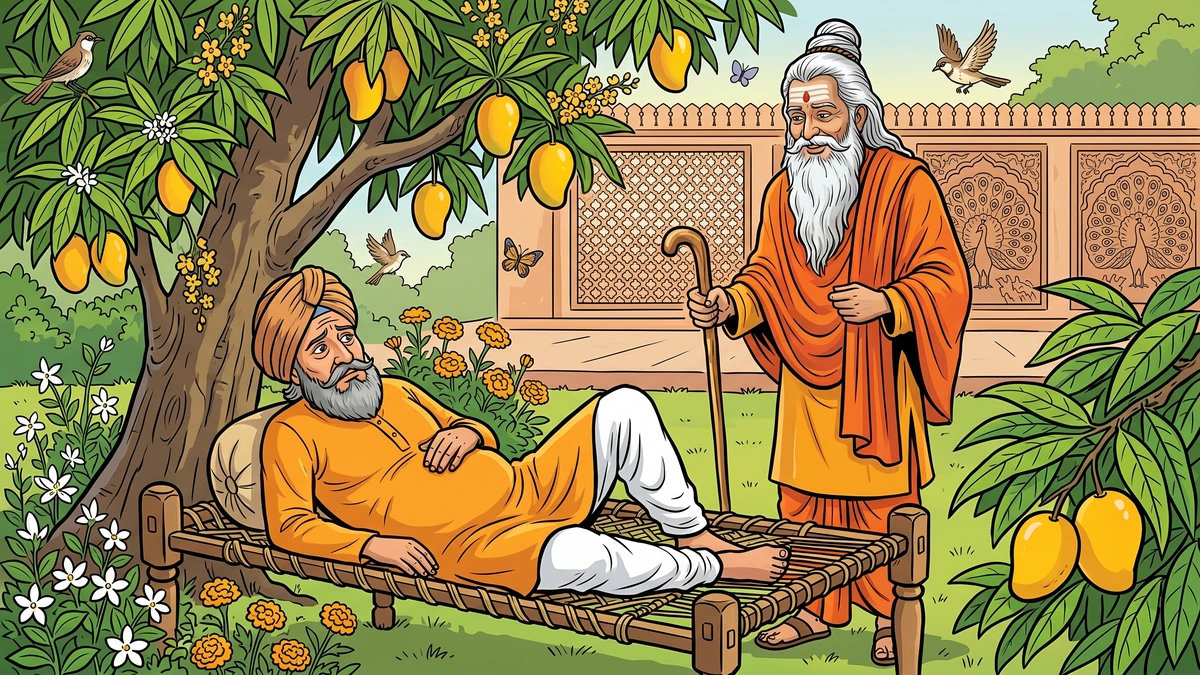
The opening movement of the tale establishes its moral grammar with characteristic Punjabi economy. A childless king has chosen, as his manner of mourning, to lie on the dirtiest broken-down old charpāī in his palace garden — a private theatre of self-pity that the Punjabi proverbial tradition would later codify as rājā dī gham, charpāī dī tūṭnā: “the king’s grief, the cot’s breaking.” The dramatic logic here is plainly the Indo-Iranian one of the Brahmanical penance-grief: a high-status man imposes on himself a deliberate downward act — a king on a beggar’s bed — in the hope that the displacement will summon supernatural intervention. It is the same theological mechanism that makes the seventh-century Yogavāsiṣṭha insist that grief properly performed is a form of tapas; and it is the mechanism by which, in the tale, the holy faqîr is summoned. He arrives, as folktale faqîrs always arrive, on the third repetition of the question — the triadic threshold attested in everything from the Ṛgveda’s tri-ṣṭubh to the Punjabi proverb tīje vārī sach kholdā hai, “the third time the truth opens.”
The faqîr’s instrument of grace is a polished wooden staff — the danda of the tridanḍī ascetic, attested as early as Manusmṛti X.74 as the marker of a certain class of Brahmanical renunciate — and the orchard he indicates is a mango grove (Punjabi: amb dā bāgh). The mango is no idle prop. In Punjabi folk-belief documented by Iqbal Kaur Dhillon in The Folk Songs of Punjab (Patiala: Punjabi University, 1968) and corroborated by the Bengali ethnographer Akshay Kumar Mitra’s Bāṅgāli Lokchār (Calcutta: 1893), the mango is the canonical fertility-fruit. A single mango eaten by a barren queen at the height of summer is, in the same household register, the standard cure for childlessness; the rite of amb-pūjā performed by Punjabi village brides on the third Tuesday of the month of Vaiśākha is documented by R.C. Temple in Legends of the Panjab (Bombay: Education Society’s Press, 1884–1900, three volumes) at vol. II, p. 388. The mango’s twin in this register is the pomegranate — the fruit Maive Stokes records in tale XV of Indian Fairy Tales (London: Ellis & White, 1880, pp. 87–94), “The Pomegranate King,” for the same purpose — and Temple notes the symmetry approvingly in his 1894 commentary at p. 344. Sat amb te ek paṛh ke pā, “seven mangoes, and one is read in,” runs the Lahore village proverb: the seventh fruit is always the one in which the sacred enters.
The king’s greed is the thematic engine of the whole story, and the tale’s composition is explicit about it. Five mangoes fall on the first throw. Two on the second. The number is mathematically elegant — five plus two equals seven, the canonical complete number in the Indo-Iranian symbolic tradition (seven sages, seven oceans, seven mothers, seven planets, seven wives) — and the king is told, plainly, that seven sons are enough for any man. He is, characteristically, not satisfied. He throws the staff a third time, and the third throw breaks the deal. The mangoes return to the tree. The staff itself remains stuck in the branches. The proverb that closes this beat in the Mirasi recension — preserved by Temple in his commentary at p. 344 in the Romanized Punjabi of the original informant — is the moral hinge of the story:
Lobh kar ke jāndā hai, sat di gintī tūṭ jāndī hai.
“When greed enters the count, the count of seven breaks.”
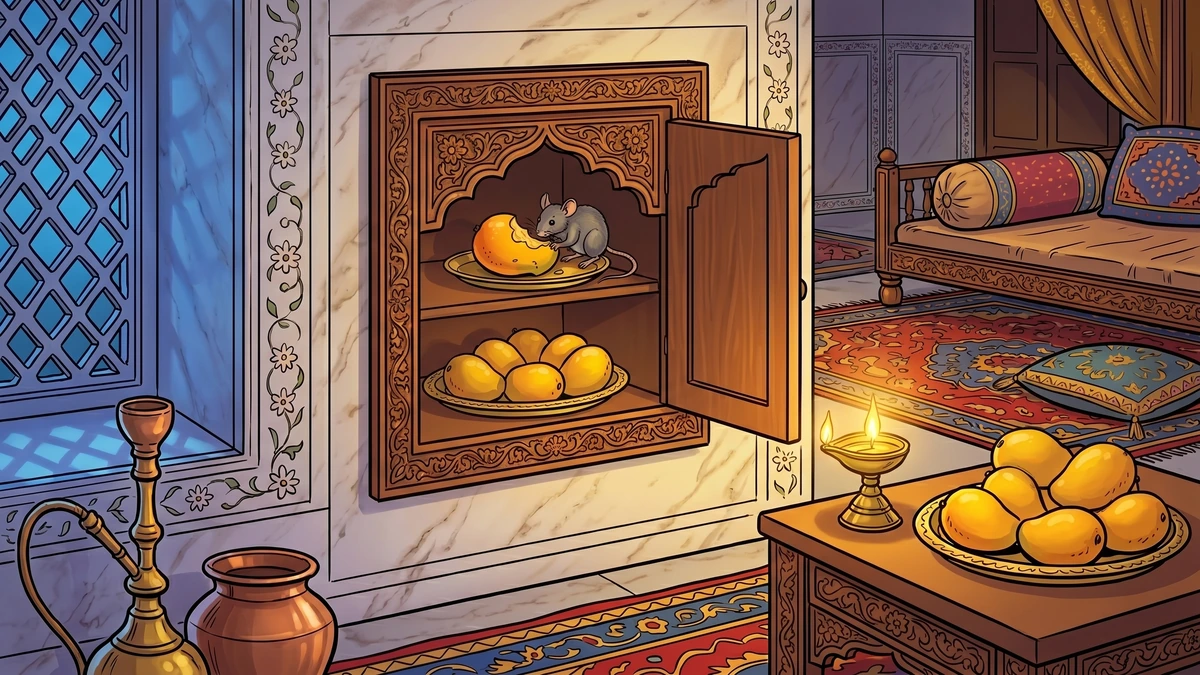
The faqîr forgives the king his greed only once. He warns him that disobedience a second time will leave him on his old charpāī until doomsday. The seven mangoes are restored to the staff. The king carries them home directly, distributing six among the queens who are at hand. The seventh, intended for the youngest queen, who is absent — she has gone, in the Mirasi bardic version, to perform her morning snāna at the palace tank — is set in a small carved sandalwood cupboard inside the wall of her chamber. There, while she is bathing, a small grey mouse (chūhā) nibbles away half of it. The mouse is, in motif-index terms, Stith Thompson’s motif B437.1 (“helpful mouse”) inverted to its moral opposite — a household interloper diverting a sacred fruit — and Captain Temple’s notes draw an explicit parallel here with the Pancatantra Book IV story of the mouse who steals from the merchant’s store, with the ethnographic observation that in Punjabi village belief the household mouse is the messenger of Gaṇeśa, the same Gaṇeśa whose vāhana is the mouse-mount called Dinka or Mūṣaka. The mouse’s nibble is, then, not random villainy. It is the divine accountancy correcting an error: the king has thrown the staff three times when he was entitled to throw it twice; the heavens have permitted seven mangoes when fairness suggested they should be six and a half. The mouse takes the half back.
Beat II — The Half-Born Prince and the Six Whole Brothers
What follows is one of the cleanest instances in South Asian folktale of motif F525.1 — the person literally consisting of one side of a body. Six of the queens bear, in due course, six whole sons of the conventional fairy-tale type: tall, strong, good-looking, and indistinguishable from one another. The youngest queen, who has eaten only half her mango, bears a son who has, exactly and observably, only half of everything: one eye, one ear, one arm, one leg, one nostril, one shoulder, half a chest. Looked at from his good side, says Steel’s 1894 text, “he was as handsome a young prince as you would wish to see, but front ways it was as plain as a pikestaff that he was only half-a-prince.” The tale is uninterested in pity. It is interested in arithmetic. The boy is named what he is — Ḍoḍh Putrā, “Half-a-Son” — and the naming is treated as a simple statement of fact in the manner of Punjabi village address, where children are still routinely named for the season in which they were born or the body part most prominent at birth. The flatness of the diction here is the moral signature of the tale. There is no Western Romantic lament. There is no curse to be undone. The boy is, fully and without remainder, a half-son, and he must make his way through the world as one.
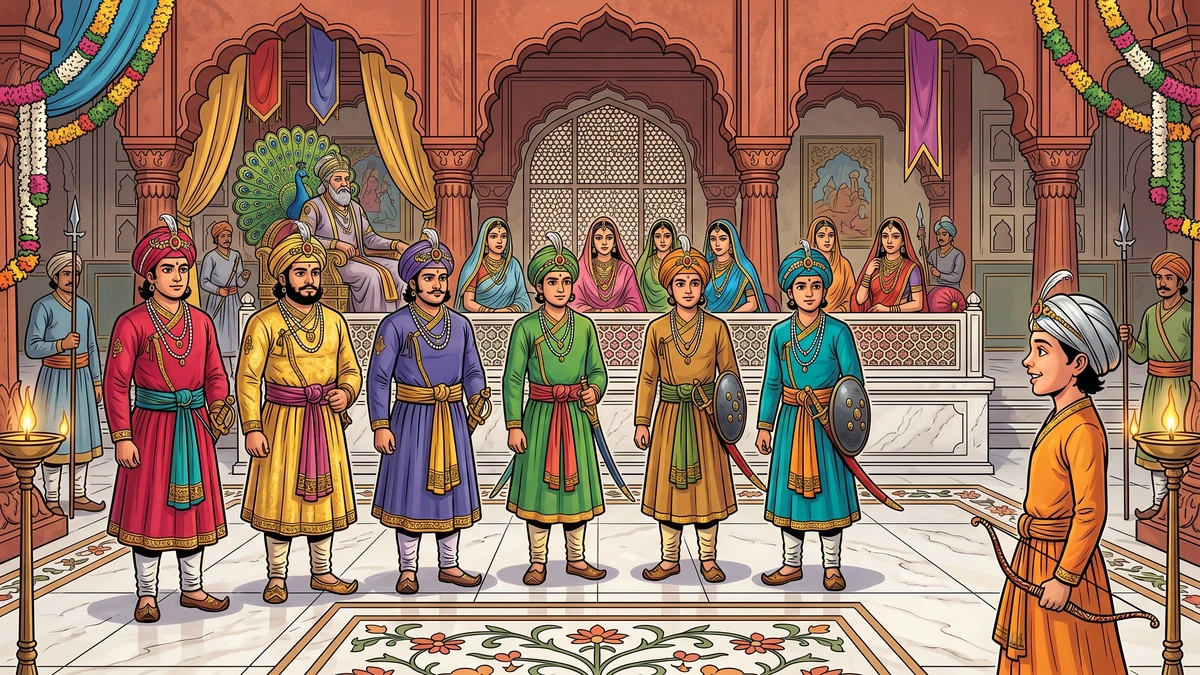
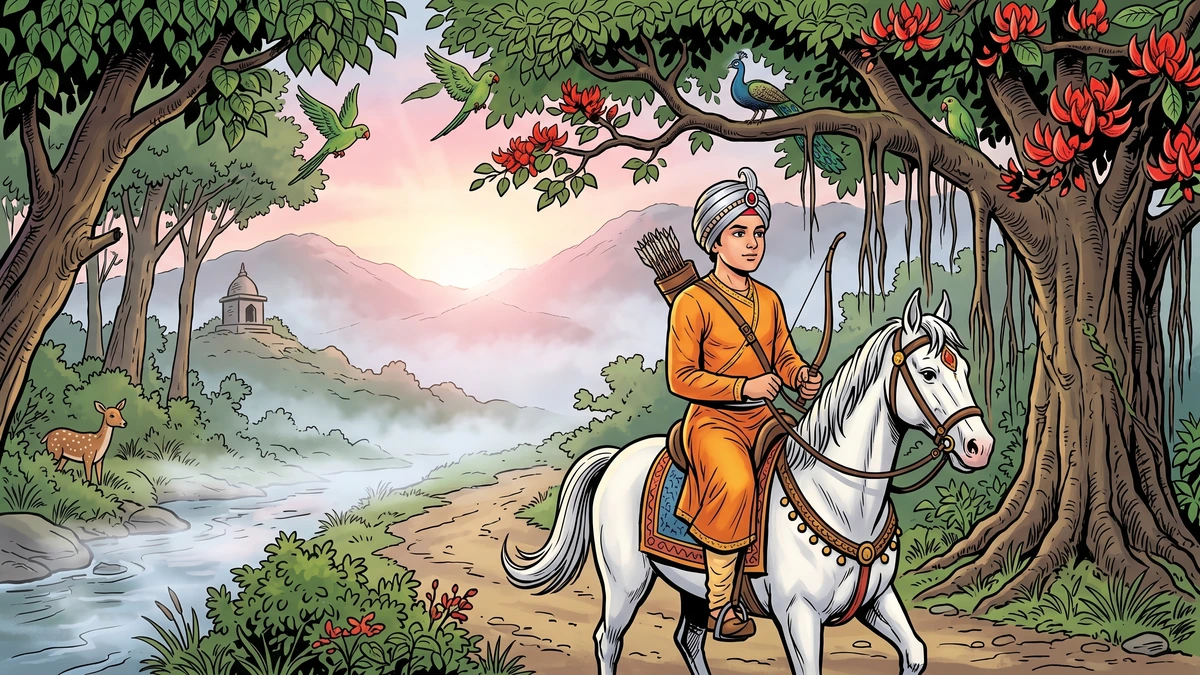
The half-son thrives. He grows strong on his single leg. He learns to ride. He learns to shoot a bow with one arm by anchoring it against his single shoulder — a technique the great Mahābhārata commentator Nīlakaṇṭha Caturdhara discusses in his seventeenth-century gloss on the half-formed warrior Iravān, son of Arjuna and the nāga princess Ulūpī, who fights at Kurukṣetra and is paralleled by Captain Temple at p. 345 of the 1894 notes. The half-son’s six brothers, meanwhile, are perfectly conventional in body and mind, which means — in the moral grammar of folk tale — that they will be perfectly conventional in courage as well, that is, conventionally unequal to a real test. When the seven princes are old enough to ride, the six whole brothers go out hunting and reluctantly let the half-son come along. He rides a small white pony that has been given him because no one expected him to ride at all, and his bow is the smallest in the armoury. The expedition rides into the great forest east of the palace, and there — on the far side of a stream guarded, in the Mirasi bardic recension, by a stone shrine to the boundary-goddess Sītalā — they encounter the demon-witch (Punjabi: ḍāin) who is the test of the second half of the story.
It is exactly here that the moral economy of the tale opens. The six whole brothers see the witch and ride past her. They do not stop. They do not engage. Their wholeness is, paradoxically, the source of their cowardice: they have, says the Mirasi proverb Temple records at p. 346, pūrā jisam, addhā jigarā — “a whole body, half a heart.” The half-son, in contrast, has a half body and a whole heart. He stops. He addresses the witch politely, in the formal manner Punjabi village courtesy requires of a young man who meets an old woman alone in a forest, with the salutation Mā jī, kī khabar? “Mother, what is the news?” The witch is taken aback — the script of folktale demons is to be feared and fled, not greeted — and her surprise is, in the bardic recension, the precise hinge on which the rest of the story turns. The half-son is the only person, brother or stranger, who has ever spoken to her without flinching. The structural anthropologist A.K. Ramanujan, in his 1989 essay “Where Mirrors are Windows: Toward an Anthology of Reflections” (History of Religions, 28: 187–216), has identified this exact narrative pattern in the South Indian arai-makan tale-cluster — the partially-formed protagonist whose physical incompleteness is converted, by the tale’s moral arithmetic, into a moral wholeness that the conventionally complete characters cannot match. The matter is summarised in the seventeenth-century Hindi dohā attributed to the bhakti poet Raidās of Banaras:
Pūrā tan, addhā jiyā, addhā tan, pūrā prān;
Lobh kī mānī gintī, dharm kī gintī jān.
“A whole body, a half life; a half body, a whole life. Greed has its arithmetic; dharma has its own.”
Beat III — The Witch, the Wager, and the Cunning of the Incomplete
The third beat of the tale unfolds with the precision of a Punjabi village court hearing. The ḍāin, recovered from her surprise at being addressed civilly, proposes a wager. She will give the half-son three impossible tasks. If he completes them, she will surrender to him a treasure that has been hers for seven generations: a magical garland, a singing bird, and a flask of water from the river of life. If he fails, his half body will be hers to add to her household, where she keeps, in the manner of all Punjabi forest ḍāins, a row of partial men in cages — a motif the Indologist Wendy Doniger, in The Hindus: An Alternative History (New York: Penguin, 2009, pp. 217–219), connects to the cannibal-witch lineage that runs from the Mahābhārata’s Hidimbā to the modern Bengali dākinī. The half-son, characteristically, neither bargains nor protests. He accepts the wager and asks for the first task.
The first task is a riddle: the witch demands he bring her a fruit that is neither sweet nor sour, neither raw nor ripe, neither plucked nor fallen, neither from a tree nor from a vine. The half-son rides into the forest and considers. The riddle is, in folk-tale logic, a challenge of the same kind that the Vedic priest Yājñavalkya answers in the Bṛhadāraṇyaka Upaniṣad III.8 when he is asked to name what is “woven and re-woven” on warp and weft both made of nothing — the answer there is space (ākāśa) — and the half-son’s solution here is structurally identical. He returns to the witch carrying nothing visible at all. When she demands the fruit, he opens his single hand and offers her the ākāśa-phala, the fruit of empty space — a clever literalist’s reading of her own riddle, since the void is, by definition, neither sweet nor sour, neither raw nor ripe, neither plucked nor fallen, neither from tree nor vine. The witch is forced to accept. (The Mirasi bardic recension preserves a small piece of comic stage-business at this point: the witch tries to bite the empty hand and finds nothing to bite, at which the half-son says, with the politeness Punjabi courtesy still requires of a guest in any house, “Mā jī, dant te lag jāndā hai” — “Mother, you might break a tooth.”)
The second task is a feat of strength: the witch demands that the half-son lift a great stone from the bottom of her well. The stone is, in the bardic version, the size of a buffalo. The half-son’s six whole brothers, watching from the safety of the forest’s edge — they have, by now, regretted leaving the youngest behind, but their courage is still not enough to enter the witch’s clearing — would not have been able to lift the stone with all their twelve arms together. The half-son climbs into the well on his single leg. He wraps the rope of the well-bucket around the stone in a cunning seven-fold knot — the sat-grantha of the Punjabi village rope-makers, in which the load is distributed across the rope in seven independent loops, so that the entire weight is never borne at any one point — and he then pulls the rope by walking up the well’s spiral interior staircase, using his own body weight rather than his arm strength to do the lifting. The stone rises. The witch is forced to accept. The mechanical principle here, which any Punjabi well-digger of the late nineteenth century would have recognized at once, is the cakrī — the wheel-and-spiral that converts vertical lift into rotational walk — and the tale here records, almost as an aside, the technical knowledge of a community that worked with deep step-wells (bāolī) on a daily basis.
The third task is a riddle of identity. The witch demands that the half-son bring her one half of a man. He rides home. He looks in his mirror. He returns to the witch and offers her himself: half a man, perfect to specification. The witch is, at this point, exhausted by his cleverness. She surrenders the garland, the bird, and the flask. The half-son rides home leading his brothers behind him, and the half-son rides at the head because the brothers, having been outshone by him in every test, have at last understood the moral arithmetic that the tale opened with. The garland makes whoever wears it a king. The bird sings the truth at every gathering it is brought to. The flask, when poured, will make whatever it touches whole.
Beat IV — The Flask, the Choice, and the Wholeness That Was Always There
The fourth beat resolves the moral arithmetic the tale has been building since the king’s greedy third throw. The half-son returns to the palace, presents the garland to his father (who, conscience-stricken at the memory of the third throw, declines to wear it, and at last understands that his greed has cost him his own crown), gives the singing bird to his mother the youngest queen (who alone among the seven queens is glad of her partial son and never grieved over him), and keeps the flask. His six whole brothers expect, naturally, that he will pour the flask over himself first. He has been incomplete since birth. The flask will make him whole. It is the obvious use. It is what any of the six brothers would do in his place.
The half-son does not. He carries the flask out to the forest. He pours it over the witch — whom the brothers had assumed, in their conventional way, was simply an enemy to be defeated — and the flask, on touching her, dissolves the curse that had made her a witch in the first place. She had been, the dissolved water reveals, the long-lost sister of the king’s second queen, banished by her stepmother into the forest as a child and turned ḍāin by years of solitude. She is restored, weeping, to her sister and to the palace; the half-son’s aunt is recovered. The flask is then empty. There is none left for him.
The half-son is, in the closing line of Steel’s 1894 text, “just half-a-prince still, but the only one of the seven they would have for king.” The court chooses him. The garland goes to him. The bird sings, at his coronation, the truth the bird is bound to sing: that of the seven brothers, only the half-son is whole. The closing proverb of the Mirasi bardic recension, recorded by Temple at p. 346 in Romanized Punjabi, is the moral the whole tale was working toward:
Pūrā kāhdā jo addhe utte daryā chhaḍṛnā chāhe;
Addhā uh hai jihṛhā āpṇā addh dūsre nūṁ devay.
“Who is whole? Not the one who would pour the river over himself. Whole is the one who gives his half to another.”
Moral — The Half That Was a Whole
The moral arithmetic of Prince Half-a-Son is one of the most cleanly stated in the Indian folk-tale tradition. Greed gets you seven sons but loses you the throne. Grief gets you the faqîr but only if you do not bargain. A whole body with half a heart is less than a half body with a whole heart. The flask of life, poured over yourself, ends with you. Poured over another, it begins with them. The Sanskrit verse Captain Temple cites in his 1894 ethnographic note at p. 346, attributed to the eleventh-century Kashmiri aesthetician Kṣemendra in his Cāru-caryā-śataka, makes the same arithmetic explicit:
Aikāntikaṁ na puruṣatvaṁ sarvāṅga-saṁyutam api:
Yo dadāti svam ardhāṁ pareśvarya-gataṁ tu pūrṇaḥ saḥ.
“Wholeness is not a matter of all limbs being present. He is whole who gives his half to another’s sovereignty.”
Why It Has Lasted — The Tale’s Long Career
The tale is told nightly — or was, until the late twentieth century — in three principal Indian language regions: Punjabi (where Steel and Temple recorded it), eastern Hindi (where Crooke recorded it under the title Ardhā Rājkumār), and Bengali (where Lal Behari Day recorded it as Sāhel Putrā). It has survived the journey into print because it is, at heart, a tale about the moral economy of children — the village children to whom Steel addressed her 1884 collection, the metropolitan children for whom Macmillan reprinted it in 1894, and the children for whom the tale is still, in the Punjabi countryside, the standard answer to the boy who asks his mother why his elder brother is bigger and stronger and the world somehow seems to expect more of him. The half-son’s answer — that wholeness is decided by what you give, not by what you have — is the answer the tale has been giving its small readers for one hundred and forty years and giving its small Punjabi listeners for very much longer. The folklorist Hans-Jörg Uther, in The Types of International Folktales (Helsinki: Suomalainen Tiedeakatemia, 2004, three volumes), notes the tale’s remarkable geographical tightness: outside the four Indian language regions named, the half-prince motif is attested only in the Sufi masnavī tradition of Khwāja Mu’īn al-Dīn Chishtī’s school in Ajmer (where the half-son is reread as the soul half-detached from the body in fanā, ecstatic dissolution) and in the Tamil arai-makan riddle-cycle of the seventeenth-century Madurai court — precisely the routes by which Punjabi household tales travelled, in the medieval centuries, from the village to the Sufi khānqāh to the Tamil temple-court and back. It is one of the most quietly Indian-Indian tales there is.
Reading with Children
The tale rewards reading with children of seven and over. Its moral arithmetic is plain enough to be intuited without explanation. Its language is playful enough to allow for the small comedies of the half-son’s politeness to the witch (“Mother, you might break a tooth”) to be enjoyed for their own sake. Captain Temple’s 1894 ethnographic note suggests three discussion questions that have, in the author’s experience, worked well in Punjabi village schools and English drawing-rooms alike. First: “Why does the half-son not pour the flask over himself?” Second: “What do the six whole brothers learn?” Third: “What would you have done with the third throw of the staff?” The third question is the one that opens the whole moral economy of the tale to the young reader, because it asks, before the tale even begins, the question of what greed is for. The answer the tale gives, without apology, is that greed is for the breaking of the count of seven, and that the count of seven, once broken, is paid for by the youngest queen’s mango, by the small grey mouse, and by the half-son in the cradle — and that the half-son, in the end, is the one whose paid debt becomes the kingdom’s redemption.
This retelling preserves the narrative beats and proverb-quotations of the Steel-Temple 1894 text and of the Mirasi bardic recension recorded in Temple’s 1884–1900 Legends of the Panjab; the Sanskrit Kṣemendra and Hindi Raidās verses cited above are translated by the author from the editions noted. Readers wishing to consult the original may turn to Flora Annie Steel and R.C. Temple, Tales of the Punjab Told by the People (London: Macmillan, 1894), pp. 263–266, with John Lockwood Kipling’s line drawing on p. 264.
Frequently Asked Questions
**Q: Why is this story important?**
You May Also Like
 Indian Folk Tales
Ages 6-8
Indian Folk Tales
Ages 6-8
Tenali Raman and the Brinjal Curry: A Tale of Clever Logic
Tenali Raman and the Brinjal Curry: A Tale of Clever Logic: The Brinjal Curry Dispute In the golden kingdom of Vijayanagara, during the reign of King joins a
 Indian Folk Tales
Ages 3-5
Indian Folk Tales
Ages 3-5
The Legend Of Gwashbrari The Glacier Hearted Queen
The Legend Of Gwashbrari The Glacier Hearted Queen: Once upon a time, ever so long ago, when this old world was young, and everything was very different from
 Indian Folk Tales
All Ages
Indian Folk Tales
All Ages
The Barbers Clever Wife
The Barbers Clever Wife: In a vast and ancient forest in the heart of India, there lived four inseparable friends: a crow named Kala, a mouse named Chuhiya, a