Si Tanggang: The Ungrateful Son and the Curse of Stone
Si Tanggang: The Ungrateful Son and the Curse of Stone: In a small fishing village nestled along the Malaysian coast, where the sea whispered ancient secrets
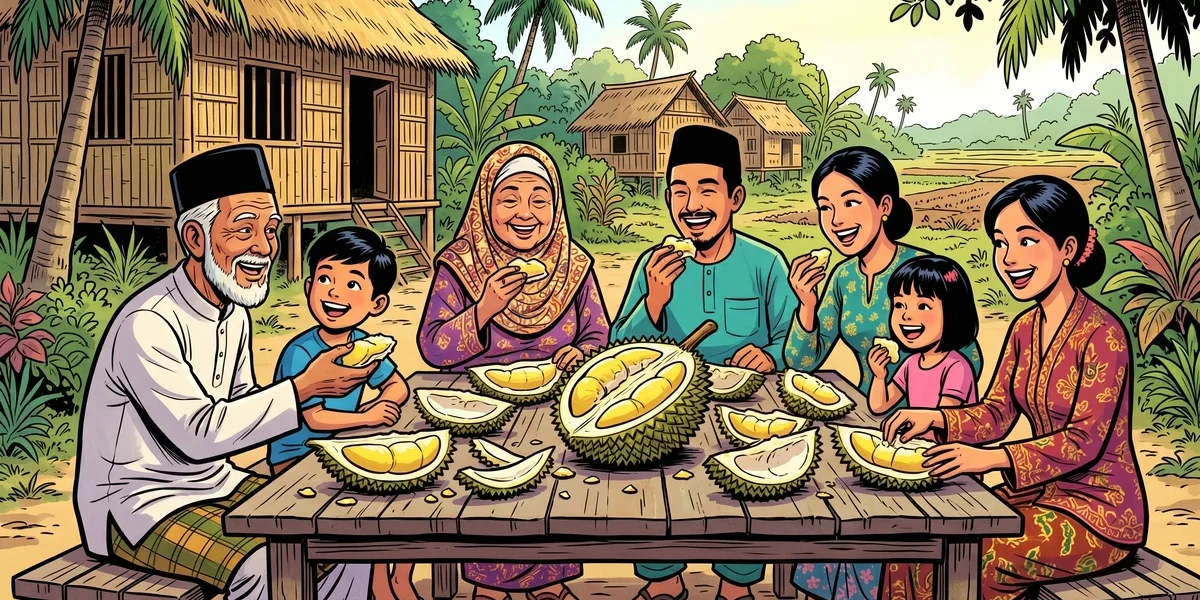
Among the great legend cycles of the Malay world, no story has achieved a more durable moral authority than the tale of Si Tanggang—a young man of humble origins who goes to sea, accumulates wealth and a new wife, and returns to his home village so transformed by prosperity that he denies his own mother to her face, calling her a beggar woman he does not know. The punishment that follows is swift, total, and geological: Si Tanggang, his ship, his crew, and all his worldly possessions are turned to stone by divine judgment. In the mouth of the Sungai Batu Pahat (Stone Cutting River) on the west coast of the Malay Peninsula, certain rock formations are pointed to by local guides as the petrified remains of the ship, the mast, the rice pots, even Si Tanggang himself—a landscape made mythological by the pressure of a moral lesson five centuries or more in the making.
The story belongs to a global family of “ungrateful son” narratives that folklorists classify under ATU tale types 923 and 935, but its specifically Malay articulation carries features that distinguish it sharply from its European cousins. Where Western variants of filial ingratitude tend toward economic or dynastic stakes—the son who disinherits his father, the daughter who likens her love to salt—Si Tanggang’s catastrophe is existential and cosmological. He does not merely wrong his mother; he violates the foundational Malay moral order of budi (gratitude, goodness, social debt) and incurs the wrath not just of his mother but of God, nature, and the sea itself. The storm that precedes his petrification is not random weather but divine response, and the conversion of flesh into stone is understood as a literalization of what he had already done spiritually—he had made himself stone-hearted, and the universe confirmed it in geology.
The legend is attested in written form from at least the 17th century in Malay manuscript traditions, but oral variants are certainly older. The Portuguese chronicler Tomé Pires, writing about the Malay Peninsula around 1515, does not mention Si Tanggang by name, but his descriptions of Malay moral culture and the centrality of mother-son bonds in coastal trading communities suggest the social substrate from which such a story would naturally emerge. The story’s geographical anchoring at Batu Pahat—a real place with real stones that can be visited—gives it an unusual credibility claim: this is not a story about somewhere, it is a story about here, confirmed by evidence in stone.
The Story in Its Classic Form
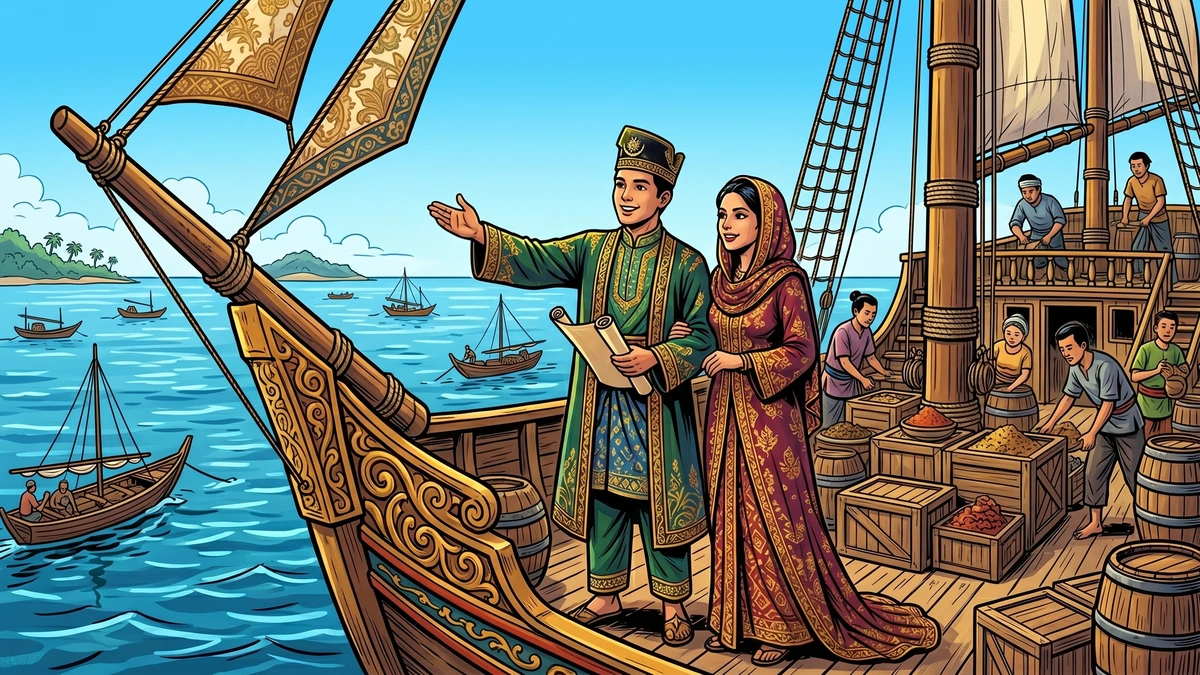
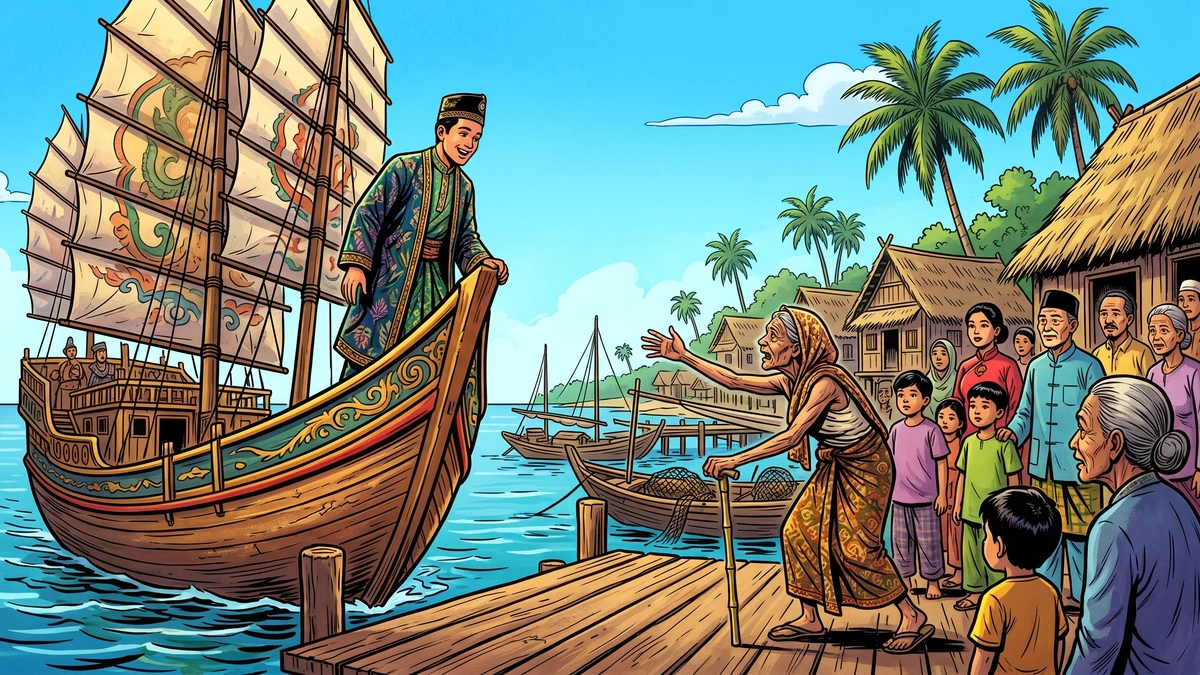
In the most widely circulated version of the tale, Si Tanggang is born to a poor widow in a small Malay fishing village. He is a bright and ambitious child who chafes against poverty, and when a wealthy merchant’s ship anchors in the village, he begs to be taken on as a cabin boy. His mother, though heartbroken, gives her blessing and her few possessions to help him on his way. Years pass. Si Tanggang rises through the merchant’s service, proves himself capable, earns the merchant’s trust, and eventually marries the merchant’s daughter—a union that transforms him from servant to son-in-law and heir to a trading empire. He acquires his own ship, his own crew, and the fine clothes and manner of a wealthy nakhoda (sea captain).
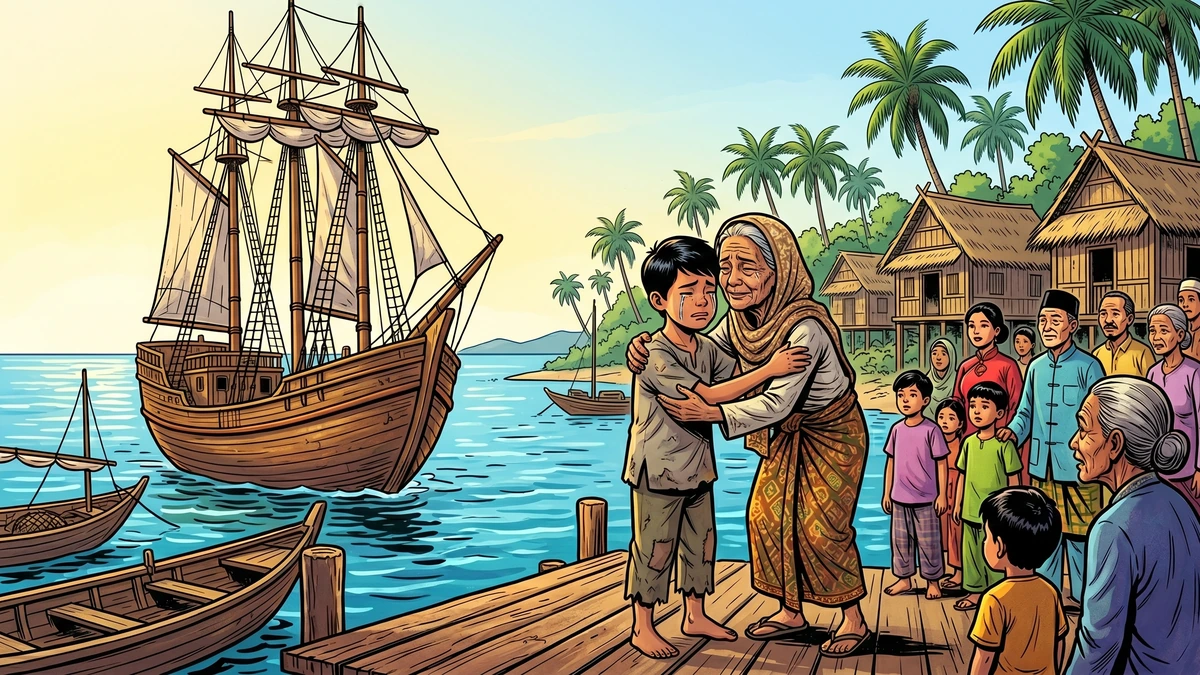
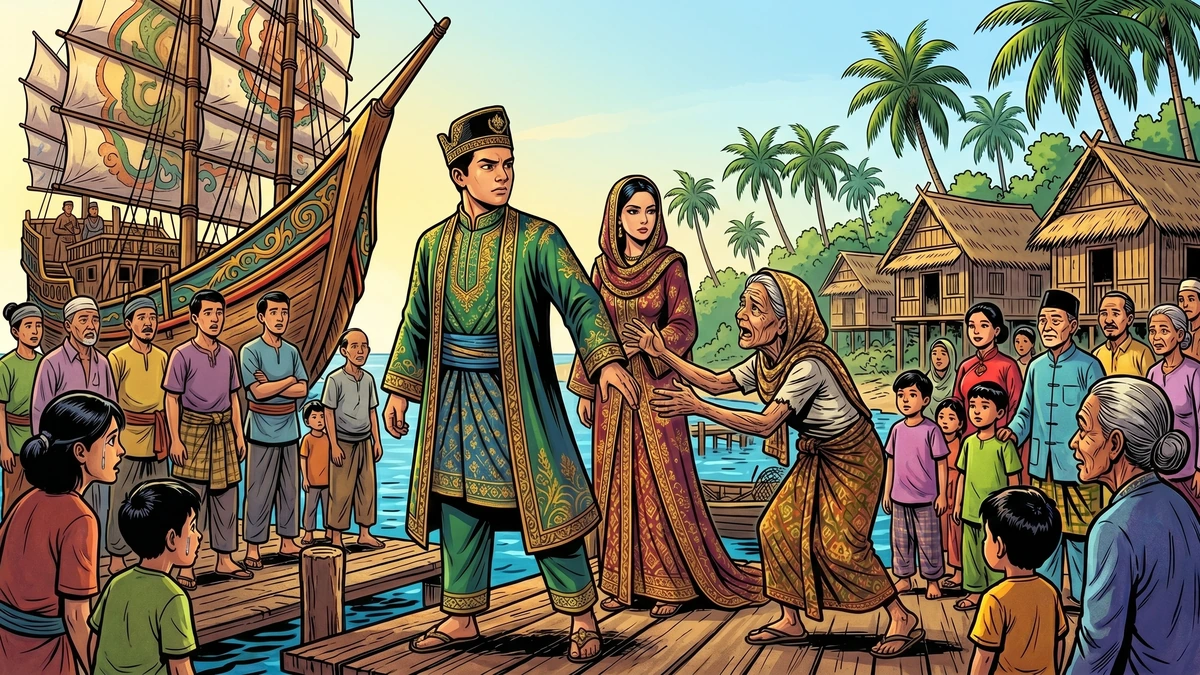
When he returns to his home village—in some versions to trade, in others by accident of navigational necessity—his mother recognizes him on the dock. She calls out to him, calls him by the childhood name she gave him, tries to embrace him. But Si Tanggang, in the presence of his elegant wife and his crew, is ashamed of her poverty and her familiarity. He denies that she is his mother. He calls her an old beggar woman who mistakes him for someone else. In the cruelest variants, he pushes her away publicly. In some tellings, his wife asks who the old woman is, and he says: “She is nobody. She is a madwoman who thinks I am her son.” His mother, devastated and weeping, turns to the sky and prays—or curses, depending on the variant—asking God to confirm whether she is truly this man’s mother.
The response is immediate. The sky darkens. A storm rises from a clear day. The ship is seized by supernatural forces—in some versions by a great wave, in others by the earth opening, in others by lightning that strikes the mast and spreads downward through hull and hull-timbers. Si Tanggang, his wife, his crew, his cargo, and the ship itself are turned to stone where they stand. The mother—now called Mak Si Tanggang (Si Tanggang’s Mother) in the tradition, her own name never given, her identity entirely defined by the relationship he denied—is left on the shore, her prayer answered in the most terrible and literal way imaginable.
The Moral Architecture of Budi and Its Violation
To understand why Si Tanggang’s act carries such cosmic weight in Malay tradition, it is necessary to understand budi—a concept that occupies in Malay ethics approximately the position that dharma occupies in Hindu thought or ren (benevolence) in Confucian philosophy: it is the master moral concept from which all specific virtues derive. Budi encompasses goodness, wisdom, gratitude, and the recognition of social debt. Its opposite, tidak tahu budi (not knowing budi), is the worst accusation that can be made of a person in Malay culture—a declaration that the accused has lost their essential humanity.
The mother-child relationship in Malay culture is understood as the paradigmatic relationship of unreturnable debt: a mother gives life, sustenance, suffering, and love, and all of this can never be fully repaid by the child. This creates a permanent moral asymmetry that is not oppressive but sacred—it is the foundation of hormat (respect) and kasih sayang (loving affection) as social values. For Si Tanggang to deny his mother is not merely rude or unkind; it is to declare that the foundational moral debt of his existence does not exist, that his own life is not owed to anyone, that he has made himself from nothing. This is both morally monstrous and cosmologically impossible—and the stone transformation enacts the universe’s refusal of the impossible.
Malay scholar Syed Hussein Alatas, writing in The Myth of the Lazy Native (1977), situates Si Tanggang within a broader pattern of Malay narrative ethics that consistently prioritizes relational loyalty over individual advancement. The merchant class (saudagar) in Malay culture was always potentially suspect—wealth accumulated through trade could loosen the social bonds of village and family, could make a man think of himself as self-made. Si Tanggang, in this reading, is not merely an ungrateful individual but a type: the man who mistakes commercial success for self-creation, who confuses wealth with ontological independence. The story is a warning to the trading culture of the Malay world about what happens when commercial logic overrides relational ethics.
Regional Variants and the Pan-Southeast Asian Pattern
Variants of the Si Tanggang legend appear across the Malay-speaking world with significant differences in detail that illuminate the range of moral concerns the story can carry. In the Minangkabau (West Sumatran) version, the story is inflected by the matrilineal social structure of Minangkabau society: the protagonist’s sin is not merely personal ingratitude but a violation of the adat (customary law) system that positions the mother as the center of family lineage and property. His denial of his mother is, in this context, a denial of his entire lineage and legal identity—he has effectively declared himself to have no family, no adat rights, no claim to anything.
In Indonesian Kalimantan (Borneo) variants, the story is often merged with local Dayak origin narratives and the stone transformation is explained through the power of a specific ancestral spirit rather than divine punishment per se—the mother’s prayer reaches not Allah but the antoh (ancestor spirits) who enforce the moral order of the forest world. This syncretism reflects the historical layering of Austronesian animist, Hindu-Buddhist, and Islamic frameworks in the region, with the Si Tanggang story flexible enough to accommodate all three theological explanations for why the stone punishment happens.
Thai and Cambodian variants—less directly connected but clearly related through the shared Austronesian and Hindu-Buddhist cultural substrate of mainland Southeast Asia—tell stories of children who deny parents after achieving wealth, with similar stone or natural-transformation punishments. In Thai tradition, the story of Nang Tani (the banana tree spirit) is sometimes told in adjacent narrative clusters as its complement: where Si Tanggang shows the punishment of ingratitude to a living mother, Nang Tani shows the supernatural protection available to those who honor women and the natural world. The Javanese tradition preserves the closest Indonesian parallel in the story of Malin Kundang—so close in narrative structure that most scholars treat them as variants of the same text, with the main differences being in the geographical setting (West Sumatra for Malin Kundang, the Malay Peninsula for Si Tanggang) and the specific theological framing.
The Malin Kundang variant from Padang, West Sumatra, has its own petrified rock formation at Pantai Air Manis (Sweet Water Beach), just as Si Tanggang has Batu Pahat—demonstrating the pattern of geographical anchoring that gives these legends their special authority. Scholars including Danandjaja (1984) in his study of Indonesian folklore have noted that “proof stones” of legendary events are a consistent feature of Malay-world legend culture, functioning as what folklorist Jan Vansina calls “testimony objects” that transform oral tradition into quasi-documentary evidence. The stone is the story’s credential.
The Indian Connection: Filial Piety Across Traditions
The conceptual world of Si Tanggang bears unmistakable traces of Hindu-Buddhist influence mediated through centuries of Indian contact with the Malay Peninsula. The concept of dharma as cosmic law that enforces moral behavior through natural consequence maps directly onto the Si Tanggang narrative’s mechanism—divine punishment expressed through geological transformation. Sanskrit literary culture, absorbed into Malay tradition through the kingdoms of Srivijaya (7th–13th centuries CE) and Majapahit (13th–15th centuries CE), is rich in stories of those who violate dharma being transformed into animals, trees, stones, or rivers—the shaapa (curse) tradition is a major narrative device in the Mahabharata, Ramayana, and the Puranas.
The most direct Indian parallel to Si Tanggang appears in the Ramayana’s depiction of Shravan Kumar—the paradigmatically devoted son who carries his blind parents on a yoke across the country for their pilgrimage, and whose death by Dasharatha’s arrow triggers a parental curse that rebound on Dasharatha’s own family. Shravan Kumar is the positive exemplar of filial devotion; Si Tanggang is the negative. Both stories exist to establish the same moral principle—that parents are owed absolute devotion—through mirror-image narrative strategies. It is not coincidental that the Ramayana was well known throughout the Malay world; the Hikayat Seri Rama, the Malay version of the Ramayana, was one of the most copied and circulated texts in the Malay manuscript tradition, and its moral framework permeates Malay narrative ethics.
Tamil traders who settled in the Malay Peninsula from the 9th century onward—and whose presence is archaeologically documented at Bujang Valley and other sites—brought with them Tamil literary traditions including the Sangam poetry’s emphasis on anbu (love) and aram (dharma/right conduct), as well as the Tirukkural’s celebrated maxims on the duties owed to parents. Verse 70 of the Tirukkural by Thiruvalluvar states: “Of what avail is wisdom if one fails to cherish one’s parents with tender care?” This sentiment finds its narrative embodiment in Si Tanggang’s story with such precision that cultural transmission rather than independent invention seems the more economical explanation.
The Story in Contemporary Malaysian Culture
Si Tanggang has achieved a level of cultural saturation in Malaysia that transcends its folkloric origins. The phrase macam Si Tanggang (like Si Tanggang) is a standard insult in Malay—applied to anyone who forgets their origins after achieving success, who abandons family for wealth, who pretends not to know those who helped them rise. It is used in political discourse, in parenting lectures, in literary criticism, and in social media pile-ons. The story is part of the Malaysian primary school curriculum, taught as an exemplar of Malay moral values, and has been adapted into film, television, theatrical productions, and children’s picture books.
The most celebrated literary treatment is Noordin Hassan’s 1974 play Bukan Lalang Ditiup Angin (Not the Grass Blown by the Wind), which uses Si Tanggang as a framework for exploring post-independence Malay identity—the question of whether modernization and westernization represent a Si Tanggang-style denial of cultural origins. This politicization of the legend reflects its extraordinary capacity for allegorical extension: the “mother” can stand for the Malay village, for Islamic tradition, for the Malay language, for the kampung social world threatened by urban migration and economic development. Si Tanggang in this reading becomes not just an individual moral failure but a template for understanding collective cultural betrayal.
The Batu Pahat rock formations—the physical “evidence” of Si Tanggang’s punishment—have become a heritage tourism site, with signage, interpretation centers, and guides who tell the story to visitors. The rocks themselves have been subjected to geological analysis, which of course reveals them to be ordinary sandstone formations of natural origin, but this scientific explanation exists in a completely different register from the mythological one—both are true in their own domains, and Malaysians who know the geology still point to the rocks as Si Tanggang’s ship with unironic conviction. The story and the stone have become mutually sustaining: the story explains the stone, and the stone confirms the story.
Feminist Readings and the Problem of the Mother’s Name
Contemporary Malaysian and Singaporean scholars have noted with increasing emphasis a troubling structural feature of the Si Tanggang legend: the mother has no name. In every variant, she is identified only by her relationship to her son—Mak Si Tanggang, “Si Tanggang’s Mother”—her identity entirely constituted by her maternal role and specifically by her relationship to the son who denied her. Feminist folklorists including Tan Chee Beng and Maznah Mohamad have argued that this anonymity is not incidental but structurally significant: the legend makes the mother’s namelessness the price of the story’s moral authority. If she had a name, she would be an independent person; as “the mother,” she is a moral category, a prop in Si Tanggang’s story rather than the protagonist of her own.
This reading opens productive questions about whose story Si Tanggang actually is. The narrative is structured as Si Tanggang’s story—his ambition, his rise, his fall—but the moral weight rests entirely on his mother. She is the wronged party, the pray-er whose prayer is answered, the person whose suffering triggers divine action. And yet she disappears after her curse/prayer is made, left on the shore while the legend rushes after the petrification of her son. What happens to her afterward? The classic tellings do not say. Contemporary retellings—particularly by Malay women writers—have begun to fill this silence, writing the mother’s interiority into the story, imagining what she felt standing on the shore watching the storm devour her son, whether grief or vindication or both at once.
The Malaysian novelist Faisal Tehrani’s 2013 novel Tuhan Manusia (God and Man) uses Si Tanggang as a structural reference for a story about contemporary urban Malays losing their spiritual moorings—a meditation on what it means to become stone-hearted in a modern city as opposed to on a medieval sea. The legend’s flexibility for such reapplication is remarkable: its moral core (the danger of forgetting origins and debts) is sufficiently universal to map onto virtually any context of economic and social change, which explains why a story rooted in medieval Malay maritime culture remains urgently relevant in 21st-century discussions of Malay identity, religious practice, and the tension between individual ambition and communal obligation.
The Ecological Imagination of the Stone Transformation
The literalism of Si Tanggang’s punishment—not death, not poverty, not exile, but petrification—deserves particular attention as an ecological and cosmological statement. Stone is the material of permanence; to become stone is to be frozen in the moment of one’s worst act, permanently. There is no possibility of redemption, no second chance, no repentance that arrives in time. The punishment forecloses the future, converting the dynamic story of a life into a static geological fact. This finality is unusual in world folklore, where divine punishments often allow for eventual release or transformation—the enchanted beast who can be disenchanted by love, the cursed maiden who can be freed by a true hero. Si Tanggang gets no such release in the classic tradition.
Some scholars, including Werner Kraus writing on Malay cosmology, have noted that the stone punishment in Si Tanggang participates in a broader Southeast Asian mythology of landscape formation in which significant moral events leave permanent marks on geography. Waterfalls, unusual rock formations, distinctive islands and peninsulas are explained throughout Southeast Asian folklore as the residue of dramatic acts—battles between gods, punishments of the wicked, transformations of the devoted. This is a landscape that is morally legible, in which the physical environment carries the memory of human ethical behavior. To walk past the Batu Pahat rocks is to walk past a preserved moral lesson, a geological sermon.
The ecological dimension extends to the sea itself, which in Si Tanggang is not merely a setting but an active moral agent. The storm that rises in response to the mother’s prayer is the sea’s judgment as much as God’s; the wave that seizes the ship is the ocean asserting its own moral order. This resonates with the Malay maritime worldview, in which the sea (laut) is deeply personified and possessed of its own spiritual demands. The sea god Tok Wali or the various sea spirits (hantu laut) in Malay folk belief are not simply dangerous; they are morally demanding, requiring proper conduct from those who sail over them. Si Tanggang’s disrespect for his mother violates not just human norms but the moral order of the sea he travels, and the sea takes its revenge.
Si Tanggang endures as one of Southeast Asia’s most powerful moral narratives because it refuses the comfortable resolution of most cautionary tales. There is no redemption arc, no moment of recognition before the punishment falls, no last-minute repentance. The legend is uncompromising in its insistence that certain acts cannot be undone, that certain debts cannot be denied without cosmic consequence. In an era of rapid urbanization, global mobility, and weakening extended family bonds across Southeast Asia, the story speaks with renewed force to anyone who has left their village for the city, their kampung for a foreign country, their origins for an arrival—asking whether, in the act of becoming someone new, they are in danger of becoming Si Tanggang, and whether the storm is already building on the horizon.
You May Also Like
 Indian Folk Tales
All Ages
Indian Folk Tales
All Ages
The Billy Goat And The King
The Billy Goat And The King: In the ancient kingdom of Varanasi, there lived a king who was known for his piety and his devotion to religious rituals. The
 Indian Folk Tales
Ages 3-5
Indian Folk Tales
Ages 3-5
The Lambikin 2
The Lambikin 2: Once upon a time there was a wee wee Lambikin, who frolicked about on his little tottery legs, and enjoyed himself amazingly. Now one day he
 Indian Folk Tales
All Ages
Indian Folk Tales
All Ages
The Barbers Clever Wife
The Barbers Clever Wife: In a vast and ancient forest in the heart of India, there lived four inseparable friends: a crow named Kala, a mouse named Chuhiya, a