Prince Wicked And The Grateful Animals
Prince Wicked And The Grateful Animals: Once upon a time a king had a son named Prince Wicked. He was fierce and cruel, and he spoke to nobody without abuse
Prince Wicked and the Grateful Animals is one of the best-loved tales in the Buddhist Jātaka literature. It is recorded in Pali as the Saccaṅkira-Jātaka (also transliterated Saccaṃkira), tale No. 73 of the Ekanipāta (the Section of Single-Verse Birth Stories) in Volume I of the Jātaka collection — a corpus of 547 stories of the Buddha’s previous lives that took shape in northern India between the third century BCE and the fifth century CE. The standard scholarly English rendering is by Robert Chalmers in The Jātaka, or Stories of the Buddha’s Former Births, edited by E. B. Cowell, Cambridge University Press, 1895, Volume I, pages 177–181. The popular children’s retelling that circulates on most Indian story sites — including the version that has lived on this page for years — is the abridgement by Ellen C. Babbitt in More Jātaka Tales (illustrated by Ellsworth Young, The Century Co., New York, 1922), tale 25, drawn directly from Chalmers and pruned for the schoolroom. Folklorists classify the tale under Aarne-Thompson-Uther type ATU 160 “Grateful Animals; Ungrateful Man”, with motif clusters W154 (ingratitude), B361 (animals grateful for rescue), Q281 (ingratitude punished), N271 (murder will out), and B435.4 (helpful rat).
I. A Prince Like Grit in the Eye
The frame story is set in Veluvana, the Bamboo Grove monastery near Rājagaha that King Bimbisāra had given to the Buddha. The monks, seated in the Hall of Truth (Dhammasabhā), were discussing how Devadatta — the Buddha’s cousin and the great schismatic of the Saṅgha — had been going about plotting to kill the Master. Hearing the conversation, the Buddha smiled and said: “This is not the first time, monks, that Devadatta has gone about to kill me; he did the same in bygone days.” And he told the story of a former birth.
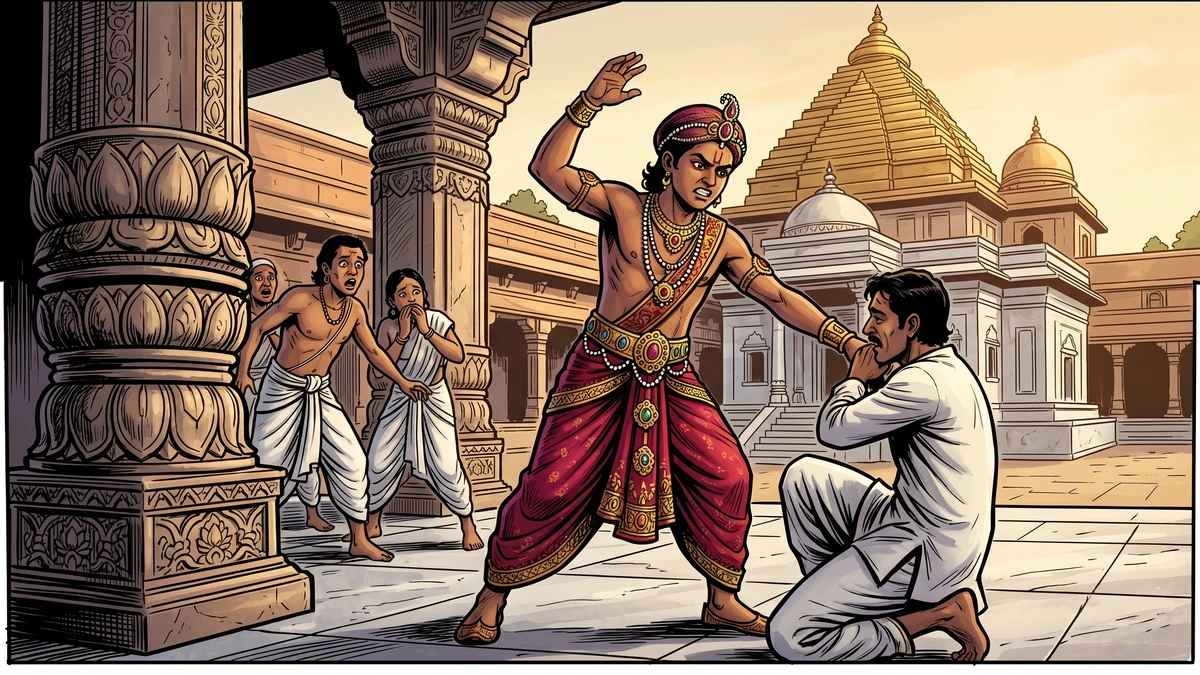
Long ago, in the city of Vārāṇasī (Benares) on the Ganges, the king named Brahmadatta — a kind of folk-Everyking who appears as ruler of Kāsi in dozens of Jātaka frame tales — had a son. The Pali names him Duṭṭhakumāra, “Prince Wicked.” Chalmers’ Victorian English keeps the temperature of the Pali simile exactly: “Fierce and cruel was he, like a scotched snake; he spoke to nobody without abuse or blows. Like grit in the eye was this Prince to all folk both within and without the palace, or like a ravening Yakkha — so dreaded and fell was he.” A scotched snake (one wounded but not killed) is a creature of pure resentful energy; a Yakkha is a tree-and-graveyard ogre of Vedic-Buddhist popular religion who eats travellers. The narrator stacks two of folk literature’s most exact images of unmotivated cruelty, then spends the rest of the tale showing what this kind of person costs the people he is born to rule.
II. The Storm, the Tree-Trunk, and Four Souls on a Log
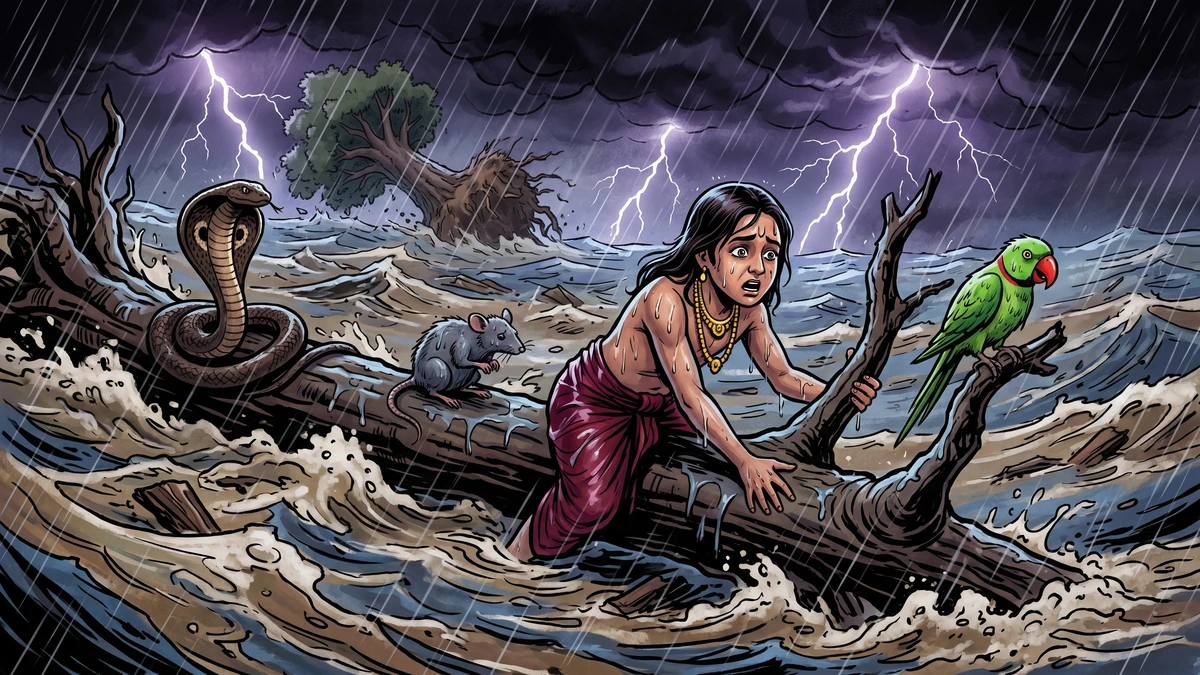
One day Prince Wicked goes down to the river with his retinue to swim. A great storm sweeps in — the Pali word the gloss tradition uses is mahā-megha, the “great cloud” of the late-monsoon evening — and the water grows dark. The prince commands his servants to take him into mid-stream. Out in the deep water they look at one another and say plainly: “What will the king do to us? Let us kill this wicked wretch here and now.” They throw him into the current and swim back ashore, telling the courtiers the prince must have come up before them. The king’s gates are flung open; the riverbanks are searched up and down by torchlight; no trace of the boy is found.
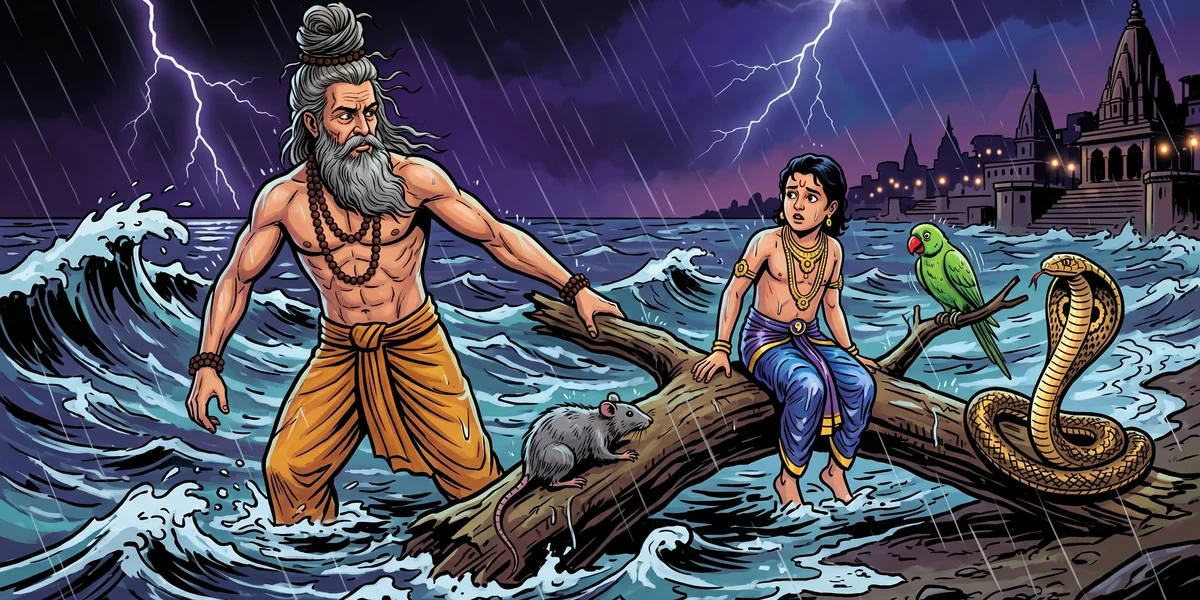
The storm has swept Prince Wicked downstream. He clutches a floating tree-trunk and is carried south, “crying lustily in the agony of his fear of drowning.” The tale now turns to its second great move — and this is where the Jātaka deepens from a simple revenge fable into something stranger and more theological. The narrator pauses to tell us about three other souls on the same river. A rich merchant of Benares had died with forty crores of gold buried in the bank; because of his craving for the buried wealth he was reborn as a snake at the spot. Another miser had buried thirty crores and was reborn as a rat over his hoard. A young parrot lived in a silk-cotton tree (Pali simbalī, Bombax ceiba) on the river’s edge. The flood waters drive all three out: the snake and the rat swim for the same drifting trunk; the silk-cotton tree itself is uprooted and topples into the river, and the parrot — its wings beaten flat by the rain — alights on the same log. Four creatures, then, ride one piece of wood through the storm: snake, rat, parrot, and Prince Wicked. The Pali commentary (Saccaṅkira-vaṇṇanā) is careful to preserve the exact order in which they board, because the order will matter at the hermitage.
III. The Hermitage: Why the Bodhisatta Warmed the Animals First
“Now the Bodhisatta had been reborn in those days as a brahmin in the North-West country.” This is the standard Jātaka formula for placing a virtuous birth — the uttarāpatha, the great trade route running through Gandhāra and Taxila to Kāpiśī, was the imagined homeland of the brahmin renouncer in the Pali imagination, just as the Ganges valley was the home of the king. Reaching manhood, the Bodhisatta had renounced household life, built himself a leaf-hut hermitage at a bend of the river, and was now living there as an isi (Sanskrit ṛṣi) — a pacing, fruit-eating, unaffiliated forest ascetic. At midnight, walking up and down outside his hut, he heard the prince’s cries.
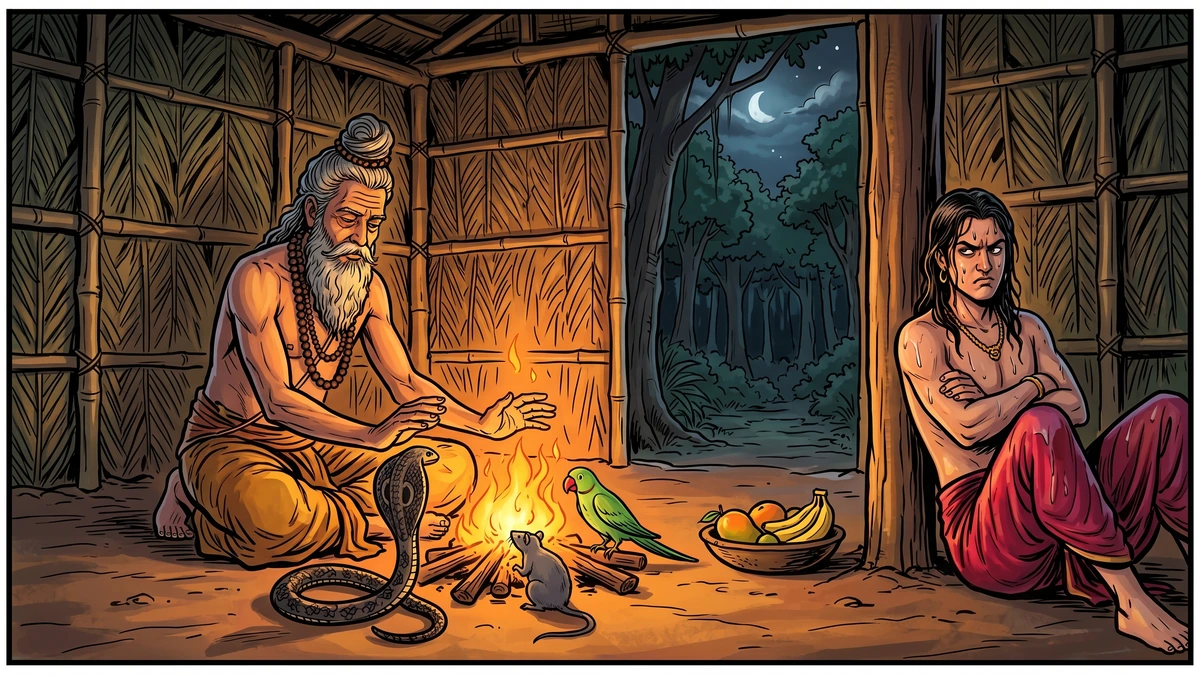
The line that follows is one of the great Bodhisatta-sayings of the entire collection: “This fellow-creature must not perish thus before the eyes of so merciful and compassionate an ascetic as I am.” Compassion (karuṇā) is here a kind of vow that the witness lays on himself — once you can hear the cry, you are responsible. The Bodhisatta plunges in, pulls the trunk to shore “with one long pull, being as strong as an elephant,” sets the prince safe on the bank, and then carries the snake, the rat, and the parrot back to his hermitage one by one. He lights a fire. And here he does the small, deliberate, ethically charged thing that the prince will never forgive him for: he warms the animals first, because they are weaker, and the prince afterwards. He brings fruits and feeds them in the same order. The animals eat first; the prince eats last.
To the Buddhist ear this is exactly correct — the precept of mettā (loving-kindness) extends in widening rings outward from oneself to friend, to stranger, to enemy, and then to all sentient beings without distinction of species. To the prince it is an unbearable insult. “This rascally ascetic pays no respect to my royal birth,” he thinks; “he actually gives brute beasts precedence over me.” And in that single inward sentence the seed of the whole later treachery is planted. The Bodhisatta has not insulted him; he has only refused to give him the precedence he had not earned. But for a person whose self-image rests entirely on rank, the refusal of rank-precedence is identical with attempted murder of the self.
IV. Three Treasures, One Betrayal: The Test of Gratitude
A few days pass. The waters subside. Each guest takes leave. The snake says: “Father, I am not poor; forty crores of gold are hidden where I dwell. Should you ever want money, all my hoard shall be yours. Come to the spot and call ‘Snake.’” The rat makes the same promise — thirty crores, come and call “Rat.” The parrot, who is poor, says: “Silver and gold have I none; but should you ever want for choice rice, come to my tree and call ‘Parrot,’ and I and my kinsfolk will give you many waggon-loads.” The animals offer, in three voices, the three classical kinds of help that the Pali ethical literature recognises: buried wealth (the snake’s nidhi), portable wealth (the rat’s coin), and labour-and-grain (the parrot’s rice from the Himalayan paddies). They give what they have, in proportion to what they have.
The prince, last to leave, stands before the Bodhisatta with murder already in his heart. But he is more polished than his servants and conceals the intent. “Come, father, to me when I am king, and I will bestow on you the Four Requisites” — that is, the four traditional supports of a renouncer: robes (cīvara), almsfood (piṇḍapāta), lodging (senāsana), and medicine (gilāna-paccaya-bhesajja). The promise is technically perfect, formally pious, and entirely false.
Some time later — the prince having succeeded to the throne and become King Wicked — the Bodhisatta sets out to test the four professions in turn. He calls “Snake”; the snake glides forth and offers him the forty crores; he leaves them and bids the snake well. He calls “Rat”; the rat offers the thirty crores; he leaves them and goes on. He calls “Parrot”; the parrot flies down and asks if he should send his kinfolk to gather paddy from the Himalayan slopes; the Bodhisatta thanks him and leaves the offer standing. Each animal has kept its word exactly. He goes last to the city and dresses carefully and walks the morning alms-round through the streets of Benares.
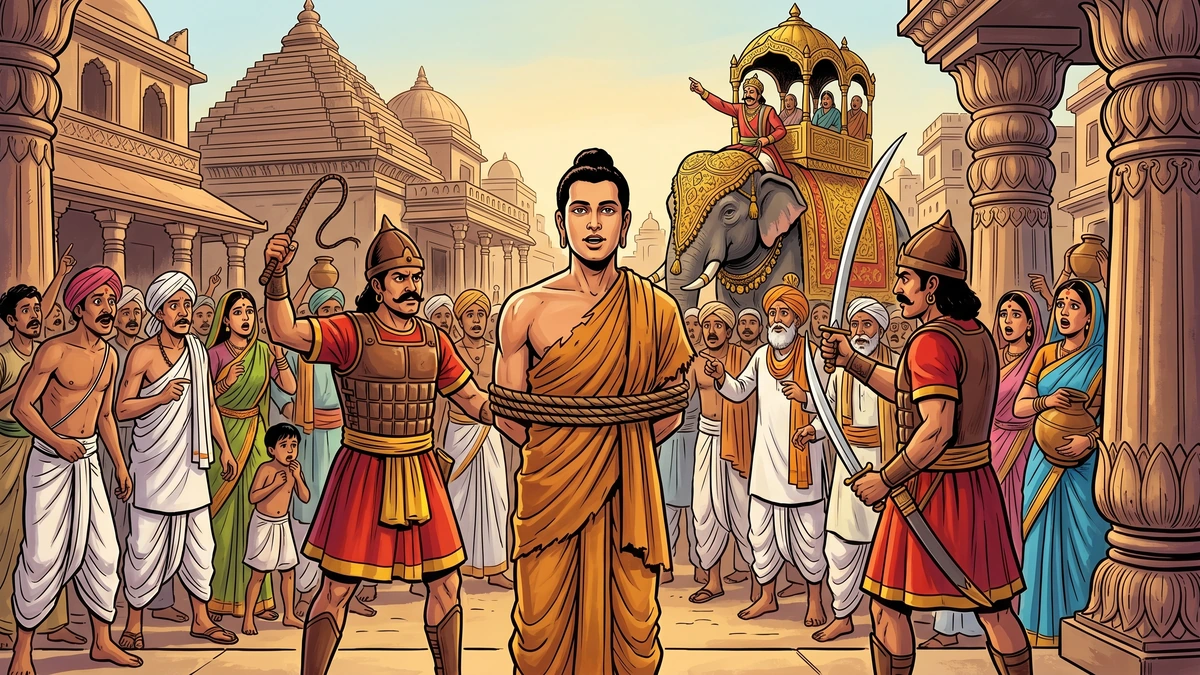
The king, riding in royal state on his elephant, sees the ascetic in the crowd. “Here’s that rascally hermit come to quarter himself and his appetite on me,” he thinks. “I must have his head off before he can publish the service he rendered me.” He signals to his attendants and orders that the man be seized, bound, flogged at every street-corner, marched out to the place of execution, beheaded, and impaled. The order is given in public, and obeyed in public. The Bodhisatta is dragged from corner to corner under the lash. He does not cry out for his mother and father — the conventional folk cry of the tortured. Instead he repeats, at every corner, a single Pali verse — the gāthā from which the whole tale takes its name:
Saccaṁ kir-evam-āhaṁsu narā ekacciyā idha:
Kaṭṭhaṁ niplavitaṁ seyyo, na tvevekacciyo naro ti.“This is the truth, it seems, that was said by some people in this place: a floating log saved is better — and not a certain kind of man.”
— Saccaṅkira-Jātaka, gāthā 1, Pali text from the Pali Text Society edition; English after Chalmers (1895) and Anandajoti Bhikkhu (2024).
The verse is a small, exact piece of folk economics. A floating log fished out of the river can be split for cooking-fuel, used to warm the cold, used to ferry others across; it pays back the rescuer many times over. A certain kind of person, fished out of the same river, returns the favour with a flogging. The wise among the bystanders hear the verse repeated and ask the ascetic what service he had rendered the king. He tells the whole story — storm, log, four souls, hermitage, fruits-and-fire, the four promises. The verb the Pali uses is ārocesi, “he announced”: the public square becomes a court, and the public square delivers a verdict. “This ungrateful king does not recognise even the goodness of this good man who saved his majesty’s life. How can we have any profit from this king? Seize the tyrant!” The crowd — khattiya, brāhmaṇa, vessa, sudda, all four varṇas, the Pali narrator is careful to specify — rushes the elephant from every side, pulls the king down with arrows and javelins and stones and clubs, drags the corpse to a ditch by the heels, and flings it in. Then they anoint the Bodhisatta king on the spot.
The Moral: Gratitude as the Hinge of Civilisation
The Saccaṅkira-Jātaka is, on its surface, a tale about a king and a saint. Underneath, it is one of the oldest pieces of Buddhist political theory we have: a society ruled by an ungrateful man (akataññū) is structurally unstable; a society ruled by a person who remembers what was done for him (kataññū) is structurally stable, because gratitude is the same virtue, scaled to the throne, that allowed a brahmin hermit at midnight to plunge into a black river for the sake of a stranger’s voice. The Aṅguttara Nikāya, in a much-quoted passage (AN 2.31), puts it as a flat moral law: “Bhikkhus, two persons are rare in the world: one who acts first to render a service, and one who is grateful for what was done.” The Saccaṅkira-Jātaka is the storied form of that flat law.
The closing identification (samodhāna) — Devadatta = the Wicked King, Sāriputta = the snake, Moggallāna = the rat, Ānanda = the parrot, the Buddha = the righteous king who won a kingdom — is more than a literary trick. In the Theravāda imagination, character is the slow accumulation of habits across many lives, and a person who has betrayed his benefactor in one birth is the exact same moral substance as the Devadatta who, in the Buddha’s own lifetime, hired archers, dropped a rock from Vulture’s Peak, and unleashed the elephant Nālāgiri on the Master in the streets of Rājagaha. The point of the identification is not to satisfy the reader’s curiosity about “who is who” but to make a precise theological claim: the wickedness on the elephant in old Benares and the wickedness in the Bamboo Grove yesterday are not merely like each other — they are the same wickedness, working its way through different bodies. The story’s moral is therefore double: be grateful, because gratitude pays better than greed; and watch what you are practising, because the habit of betrayal will follow you, life after life, until you stop.
Why It Lasted: A Folk Tale That Travelled Without Borders
The Saccaṅkira-Jātaka is one of the most exported tales in world folklore. The Aarne-Thompson-Uther index (Hans-Jörg Uther, FFC 284–286, Helsinki, 2004) gives it the type number ATU 160 “Grateful Animals; Ungrateful Man”, and lists analogues across Sanskrit, Persian, Arabic, Hebrew, Latin, Old French, Old Spanish, Russian, Korean, and African oral literatures.
The closest Sanskrit parallel is in the Pañcatantra — Mitra-saṃprāpti (Book II) and Aparīkṣita-kāraka (Book V) both contain the four-on-a-pit version, in which a man rescues a tiger, a monkey, a snake and a goldsmith from a well; the three animals reward him and the goldsmith betrays him to the king. From the Pañcatantra it travels into the eighth-century Pahlavi Kalīla wa Dimna of Burzōē, then into Ibn al-Muqaffaʿ’s Arabic prose (c. 750 CE), then into the Greek Stephanites kai Ichnelates of Symeon Seth (c. 1080), the Hebrew Sefer Kalila ve-Dimna of Rabbi Joel (c. 1250), the Latin Directorium Humanae Vitae of John of Capua (c. 1270), and from there into every European nursery library. Theodor Benfey, in the long introduction to his Pantschatantra (Leipzig, 1859, vol. I, §§ 81–82), traced the migration in detail and made this tale one of the cornerstones of his great hypothesis that medieval European folk literature was largely an Indian import.
The tale also travelled along the southern Buddhist arc: a Sinhala recension survives in the Saddharmālaṅkāraya of the fourteenth century; a Sukhothai-period Thai version is preserved in mural paintings at Wat Si Chum; a Tibetan version is collected in the mDzangs-blun (“Sūtra of the Wise and the Foolish”). Aesop, on the western side, gives us a related but inverted tale (Perry index 75: “The Husbandman and the Snake”), in which a man warms a frozen snake in his bosom and the snake bites him — there the lesson is the same (you cannot rescue the wicked into virtue) but the cast has been reduced to two and the comparative material is missing. La Fontaine’s reworking, Le Villageois et le Serpent (Fables VI.13, 1668), is essentially a French translation of Aesop. The Jātaka’s quartet of snake-rat-parrot-prince — three animals giving from what they have plus one human giving from what he is — is the richer and older form.
The folklorist A. K. Ramanujan, in “Toward a Counter-System: Women’s Tales” and the related essays collected in The Collected Essays (Oxford, 1999), pointed out that the Indian versions almost always preserve a feature the European versions lose: the specific test. The Bodhisatta does not stumble upon his benefactors in their hour of need; he goes deliberately to test them, snake first, rat second, parrot third, king last, and the order matters because the test moves up the social ladder from the lowest to the highest, and the moral failure occurs precisely at the top. The tale is not pessimistic about animals; it is pessimistic about untested high status. Wendy Doniger, in The Hindus: An Alternative History (Penguin, 2009, pp. 184–187), connects this to the wider Jātaka pattern in which animals routinely outperform humans in the dharma — a kind of zoological egalitarianism that runs against the grain of Brahmanical varṇa hierarchy and that may explain the Jātakas’ enormous popularity among non-elite audiences in early historic India.
Iconography: Golden Tube, Crystal Casket, Cage of Gold
The closing scene of the Pali tale is not narrated again in most modern retellings, but it is one of the most striking endings in the Jātaka collection. After the new king-Bodhisatta has collected the seventy crores of gold from the snake and rat (the parrot, with kingly courtesy, is told he need not gather rice), all four return to Benares together. The king mounts to the top floor of his palace and there installs his three benefactors permanently. He has a golden tube (kanaka-sallaka) made for the snake to dwell in; a crystal casket (phalika-mañjūsā) for the rat; and a cage of gold (suvaṇṇa-pañjara) for the parrot. Every day food is served in vessels of gold — sweet parched-corn for the parrot and the snake, scented rice for the rat. The four live in mutual goodwill until the end of their natural lives.
The image — a king on a high palace floor, with snake-rat-parrot in golden housings as his constant companions — became a favourite of Pāla-period Indian Buddhist manuscript illuminators (Aśokāvadāna palm-leaf manuscripts, eighth–twelfth centuries) and survives in stone at the Sukhothai-period Wat Si Chum Jātaka-frieze in Thailand and on the eastern doorway of the Pegu Shwemawdaw in Lower Burma. It is a visual statement of what righteous kingship looks like in the Theravāda imagination: not the absence of subjects, but the absence of subjects-treated-as-subordinates. The animals at the high table are not pets; they are the Bodhisatta’s kalyāṇa-mittā, his good companions on the moral path, raised to their right place at last.
Reading with Children
For parents, teachers, and storytellers reading this tale aloud to younger listeners, three details from the Pali repay slowing down for. First, the warming-fire scene. Why does the Bodhisatta warm the animals before the prince? Not because the animals are more important — but because they are weaker (dubbalā). Children grasp the principle of looking-after-the-smaller-one immediately, and the prince’s resentment of it gives them an exact image of the kind of pride that comes apart at exactly that point. Second, the four promises. The snake offers buried gold, the rat offers buried gold, the parrot offers grain — and the prince offers the four monastic requisites. Three creatures keep their word; one breaks it. The arithmetic is perfect for a child: the test is fair, the failure is squarely the prince’s. Third, the verse on the gallows. The Bodhisatta does not curse the king. He simply repeats a proverb. The verse is short enough — “a floating log saved is better, and not a certain kind of man” — that a child can learn it, and the image of the wood-and-the-wicked-man is concrete enough that a five-year-old will understand it. The verse is what turns the public square into a court. Children should be told that the verdict is delivered by ordinary people who heard the story and judged for themselves.
A Note on the Two English Versions
The version preserved on this page above the moral has long been the Ellen C. Babbitt retelling from More Jātaka Tales (1922) — the gentle, schoolroom-friendly text of an American author who wrote Jātaka tales for the Little Folks Standard Library. Babbitt drew her material from Robert Chalmers‘s 1895 Cambridge translation, and her storyline is faithful, but she trims the dark flourishes — the buried-treasure rebirth-doctrine, the four-corners flogging, the named identification of Devadatta — that are essential to the Pali. Readers who want the older and richer text can find Chalmers complete on sacred-texts.com (Volume I, pages 177–181) or in Anandajoti Bhikkhu’s modernised translation at ancient-buddhist-texts.net. Both are in the public domain. Above all the retellings stands the Pali itself, in the Pali Text Society Roman-script edition of V. Fausbøll (London, 1877–1897), Volume I, pages 322–327: short, fast, exact, and ending in the small wooden-and-human verse on the gallows.
Moral: Gratitude is not a feeling — it is a memory you keep alive on purpose. A floating log, fished from a flood, will give back more than it cost: warmth, fuel, a bridge for the next traveller. A man without gratitude, fished from the same flood, will give back the river itself. Choose, in your own life, to be the one who remembers. The world is built by the few who answer the cry at midnight, and the few who, in the morning, remember who answered.
Read time: about 10 minutes. Suitable for ages 8 and up; suitable for read-aloud from age 6 with the violence of the flogging-and-execution scene gently summarised.
Frequently Asked Questions
**Q: Why is this story important?**
You May Also Like
 Indian Folk Tales
Ages 3-5
Indian Folk Tales
Ages 3-5
Princess Aubergine
Princess Aubergine: Once upon a time there lived a poor Brahman and his wife, so poor, that often they did not know whither to turn for a meal, and were
 Indian Folk Tales
Ages 9-12
Indian Folk Tales
Ages 9-12
How Raja Rasalu Killed the Giants | Punjabi Folk Epic (9–12+)
Punjabi hero Rasalu stops for a weeping widow, takes her son’s place, and ends Nila’s tribute to the giants. Full episode + moral.
 Indian Folk Tales
Ages 6-8
Indian Folk Tales
Ages 6-8
Diamond Cut Diamond
Diamond Cut Diamond: In a village in Hindustan there once lived a merchant who, although he rose early, worked hard, and rested late, remained very poor; and