The Rats Wedding
A charming Punjabi folk tale about a little rat who swaps his way from a piece of root to a noble bride — and a famous lesson about honesty in trade.
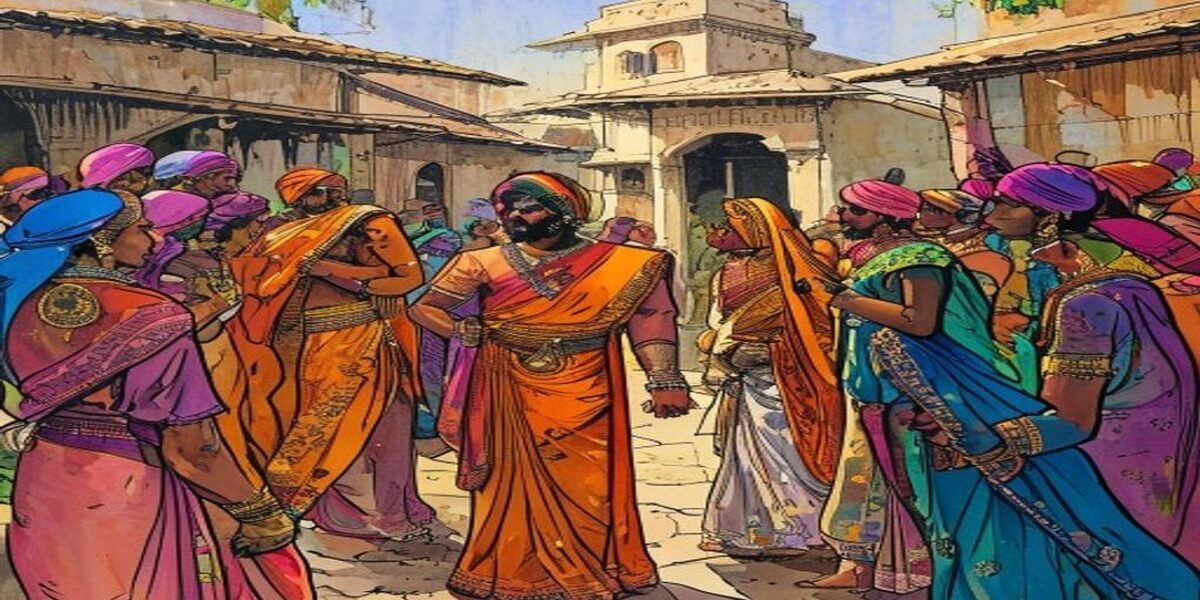
The Rat’s Quest for the Mightiest Groom
In a village not far from the sacred Ganges, a prosperous rat-father resolved that his daughter — radiant, clever, and of marriageable age — deserved nothing less than the most powerful being in the universe. This premise launches one of India’s most beloved folk tales and aligns it squarely within a vast cross-cultural genre: the impossible-marriage quest. Yet what distinguishes the Indian telling is its cosmological scaffolding. The father does not simply survey human suitors; he ascends the very rungs of the cosmic hierarchy — Sun, Cloud, Wind, Mountain — in turn, asking each whether it is the greatest power in existence. Each deity deflects, naming a superior, until the chain loops back to the rat community itself. The tale’s engine is not mere comedy but a rigorous interrogation of what “greatest” means in a world where power is always relative, contextual, and ultimately circular.
Folklorist Stith Thompson catalogued this narrative under AT 2031 (Chain Tale: Most Powerful Husband), and variants surface from Japan’s Nezumi no Yomeiri to Swiss literary versions, from Korean mouse-bride tales to European analogues. Yet the Indian iteration is distinguished by its placement within a cosmogonic frame: Sun, Cloud, Wind, and Mountain are not mere nature metaphors but devas — divine functionaries whose powers are real and ranked. The father’s journey is therefore simultaneously a matchmaking quest and a theological seminar on the nature of power.
Svayamvara in Miniature: Choice, Agency, and the Animal Court
The classical Indian institution of the svayamvara — the bride’s self-choice ceremony celebrated in epics like the Mahabharata and Ramayana — echoes quietly through this humble rat tale. In the epics, a princess garlands the hero who proves superior in contest; here, the father performs a proxy svayamvara, canvassing cosmic contestants on his daughter’s behalf. This inversion — father as agent rather than daughter — reflects the patriarchal structure of most village folk tales, yet the tale’s resolution subverts that structure elegantly: the daughter ultimately marries within her own caste, her own kind, suggesting that the most authentic choice was always the one closest to home.
Scholars of Indian folk narrative note that animal bride-and-groom tales frequently encode caste and jati (birth-community) logic. The rat’s return to rathood after surveying cosmic heights is not defeat but recognition — what Sanskrit aestheticians call svajati-prema, love of one’s own kind. Sociologist G. S. Ghurye observed that endogamy rules in Indian caste society are so deeply internalized that they surface even in animal fable, where creatures instinctively seek mates within their species despite fantastical alternatives. The Rat’s Wedding, on this reading, is an allegory for the gravitational pull of social belonging.
The Ladder of Power: Cosmological Reasoning in Folk Narrative
The tale’s theological argument is surprisingly sophisticated. The Sun confesses it cannot shine when Cloud covers it; Cloud admits it disperses before Wind; Wind halts before Mountain; Mountain crumbles before the rat who gnaws its roots. This chain of mutual vulnerability — each mighty power undone by a humbler one — maps onto the Indian philosophical concept of shakti-parampara, the relay of power, and anticipates the paradoxes of systems theory: in a sufficiently complex web of dependencies, there is no single apex. Power is always relational.
This logic resonates with the Rigvedic hymn to Indra, who is praised as greatest among gods yet himself is sustained by soma and weakened by Vritra — a cosmic counter-force. It resonates equally with Buddhist pratityasamutpada (dependent origination): nothing exists independently; every being’s power is conditional on context. The rat who gnaws the mountain’s roots is not superior in an absolute sense; he is simply the final link in a circle. And circles, unlike ladders, have no top — which is the tale’s quiet philosophical punch line.
This circularity prevents the story from endorsing simple social conservatism. The father does not discover that rats are the greatest power in creation; he discovers that greatness is always situational. The lesson is less “stay in your place” than “your place is not as lowly as you assumed, nor as exalted as you might dream.”
Why This Rat’s Wedding Still Gets Celebrated
The Rat’s Wedding endures because it satisfies simultaneously on multiple registers. As comedy, the image of a rat-father solemnly petitioning the Sun god for his daughter’s hand is irresistible. As theology, it encapsulates a Hindu cosmological truth that power is hierarchical yet circular. As social commentary, it validates endogamy without condemning aspiration. And as narrative art, its chain structure — each suitor naming a stronger, who names a stronger still — creates a pleasurable, suspenseful rhythm that culminates in a twist every listener half-expects and fully enjoys.
In Japanese versions the mouse bride marries a mouse; in Korean versions the same; in Swiss literary retellings the theme veers toward satire of bourgeois ambition. But in the Indian village telling, the ending is suffused with something warmer than satire: a gentle vairagya (dispassion toward vanity) and a recognition that the ordinary community one was born into carries its own form of power — the power of belonging, continuity, and mutual care.
“The sun bows to the cloud, the cloud to the wind, the wind to the mountain, and the mountain to the little gnawing rat — in a world of mutual dependence, the greatest power is the one that completes the circle.”
Why This Story Lasted
Every culture that has produced this tale has kept it because it resolves a universal anxiety: the fear that one’s community, one’s family, one’s ordinary life is somehow insufficient against the grandeur of the cosmos. The Rat’s Wedding answers that fear not with false consolation but with a cosmological argument — the very gods acknowledge their limits, and the modest rat holds a power no deity can replicate within that specific niche. Generations of Indian children who heard this story before sleep absorbed not just its comedy but its epistemology: look carefully before you rank, because the hierarchy you see depends entirely on where you stand.
Frequently Asked Questions
What is the main theme of The Rat’s Wedding?
The central theme is the relativity of power and the value of belonging. A rat-father discovers through petitioning Sun, Cloud, Wind, and Mountain that each mighty power is surpassed by a humbler one, and that his daughter’s ideal match is within her own community — encoding both cosmological circularity and the social logic of endogamy.
How does The Rat’s Wedding relate to the svayamvara tradition?
The tale mirrors the epic svayamvara ceremony in miniature — instead of a princess choosing from assembled kings, the father evaluates cosmic suitors on her behalf. The resolution echoes svayamvara wisdom: the truest match emerges from authentic context rather than external prestige.
Are there international versions of The Rat’s Wedding?
Yes — folklorist Stith Thompson classified this as AT 2031. Parallel versions exist in Japan (Nezumi no Yomeiri), Korea, China, and several European traditions. The Indian version is distinctive for its cosmological frame involving actual Hindu devas as suitor-candidates.
What does the chain of power (Sun–Cloud–Wind–Mountain–Rat) symbolize philosophically?
The chain embodies the Buddhist and Vedic principle that power is relational and contextual rather than absolute. Each entity’s dominance is conditional — mirroring pratityasamutpada (dependent origination) and the Vedic idea that even great devas depend on forces beyond themselves. The circle it forms denies any single apex of power.
Why does the rat-father ultimately choose a rat groom?
After discovering that every cosmic power is surpassed by another, the father recognizes that “greatest” is situational. The rat groom represents svajati-prema — love and belonging within one’s own kind — and carries the power of community, continuity, and mutual care that no deity can offer his daughter.
Frequently Asked Questions
**Q: Why is this story important?**
You May Also Like
 Aesop's Fables
Ages 3-5
Aesop's Fables
Ages 3-5
Valiant Vicky The Brave Warrior
Valiant Vicky The Brave Warrior: Once upon a time there lived a little weaver, by name Victor Prince, but because his head was big, his legs thin, and he was
 Aesop's Fables
Ages 3-5
Aesop's Fables
Ages 3-5
The Gold-Giving Serpent
The Gold-Giving Serpent: A poor Brahmin farmer named Haridatta once rested in the shade after working in his field and saw a hooded serpent emerge from a
 Aesop's Fables
Ages 3-5
Aesop's Fables
Ages 3-5
The Mother In Law Became An Ass
The Mother In Law Became An Ass: Little by little the mother-in-law became an ass - vara vara mâmi kaludai pôl ânâl̤, is a proverb among the Tamil̤s, applied