The Grateful Tiger
The Grateful Tiger: In a land of dense forests and hidden valleys, there lived a man of humble station who spent his days hunting small game to feed his family.
Origin & Tradition
The Grateful Tiger belongs to a widespread Korean tale-type in which a human extends compassionate help to a tiger in distress and receives in return a protection or gift that exceeds any reasonable expectation. Such tales are collected across every Korean province and form a significant sub-genre within the broader body of tiger folklore, which in Korea uniquely positions the tiger as simultaneously fearsome predator, mountain guardian, and honourable debtor. The tiger’s capacity for eunhye (은혜, grace-debt and its repayment) — the obligation felt and discharged when a genuine benefit has been received — is treated in these tales not as anthropomorphic fantasy but as a literal truth about the moral architecture of the mountain world.
Beat I — The Bone in the Throat
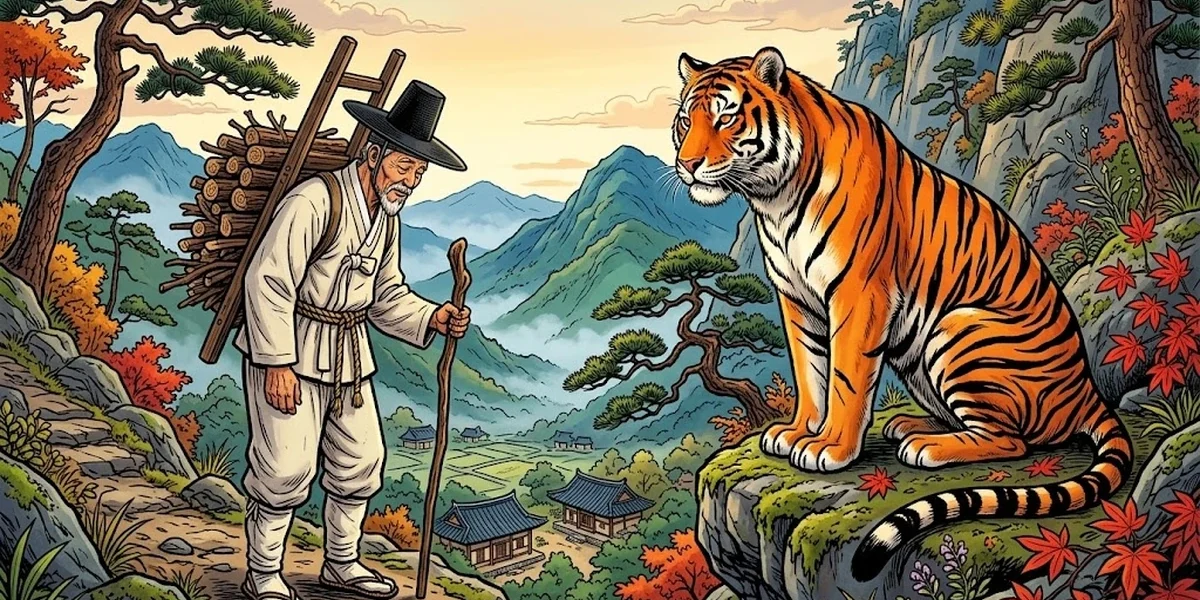
A woodcutter working alone in the mountains hears a sound from the far side of a ridge — not the roar of a tiger on the hunt but something lower, more irregular, unmistakably pain. He follows the sound and finds an enormous tiger lying on its side, one paw over its mouth, unable to rise. The tiger looks at him with an expression he recognises, despite everything he has been taught about tigers, as a request.
He approaches. The tiger opens its mouth. A large bone is lodged across the back of its throat — swallowed during a meal, caught at an angle that prevents swallowing and prevents expulsion. The woodcutter reaches in with both hands, grips the bone, and works it free. The tiger swallows, breathes, rises. The woodcutter stands very still. The tiger looks at him for a long moment, then turns and walks into the trees without sound.
He goes home. He tells no one — not because he is ashamed but because he knows no one will believe him.
Beat II — The Tiger’s Return
In the weeks that follow, the woodcutter finds things. A deer carcass at the edge of his wood-pile — more meat than his family has eaten in a month. A bundle of ginseng roots at his door, the kind that grows only in the high mountains and sells for enough to clear a debt. His youngest daughter, who wanders from the yard and gets lost in the forest, is returned to the edge of the village unharmed, smelling of pine and wild grass.
The woodcutter understands. He does not go back to the ridge to verify; he does not leave offerings or thanks. He simply continues cutting wood, and the things continue appearing. When a fire destroys the family’s barn, lumber appears at the building site — freshly cut, the right lengths, as if measured. When his wife becomes ill, a bundle of mountain herbs is left outside, and she recovers. The tiger has appointed itself the family’s guardian and is discharging its eunhye with the thoroughness of an official who has been assigned a post and intends to hold it faithfully.
Beat III — Eunhye and the Mountain Spirit’s Network
Korean mountain lore distinguishes between the tiger as a biological animal and the tiger as an agent of sansin (산신, the mountain spirit). The sansin is the presiding consciousness of a mountain — the force that maintains the mountain’s internal order and mediates between the mountain world and the human world below it. Tigers in Korean folk tradition often function as the sansin’s messengers and instruments: they carry out the mountain’s judgements, protect those who deserve protection, punish those who violate mountain law, and — in tales like this one — honour debts that the mountain spirit has witnessed.
When the woodcutter removed the bone from the tiger’s throat, he entered into a relationship with the mountain’s moral economy. The act was witnessed. The eunhye was registered. The tiger’s subsequent gifts are not personal gratitude alone — they are the mountain spirit’s acknowledgement that a human behaved with the kind of uncalculating compassion that the mountain rewards. The woodcutter did not help the tiger because he expected a return; he helped it because it was in pain and he could help. This absence of calculation is, in Korean mountain lore, the precise quality that activates eunhye rather than simple barter.
The distinction matters: a person who helps a tiger in hope of reward has made a commercial transaction. A person who helps a tiger without expectation has made a moral statement about what kind of creature they are, and the mountain notices. The tiger’s gifts are not payment for a service — they are the mountain’s recognition of a character.
Beat IV — The Dangerous Made Safe by What It Owes
The tale’s deepest observation is practical rather than mystical: the tiger that owes eunhye is, for that family, the safest creature on the mountain. Not because it has been tamed — it remains entirely a tiger, capable of killing anyone else it encounters — but because its code of obligation is more reliable than the social contracts most humans actually honour. The woodcutter’s family is protected not by a fence or a weapon or an official’s stamp but by a tiger’s sense of what it owes, which turns out to be more durable than most human forms of protection.
Korean storytellers have always noted this irony without resolving it: the creature that the family had most reason to fear became, through a moment of uncalculated compassion, the one they could most completely trust. The tiger keeps its eunhye long after any human creditor would have renegotiated, forgotten, or simply walked away from the debt.
“Compassion extended to the dangerous is not foolishness when it is offered without calculation — and the creature that receives such unconditioned help often carries the debt more faithfully than the people it would be safer to help.”
Why This Story Lasted
The grateful tiger tale has lasted because it validates two things simultaneously: the risk of compassion toward dangerous creatures, and the reliability of genuine obligation when it is honoured by someone — or something — that takes its debts seriously. It also satisfies a persistent Korean cultural need to find the tiger in its honourable mode rather than its fearsome mode — to discover that the mountain’s most powerful creature is also its most faithful keeper of accounts.
The Tiger as Mountain Guardian
Korean folk art frequently depicts the mountain spirit (sansin) accompanied by a tiger — the spirit as white-bearded elder, the tiger as companion and instrument of the spirit’s will. Sansin shrines (산신각, sanshin-gak) are found in Buddhist temples and village sacred groves throughout Korea, and offerings are made to the sansin for protection of hunters, woodcutters, and travellers in mountain terrain. The tiger’s role in grateful-tiger tales is continuous with this iconographic tradition: it is not acting independently but as the mountain spirit’s agent, honouring a debt that the spirit’s moral accounting system has registered.
Frequently Asked Questions
What is the moral of The Grateful Tiger?
Uncalculated compassion — help given without expectation of return — activates a moral economy more reliable than most human social contracts. The tiger’s eunhye (grace-debt) is honoured more faithfully than most human debts because it is registered by the mountain spirit’s moral accounting and discharged by a creature whose code of obligation is not subject to human rationalisations for walking away.
Why does the woodcutter help the tiger when it would be dangerous?
Because it is in pain and he can help. The story does not present this as a calculated risk — the woodcutter does not weigh the odds of being eaten against the odds of being rewarded. He acts from the recognition that a creature is suffering and he has the means to relieve the suffering. This absence of calculation is precisely what the mountain spirit’s moral economy rewards.
What is eunhye and how does it differ from simple gratitude?
Eunhye (은혜) is the obligation felt and discharged when a genuine benefit has been received — closer to grace-debt than to gratitude. Gratitude is an emotional response; eunhye is a moral obligation that persists and must be actively discharged through equivalent or greater return. The tiger’s ongoing protection of the woodcutter’s family is eunhye, not gratitude: it is a debt being paid, methodically and completely, over years.
What is sansin and why does it matter in this story?
Sansin (산신, mountain spirit) is the presiding consciousness of a Korean mountain — the force that maintains the mountain’s internal moral order and mediates between the mountain world and human communities. The tiger in this tale functions as the sansin’s agent: when it honours its eunhye to the woodcutter, it is acting within the mountain’s moral accounting system, which witnessed the original act of compassion and registered the obligation. The woodcutter’s reward comes not just from the tiger but from the mountain itself.
How is the grateful tiger different from the fearsome tiger in Korean folklore?
Korean tiger folklore uniquely maintains both modes simultaneously. The same tiger that is the mountain’s most dangerous predator is also its most faithful keeper of debts, most reliable guardian of those it has committed to protect, and most honest representative of the sansin’s moral accounting. The two modes are not contradictions — they are the same rigorous nature applied to different situations: the tiger that takes its prey without mercy and the tiger that honours its eunhye without exception are the same creature operating according to the same absolute code.
You May Also Like
 Korean Folk Tales
Ages 9-12
Korean Folk Tales
Ages 9-12
The Snake’s Revenge
The Snake's Revenge: There lived in ancient days an archer, whose home was near the Water Gate of Seoul. He was a man of great strength and famous for his
 Korean Folk Tales
Ages 9-12
Korean Folk Tales
Ages 9-12
The Goblin’s Magic Bat (Dokkaebi)
The Goblin's Magic Bat (Dokkaebi): In the mountains of Korea, where mist clung to the peaks like ancient dreams and the forest held secrets older than memory
 Korean Folk Tales
Ages 9-12
Korean Folk Tales
Ages 9-12
The Geomancer
The Geomancer: [Yi Eui-sin was a specialist in Geomancy. His craft came into being evidently as a by-product of Taoism, but has had mixed in it elements of