The Voice of the Bell
King Tai Jo wants a bronze bell so huge that its music will roll over every street of Seoul and for miles across the hills, yet each casting cracks.

Griffis’s legend begins when Tai Jo, the great general who became the first king of a new line of Korean kings, founded his dynasty, he moved the capital close to the great Han River and decided to build a mighty city there called Han Yang, the Castle on the Han, with a high wall all around it and lofty gates on every side. Most people simply called it Seoul, which means the capital, and all the roads in the kingdom led there.
The king was delighted when workmen digging the foundations of the East Gate found a bell in the earth. It was a lucky sign, and they carried it straight to him. He had it hung over the entrance to his palace, where it hangs in the narrator’s account. But such a bell could only tinkle, and King Tai Jo wanted one that would boom loud and long. In Silla, a kingdom that had once been a rival, there had hung for centuries one of the biggest bells in the world, and Tai Jo wanted a bell even greater than that. It would hang in the central square of Seoul, where every man, woman and child in the city could hear it, and its music would roll for miles over hill and valley.
By its sound the people would know when to get up, when to cook breakfast, when to sit down to supper and when to go to bed. On special days it would tell them that a royal procession was passing or that a prince or princess was being married. When a king died, it would toll a lament, and the whole land would mourn and wear white for three years. And the guardian spirit of the city would make its home in the bell.
Messengers rode out on big horses, little ponies, donkeys and bulls to every province, carrying the king’s command to all the governors, magistrates and village heads to collect copper and tin for the bronze. The bell was to stand ten feet tall and measure eight feet across, as high and wide as a Korean bedroom. On top, forming the loop to hang it by, would be two fierce-looking dragons. It would weigh so many tons that it could balance five hundred fat men on a seesaw, and only beams made of whole tree trunks could hold it in a belfry strong enough to stand the shaking when it rang. It would have no clapper inside. Instead, a long log hung from ropes and pulleys outside would be pulled back and let fly against the boss on the bell’s side, and the bell would boom or hum or rumble or sing sweetly, just as the old bell-ringer wished.
So the roads to Seoul creaked with oxcarts full of copper bars. Many a donkey slurped gallons of bean soup at the inn stables before it dropped its load of metal in the city, and hundreds of bulls bellowed under the brushwood and timber piled on their backs to feed the furnaces that would melt the metal for the mighty bell. A deep pit was dug to hold the core and the mold, and hundreds of clay pots and ladles were made ready for the moment the red-hot stream would flow. Every boy in Seoul was waiting to watch the fire lit, the smoke rise, the bellows roar and the metal run.
When the fire goblin who lived in the volcano heard what was going on, he was terribly jealous. He had never imagined that ordinary men could handle so much metal or control such roaring flames, and he snorted at the idea that King Tai Jo’s workmen could make a bell to beat those in China’s great temples or Silla’s pagodas.
While there was still not enough metal and the collectors were still going about their work, one of them came to a certain village and called at a house where an old woman lived with a baby boy tied on her back. She had no coins, no metal and no fuel to give, but she seemed quite ready to give herself or the baby. In a willing voice she asked, “May I give you this boy?” The collector paid no attention and went on his way, taking nothing from her. But when he got back to Seoul, he told the story, and so many people heard of it and remembered it later.
When everything was ready, the clay pots were set on the white-hot coals, and the blast roared until the bronze turned to liquid. At the master’s word, the hissing, glowing stream poured out and filled the mold. They waited patiently for it to cool, and then, alas, they found the bell was cracked. It was hoisted out with heavy tackle built at great cost, and strong blacksmiths broke it into pieces with big hammers. A second bell was cast, but when it cooled, it too was cracked.
Three times this happened, until a palace’s worth of money had been spent on work, fuel and wages, and still there was no bell. King Tai Jo was in despair. But instead of weeping or tearing at his topknot or scolding the workmen, who had done their best, he offered a big reward to anyone who could say what was wrong or what was missing so that the casting would come out perfect.
Then a workman stepped forward and told the story of the old woman, and he said the bell would crack every time it cooled unless her offer was accepted. Besides, he said, the old woman was a witch, and if the child was not truly human, there could be no harm in it. So the baby was sent for, and when the pit was half full of molten metal, the child was given to the bell. Some people were troubled about feeding a child to the fire goblin, but when the cooled bell was hoisted out of the mold, the casting was perfect, and everyone seemed to forget that a human life had gone into the bell.
Soon the great work was finished with file and chisel. The bell was hung with grand ceremony in the city’s central square, where the broad streets from the South Gate and from the east and west came together. It hung from heavy iron links on a stout timber frame, its mouth exactly a foot above the ground, and a belfry was built around and over it. The names of the chief bell makers and the royal officers who oversaw the hanging were carved into the metal. But it was decided not to strike the bell until it was fully housed and the striker, a log as thick as a ship’s mast, was ready to send out the first boom.
Meanwhile tens of thousands of people waited to hear the bell’s first music. Everyone believed it would bring good luck and a long life. The children could hardly bear to go to bed, and some were afraid they might be asleep when it rang. The little ones, whose eyes were usually shut tight by sunset, begged to stay up, but some of them dropped off anyway before they knew it.
“What shall the bell be called, Your Majesty?” asked a wise counselor.
“Call it In Jung,” said King Tai Jo, “which means Man Decides. For every night at nine o’clock, every man and boy must decide to go to bed. Apart from magistrates, no male may be found in the street after that hour, or he will be punished. From then until midnight the streets shall belong to the women.” Trumpeters proclaimed the royal law, and it was ordered too that every morning and evening, at sunrise and sunset, the band should play as the city gates opened and closed. The narrator gives the bell this name and explanation as part of the legend.
But the bell had still not spoken. When it did, the people of Seoul found it was the most wonderful bell ever made, for it had a memory and a voice. It could wail as well as sing. In the tale, people say that it can cry, for whether they are young or old, happy or sad, the bell seems to speak their own feelings with its changing notes, lively or merry, warning or rejoicing.
At nine o’clock on the first night of the seventh moon, the month of the Weaving Maiden and the Ox-Herd, who stand on opposite sides of the River of Heaven and cross over on the bridge of birds, the great bell of Seoul was to ring for the first time. The men were all in their rooms, ready to go to bed, and the women, dressed in their best, stood on their doorsteps with lanterns in their hands, ready for their walk.
Four strong men grabbed the rope, pulled the striking log back a full yard and let it fly. The log bounced back, and out poured a flood of music that rolled across the city in every direction and over the hills, filling miles of air with sweet sound. The children clapped and danced for joy, sure they would live long because they had heard the first music of the bell, and the old people smiled happily.
But imagine the grown-ups’ surprise when they heard that the bell could talk! Its sounds made real words. “Mu-u-u-ma-ma-ma-la-la-la-la,” it went, ending like a baby’s cry, and there was no mistaking what it said: “My mother’s fault. My mother’s fault.”
In Griffis’s closing scene, the mothers of Seoul hold their little ones close and promise that it will never be their fault if their children lack love or care. They take more delight in their babies and treat them more tenderly because they hear the great bell speak, reminding every parent to guard the children Heaven has given them.
About this story
“The Voice of the Bell” is retold from William Elliot Griffis’s Korean Fairy Tales (1922), which sets this narrative in Seoul. A related child-sacrifice legend concerns the Divine Bell of King Seongdeok. Korea Tourism Organization’s account identifies that surviving bell with Gyeongju and dates its completion to 771. The legend and Griffis’s imagined setting should not be mistaken for the object’s documented history.
This disturbing legend includes the killing of an infant. Its ending directs blame toward the mother, but the wider chain of adult decisions deserves scrutiny too. The story is evidence of a telling, not evidence that this sacrifice occurred.
Read the original: Korean Fairy Tales (Project Gutenberg)
For older readers: includes infant killing in a furnace and a supernatural accusation against the child’s mother.
Who pays for the perfect bell?
The workman claims the child might not be human, making an otherwise intolerable act sound permissible. The finished bell then gives the crowd something magnificent to admire, and they forget the life taken to make it. Its cry interrupts that convenient forgetting.
The words blame the mother, but the plot names other decision-makers: the man proposing the sacrifice, those who fetch the child, and those who carry it out. Reading critically means noticing their responsibility rather than accepting the cry as a complete judgment. The children’s delight at the first ringing is painful because they do not share the reader’s knowledge of its cost.
Account for each decision
List the stages from the failed castings to the first ringing. At each stage, identify who could stop the sacrifice. Write a short museum-style label that distinguishes the legend’s imagined events from the surviving historical bell, without calling the child’s death necessary or justified.
Think about it
- Why do you think the people forgot so quickly about the child once the bell was perfect?
- What does the bell’s cry mean, and who is it really talking to?
- Why do you think people told this sad story to parents?
Related stories
- The Mirror That Made Trouble — another tale from Griffis set in old Seoul
- The Sky Bridge of Birds — the story of the star lovers whose month the bell first rang in
- The King of the Flowers — another Korean tale about a king and the lessons he must learn
Frequently Asked Questions
Why does the bell’s voice disturb the ending?
Is the sacrifice a documented event?
Which historical bell has a related legend?
Who should read this tale?
You May Also Like
 Korean Folk Tales
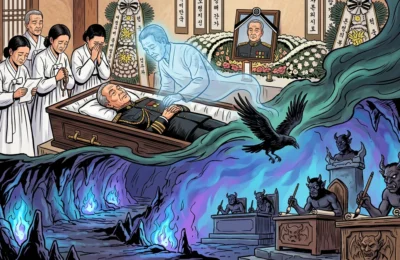
Hong’s Experiences in Hades
Taken to the underworld by mistake, a Korean officer is shown the hells of liars and deceivers before a golden-faced Buddha sends him back to life.
 Korean Folk Tales
All Ages
Korean Folk Tales
All Ages
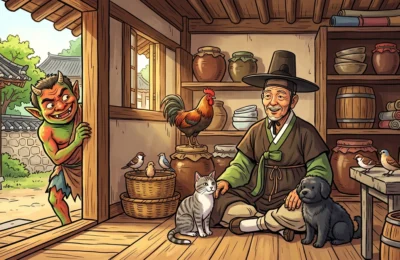
Tokgabi’s Menagerie
When the magic stone that keeps old Tip Pul’s wine bottle full goes missing, his dog Snap and his cat Mee Yow both set out to find it.
 Korean Folk Tales
All Ages
Korean Folk Tales
All Ages
The Sky Bridge of Birds
Once a year every magpie in Korea flies up to the sky, where millions of them join wings to make a bridge across the River of Stars for two parted lovers.