The Sky Bridge of Birds
Once a year every magpie in Korea flies up to the sky, where millions of them join wings to make a bridge across the River of Stars for two parted lovers.
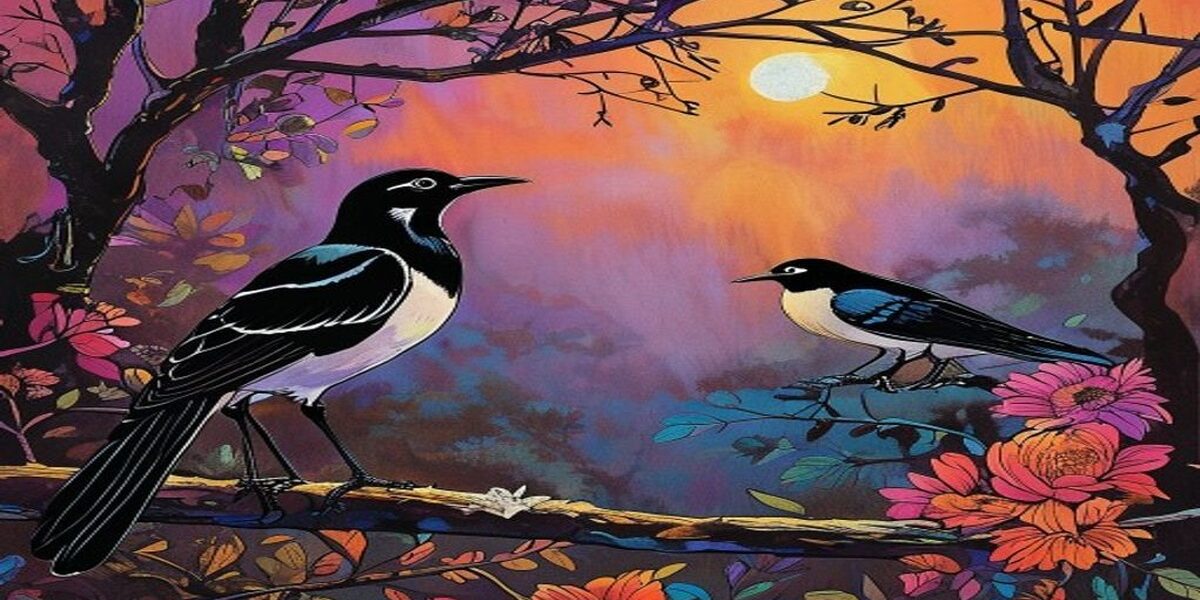
In Griffis’s telling, the familiar chatter of magpies falls silent on the seventh day of the seventh month. On that day the magpies have an appointment they keep every single year. They are all supposed to be gone from the streets and houses, for every well-mannered magpie is far up in the sky, building a bridge across the River of Stars that we call the Milky Way. With their wings for the cables and their heads for the floor, they make a pathway for two lovers on either side of the Silver Stream.
Korean children are usually kind to magpies, but if a single one is found hanging about the houses or roofs or streets on that day, the children shoo it off with shouts for not being at its job of building the bridge across the Starry River. By evening the magpies come back to their usual places, for by then their work is supposed to be done.
Within the legend, If you want proof that the bridge was really built and crossed, just look at the magpies’ heads at this time of year. They are bald, for their feathers have been worn off by the tramping feet of all the servants who follow the Prince of Star Land across the bridge to meet his bride.
If it rains on the morning of this day of the Weaver Maiden and the Cattle Prince, the raindrops are tears of joy that the lovers shed when they meet. If showers fall in the afternoon, they are tears of sorrow as they say goodbye. And if there is thunder, the story calls it the rumble of the wagons carrying the prince’s and princess’s baggage as they travel homeward, away from each other.
Within the legend, This is the story the mothers in the tale tell their children about the Bridge of Birds.
Long, long ago, a king ruled in the Kingdom of the Stars, and he had a lovely daughter. She was not only the most beautiful sight in the kingdom but also a skilled weaver, and there was no useful task in the palace that she could not do. She was gifted, sweet-tempered and always willing, so hardworking that she was a model to everyone. Her parents loved her dearly, and she had great influence over her father, who would do almost anything to please his darling daughter.
In time a young and very handsome prince of Star Land came to her father’s court and fell in love with the princess. Her parents agreed, and the wedding was held with great splendor. Now that she was a wife with a home of her own, she became even more of an example to every young woman in Korea. She took great care with clothes and food, set her servants a good example of thrift and thought a great deal about their happiness. She served her husband tirelessly, and her chief wish was to fill his life with joy.
But instead of following his bride’s good example and valuing all she did for him, the prince gave himself up to waste and idleness. He grew lazy and careless and neglected his duties, squandering his own fortune and his wife’s dowry. He sold all his oxen and calves for money, only to lose it gambling. He borrowed long strings of coins from anyone who would lend them, until at last he was so shamefully poor, down to his last string of cash, that he was in danger of losing his rank as a prince and having his name spoken with scorn.
The King of the Stars watched his son-in-law going downhill and more than once threatened to cut him off or banish him, especially after the prince sold his cattle. But each time his daughter pleaded for her husband, the king gave in, settled the young man’s debts and let him try once more. When the worthless fellow slipped back into his old ways and grew worse and worse, the king decided to part the couple. He sent the prince off to a place six months’ journey to the north of the River of Heaven, and sent the princess a half year’s distance to the south of the Starry Stream.
Though the king in his anger had hardened his heart even against his own beloved child and sent her away from the palace because of her worthless husband, he still showed some pity. He decreed that on one night each year, the seventh night of the seventh moon, they might meet for a few hours.
The young couple parted and made their sad journeys to the edges of the starry sky, but they loved each other so much that as soon as they reached their places of exile, they turned around to go and meet each other. When the day came, after six months of weary travel, they had reached the banks of the Starry River, and there they stood, catching glimpses of each other and waving, but unable to come any closer. On summer nights you can still spot them glittering across the wide starry stream from each other, full of love and with no way over.
Sure that the vast gap of sky would always lie between them, the pair began to weep. Their tears made the river overflow and poured down on the earth below, threatening to wash away everything, houses, people and animals. What could be done?
The four-footed creatures, the fish and the birds held a meeting, and they agreed that only birds with strong wings that could fly high could do anything. So with many flattering speeches, they chose the magpies for the job. When these noisy, chattering birds, who are nevertheless so kind and friendly to the sparrows, heard of the lovers’ trouble up above, they decided to help the grieving pair across the River of Stars. Out of their big, untidy nests they flew gladly to the meeting, which voted to build the bridge.
Word went out all over the world, and millions of magpies gathered in the air. With their wisest elders in charge, they set to work making a flying bridge of wings that would stretch from one shore of the Starry Stream to the other. First they put their heads together so closely to make a floor that the bridge looked as though it were paved with white granite. Then with their wings they held up the great arch, and across it marched the prince, followed by his servants and his luggage, to reach his bride. A feast was quickly laid out, and husband and wife sat down to it together, with many tender words.
The magpies have done this every year since, for ages and ages, on that same summer day. And although the star lovers meet only once a year, they live forever, so in the end the wife has her husband and the husband his wife far longer than any couple on earth. It is a law in the magpie kingdom that no bird may skip this work.
Griffis closes by imagining children chasing away any magpie that has skipped the bridge building. His ending holds up the princess’s hard work and the lovers’ faithfulness as examples. These are the narrator’s lessons and imagined customs, not instructions to disturb birds or roles that all children must follow.
About this story
“The Sky Bridge of Birds” is retold from William Elliot Griffis’s Korean Fairy Tales (1922). The tale of the Weaver Maiden and the Cowherd, known in Korea as Jingnyeo and Gyeonu, is told all over East Asia, and the two lovers are the bright stars Vega and Altair, which shine on either side of the Milky Way.
The story names the seventh night of the seventh moon. Related star-lover celebrations include Chilseok, Qixi and Tanabata, but their calendar observances differ. Griffis’s printed August 7th should not be used as a universal date for all of them.
Read the original: Korean Fairy Tales (Project Gutenberg)
Best for all ages — two star-crossed lovers are separated by the River of Stars, and the magpies build a bridge so they can meet once a year.
Who makes the mistake, and who does the work?
The prince gambles away his cattle, but both spouses are banished. The princess has already worked hard and pleaded for him; her punishment is not explained by any matching offence of her own. The magpies repair the separation through collective effort, while also protecting the earth from the lovers’ flooding tears. Their bridge answers several needs at once.
Distribute the burden
Give the prince, princess, king and magpies one row each. Record what each does, suffers and contributes. Propose a different royal decision that holds the prince responsible without punishing the princess for his choices. Keep the birds on the page: the legend is no reason to chase real magpies.
Think about it
- Why did the King of the Stars separate the prince and princess?
- How does this telling explain rain and thunder on the lovers’ meeting day?
- Next time you look at the Milky Way on a summer night, can you find the two bright stars on either side?
Related stories
- The Woodman and the Mountain Fairies — another Korean tale of a love between earth and heaven
- The King of the Sparrows — another Korean tale of helpful birds
- The Magic Peach — another Korean tale of heavenly lovers parted and reunited
Frequently Asked Questions
What makes the bridge in the legend?
Why are the lovers separated in this version?
Does this describe real magpie behaviour?
You May Also Like
 Korean Folk Tales
Ages 9-12
Korean Folk Tales
Ages 9-12
The Home of the Fairies
After his servant and horse die in a mountain storm, a young scholar is guided to a marble palace where the king of the immortals has been expecting him.
 Korean Folk Tales
Ages 9-12
Korean Folk Tales
Ages 9-12
The King of the Sparrows
A kind man mends the broken leg of a young sparrow, and the grateful bird flies off to tell the Sparrow King, who sends back a seed packed with treasure.
 Korean Folk Tales
Longka, the Dancing Girl
Taken captive by invaders, a Korean dancing girl performs at the enemy general’s banquet in the Cliff House, then leads him to the edge of a cliff.