Princess Bari
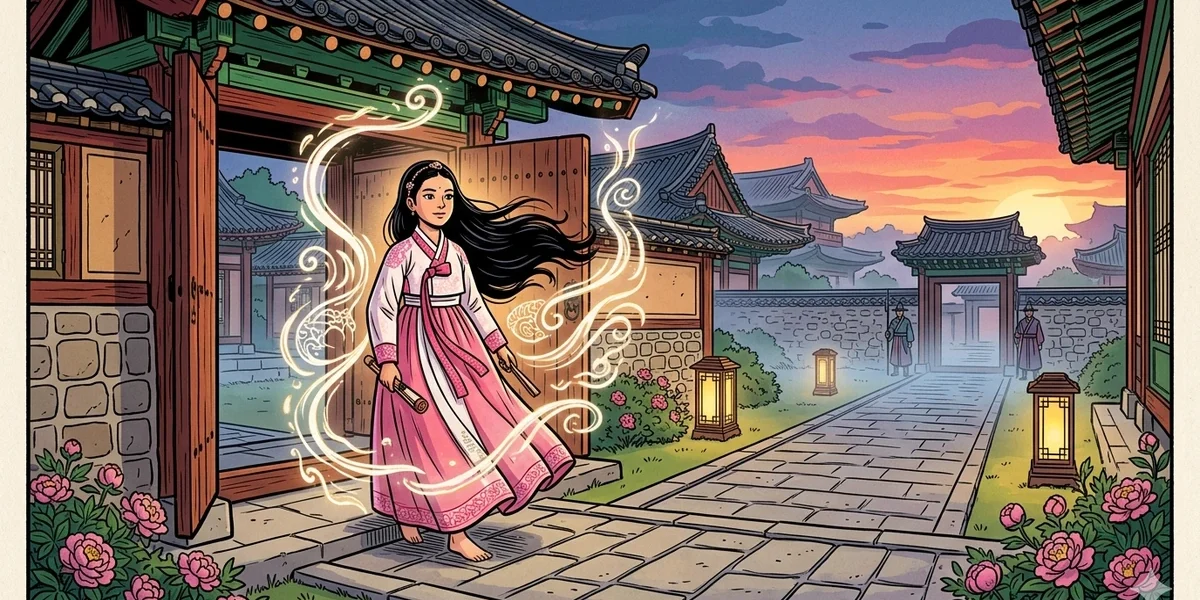
Princess Bari: In a kingdom surrounded by mountains and blessed by deep rivers, there lived a King and Queen who longed desperately for children. After many
Origin & Tradition
Princess Bari (Bari Gongju, 바리공주) is the foundational myth of Korean shamanism (musok, 무속) — the sacred narrative that explains the origin of the mudang (무당, shaman) and the cosmic journey they perform on behalf of the dead. It is chanted rather than told, performed by shamans during the gut (굿) — the ritual ceremony for guiding the recently deceased to the afterlife — as both narrative and liturgy. Unlike the tales in this collection that belong primarily to the oral folk tradition, Bari Gongju is a living ritual text: it is performed today in the same contexts for which it was composed, making it one of the oldest continuously used sacred narratives in East Asia. UNESCO’s inscription of Korean shamanic ritual as an Intangible Cultural Heritage has drawn renewed scholarly attention to the myth at its centre.
Beat I — The Seventh Daughter Abandoned
A king and queen desperately want a son. Their first six children are daughters. When the seventh child is born — another daughter — the king, in his disappointment, orders the infant placed in a stone chest and cast into the sea. The baby drifts to an island where she is raised by an old couple with no children of their own. She grows up with no knowledge of who she is or where she came from.
Years pass. The king and queen fall gravely ill — a divine punishment, the royal physicians determine, for the abandonment of their daughter. The only cure is the water of life (samsaeng-mul, 삼생물), which exists in the far reaches of the underworld and can only be retrieved by someone willing to make the journey. The six daughters who were kept, raised, and married into noble families refuse. None will go.
A messenger finds the seventh daughter — the abandoned one, the cast-off child — and tells her who she is and what is needed. She agrees without hesitation. She does not ask why the parents who discarded her deserve her rescue. She simply goes.
Beat II — The Journey to the Underworld
Bari’s journey to the underworld is structured as a series of trials, each more demanding than the last. She crosses mountains of knives, seas of fire, fields of razor grass. At the entrance to the realm of the dead she meets a guardian — sometimes depicted as a spirit, sometimes as a powerful old man — who demands service in exchange for the water of life. She works for him for years, in some versions bearing his children, before he gives her what she came for.
She returns to the upper world carrying the samsaeng-mul. When she arrives at the palace, her parents are already dead. She pours the water over their bodies. They revive. They see who saved them. The king, confronted with the daughter he abandoned and the cost of what she did for him, can offer only grief and gratitude in the same moment. Bari does not rebuke him. She has completed what she came to do.
After the reunion she does not stay in the palace. She ascends — transformed into the divine ancestress of all shamans, the queen of the dead and guide of souls. Every mudang who performs a gut for the recently deceased is, in the tradition’s understanding, channelling Bari’s journey: traversing the boundary between worlds to bring comfort to those who can no longer navigate it alone.
Beat III — The Shamanic Vocation as Earned Qualification
Korean musok theology is precise about what makes a person capable of being a mudang: they must have crossed the boundary between the living world and the dead world and returned. This crossing is not metaphorical — it is experienced, in the tradition’s understanding, as a genuine death and resurrection during the initiation period of the candidate shaman (sinbyeong, 신병, spirit sickness: a crisis of illness, vision, and transformation that precedes the assumption of the shamanic role). Bari’s myth is the template for this experience: abandonment, descent, retrieval, and return.
The myth adds a specific qualification that makes Bari uniquely suited to her role: she was abandoned by the very people she saved. She has been, at the most foundational level, treated as disposable by those with power over her. And she responded not with resentment but with a compassion so total that it extended even to them. A shaman whose vocation is grounded in Bari’s myth is one who has survived being discarded and emerged not bitter but enlarged — capable of accompanying the dead because they have already experienced the most extreme form of being treated as if they did not matter, and chose to matter anyway.
Beat IV — The Origin of the Mudang
The myth’s final transformation — Bari ascending to become the divine patroness of Korean shamanism — completes a narrative arc that is simultaneously cosmological and vocational. The mudang who chants Bari’s story during a gut is not reciting a myth about someone else; she is identifying herself with Bari’s journey and claiming Bari’s qualification. She has been through her own sinbyeong; she has crossed her own boundary; she carries her own version of the water of life. The chanting of the myth is the statement of credential.
This is why Bari Gongju is chanted rather than told. A story told for entertainment is separate from the teller. A chant performed in ritual context is the teller claiming identity with the narrative — asserting that what Bari did, the mudang can do, because what Bari survived, the mudang has survived, and the compassion that carried Bari through the underworld is the same compassion that makes the mudang’s presence bearable to the newly dead.
“The one who was abandoned becomes the one who saves — not through resentment turned to power but through compassion so total that it extends even to those who discarded her, and it is precisely this completeness of care that qualifies her to guide the dead.”
Why This Story Lasted
Bari Gongju has lasted as a living ritual text — not an archived myth but a performed narrative — because it answers the hardest question the bereaved bring to a shaman: who is qualified to accompany my person across the boundary I cannot cross? The answer the myth provides is: the one who has already crossed it, who was abandoned and chose to return carrying what the living needed, whose compassion survived the very thing that should have destroyed it. Every mudang who performs a gut embodies that answer.
Musok and Living Practice
Korean shamanism (musok) has survived Joseon Confucian suppression, Japanese colonial prohibition, and postwar modernisation to remain a living practice. Mudang perform gut ceremonies for the newly deceased, for those suffering from chronic illness, and for communities seeking protection from misfortune. The chanting of Bari Gongju is specific to the death ritual. Regional variants of the myth differ in the number of trials Bari faces, the identity of the underworld guardian, and the precise nature of the water of life, but the core structure — abandonment, descent, retrieval, return, transformation — is consistent across all Korean shamanic traditions.
Frequently Asked Questions
What is the moral of Princess Bari?
The one who was abandoned and chose compassion anyway becomes the most qualified guide for those navigating the boundary between life and death. Bari’s qualification as the divine ancestress of shamans comes not from power or royal birth but from the specific combination of having survived abandonment and having responded to it with total, unconditional care.
Why does Bari save the parents who abandoned her?
The myth does not explain her motivation in terms of duty or filial obligation — she is not performing hyodo for parents who deserve it. She goes because the need is real and she is the only one who will go. This absence of calculation — her willingness to save those who discarded her without asking whether they deserve saving — is precisely what the shamanic tradition identifies as the quality that makes her uniquely qualified for her role.
What is samsaeng-mul and what does it represent?
Samsaeng-mul (삼생물, water of three lives or water of life) is the life-restoring water found in the deepest reaches of the underworld. In the myth’s symbolic logic it represents the vital principle that the dead have lost and that only someone who has traversed the full distance of the underworld journey can retrieve. In shamanic ritual, the mudang’s chanting of Bari’s journey is understood as a symbolic re-enactment of the retrieval.
What is sinbyeong and how does it relate to the Bari myth?
Sinbyeong (신병, spirit sickness) is the initiatory crisis through which a person becomes a mudang — a period of severe illness, visions, and psychological disruption that the tradition understands as the spirits claiming a person for shamanic service. It is the contemporary form of Bari’s journey: a descent into a liminal state, the experience of the boundary between living and dead, and the emergence transformed and qualified. Bari’s myth is the cosmic template; sinbyeong is its biographical enactment.
Why is Princess Bari chanted rather than told?
Because chanting in ritual context is not narration but identification — the performer claiming the authority of the character’s experience by re-enacting the journey in sound. A mudang chanting Bari Gongju during a gut is asserting that she has crossed the boundary Bari crossed and is therefore qualified to guide the newly dead across it. The chant is simultaneously myth, credential, and ritual act.
You May Also Like
 Korean Folk Tales
All Ages
Korean Folk Tales
All Ages
Hyung Bo And Nahl Bo
Hyung Bo And Nahl Bo: OR, THE SWALLOW-KING’S REWARDS. In the province of Chullado, in Southern Korea, lived two brothers. One was very rich, the other very
 Korean Folk Tales
All Ages
Korean Folk Tales
All Ages
The Sky Bridge Of Birds
The Sky Bridge Of Birds: No bird is more common in Korea than the magpie. They are numbered by millions. Every day in the year, except the seventh day of the
 Korean Folk Tales
Ages 6-8
Korean Folk Tales
Ages 6-8
The Visit Of The Man Of God
The Visit Of The Man Of God: In the thirty-third year of Mal-yok of the Mings (A.D. 1605), being the year Eulsa of the reign of Son-jo, in the seventh moon, a