Im, The Hunter
Im Kyong-up, a legendary general and sage, uses cryptic wisdom and unconventional thinking to solve impossible problems and serve justice with moral clarity.
The Man Who Knew the Mountain
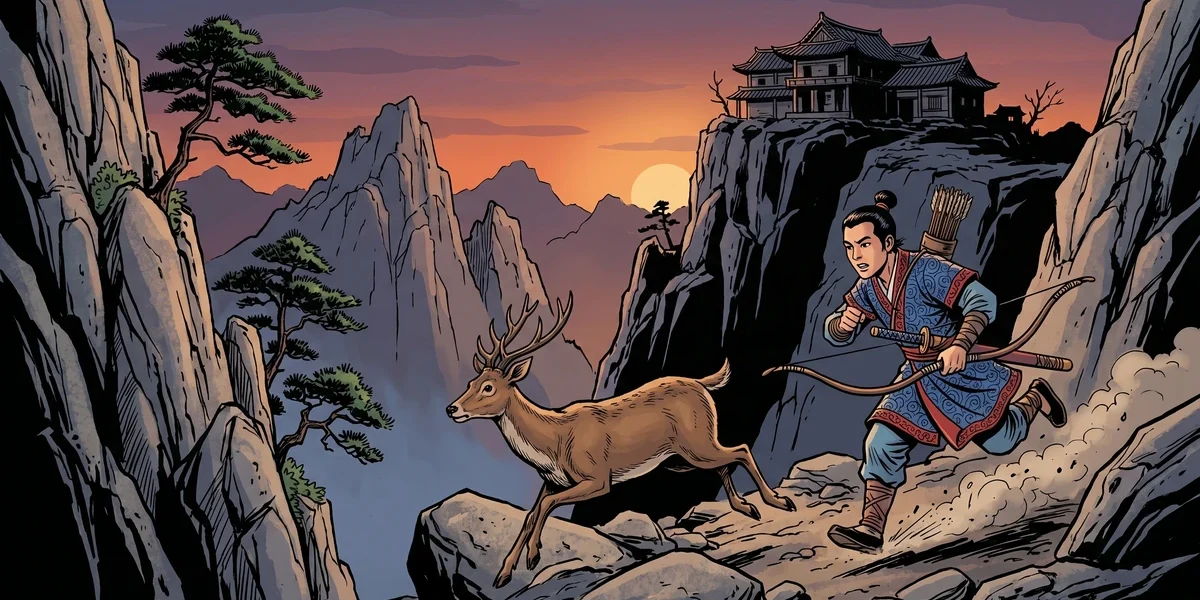
In the forested mountains of the Korean peninsula, hunters occupied an ambiguous position in the social and spiritual order. They provided meat, fur, and bone — necessities for communities at the margins of subsistence — but their work required the repeated taking of life in a culture shaped significantly by Buddhist ideas about the value of all sentient beings. This tension was navigated not by renouncing the hunt but by embedding it within a framework of reciprocal obligation. The hunter who understood this framework was not merely skilled; he was in right relationship with the mountain and its presiding spirit. The hunter who ignored it was taking what was not, ultimately, his to take.
Im was a hunter who understood the mountain. His story, transmitted through Korean village oral tradition, is not primarily a tale of adventure or supernatural encounter — though it contains both — but a study in what it means to hunt rightly: to take what is offered within the terms of the offering, to acknowledge the source, and to recognise that the mountain’s abundance is not an inexhaustible resource to be extracted but a conditional gift requiring the hunter’s sustained reciprocal conduct.
Beat I — Im’s Practice and the Sanshin Compact
Im had hunted the same mountain range for thirty years. He was not the most physically powerful hunter in his district, nor the most adventurous. What distinguished him was discipline: a set of practices he had inherited from his father and maintained without exception. Before ascending the mountain each season, he spent a night at the small mountain shrine at the trailhead, making offerings to sanshin (산신) — the Mountain God — and requesting permission to hunt. After a successful hunt he returned a portion of what he had taken: not the whole, but a measured share, left at the base of a prominent boulder he regarded as the sanshin’s visible presence on the mountain’s lower slopes.
He also maintained what he called his “three refusals”: he would not take a mother animal nursing young, he would not take more than he and his family could use before the meat spoiled, and he would not hunt in the high months of spring when the mountain’s animals were reproducing. These constraints were not mandated by any external authority. They were the terms of the compact Im understood himself to have with the mountain — the conditions under which the sanshin’s gift of game was extended. Within those terms, he hunted freely and successfully. The mountain yielded to him with a generosity that other hunters in the region noted and could not explain.
The sanshin in Korean folk belief is among the most widely venerated of the country’s nature spirits. Depicted typically as a white-bearded elder accompanied by a tiger, the mountain god presides over the local mountain’s ecosystem in a role that combines protection, regulation, and the conditional granting of human access. Mountains in Korean cosmology are not neutral terrain; they are inhabited, administered, and responsive to how humans conduct themselves within them.
Beat II — The Encounter and Its Test
One autumn, Im encountered on the high trail an old man sitting at the base of a great pine — white-bearded, unhurried, with a presence that made the forest around him unusually quiet. The old man asked Im what he had taken that day. Im reported honestly: two pheasants, one rabbit. Not much for a full day’s work on a trail he knew well.
The old man nodded. He asked whether Im had encountered the white deer that ranged the northern slope. Im said he had. He had seen it from a ridge, a clear shot available, the animal still and facing away. He had not taken it. The old man asked why. Im said that a white deer on the mountain was unusual — it might be the last of its kind on this range, and taking it would close something that could not be reopened. The old man was quiet for a moment. Then he told Im that from the following season the northern slope would be his to hunt, a territory he had previously avoided because it was considered unlucky. He would find it generous.
Im understood, riding back down the mountain that evening, that he had been speaking with the mountain itself — or with the sanshin in a form that allowed direct conversation. The encounter retroactively illuminated thirty years of practice: the offerings, the three refusals, the measured taking. These had not been merely customs. They had been a continuous conversation with the mountain, conducted in acts rather than words, and the mountain had been listening and responding all along — in the form of game that appeared where other hunters found none, trails that stayed passable through difficult weather, and the accumulated luck that had kept Im uninjured across three decades of dangerous work.
Beat III — The Ethics of Taking and the Sanshin Framework
Im’s story illuminates the Korean mountain-hunting tradition’s understanding of the relationship between humans and natural abundance. The sanshin compact is not a transaction in the commercial sense — it is not that the hunter pays a fee in ritual and receives game in return as equivalent exchange. It is closer to a relationship of stewardship: the mountain god entrusts the hunter with access to the mountain’s life, and the hunter is responsible for using that access in ways that maintain rather than deplete the trust.
This framework makes the three refusals legible as more than superstition. Refusing to take nursing mothers protects reproductive capacity. Refusing to take more than can be used prevents the waste that kills without feeding. Refusing to hunt during spring reproductive months allows the mountain’s population to replenish. These are, in contemporary terms, sustainable harvesting practices. But the tradition encodes them not as rational resource management but as moral obligations to the mountain’s presiding spirit — a framing that may be more motivationally robust than the rational-management framing, since the latter depends on calculated self-interest while the former depends on relationship.
The white deer episode is the story’s moral pivot. Im had a clear opportunity — good shot, valuable target, no witnesses — to take an animal whose rarity made it worth considerable money. He refrained not because he had calculated the long-term consequences for the deer population but because he recognised a line: this would be taking something that the mountain had not offered within the terms of the compact. The restraint was not strategic; it was relational. And it is precisely this relational restraint — operating independently of self-interest calculation — that the sanshin recognises and rewards.
Beat IV — What Im’s Practice Teaches
Im grew old and eventually could no longer climb to the high trails. He spent his last years at the mountain shrine where he had begun each season’s hunt, maintaining the space and receiving the occasional younger hunter who sought his counsel. What he told them, consistently, was not primarily technical: not how to track, how to shoot, how to move silently through forest. He told them about the compact. He told them that the mountain remembered what was taken and how it was taken, and that a hunter’s relationship with a mountain range was long and cumulative — that seasons of respectful taking built up a credit of trust, and seasons of greedy or careless taking drew that credit down, and when it was exhausted the mountain closed.
He told them about the white deer, and about the old man at the pine. He told them that these encounters — the mountain meeting the hunter in a form that allowed conversation — happened to hunters who had earned them through practice: not to beginners or to those who treated the mountain as a resource to be exploited, but to those who had maintained the relationship long enough that the relationship had something to say.
The story of Im the hunter endures in Korean oral tradition because its insight transcends the specific context of mountain hunting. What Im understood — that access to natural abundance is conditional, that the conditions are maintained through practice rather than declared through intention, and that the relationship is cumulative and responsive over time — is a moral template applicable wherever humans draw on sources of sustenance they did not create and cannot fully control. The mountain that responds to the quality of a hunter’s relationship with it is a figure for the larger natural world, and Im’s practice is a model for inhabiting that world with the combination of active engagement and structural restraint that sustains rather than exhausts it.
“A hunter who asks before taking will always have something to take. A hunter who takes without asking will eventually have nothing.” — Korean mountain hunter’s proverb
Im’s story asks its listeners to consider what compacts they are maintaining or violating with the sources of their livelihood — and whether those sources are listening to the conduct of their days in the same way that Im’s mountain was listening to his. The answer the story provides is unambiguous: the mountain hears everything, remembers everything, and responds over time to the aggregate of a person’s practice. Building that practice carefully, maintaining it without exception, and recognising the limits of what one has been offered — these are not merely practical strategies. They are the terms of a relationship that, honoured, yields more than any amount of unconstrained extraction ever could.
Frequently Asked Questions
What is the moral of Im, The Hunter?
The story’s moral is that access to natural abundance is conditional and relational rather than unconditional and extractable. Im’s decades of restrained, ritually acknowledged hunting build a relationship of mutual trust with the Mountain God, which expresses itself in sustained access and eventual recognition. The white deer episode demonstrates that the moral quality of the relationship is tested precisely at the moments when violation would be easiest and most profitable — and that the restraint exercised at those moments is what distinguishes the hunter the mountain trusts from the hunter it closes against.
What happens in Im, The Hunter?
Im is a hunter who has maintained a ritual compact with the Mountain God (sanshin) for thirty years: making offerings before and after each hunt, refusing to take nursing mothers or reproduce-season animals, taking only what his family can use. One autumn he encounters a white-bearded old man on a high trail who questions him about his day’s hunt and, crucially, about the white deer Im chose not to shoot despite a clear opportunity. Recognising the old man as the sanshin, Im understands that the encounter is a recognition of his long practice. He is granted access to a previously closed territory as acknowledgement, and spends his later years counselling younger hunters on the ethics of the mountain compact.
Who is sanshin and what role does the Mountain God play in Korean tradition?
Sanshin (산신) is the presiding deity of each mountain in Korean folk religion — typically depicted as a white-bearded elder accompanied by a tiger, embodying both the mountain’s nurturing abundance and its formidable power. Sanshin worship is one of the oldest and most persistent elements of Korean religious life, incorporated syncretically into Korean Buddhism (where mountain god shrine halls appear within temple compounds) while remaining rooted in pre-Buddhist shamanic traditions. The mountain god administers the mountain’s ecosystem in Korean belief, granting or withdrawing access to game, protecting or challenging travellers, and responding over time to the quality of the human relationships maintained with the mountain through ritual and conduct.
What do Im’s three refusals represent?
Im’s three refusals — not taking nursing mothers, not taking more than can be used before spoilage, not hunting during spring reproductive months — represent the operational terms of his compact with the mountain. They function simultaneously as sustainable harvesting practice and as moral obligations to the sanshin. The story presents them not as rational resource management (though they are that) but as relational commitments: conditions under which the mountain’s gift of game is extended, maintained through the hunter’s voluntary restraint across thirty years of practice. Their consistency — maintained even when violation would be easy and profitable — is what makes them morally significant rather than merely habitual.
How does the Im story reflect Korean attitudes toward nature?
The story reflects a Korean folk understanding of nature as inhabited, administered, and relational rather than as inert resource. Mountains are not neutral terrain in Korean cosmology but spiritually presided-over domains whose abundance is conditional on the quality of human conduct within them. This understanding differs from both pure extractive resource-management thinking (which treats nature as raw material for human use) and pure preservation thinking (which treats human presence in nature as inherently damaging). Im’s model is participatory and reciprocal: humans belong in the mountain, can take from it, and should — but must do so within terms that maintain the relationship that makes the taking possible.
You May Also Like
 Korean Folk Tales
All Ages
Korean Folk Tales
All Ages
Pigling And Her Proud Sister
Pigling And Her Proud Sister: Pear Blossom had been the name of a little Korean maid who was suddenly left motherless. When her father, Kang Wa, who was a
 Korean Folk Tales
All Ages
Korean Folk Tales
All Ages
The Home Of The Fairies
The Home Of The Fairies: In the days of King In-jo (1623-1649) there was a student of Confucius who lived in Ka-pyong. He was still a young man and unmarried.
 Korean Folk Tales
All Ages
Korean Folk Tales
All Ages
The Fortunes Of Yoo
The Fortunes Of Yoo: There was a man of Yong-nam, named Yoo, who lived in the days of Se-jong. He had studied the classics, had passed his examinations, and