The Golden Canister
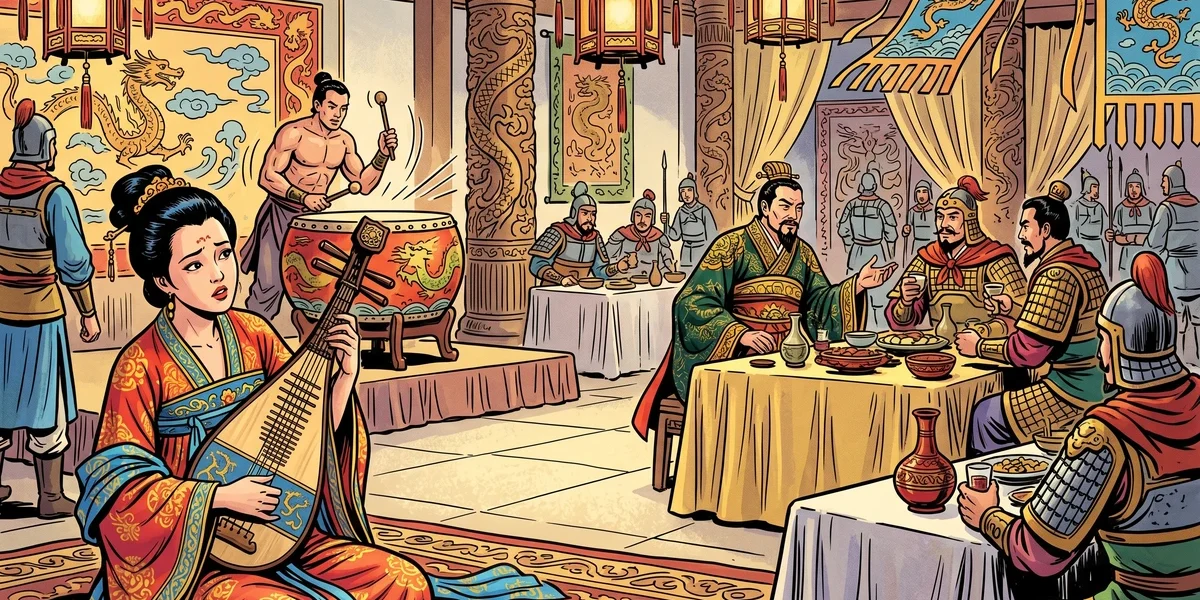
The Golden Canister: In the days of the Tang dynasty there lived a certain count in the camp at Ludschou. He had a slave who could play the lute admirably, and
Origin & Tradition
“The Golden Canister” belongs to the global tradition of the magical inexhaustible vessel — the container that produces wealth, food, or magical substance without ever being depleted. Known to folklorists under the Aarne-Thompson-Uther index as part of the ATU 750 family (“Wishes”), this story type appears across virtually every human culture: the Norse cornucopia, the Indian akshaya patra (inexhaustible bowl) of the Mahabharata, the European magic pot of porridge, the Chinese golden canister. The Chinese telling, preserved in oral tradition and recorded in Richard Wilhelm’s Chinesische Volksmärchen (1914), inflects this universal motif with specifically Daoist moral content: the test the canister poses is not merely a test of greed in the simple Western sense, but a test of zhi zu (知足, “knowing sufficiency”) — one of the cardinal Daoist virtues, identified by Laozi as the foundation of all genuine wealth. The canister is a cosmological examination, and it marks its examinees with devastating precision.
Part I — The Gift and Its Conditions
The golden canister comes to its possessor through one of the classic channels by which Chinese folk tales deliver supernatural gifts: an act of kindness toward a stranger in distress, the rescue of an animal who turns out to be a supernatural being in disguise, or the discovery of an unusual object in an unusual place that carries with it invisible instructions. In each variant, the gift is accompanied — explicitly or implicitly — by conditions. The canister produces what it produces; the possessor may use what it gives; but there is a boundary, and that boundary is the story’s central drama.
In the story’s opening phase, the canister performs as promised. A family that was struggling finds itself comfortable; a person who was hungry finds themselves fed. The golden vessel delivers with remarkable precision: exactly the right amount arrives at exactly the right time, and the recipient, initially overwhelmed with gratitude, settles into the new abundance with a contentment that is, at this stage, genuine. They share with neighbours, provide for relatives, extend hospitality with a generosity that their previous poverty had prevented. The canister has not merely solved a material problem; it has, in this opening phase, enabled a life closer to the one its possessor had always wished to live — one characterised by sufficiency, generosity, and the quiet dignity of having enough.
Part II — The Escalation of Desire
The story’s crisis emerges from the gap between sufficiency and appetite. Sufficiency, once achieved, does not necessarily stay in view — it becomes invisible, the new baseline from which a recalibrated desire measures its distance from the next level of “enough.” The possessor who was grateful when hungry is now comfortable; comfort reveals the existence of wealth; the sight of wealth reveals the existence of luxury; the taste of luxury reveals the existence of imperial magnificence. Each threshold crossed in the upward direction simply opens a view of the next threshold, which now appears as a new form of insufficiency.
This psychological dynamic — the moving baseline of desire, the inability of achieved abundance to satisfy for long — is what the canister tests. It is not testing whether the possessor will steal; there is nothing to steal. It is testing whether the possessor can maintain zhi zu in the face of its own generative capacity — whether the person who has found sufficiency can recognise it as the destination rather than a waystation. The possessor cannot. More is demanded of the canister; more is extracted; the conditions that governed the gift — visible or invisible — are exceeded; and the canister, with the impersonal precision of a cosmological mechanism, responds to the violation of the conditions by ceasing to function, reversing its abundance, or being reclaimed by the supernatural authority that issued it.
The loss, when it comes, is calibrated to the violation. The person who demanded slightly more than was offered loses slightly more than they gained; the person who demanded everything loses everything, including what they had before the canister arrived. The measure is exact because the Chinese moral cosmos is exact: the bao ying (報應, retributive response) that governs this story is not punishment in the punitive sense but consequence in the mechanical one. The canister does not judge; it simply reflects back the quality of the relationship its possessor maintained with sufficiency.
Part III — Zhi Zu and the Daoist Critique of Insatiable Desire
Zhi zu (知足, “knowing sufficiency” or “knowing contentment”) is one of the most compact and powerful of Laozi’s practical teachings. Chapter 33 of the Tao Te Ching declares: zhi zu zhe fu (知足者富, “those who know sufficiency are wealthy”). The paradox is deliberate: genuine wealth is not a quantity of possessions but a quality of relationship to what one has. The person who has little but knows it to be enough is wealthy; the person who has much but experiences it as insufficient is poor, regardless of what the ledgers show.
This teaching is not an injunction to poverty or passivity. Laozi’s zhi zu does not advise against acquiring what one needs — it advises against the structural inability to experience what one has as sufficient, the psychological condition in which satisfaction is always deferred to the next acquisition. This condition is what the Daoists call yu (欲, craving or desire), and it is understood not as a moral failing in the Western sense but as a cosmological disorder: a disruption of the natural relationship between a being and the flow of the Tao, which always provides exactly what is needed and no more.
The golden canister, in this framework, is not a test of virtue in the sense of resisting temptation — it is a diagnostic tool that reveals the possessor’s relationship with sufficiency. Does this person experience what arrives as the Tao’s provision — adequate, good, trustworthy? Or does what arrives simply reveal a further gap between what is present and what is craved? The canister cannot provide satisfaction to someone incapable of experiencing satisfaction; it can only continue producing until the incapacity to rest in sufficiency exhausts or inverts the gift entirely.
A parallel tradition in Chinese folk narrative involves the magical vessels of Daoist alchemical practice — specifically the hu lu (葡蒜, the immortal’s gourd), which features in countless tales of Daoist adepts. The immortal’s gourd is a container whose interior space is larger than its exterior — a whole world contained in a small vessel — and it is associated with the Daoist insight that the boundary between small and large, finite and infinite, is itself a function of perspective rather than quantity. The golden canister shares this symbolic register: its inexhaustibility implies that what it contains is in some sense beyond quantity — drawn from the Tao’s own endless provision — and that the only thing that can limit it is the failure of the relationship between the recipient and the gift.
Part IV — The Wisdom of Enough
The moral that the golden canister story delivers is simultaneously personal and political. Personally, it identifies the experience of sufficiency — the ability to feel, with genuine conviction, that what one has is enough — as the most practically important of all virtues, because it is the one that determines whether abundance produces happiness. All the other virtues — courage, loyalty, wisdom, generosity — can be rendered ineffective by the inability to experience sufficiency; a courageous, loyal, wise, generous person who cannot feel that they have enough will always be driven forward by a craving that no achievement can satisfy.
Politically, the story is a quietly radical critique of the systems that produce and reward insatiability — the markets, the hierarchies, the status competitions that make the experience of sufficiency structurally difficult by constantly presenting the next level of acquisition as the real threshold of acceptability. In this reading, the golden canister’s loss is not the loss of an individual moral failing but of a social one: a society that cannot teach its members how to experience sufficiency will always exhaust its magical canisters, however many it possesses.
“The canister knew exactly how much was enough. The person holding it did not — and so the canister, having nothing more to teach, gave the only lesson left: the experience of its absence.”
Why This Story Lasted
“The Golden Canister” lasted because the problem it diagnoses — the structural difficulty of experiencing sufficiency as a resting place rather than a temporary station — is permanent and universal. Every generation produces both the magical canisters of unprecedented productive capacity and the inability to rest in what they provide, always reaching for the next level of abundance while the current level recedes into invisibility. The story is not a historical document; it is a current events report that happens to use a golden canister as its focal point.
The story also lasted because the zhi zu teaching it embodies is genuinely difficult — not intellectually (the proposition that knowing sufficiency is the foundation of wealth is perfectly easy to understand) but practically (actually experiencing what one has as enough, in the face of everything that suggests it should be more, requires a quality of inner life that is cultivated over years, not acquired in a moment). The golden canister story makes this difficulty visible and dramatises its consequences, which is the most useful service a folk tale can render: not telling people what they already know, but helping them feel, for a moment, the full weight of what they know but do not yet live.
You May Also Like
 Chinese Folk Tales
Ages 9-12
Chinese Folk Tales
Ages 9-12
How Greed For A Trifling Thing Led A Man To Lose A Great One
A man's obsession with a trifling possession cost him a great opportunity.
 Chinese Folk Tales
All Ages
Chinese Folk Tales
All Ages
The Fairy Bonze
The Fairy Bonze: In a certain well-known and populous city in one of the north-western provinces of China, there once resided a man of the name of Meng. Greed
 Chinese Folk Tales
Ages 6-8
Chinese Folk Tales
Ages 6-8
The Spirit Of The Wu-Lian Mountain
The Spirit Of The Wu-Lian Mountain - a folk tale retold for young readers with a clear moral, simple words, and the warmth of a bedtime story from long ago.