Dschang Liang
Dschang Liang: was a native of one of those states which had been destroyed by the Emperor Tsin Schi Huang. And Dschang Liang determined to do a deed for his
Origin and Narrative Tradition
“Dschang Liang”—the German romanisation of Zhang Liang (張良) used in Richard Wilhelm’s early twentieth-century translations of Chinese folk and literary narratives—is the story of one of Chinese history’s most celebrated strategists and one of its most beloved legends of wisdom transmission. Zhang Liang (d. 189 BCE) was a scion of the old Han aristocracy of the Warring States period who turned to sabotage, strategy, and eventually statesmanship after the Qin dynasty destroyed his family’s kingdom. He served as the principal strategist of Liu Bang, the commoner who overthrew the Qin and established the Han dynasty as its first emperor (Han Gaozu), and was celebrated by Gaozu himself as one of the Three Heroes without whom he could not have won the empire. The historical Zhang Liang is documented in the Shiji (Records of the Grand Historian) of Sima Qian (c. 109 BCE); the legendary Zhang Liang, whose story this tale tells, receives his wisdom from a mysterious old man on a bridge who drops his sandal and requires the young aristocrat to retrieve it. This encounter—the sandal test, the three-morning trial of patience, and the gift of the ancient military classic—became one of Chinese folk culture’s canonical accounts of how genuine wisdom is transmitted: not through institutional education but through tests of character administered by those who carry it.
Beat I — The Young Aristocrat and the Old Man
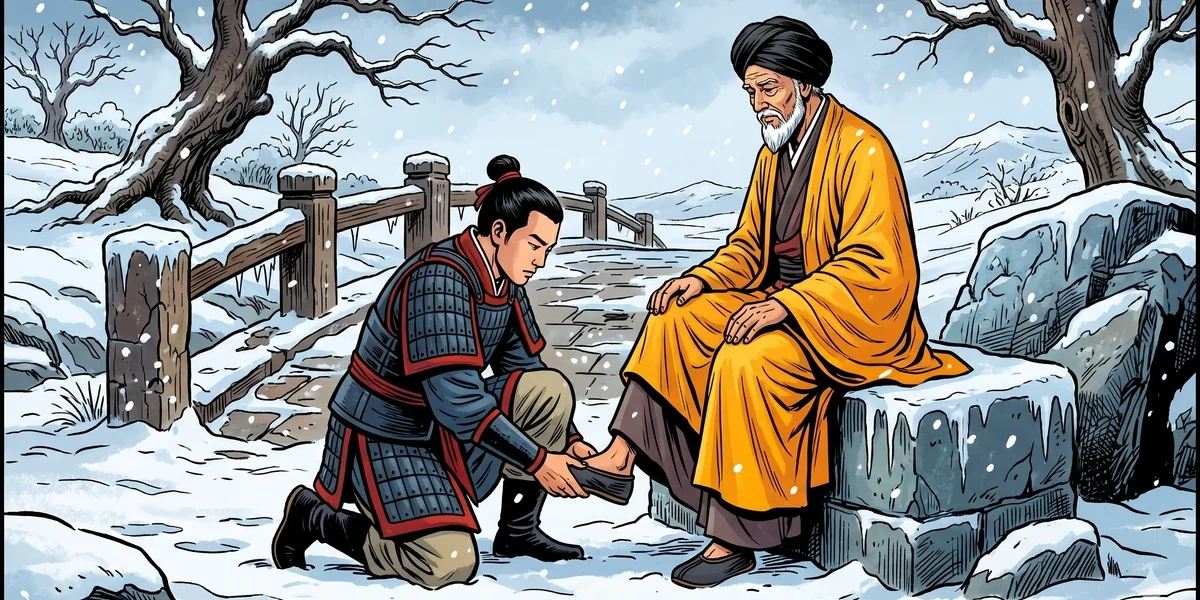
The encounter takes place on a bridge over the Si River—a liminal space, as bridges always are in Chinese sacred geography, a point of crossing between two states of being. Zhang Liang meets an elderly man dressed in rough cloth, who looks at him assessingly, drops his sandal off the bridge’s edge, and says to the young aristocrat: “Boy, go down there and fetch my shoe.” The instruction is deliberately humiliating: a man of Zhang Liang’s social standing would never fetch a shoe for an old commoner. The young man’s first impulse is to strike the old man for his insolence. But something—the old man’s tranquillity, the quality of the assessment in his gaze—restrains him. Zhang Liang goes down, retrieves the shoe, and brings it back. The old man extends his foot without a word of thanks and says: “Put it on.” Zhang Liang kneels and puts the shoe on the old man’s foot. The old man smiles, says nothing further, and walks away. The young aristocrat has just passed the first test—not of his military skill or his intelligence, but of his ability to subordinate pride to patience.
Beat II — The Three-Morning Test of Commitment
The old man returns along the bridge, looks back at Zhang Liang, and says: “You are worth teaching. Come to this bridge in five days at dawn.” On the appointed morning, Zhang Liang arrives at dawn to find the old man already there, angry: “You are late. Come again in five days.” On the second appointed morning, Zhang Liang arrives before dawn and finds the old man already there again—the same rebuke. On the third appointment, Zhang Liang arrives at midnight, standing in the cold darkness on the empty bridge for hours before the old man comes. The old man is pleased. He produces a bundle—the Taigong Bingfa, the military classic attributed to the ancient military sage Jiang Ziya (Taigong Wang, counsellor to King Wen of Zhou)—and presents it to Zhang Liang with a prophecy: “Read this and you will become the teacher of kings. In ten years the world will change. Thirteen years hence you will see me again—look for the yellow stone at the foot of Mount Gucheng.” The gift is not merely a book but a lineage: Zhang Liang receives the military wisdom of the Zhou dynasty’s founding through an unbroken chain of transmission that the old man maintains across centuries.
Beat III — The Transmission of Strategic Wisdom in Chinese Tradition
The Taigong Bingfa (or Liu Tao—the Six韬 of Taigong) and the related military classics of ancient China were not merely tactical manuals but comprehensive philosophies of strategic action: how to read political situations, how to identify the conditions under which force should and should not be used, how to align one’s strategy with the natural currents of historical change rather than against them. The strategic tradition they represent was understood in Chinese culture as a form of dao—a way of relating to power and conflict that had cosmological as well as practical dimensions. Zhang Liang’s extraordinary effectiveness as Liu Bang’s strategist—his ability to see several moves ahead, to identify the moment of opportunity in each shifting configuration of power, and to counsel restraint at precisely the moments when Liu Bang’s impulsiveness would have been fatal—is attributed by the folk tradition to the quality of the transmission he received: not mere tactics but the dao of strategy, the understanding of how power actually flows and what it actually responds to.
Beat IV — The Retirement and the Yellow Stone
The legend’s final movement confirms Zhang Liang’s ultimate priorities. After Liu Bang’s victory and the establishment of the Han dynasty, when the other generals were competing for rewards—territories, titles, armies—Zhang Liang requested only the smallest fief and the permission to pursue Daoist cultivation. He had understood from his encounter with the old man that the power he had been given was borrowed from a tradition larger than himself, and that the appropriate response to the completion of the task was not the accumulation of reward but the return to the source. When he travelled to Mount Gucheng thirteen years after his transmission, he found the yellow stone at the foot of the mountain, brought it home, and worshipped it as a sacred object for the rest of his life. The old man had fulfilled his prophecy precisely; Zhang Liang fulfilled his part by remaining the kind of person who could receive the prophecy’s completion without having been corrupted by the power that made it possible.
Sheng ren bu ji—The sage does not accumulate. The more he gives to others, the more he himself possesses. The Dao of heaven benefits and does not harm; the way of the sage acts and does not contend. (Tao Te Ching 81, the final verse, which Zhang Liang embodies in his post-victory retirement)
Why This Story Has Lasted
The Zhang Liang legend endures because it gives a concrete, story-shaped answer to one of Chinese culture’s most persistent questions: how does genuine wisdom come to the person who needs it? The answer the story proposes is characteristically anti-institutional: wisdom is not obtained through examinations, lineages, or social position, but through the willingness to bend one’s pride and extend one’s patience beyond what the social self considers reasonable. The old man at the bridge is not testing Zhang Liang’s intelligence; he is testing whether Zhang Liang’s intelligence is strong enough to govern his pride—and only when that test is passed does the transmission become possible. The story has been told for two thousand years because the test it describes never becomes obsolete.
Tradition & Collection Notes
Historical source: Sima Qian, Shiji (Records of the Grand Historian), “Biography of Liu Hou Zhang Liang,” chapter 55 (c. 109 BCE). Military classic: Liu Tao (Six韬 of Taigong / Taigong Bingfa), attributed to Jiang Ziya (Taigong Wang), counsellor to King Wen of Zhou; one of the Seven Military Classics of China. German romanisation: “Dschang Liang” follows Richard Wilhelm’s orthography in Chinesische Märchen (Chinese Fairy Tales, 1914). Historical figures: Zhang Liang (the strategist); Liu Bang / Han Gaozu (the founding emperor); Huangshigong / Yellow Stone Duke (the mysterious teacher). Motif index: H1558 (Tests of patience), D1810 (Magic knowledge acquisition), F402 (Supernatural teacher). Han dynasty context: Chu-Han contention (206–202 BCE); Three Heroes of Han: Zhang Liang (strategy), Xiao He (administration), Han Xin (military command). Scholarly reference: Burton Watson, Records of the Grand Historian: Han Dynasty I (1993); Ralph Sawyer, The Seven Military Classics of Ancient China (1993).
You May Also Like
 Chinese Folk Tales
All Ages
Chinese Folk Tales
All Ages
Sky O’Dawn
Sky O'Dawn: Once upon a time there was a man who took a child to a woman in a certain village, and told her to take care of him. Then he disappeared. And
 Chinese Folk Tales
Ages 9-12
Chinese Folk Tales
Ages 9-12
King Mu Of Dschou
King Mu Of Dschou: In the days of King Mu of Dschou a magician came out of the uttermost West, who could walk through water and fire, and pass through metal
 Chinese Folk Tales
Ages 9-12
Chinese Folk Tales
Ages 9-12
The Butterfly Lovers: Transcendent Love Beyond Death
The Butterfly Lovers: Transcendent Love Beyond Death: In the southern regions of ancient China, where green mountains rose like sleeping dragons and rivers