Kwang-Jui And The God Of The River
Kwang-Jui And The God Of The River: China is a land where the great masses of the people have to toil and struggle incessantly in order to obtain even the bare

Origin and Tradition
Kwang-Jui and the God of the River — the title using the old romanisation of Chen Guangrui (陳光蕊) — belongs to the sacred origin narrative embedded in one of the greatest works of Chinese literature: Xi You Ji (西遊記 — Journey to the West), the sixteenth-century novel attributed to Wu Cheng’en that recounts the Buddhist pilgrimage of the monk Xuanzang (玄奘, also called Tang Sanzang or Tripitaka) to retrieve scriptures from India. Before the monk’s great westward journey begins, however, a prior story must be told: how his father Chen Guangrui was murdered and preserved by supernatural power, and how this act of divine preservation shaped the destiny of the child who would become one of China’s most revered religious figures.
The Chen Guangrui episode appears in the earliest printed editions of Journey to the West and in the folk narrative tradition that surrounded and fed the novel. It draws on the intersection of three great religious traditions that characterises Ming dynasty popular religious culture: Buddhism (with its doctrines of karma, rebirth, and providential spiritual destiny), Daoism (with its river deities, immortal powers, and cosmological geography), and Confucianism (with its emphasis on family piety, righteous suffering, and the eventual vindication of virtue). The River God who preserves Chen Guangrui is simultaneously a Daoist supernatural being, an instrument of Buddhist karmic justice, and a figure in the Confucian drama of wronged virtue eventually restored.
The Narrative: Murder, Divine Preservation, and Karmic Design
Chen Guangrui, a successful scholar-official newly appointed to a prestigious post, travels by boat with his young wife Lady Yin to take up his position. During the river crossing, the boatman Liu Hong, overwhelmed by covetous desire for both the scholar’s wife and his position, murders Chen Guangrui and throws his body into the river. Assuming Guangrui’s identity through the clothes and credentials he has stolen, Liu Hong installs himself in the scholar’s post and forces Lady Yin to live as his wife under threat of violence. She complies, hiding her true identity and her grief, and in time gives birth to a son — the child who will grow up to be the monk Xuanzang.
Beneath the river, the murdered scholar’s fate takes an unexpected turn. The Dragon King of the River (龍王, Long Wang) — the aquatic divine sovereign who governs the river’s depths and all life within it — receives Chen Guangrui’s spirit and, perceiving his innocence and the injustice of his death, preserves his body incorruptible beneath the waters while awaiting the moment that heavenly justice will permit his restoration. This preservation — the body kept intact, the spirit sustained — is not accidental but providential: the Dragon King acts in accordance with a heavenly design in which Chen Guangrui’s death and restoration are necessary stages in the larger karmic narrative that will produce Xuanzang and his saving mission to retrieve the Buddhist scriptures.
The Dragon King as Cosmic Instrument of Justice
The Dragon King (龍王, Long Wang) who preserves Chen Guangrui is a figure of central importance in Chinese religious cosmology, quite distinct from the malevolent or ambiguous river spirits of other Chinese folk traditions. The Dragon Kings — four in the canonical Buddhist-Taoist synthesis, presiding over the four seas and major river systems — are servants of the heavenly order (天庭, Tian Ting), subordinate to the Jade Emperor (玉皇大帝) who governs the celestial bureaucracy. They act not arbitrarily but in accordance with heavenly mandate; when the Dragon King of the River preserves Chen Guangrui’s body, he does so because heaven’s design for that body is not yet complete.
This understanding of the River God as a bureaucratic instrument of cosmic justice represents the distinctively Chinese synthesis of Buddhist karma doctrine and Daoist cosmological organisation. The river is not simply a natural feature or even a powerful divine presence; it is a zone of the heavenly administrative system, governed by divine officials who maintain records, receive petitions, and administer justice according to the cosmic ledger. Chen Guangrui’s preservation is essentially a stay of cosmic execution: the Dragon King holds the body in trust until the moment that heavenly justice — working through the natural development of the murdered man’s son into the great monk Xuanzang — is ready to administer its verdict against the murderer Liu Hong.
“Heaven’s justice does not sleep though it sometimes seems to; those who wait in righteousness will see the dawn that comes after the longest night.”
— Chinese Buddhist-Taoist proverb in the Journey to the West folk tradition
Lady Yin’s Heroic Endurance: The Mother of a Saint
Lady Yin’s role in the Chen Guangrui episode is morally as significant as her husband’s miraculous preservation. Compelled to live as the murderer’s wife while concealing her true identity, she endures her captivity with strategic patience — neither submitting spiritually to her situation nor acting precipitously in ways that would endanger herself or her unborn child. When her son is born, she sets him afloat in the river (echoing the ancient Chinese and pan-Asian motif of the hero exposed at birth and preserved by water), trusting that heaven will protect the child she cannot openly claim.
Her endurance is the feminine complement to Chen Guangrui’s passive preservation: both the murdered father and the captive mother wait, in different states of suspension, for the heavenly design to work itself out. Chinese Buddhist literature in particular celebrated this quality of patient, purposive endurance under unjust suffering — ren (忍 — forbearance) elevated to the status of a spiritual virtue that itself generates the merit necessary for providential rescue. Lady Yin’s patient suffering is not weakness but a form of spiritual strength, and her vindication — when Xuanzang is eventually revealed as her son and Chen Guangrui is restored to life — is the completion of a cosmic moral narrative.
Why This Story Endured
The Chen Guangrui episode endured because it served multiple narrative and theological purposes simultaneously. As the sacred origin story of Xuanzang — whose pilgrimage to India represents the definitive event in the Chinese Buddhist imagination of the transmission of dharma from its source to its destination — the story gave the monk’s mission a cosmic genealogy: he was born not accidentally but as the necessary outcome of a providential drama involving murder, divine preservation, patient suffering, and ultimate vindication. Every story needs an origin; this one gave Xuanzang’s story an origin commensurate with the magnitude of his mission.
The story also provided Chinese popular religious culture with a vivid demonstration of the Buddhist-Taoist synthesis’s core theological claims: that karmic justice operates through the natural and supernatural order in ways invisible to ordinary human perception; that suffering borne righteously generates merit that heaven eventually recognises and rewards; and that divine powers — the Dragon Kings, the celestial bureaucracy, the Jade Emperor — participate actively in the moral governance of human affairs. The River God who holds Chen Guangrui’s body in perfect preservation beneath the waters is not a nature spirit but a cosmic official carrying out heaven’s design, and the story’s ending — the scholar restored, the murderer punished, the monk sent on his great journey — is the visible expression of that design completed.
You May Also Like
 Chinese Folk Tales
Ages 6-8
Chinese Folk Tales
Ages 6-8
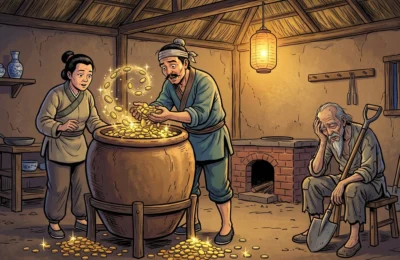
The Magic Cask
The Magic Cask: Once upon a time there was a man who dug up a big, earthenware cask in his field. So he took it home with him and told his wife to clean it out.
 Chinese Folk Tales
All Ages
Chinese Folk Tales
All Ages
The Vengeance Of The Goddess
The Vengeance Of The Goddess: In a certain temple in the northern part of the Empire, there once lived a famous priest named Hien-Chung, whose reputation had
 Chinese Folk Tales
Ages 9-12
Chinese Folk Tales
Ages 9-12
The Dangerous Reward
The Dangerous Reward: Once upon a time a man named Hu-Wu-Bau, who lived near the Great Mountain, went walking there one day. And there, under a tree, he met a