The Spirit Of The Wu-Lian Mountain
The Spirit Of The Wu-Lian Mountain - a folk tale retold for young readers with a clear moral, simple words, and the warmth of a bedtime story from long ago.
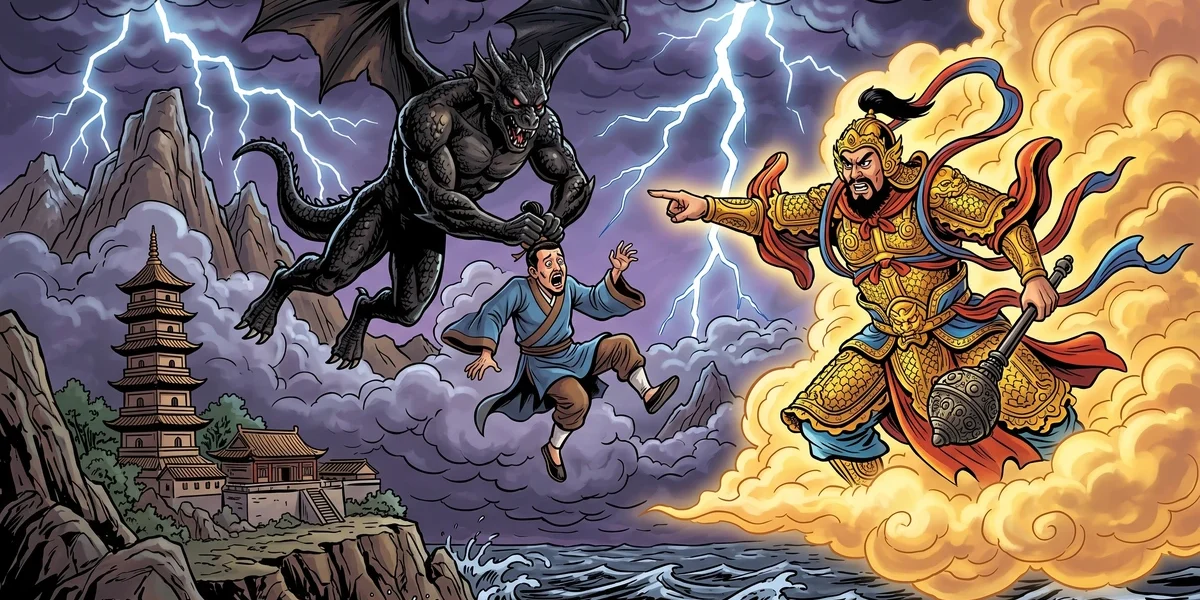
Mountain Shen and the Moralized Landscape of Chinese Sacred Geography
The Spirit Of The Wu-Lian Mountain belongs to the extensive Chinese tradition of shan shen (山神, mountain spirit/deity) accounts — narratives that treat prominent peaks not as inert geological formations but as conscious presences with moral authority over the terrain and communities within their sphere. Mountain deities appear in the earliest layers of Chinese religious literature: the Shan Hai Jing (山海經, Classic of Mountains and Seas, approximately 4th–2nd century BCE) catalogues hundreds of mountain spirits and their characteristic behaviors, powers, and the ritual protocols required to move safely through their domains.
The Wu-Lian Mountain (Wu Lian Shan, 五蓮山) in Shandong province is a historically documented site of mountain spirit veneration, associated with both Daoist and Buddhist temple complexes built on its slopes over many centuries. Its name — “Five Lotus Mountain” — connects it to the lotus symbolism of Pure Land Buddhism, though its mountain spirit traditions predate Buddhist influence and belong to the older stratum of Chinese landscape religion in which specific peaks are understood as nexuses of concentrated qi (氣, vital force) and the residence of shen who govern the local moral order.
Beat I — The Woodcutter and the Hunter on the Same Path
Two men set out on the same autumn morning to enter the Wu-Lian Mountain. The first was a woodcutter named Pei Liang, who had worked the mountain’s lower slopes for twenty years and had developed the careful, deliberate relationship with the landscape that experienced woodcutters acquire: he took dead wood where possible, harvested living timber with attention to what the slope could sustain, replaced what he could, and maintained the small trail-side shrine to the mountain spirit that his father had taught him to honor with a pinch of incense and a moment’s respectful acknowledgment each time he passed.
The second was a hunter named Cui Bao, new to the district, who had heard that the upper slopes of Wu-Lian were home to particularly large deer and wished to take a trophy before winter. Cui Bao was not a malicious man, but he was impatient and commercial in his relationship with the landscape — he saw the mountain as a resource reservoir to be efficiently exploited rather than a presence to be engaged with on its own terms. He had no practice of trail-side shrines and considered such customs superstitious remnants better left behind.
They met on the path near the mountain’s middle elevation and walked together for an hour before their routes diverged. During that hour Pei Liang pointed out the features of the landscape — a spring that ran cold even in summer, a grove of old pines that had never fallen despite decades of wind, a rock formation that marked the boundary the woodcutters traditionally observed between harvest zones. Cui Bao listened with polite interest and privately concluded that the woodcutter’s extensive knowledge of the mountain was the superstitious overlay of a simple man who had spent too long alone in the hills.
Beat II — What Each Man Found
Pei Liang had a productive day. The dead wood was plentiful after the summer’s storms; he found two large fallen pines that would supply his family through winter with a single day’s hauling. Near the upper spring he encountered an old man sitting on a stone who offered him water from a wooden bowl and asked him, in the manner of mountain travelers, about conditions lower down. Pei Liang answered honestly and at length — the harvest had been middling, the track repairs needed attention before winter, the stream crossing at the third ridge was silted and dangerous. The old man thanked him with quiet attentiveness and disappeared up the path when Pei Liang turned to refill his own flask. The woodcutter recognized, in retrospect, the quality of the encounter — the unusual stillness of the man, the way the water from the bowl had tasted different from spring water — and understood he had spoken with the mountain’s spirit. He descended carefully and arrived home before dark.
Cui Bao’s day went differently. He found deer sign in the upper slopes and followed it for hours, but the tracks seemed always to lead slightly further than his calculation suggested. What should have been a half-day circuit became a full day’s exhausting traverse. The landscape refused to resolve into the simple legibility he expected: paths that appeared clear from a distance dissolved into undergrowth when he reached them, landmarks shifted in ways that made navigation unreliable, and twice he found himself looking at terrain he was certain he had passed before from a direction that made no spatial sense. He descended in near-darkness, empty-handed, with a sense that the mountain had been playing with him — though he could not admit this to himself in those terms and attributed his experience to unusual and inconveniently arranged terrain.
He never took a deer from Wu-Lian Mountain. Each subsequent attempt produced variations of the same experience: the sign was present, the quarry always just ahead, the landscape always arranging itself to prevent the final conclusion. Eventually he hunted elsewhere, and Wu-Lian Mountain was added to his private list of places where, for reasons he preferred not to examine, the hunting simply did not work.
Beat III — Shan Shen and the Moral Topography of Chinese Sacred Landscape
The Chinese mountain spirit tradition operates within a coherent philosophical framework that understands landscape as morally responsive rather than morally neutral. This is not merely animism in the anthropological sense — the attribution of spirit to natural objects — but a more specific claim about the relationship between human moral quality and the behavior of the natural world in the vicinity of concentrated qi.
Mountain peaks are understood in this framework as locations where the vertical axis of heaven-earth connection is particularly strong, where yang qi (陽氣) is concentrated, and where the boundary between ordinary human experience and more fundamental patterns of reality is thinner than in flat terrain. The shan shen who governs such a location is not a separate being imported into the landscape from some divine realm; it is the mountain’s own moral consciousness — the concentrated intelligence of centuries of wind, water, rock, root, and the accumulated presence of all those who have engaged with the landscape honestly.
This framework explains why Pei Liang’s relationship with the mountain is described in terms of knowledge and respect rather than in terms of prayer and supplication. He knows the mountain — its springs, its boundary markers, its capacity — and this knowledge is itself a form of honoring it. The trail-side shrine is not a payment to a supernatural agent but an acknowledgment of ongoing relationship: he is here in a landscape that has its own existence independent of his purposes, and he recognizes this fact with a pinch of incense.
Cui Bao’s difficulty is correspondingly not punishment imposed by a vengeful spirit but the natural consequence of attempting to use a landscape without engaging with it. He approaches Wu-Lian as a resource to be extracted, which means he does not actually perceive it accurately — he sees what he expects to see rather than what is there. The deer that always remain slightly ahead, the paths that dissolve, the landmarks that shift: these are the mountain’s moral topography expressing itself to someone whose mode of attention cannot read it correctly.
Beat IV — Sacred Geography and the Ethics of Landscape Relationship
The legend participates in a much larger Chinese discourse about the ethics of how human beings relate to natural landscapes. This discourse runs from the earliest ritual texts through the great landscape poetry tradition of the Tang and Song dynasties, through the mountain pilgrimage literature, through the garden design philosophy that became one of China’s most sophisticated aesthetic traditions. What it consistently argues is that landscape is not background to human activity but a participant in it — that the quality of attention and relationship one brings to a mountain, a river, or a garden determines what that landscape is capable of offering in return.
This is a position with significant practical implications. The woodcutter who knows his mountain’s sustainable yield and works within it will have wood for decades; the one who clears without attention will have a denuded slope within a generation. The hunter who understands a landscape’s ecology and works within its carrying capacity will hunt successfully over years; the one who sees only the quarry will eventually find the quarry gone. The legend encodes ecological wisdom in spiritual language — a typical move in Chinese nature literature, which has rarely distinguished sharply between the practical and the sacred.
The old man at the spring whom Pei Liang encounters is the legend’s most economical image. He asks about conditions lower down — what a landscape spirit would want to know, what a person with genuine concern for the territory’s welfare would ask. Pei Liang answers honestly and at length, because he actually knows the answers. The water from the bowl tastes different: something of the mountain’s essential quality is offered to someone capable of receiving it. This is the legend’s image of what right relationship with sacred landscape produces — not dramatic blessing but the quiet experience of being genuinely met by the place one has genuinely engaged with.
“Go into the mountain knowing what it is. It will know what you are. This is the beginning of every honest relationship between a person and the land they enter.”
— Principle of Chinese shan shen veneration tradition
Why This Legend Has Lasted
The Spirit Of The Wu-Lian Mountain has endured because it captures with unusual precision the difference between two modes of relationship with natural landscape — one that recognizes the landscape as a participant, one that treats it as a resource — and shows their different outcomes without melodrama or supernatural theatrics. Nobody is harmed. The hunter simply cannot do in Wu-Lian what he can do elsewhere. The woodcutter simply finds the mountain more generous than terrain alone would explain. The legend works through the accumulation of small differences rather than dramatic confrontation.
This restraint reflects something important in the Chinese mountain spirit tradition: the shan shen is not typically a dramatic interventionist, hurling lightning at the impious or showering gold on the virtuous. The mountain spirit operates at the level of the landscape’s ambient intelligence — subtly organizing conditions so that right relationship is rewarded with practical success and wrong relationship encounters practical resistance. The lesson is not that you will be punished for dishonoring the mountain but that you simply cannot work effectively in a landscape you are not in honest relationship with. This is, simultaneously, an ecological truth and a spiritual one.
Wu-Lian Mountain and Mountain Spirit Veneration in Shandong
Wu-Lian Mountain (五蓮山, Five Lotus Mountain) in Rizhao Prefecture, Shandong Province, is a historically significant site of religious veneration combining Daoist, Buddhist, and older indigenous landscape religion elements. Its temple complexes include the Guangming Temple (光明寺) with foundations dating to the Tang dynasty. Shandong province is particularly rich in mountain spirit veneration traditions, connected partly to the region’s relationship with Taishan (Mount Tai), one of the Five Sacred Mountains of China and one of the most important sites of mountain deity worship in East Asia. The Taishan deity (Dongyue Dadi, 東嶽大帝) is the supreme mountain spirit in the Chinese pantheon, heading a celestial bureaucracy of mountain spirits who govern specific peaks throughout the country. Local mountain spirits like that of Wu-Lian Mountain function within this larger framework as regional officials within a divine administrative hierarchy, responsible for the moral order of their terrain — a conception that mirrors the structure of the imperial bureaucracy and reflects the deep interpenetration of political and religious thinking in Chinese civilization.
You May Also Like
 Chinese Folk Tales
Ages 9-12
Chinese Folk Tales
Ages 9-12
The Talking Silver Foxes
The Talking Silver Foxes: The silver foxes resemble other foxes, but are yellow, fire-red or white in color. They know how to influence human beings, too.
 Chinese Folk Tales
Ages 9-12
Chinese Folk Tales
Ages 9-12
The Butterfly Lovers: Transcendent Love Beyond Death
The Butterfly Lovers: Transcendent Love Beyond Death: In the southern regions of ancient China, where green mountains rose like sleeping dragons and rivers
 Chinese Folk Tales
Ages 9-12
Chinese Folk Tales
Ages 9-12
The Panther
The Panther: Once upon a time there was a widow who had two daughters and a little son. And one day the mother said to her daughters: “Take good care of the