The Fox And The Raven
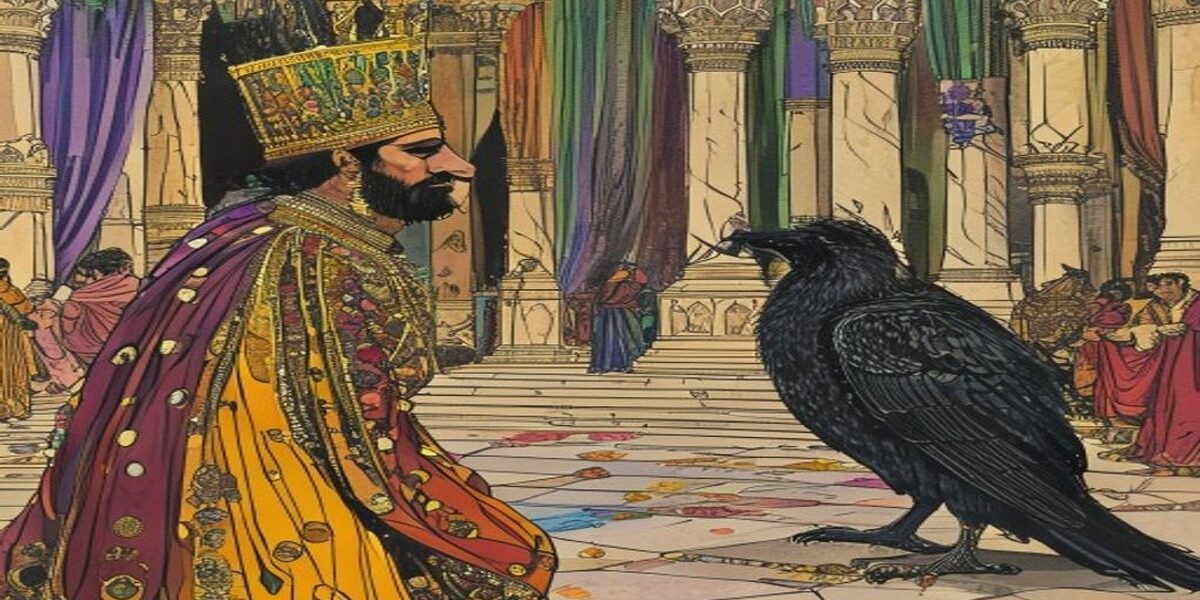
The Fox And The Raven: The fox knows how to flatter, and how to play many cunning tricks. Once upon a time he saw a raven, who alighted on a tree with a piece
Origin & Tradition
“The Fox and the Raven” occupies a fascinating position at the crossroads of universal fable tradition and specifically Chinese moral philosophy. The story’s core structure — a clever trickster flattering a vain creature into relinquishing something of value — belongs to the Aesopic inheritance: it is most familiar in the West through Aesop’s fable of the Fox and the Crow (c. 600 BCE) and La Fontaine’s celebrated verse retelling Le Corbeau et le Renard (1668). Yet the Chinese version, transmitted through oral tradition and recorded in anthologies such as Richard Wilhelm’s Chinesische Volksmärchen (1914), is not simply a borrowing — it is a reframing. In the Chinese telling, the fox carries the full weight of the hu li jing (狐狸精, fox spirit) tradition: a supernatural trickster whose cunning is morally ambiguous, simultaneously a symbol of dangerous seduction and a didactic instrument exposing human vanity. The raven, meanwhile, carries the symbolism of the wu ya (烏鸦) — a bird associated in Chinese culture with both solar mythology (the three-legged crow of the sun) and, in popular usage, with ill-omened pride. Together they stage a Confucian drama about the social danger of ning ren (佞人, flatterers) and the moral imperative of self-knowledge.
Part I — The Raven’s Treasure
A raven, proud of its glossy black plumage and its commanding perch in the tallest tree at the forest’s edge, has come into possession of something valuable — a piece of choice food, a morsel of remarkable quality — and sits holding it with every intention of consuming it at leisure. Ravens, in Chinese folk consciousness, are associated with an elevated sense of their own importance: the mythological sun-crow (Jin Wu, 金烏, the Golden Crow) was the divine bird who drew the sun across the sky, and ordinary ravens carry a trace of this celestial heritage in their bearing, even if the actual content of their lives does not justify such dignity.
This raven has all the self-regard of its mythological ancestor and none of the astronomical responsibilities. It is, in short, an ideal target for a fox. And a fox, of course, is precisely what arrives.
The fox’s approach is studied and unhurried. She does not rush at the raven or startle it into flight. She positions herself at the base of the tree with the patience of an angler setting a line and begins to speak — her voice modulated to convey admiration, wonder, even a touch of reverence. She praises the raven’s form, its bearing, the depth of its dark eyes, the audacity of its proud head against the sky. Each sentence is a carefully placed stone in the path toward the raven’s vanity.
Part II — The Anatomy of Flattery
The fox’s genius is that nothing she says is entirely false. The raven’s plumage is extraordinarily lustrous. Its perch is commanding. Its posture does carry a certain natural authority. The fox has observed all these things accurately, and she reports them with what sounds like genuine appreciation. This is the master stroke of skilled flattery: it begins from truth, proceeds to exaggeration, and arrives at manipulation — and because the first move is genuinely accurate, the flattered creature cannot easily identify the point at which honest observation ceded to strategic exploitation.
The raven listens. Its chest swells. The fox continues: surely a creature of such magnificent appearance must also possess a magnificent voice? Surely the raven’s song, if it were to sing, would be the equal of its looks? The raven, whose actual voice is a harsh and undistinguished croak, has never been told anything so gratifying in its life. The possibility that this might be precisely because it is untrue does not surface. The food in its beak begins to feel like an irrelevance compared to the pleasure of this moment. It opens its beak to demonstrate its voice. The food falls. The fox snatches it and is gone before the raven has completed its first note.
What the raven experiences in the following silence is, among other things, a very fast education. It has been taught something that Confucian social theory had been warning about for centuries: the flatterer (ning ren, 佞人) is among the most dangerous figures in human — or animal — society, not because they lie, exactly, but because they weaponise the truth we most want to hear. The raven was not deceived about the reality of its appearance; it was deceived about the sincerity of the fox’s interest in that appearance. These are different things, and distinguishing between them requires a quality of self-awareness that most creatures — human and corvid alike — struggle to maintain when the flattery is sufficiently pleasurable.
Part III — The Fox Spirit and the Ethics of Cunning
In Chinese folklore, the fox spirit (hu li jing, 狐狸精) is one of the most morally complex supernatural figures in the entire tradition. Unlike the purely malevolent demons of other story categories, the fox spirit occupies an ethical middle ground: she is dangerous, but her danger is inseparable from her intelligence; she deceives, but her deceptions expose weaknesses in her victims that arguably needed exposing. In the great literary anthology Liaozhai Zhiyi (c. 1740), Pu Songling’s fox women are frequently more cultivated, more literate, and more ethically perceptive than the human men they ensnare — the irony being that the human men’s vulnerability to seduction reveals a poverty of moral discernment that the fox women themselves lack.
In “The Fox and the Raven,” the fox performs this traditional role of the instructive trickster. She is not simply a thief; she is a teacher, though the curriculum is brutal and the tuition is paid in humiliation. The lesson she teaches — that vanity creates exploitable vulnerability — is one that the raven could not have learned from a straightforward lecture. It required demonstration, lived experience, the actual sting of loss to make the abstract principle concrete. Chinese pedagogical tradition, in its more rigorous forms, understood this: certain lessons resist gentle delivery and require the shock of consequence to take root.
The fox is also significant as a specifically female trickster in the Chinese tradition. The hu li jing is almost invariably female, and her manipulation of male (or male-coded) vanity carries a social commentary that would have been legible to Chinese audiences: it is the powerful who are most susceptible to flattery, because power creates the expectation of deference, and deference is flattery’s native register. The raven, perched above the fox and holding something the fox wants, is briefly powerful — and the fox’s entire strategy depends on that brief sense of power creating a corresponding vulnerability.
Part IV — The Confucian Warning and Universal Resonance
Confucius himself identified the flatterer (ning ren) as one of the four great dangers to moral order alongside the bully, the hypocrite, and the nihilist. The Analects (論語, Lunyu) contain multiple warnings against the person who says pleasing things rather than true things — qiao yan ling se (巧言令色, “clever words and an ingratiating manner”) being identified as incompatible with genuine virtue. The true friend, in Confucian ethics, offers honest counsel even when it discomforts; the flatterer offers comfortable counsel that serves only the flatterer’s interest. The raven, deceived by the fox’s “clever words and ingratiating manner,” enacts exactly the cautionary scenario that the Confucian tradition had been mapping for two thousand years.
The universal persistence of this fable type — from Aesop to La Fontaine to the Chinese oral tradition — reflects a truth that human social experience confirms across every culture and historical period: the desire to be praised is among the most powerful and least examined of human motivations. It operates below the level of rational deliberation, triggering responses that feel like pleasure before they can be evaluated as warranted or unwarranted. Every society that has ever produced social life has produced both flatterers and the cautionary tales designed to inoculate against them. “The Fox and the Raven” is China’s contribution to this universal curriculum — and a particularly elegant one, because it arrives not as a lecture but as a story whose ending does the lecturing for it.
“The fox praised what was real, but desired what was held. The raven heard only the praise and forgot it was holding anything — and in the moment of forgetting, lost everything it had and gained only the knowledge of its own weakness, which it should have had before.”
Why This Story Lasted
“The Fox and the Raven” has lasted because its mechanism is as precise and repeatable as a lock: vanity is the key, flattery is the pick, and the door that opens leads always to loss. This precision means the story can be retold across centuries without losing its force — the mechanism does not become obsolete, because vanity does not become obsolete. The specific food in the raven’s beak is irrelevant; the structure of the encounter is everything.
The story also lasts because the fox is irresistible. Her intelligence, her patience, her elegant refusal to use force when language suffices — these qualities make her, paradoxically, more admirable than her victim even as she behaves badly. Chinese audiences, who have always had a sophisticated appreciation for wit used well, tend to leave the story with something more complicated than simple moral instruction: a residue of admiring the fox, even while knowing they should guard against her. This complexity — the capacity to feel the moral and its undermining simultaneously — is what distinguishes great folklore from simple didactic tale, and what keeps this story alive across its many retellings in many cultures under many names.
You May Also Like
 Chinese Folk Tales
Ages 9-12
Chinese Folk Tales
Ages 9-12
The Herd Boy And The Weaving Maiden
The Herd Boy And The Weaving Maiden: The Herd Boy was the child of poor people. When he was twelve years old, he took service with a farmer to herd his cow.
 Chinese Folk Tales
Ages 9-12
Chinese Folk Tales
Ages 9-12
The Maiden Who Was Stolen Away
The Maiden Who Was Stolen Away: In the western portion of the old capital city of Lo Yang there was a ruined cloister, in which stood an enormous pagoda
 Chinese Folk Tales
All Ages
Chinese Folk Tales
All Ages
The Kindly Magician
The Kindly Magician: Once upon a time there was a man named Du Dsi Tschun. In his youth he was a spendthrift and paid no heed to his property. He was given to