The Bird With Nine Heads
The Bird With Nine Heads: Long, long ago, there once lived a king and a queen who had a daughter. One day, when the daughter went walking in the garden, a
Origin and Tradition
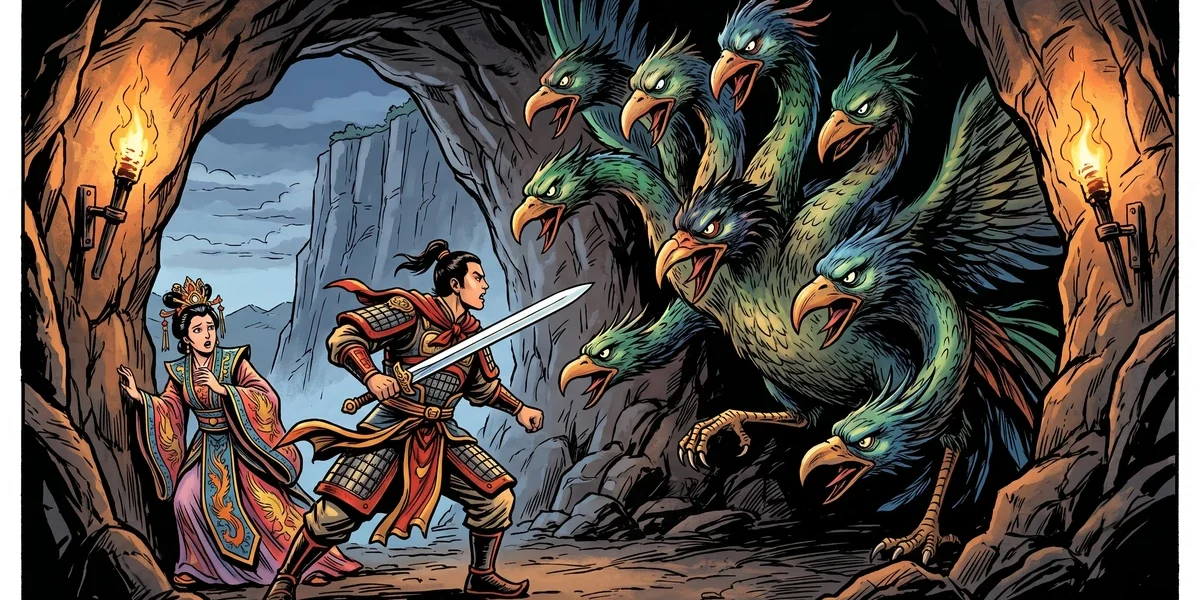
The Bird with Nine Heads draws on one of the oldest and most dramatically vivid monster figures in Chinese mythology: the jiu tou niao (九頭鳥 — Nine-Headed Bird), a creature of ancient lineage documented in the Shan Hai Jing (Classic of Mountains and Seas) and embedded in the mythological traditions of the ancient southern state of Chu (楚), whose distinctive cultural and religious imagination produced some of the most extraordinary mythology in the Chinese literary record. The nine-headed bird appears across a wide range of Chinese folk narrative traditions as both a mythological creature of cosmic significance and as the monster of a specific tale type: the abductor of a beautiful young woman who must be rescued by a hero willing to descend into the creature’s underground lair.
The number nine (九, jiǔ) carries profound symbolic weight in Chinese numerology: it is the highest single digit, associated in Chinese cosmology with the most extreme yang quality, with heaven, with the emperor (the “son of heaven” resided in the “nine-fold forbidden city”), and with the largest and most powerful manifestation of any quality. A bird with nine heads is thus not merely a large bird with multiple heads but a creature that embodies avian power in its most extreme, superlative, yang-saturated form — a being of fearsome vitality that has pushed the avian principle to its furthest possible expression. The creature’s cosmological extremity is what makes it both terrifying and, paradoxically, vulnerable: extreme yang carries within it the seed of its own undoing.
The Shan Hai Jing and Chu Mythology: Ancient Roots
The Shan Hai Jing (山海經 — Classic of Mountains and Seas), composed in multiple layers between the fourth century BCE and the second century CE, is the most comprehensive repository of Chinese mythological zoology, geography, and demonology, cataloguing the fantastic creatures that inhabit the mountains, seas, and wilderness zones beyond the known world. It mentions the nine-headed bird (in variants called the jiu feng, 九鳳, or other names) in the context of the far southern mythological geography — the landscape from which the ancient state of Chu drew its distinctive religious imagination.
Chu mythology, preserved most fully in the Chu Ci (楚辭 — Elegies of Chu) compiled by Wang Yi in the Han dynasty but preserving much earlier material, is characterised by a passionate, shamanistic intensity quite distinct from the more restrained official mythologies of the northern Zhou states. The Chu tradition celebrated bird symbolism with particular fervour — the phoenix (fenghuang), the heavenly bird of the south, was the totemic symbol of Chu cultural identity. The nine-headed bird fits within this southern Chinese avian mythological complex as the dark counterpart to the luminous phoenix: a creature of overwhelming vitality that has crossed the boundary from the numinous to the monstrous.
The Folk Narrative: Hero, Monster, and the Rescued Princess
In its most widespread folk narrative form, the nine-headed bird story follows a classic hero-and-monster structure. The creature abducts a beautiful young woman — typically a princess or a girl of exceptional quality — and carries her to its lair, an underground or remote domain inaccessible to ordinary human pursuit. The king or father offers a reward to anyone who can rescue her; multiple heroes attempt the task and fail, either killed or driven back by the creature’s ferocious multiple-headed attack. The eventual hero — typically of humble origin but exceptional courage and ingenuity — discovers something crucial that the earlier heroes missed: the bird has a vulnerability, typically associated with one of its nine heads being less formidable than the others, or with a specific condition or timing that reduces its power.
The hero’s descent into the bird’s lair is the narrative’s most dramatic moment: a journey into a subterranean or otherwise enclosed space, away from human society and the normal protections of daylight, where the hero must face the nine-headed creature on its own terrain. The method of defeating it varies across regional variants — sometimes he cuts off heads until the creature is reduced to one; sometimes he exploits the bird’s internal conflict (nine heads pulling in nine directions); sometimes he uses a specific weapon or technique revealed to him by a spirit guide or the captive woman herself. The rescue completes the standard narrative arc, but what lingers in the imagination is the middle section: the hero in the monster’s domain, facing something that has defeated everyone else, finding through ingenuity and courage the specific path through the apparently impossible.
“The bird that terrorises many kingdoms can be overcome by one who understands that nine heads make nine arguments, and the monster divided against itself is already half-defeated.”
— Chinese folk commentary on the nine-headed bird tale tradition
Nine-Headed Monsters Across Chinese and World Mythology
The multi-headed monster is a figure of remarkable cross-cultural persistence, appearing in mythological traditions across Eurasia and beyond: the Greek Hydra (which grew two heads for every one cut off), the Norse Jormungandr, the Hindu Ravana (whose ten heads made him virtually indestructible), the Slavic three-headed Zmey, and the Japanese Yamata no Orochi (eight-headed serpent slain by Susanoo). Comparative mythologists have identified the multi-headed monster as a figure encoding a specific cluster of symbolic meanings across these traditions: the idea of an energy or force that has multiplied beyond natural limits, that has escaped the organic unity of single-headed being, and that must be overcome not by matching its power but by finding the principle of its unity — or of its internal contradiction.
The Chinese nine-headed bird shares this symbolic structure while expressing it in distinctively Chinese cosmological terms. The creature’s nine heads represent yang power pushed to its extreme; the hero’s task is to find the principle of yang’s self-defeat — the way in which too much of any quality turns against itself — and to use that understanding rather than raw power to achieve the creature’s overthrow. This is the Chinese version of the universal wisdom encoded in multi-headed monster tales: that the greatest power is not the one that matches force with force, but the one that understands the nature of force itself well enough to find the point where it fails.
Why This Story Endured
The nine-headed bird story endured because it offered a vivid and memorable form to the universal human experience of facing something that appears overwhelming, that has defeated everyone else who has tried to deal with it, and that requires not more of the same approach but a fundamentally different kind of understanding. The hero who succeeds against the nine-headed bird does not succeed by being nine times stronger or nine times more courageous than those who failed; he succeeds by perceiving something about the creature’s nature that his predecessors missed, and by finding the specific point at which apparent invincibility is vulnerable.
This epistemological dimension of the monster tale — the insight that victory requires understanding rather than mere force — connects the nine-headed bird tradition to the broader Chinese wisdom literature’s emphasis on zhi (智 — wisdom, strategic intelligence) as the supreme human quality. The story’s geography, moving from the ordinary human world into the monster’s underground domain and back, maps the psychological journey from ordinary consciousness into the confrontation with something outside normal human experience, and back into the ordinary world transformed by that encounter. The princess rescued is important; but what the hero brings back — the knowledge of how to face the apparently impossible — is the story’s deepest gift.
You May Also Like
 Chinese Folk Tales
Ages 9-12
Chinese Folk Tales
Ages 9-12
The Little Hunting Dog
The Little Hunting Dog: Once upon a time, in the city of Shansi, there lived a scholar who found the company of others too noisy for him. So he made his home
 Chinese Folk Tales
All Ages
Chinese Folk Tales
All Ages
The Disowned Princess
The Disowned Princess: At the time that the Tang dynasty was reigning there lived a man named Liu I, who had failed to pass his examinations for the doctorate.
 Chinese Folk Tales
Ages 6-8
Chinese Folk Tales
Ages 6-8
The Fire-God
The Fire-God. Kids-friendly retelling with setting, characters, moral, and a lesson for today.