How Molo Stole The Lovely Rose-Red
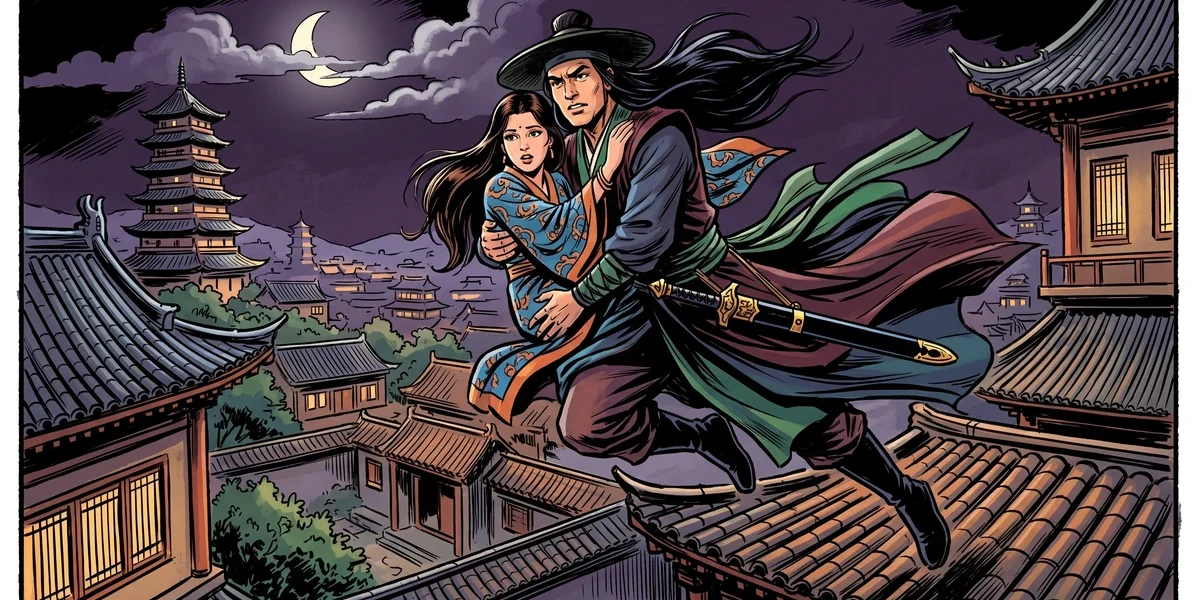
How Molo Stole The Lovely Rose-Red: At the time when the Tang dynasty reigned over the Middle Kingdom, there were master swordsmen of various kinds. Those who
Origin and Tradition
How Molo Stole the Lovely Rose-Red belongs to one of the most dramatically compelling traditions in Chinese folk narrative: the yao guai qianghun (妖怪搶婚) cycle — tales in which a supernatural being, demon, or powerful spirit abducts a beautiful young woman, compelling a mortal hero to undertake a dangerous quest for her rescue. This tale type spans Chinese literary culture from the ancient mythological records of the Shan Hai Jing (Classic of Mountains and Seas) through the great Tang dynasty chuanqi romance fiction, the Song-era huaben short stories, and the popular Ming-Qing vernacular novel tradition. The story as it appears in regional folk collections preserves the essential structure of this ancient narrative form while grounding it in the vivid particularity of local custom and landscape.
The abductor Molo represents the figure scholars of Chinese demonology classify as a yao jing (妖精) — a powerful supernatural being, neither entirely demonic nor divine, that exists at the boundary between the human and spirit worlds. Unlike the malevolent ghosts (gui 鬼) of Chinese folk belief, the yao jing retains a kind of amoral vitality: it acts not from hatred of humanity but from desire, envy, or the wilful exercise of supernatural power over those weaker than itself. Rose-Red (the lovely woman at the tale’s centre) embodies the ideal of feminine beauty and virtue that Chinese folk culture invested with cosmic significance — her abduction is not merely a personal tragedy but a disruption of the social and moral order that heaven itself requires to be set right.
The Narrative: Desire, Theft, and the Hero’s Journey
The story opens with the establishment of Rose-Red’s beauty and her position within a human community: she is a daughter of a good family, beloved and sheltered, her future the proper subject of parental arrangement and community celebration. Molo — whose name carries connotations of supernatural power and transgressive desire — perceives her and is overwhelmed by covetous longing. Where a human suitor would negotiate, petition, and submit to social protocol, the yao jing acts outside human social order entirely: he steals Rose-Red, carrying her away to his domain in a realm inaccessible to ordinary human pursuit.
The theft inaugurates the narrative’s central movement: a hero — her betrothed, her brother, or a young man who loves her — resolves to recover Rose-Red regardless of the supernatural dangers involved. His quest takes him into the liminal territories of the Chinese imaginary, the mountain fastnesses and subterranean palaces where spirit beings hold their courts. Along the way he must navigate trials of courage, cunning, and moral steadfastness, typically receiving assistance from benevolent spirits, Daoist immortals, or the compassion of minor supernatural beings moved by the purity of his love and intention.
Moral Architecture: Cosmic Order, Desire, and the Claims of Human Love
The yao guai abduction tale encodes a sophisticated moral cosmology that is characteristically Chinese in its refusal of simple good-versus-evil dichotomy. Molo is not pure evil; he is powerful desire operating outside its proper channels. Chinese folk ethics held that desire — including the desire for beauty — is not inherently wicked; what makes it transgressive is the mode of its satisfaction. The abductor does not simply want Rose-Red; he wants to possess her outside the social and moral contracts that govern human relationships. This is his transgression against the li (禮 — ritual propriety) that structures human community.
The hero’s quest, conversely, is grounded in legitimate love: a bond established through proper social relationship and sanctioned by family and community. Chinese folk tradition understood this contrast not merely as personal virtue against personal vice but as a cosmological contest between the moral order (the Confucian social world undergirded by heavenly principle) and the amoral power of supernatural desire. The hero’s eventual success — typically achieved through the intervention of sympathetic supernatural beings who recognise the righteousness of his cause — affirms that heaven ultimately supports the moral order against transgressive force.
“What is seized by power and held by fear is already lost; love that flows from virtue cannot be stolen, only given.”
— Chinese proverb from the yao guai romance tradition
Rose-Red as Moral Axis: Beauty, Virtue, and Cosmic Significance
The female protagonist’s name — Rose-Red (meijuhong or a regional variant emphasising her luminous beauty) — situates her within the Chinese literary convention of naming beautiful women after flowers and natural colours, a convention that simultaneously celebrates their beauty and signals their metaphorical significance. In Chinese cosmology, extreme beauty attracted supernatural attention precisely because beauty, like all exceptional qualities, was understood to concentrate cosmic force. The beautiful woman who attracts demonic desire is not blamed for her beauty; rather, her abduction becomes a cosmological event requiring cosmological resolution.
Rose-Red’s behaviour during her captivity is morally significant: she maintains her virtue and her fidelity to the human social order from which she has been torn. This steadfastness — her refusal to accept the demon’s desire as legitimate — is as morally active as the hero’s quest. Together, the faithful hero’s courage and the captive’s moral integrity constitute the full moral response to supernatural transgression, and it is this combined human virtue that heaven recognises and supports. The story thus affirms that human moral integrity, maintained under extreme pressure, retains its force even in the face of supernatural power.
Why This Story Endured
The yao guai abduction narrative endured in Chinese folk tradition because it addressed perennial anxieties about the vulnerability of family bonds and social order to forces beyond human control. In a culture where family honour, proper marriage arrangement, and the protection of daughters were central social values, tales of supernatural abduction and heroic rescue gave narrative form to both the fear of disruption and the affirmation that disruption could be overcome. The story’s supernatural frame allowed communities to explore these anxieties at a safe emotional distance while reinforcing the social values — courage, fidelity, proper social conduct — that the community wished to perpetuate.
Comparativists have noted structural parallels between the yao guai abduction cycle and the Ramayana tradition in South and Southeast Asia, the Greek myth of Persephone’s abduction by Hades, and the European fairy-tale tradition of the stolen princess. These parallels suggest that the narrative structure touches something deeply human: the experience of loss through forces beyond one’s power, and the conviction that faithful love and righteous action can recover what has been stolen. How Molo Stole the Lovely Rose-Red gives this universal human story its distinctively Chinese form, grounded in the cosmology, social ethics, and imaginative geography of the Chinese folk tradition.
You May Also Like
 Chinese Folk Tales
Ages 9-12
Chinese Folk Tales
Ages 9-12
The Punishment of Greed
A lonely teacher sees a strange glow in the grass and opens a coffin he should have left alone.
 Chinese Folk Tales
All Ages
Chinese Folk Tales
All Ages
The Tragedy Of The Yin Family
The Tragedy Of The Yin Family: In a certain district in one of the central provinces of China, there lived a man of the name of Yin. He was possessed of
 Chinese Folk Tales
All Ages
Chinese Folk Tales
All Ages
The Eight Immortals (I)
The Eight Immortals (I): There is a legend which declares that Eight Immortals dwell in the heavens. The first is named Dschung Li Kuan. He lived in the time