The Monk Of The Yangtze-Kiang
The Monk Of The Yangtze-Kiang: Buddhism took its rise in southern India, on the island of Ceylon. It was there that the son of a Brahminic king lived, who had
Origin & Tradition
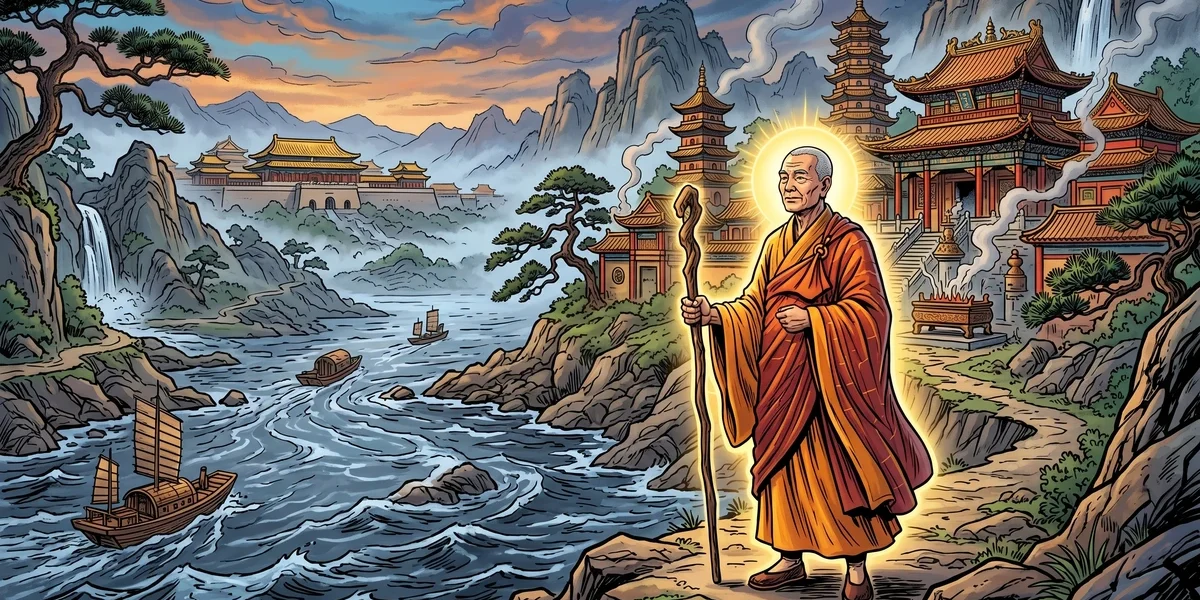
“The Monk of the Yangtze-Kiang” is set on the banks of China’s greatest river — the Chang Jiang (長江, “Long River”), known in the West as the Yangtze — a waterway that runs six thousand kilometres from the Tibetan plateau to the East China Sea and serves in Chinese spiritual culture as both a literal geographical axis and a profound philosophical metaphor. The story appears in Richard Wilhelm’s Chinesische Volksmärchen (1914) and participates in the rich Chan Buddhist tradition that took deep root in the Yangtze River valley from the Tang dynasty (618–907 CE) onward — a tradition in which rivers, mountains, and the act of traveling between them were understood not merely as physical experiences but as ongoing teachings in the nature of mind. The Yangtze valley was home to some of the most influential Chan masters in Chinese Buddhist history: Mazu Daoyi (馬祖道一, 709–788 CE), Baizhang Huaihai (百丈懷海, 749–814 CE), and Huangbo Xiyun (黃跫希運, c. 850 CE) all worked in the region now corresponding to Jiangxi and Hunan provinces, along or near the Yangtze. The monk of this story, whether historical or composite, walks in their footsteps.
Part I — The River and the Monk
The Yangtze River is, in Chinese spiritual geography, not a neutral body of water. Its scale — wider than the horizon at its lower reaches, turbulent and unpredictable at its middle gorges, clear and mountain-fed at its source — makes it an overwhelming physical presence that resists the neat conceptual categories that human minds prefer to impose on experience. Standing at the Yangtze’s edge, one encounters something that is always moving and never the same from one moment to the next, yet always recognisably the same river, always flowing in the same direction, always finding its way to the sea through whatever obstacles the landscape presents. The river does not struggle; it does not resist; it does not take a position on the best route to the sea. It flows.
For the Chan Buddhist tradition, the river has always been one of the most powerful teaching images available. The famous Chan phrase “before enlightenment, chop wood, carry water; after enlightenment, chop wood, carry water” is matched in the tradition by its aquatic parallel: the ordinary mind and the enlightened mind both encounter the river; the difference is in what they see in it. The monk who walks along the Yangtze and performs his ordinary duties — begging, chanting, meditating, sleeping under the stars — is engaged in an activity that is simultaneously completely ordinary and potentially transformative, depending on the quality of attention he brings to the river’s continuous teaching.
The monk of the story is distinguished from ordinary travellers not by extraordinary powers or dramatic miraculous interventions but by the quality of his presence — a stillness at his centre that the river’s movement seems to clarify rather than disturb. Those who encounter him on the riverbank find themselves, without understanding how it happened, seeing the river differently after the encounter than before — as if the monk’s quality of attention has briefly been lent to them, and they have seen, through borrowed eyes, something that was always there.
Part II — Chan Teaching and the Yangtze Valley Tradition
The Chan Buddhist tradition that developed in Tang dynasty China represents one of the most radical innovations in the history of Buddhist thought. Chan — the Chinese pronunciation of the Sanskrit dhyana (meditation) — insisted that the goal of Buddhist practice (liberation from suffering through the recognition of the true nature of mind) was not achieved through scholarly study of texts, accumulation of ritual merit, or elaborate doctrinal understanding, but through direct insight into one’s own nature, potentially achievable in a single moment of recognition. The famous encounter dialogues (gong an, 公案, known in the West through the Japanese word “koan”) that Chan masters used to shock students out of conceptual thinking were designed to produce exactly this direct insight — not through the transmission of information but through the disruption of the ordinary mental habits that prevent direct seeing.
Mazu Daoyi, one of the greatest Chan masters who worked along the Yangtze, was famous for the physicality and unexpectedness of his teaching methods — hitting students, shouting, doing and saying things so unexpected that the student’s ordinary mind, which processes experience through familiar categories, was momentarily suspended, and in that suspension, direct insight could occur. His famous statement that “ordinary mind is the Way” (ping chang xin shi dao, 平常心是道) pointed the student directly back to the river they had just walked past, the breath they were drawing as they listened, the immediate unmediated experience that was always already the teaching and never needed to be learned from a text.
The monk of this story operates in this tradition. His encounters with the people along the Yangtze are teaching encounters, though they may not be recognised as such — a question answered with a question, an apparent non sequitur that lodges in the listener’s mind and, over the following days, unpacks into unexpected insight; a gesture toward the river that, looked at in the right light, contains the complete curriculum of Chan practice. The Yangtze flows past; the monk points; the student looks; and if the student’s looking is of sufficient quality, they see what the river has always been demonstrating: that what moves and changes and is always the same, that what flows without resistance and finds its way without planning, that what is never still and never disturbed — this is the teaching. This is what mind is, when the concepts are rinsed away by the water.
Part III — The River as Dharma: Water Metaphors in Buddhist Thought
Water is among the richest sources of metaphor in Buddhist philosophy, and rivers specifically carry a cluster of meanings that Chan teachers found particularly useful. The most fundamental is the river as an image of the dharma (fa, 法) itself — the teaching of the Buddha understood not as a set of propositions but as a living current that flows through the tradition, carrying those who enter it toward liberation as the river carries whatever enters it toward the sea. The Nirvana Sutra uses the river image explicitly: the dharma is a raft for crossing to the other shore, and once one has crossed, the raft should be set down rather than carried on one’s back. The river is not the destination; it is the means; and the liberated person has crossed it and left it behind.
For Chan, this water metaphor took on a more immediate and less metaphorical character. The river was not merely a figure for the dharma — it was a teaching in itself, available to anyone willing to look at it carefully. The river does not pursue enlightenment; it does not accumulate merit; it does not study the sutras. It simply flows, without resistance, in response to the actual configuration of the terrain it encounters. This is precisely the quality that Chan cultivation aimed to produce in the practitioner: a mind that responds to what is actually present without the overlay of habit, preference, aversion, and conceptual categorisation that constitutes ordinary mental suffering.
The Yangtze specifically, as the world’s third-longest river, adds a dimension of scale that smaller rivers cannot provide. Its source is in the Tibetan plateau at more than five thousand metres elevation; its mouth is in the East China Sea at sea level. Everything in between — the gorges, the rapids, the wide slow lower reaches, the cities, the farms, the mountains visible from its banks — is part of a single continuous flow that has been moving in essentially the same direction for geological ages. To stand at any point along the Yangtze and look at the water passing is to encounter a visual meditation on continuity within change, persistence within impermanence, the movement of ten thousand things within the stillness of one direction. The monk who has made his practice along this river has chosen his classroom well.
Part IV — The Teaching Encounter and Its Aftermath
The story’s central encounter — between the monk and a specific person who comes to him with a problem, a question, or simply a presence that the monk addresses — is structured as a Chan teaching encounter, even if the folk narrative frame does not use this terminology. The person who approaches the monk is in some form of difficulty: practical difficulty, perhaps, but more fundamentally the difficulty of a mind that knows something is wrong but cannot see clearly enough to address it. They have tried the ordinary solutions; the ordinary solutions have not resolved the difficulty. They come to the monk without knowing exactly what they are asking for.
The monk’s response is not a lecture, a doctrine, or a prescription. It is a redirection of attention — a gesture toward something immediately present in the encounter that the seeker, lost in their difficulty, has not noticed. Look at the river. Listen to it. Notice what it is doing. Notice how it handles the obstacle of this boulder, this bank, this fallen tree. Notice that it does not struggle. Notice that the struggling is in you, not in it. Now: what would it be like to handle your difficulty the way the river handles the boulder?
This teaching — conveyed not through words but through the direction of attention — may be received immediately or may take weeks to unfold. The person who leaves the monk’s presence may not understand what happened for months, until a specific moment in their life suddenly illuminates the encounter retrospectively, and they see what the monk was pointing at with a clarity that could not have been achieved at the moment of the pointing. This delayed understanding is characteristic of the best Chan teaching: the insight arrives not when it is sought but when the mind has prepared itself to receive what was always already there.
“The student came with a knotted question and left with the same question. But she had sat with the monk while the river passed, and something in the river’s passage had entered her — and three months later, walking past a different river in a different town, the knot simply released itself, and she understood that she had been taught at the Yangtze and had not known it until now.”
Why This Story Lasted
“The Monk of the Yangtze-Kiang” lasted because it encodes the experience — familiar to everyone who has encountered genuine wisdom — of understanding something only in retrospect: of having been taught without knowing it at the time, of receiving something that could not be consciously processed at the moment of reception but that later unpacked into insight. This experience is one of the most mysterious and most reliable of human encounters with wisdom, and folk narrative’s ability to model it — to create in miniature the structure of the encounter and its delayed resolution — makes the story a kind of teaching in itself.
The story also lasted because the Yangtze is inexhaustible. It has been flowing past the same banks for geological ages; it will continue to flow for geological ages more. Every generation that has lived along its banks has had the same river to look at, and the same teaching available in its passage — the lesson that change and continuity are not opposites, that what flows and what persists are aspects of the same thing, and that the mind which can rest in this recognition has found, in the river, a teacher that never runs dry.
You May Also Like
 Chinese Folk Tales
Ages 9-12
Chinese Folk Tales
Ages 9-12
Yang Oerlang
Yang Oerlang: The second daughter of the Ruler of Heaven once came down upon the earth and secretly became the wife of a mortal man named Yang. And when she
 Chinese Folk Tales
All Ages
Chinese Folk Tales
All Ages
Old Dragonbeard
Old Dragonbeard: At the time of the last emperor of the Sui dynasty, the power was in the hands of the emperor’s uncle, Yang Su. He was proud and extravagant.
 Chinese Folk Tales
Ages 6-8
Chinese Folk Tales
Ages 6-8
The Halos Of The Saints
The Halos Of The Saints: In ancient China, during a time when Buddhism was spreading throughout the land and changing how people understood the world, there