The King Of Huai Nan
The King Of Huai Nan: was a learned man of the Han dynasty. Since he was of the blood royal the emperor had given him a kingdom in fee. He cultivated the
Origin & Tradition
“The King of Huai Nan” concerns Liu An (劉安, 179–122 BCE), the Prince of Huainan during the Western Han dynasty — one of the most remarkable intellectual and spiritual patrons of antiquity, who assembled at his court a circle of thousands of scholars (bin ke, 賓客) dedicated to synthesising the philosophical and cosmological knowledge of the early Chinese tradition. The most enduring product of this circle is the Huainanzi (淮南子, “The Philosophers of Huainan,” c. 139 BCE) — a monumental work of Han dynasty syncretism that drew on Daoist, Confucian, Legalist, and cosmological traditions to produce a comprehensive account of the universe, human society, and the sage ruler’s proper relationship to both. Liu An’s court was also a centre of Daoist alchemical research, and the legend of his ascension to immortality — taking with him not only his household but his chickens and dogs — became the source of one of the most quoted proverbs in the entire Chinese tradition: yi ren de dao, ji quan sheng tian (一人得道,雞犬升天, “one person achieves the Tao, the chickens and dogs ascend to heaven”). The story is preserved in the Shenjian (神仙傳, “Biographies of Divine Immortals”) attributed to Ge Hong (葛洪, 283–343 CE) and transmitted through oral tradition into Richard Wilhelm’s Chinesische Volksmärchen (1914).
Part I — Liu An and His Alchemical Circle
Liu An was the grandson of Liu Bang, founder of the Han dynasty, and held the hereditary title of Prince of Huainan in what is now northern Jiangsu and Anhui provinces. His political status gave him the resources to pursue the two great passions of his life: philosophy and the search for immortality. His philosophical circle — reportedly numbering in the thousands, including the celebrated “Eight Immortals of Huainan” (Huainan Ba Gong, 淮南八公) who were in fact eight Daoist adepts — produced the Huainanzi under his personal direction. The text remains one of the great monuments of early Chinese thought: twenty-one chapters covering cosmology, astronomy, geography, political philosophy, and the cultivation of the sage mind, written in a style that moves fluidly between rigorous philosophical argument and mythological narrative.
But alongside his philosophical work, Liu An pursued what the Daoist tradition called wai dan (外丹, external alchemy) — the laboratory-based search for the elixir of immortality through the refinement of cinnabar and other minerals. The Huainan court maintained sophisticated alchemical laboratories, and Liu An and his scholars genuinely believed that through the correct application of natural processes — guided by an understanding of the Five Phases, the movement of qi, and the cosmological principles elaborated in the Huainanzi itself — it was possible to produce a substance that would transform the human body from mortal to immortal.
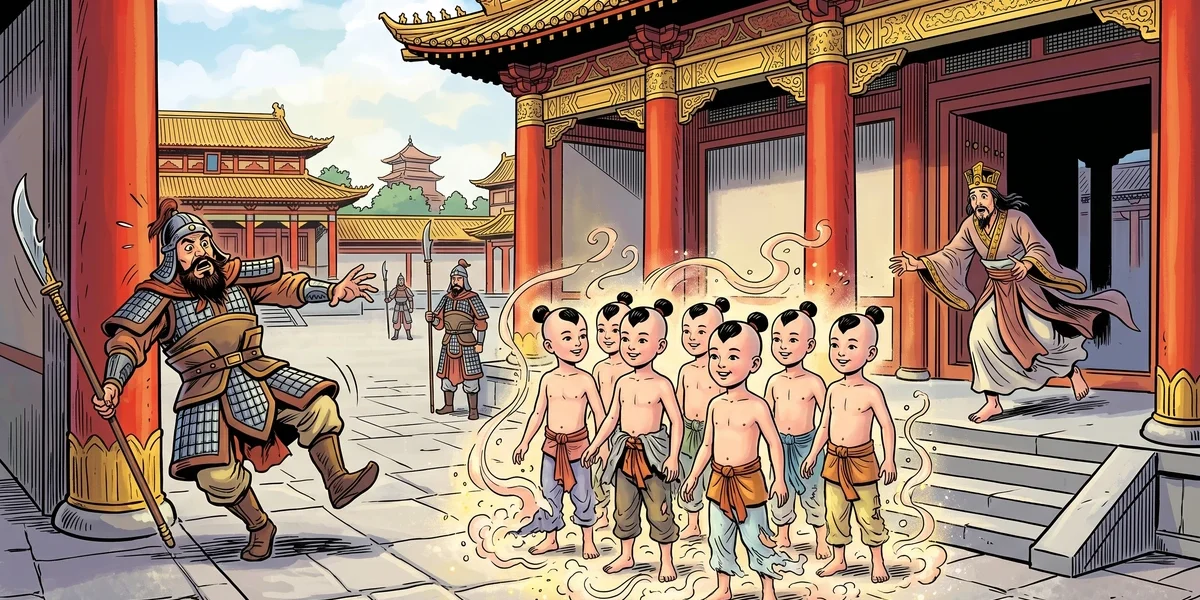
In 122 BCE, this long pursuit reached a dramatic conclusion. Ge Hong’s Shen Xian Zhuan records that a group of Daoist adepts visited Liu An with the completed elixir. Liu An and his entire household — family members, retainers, servants — drank the elixir and ascended to heaven in full daylight, their bodies rising from the earth in a luminous cloud. The leftover elixir in the courtyard was lapped up by the chickens and dogs of the household, who also rose into the sky, their crowing and barking fading as they ascended.
Part II — The Mass Ascension and Its Meaning
The legend of Liu An’s mass ascension is extraordinary for a detail that seems peripheral but is in fact the story’s most theologically significant element: the chickens and dogs. Their inclusion in the ascension is not merely a colourful detail added for narrative vividness; it encodes a specific claim about the nature of spiritual attainment and its relationship to community.
In the Chinese Daoist tradition, individual immortality — the personal ascension of a single practitioner through decades of dedicated cultivation — was the standard model. The adept withdrew from ordinary social life, cultivated the refinement of jing into qi into shen, and eventually transcended the mortal condition through a combination of physical, mental, and spiritual practices. This model was inherently solitary in its culminating phase: the final breakthrough was an individual achievement, a crossing of a threshold that each person must ultimately cross alone.
Liu An’s mass ascension challenges this model with a different possibility: that genuine attainment of a sufficient depth creates a field of transformation that extends beyond the individual to encompass everyone in proximity — family, servants, even animals. The elixir that Liu An and his scholars had prepared through years of collective research was potent enough not merely to transform the cultivated practitioners who had contributed to its development, but to overflow into the shared space of the household, lifting everyone and everything within it.
This is the theological meaning of the proverb yi ren de dao, ji quan sheng tian: genuine attainment is not a private achievement but a collective transformation. The person who achieves the Tao does not simply elevate themselves; they elevate the space they inhabit, the relationships they have maintained, the community they have been part of. The chickens and dogs are the reductio ad absurdum of this principle — the proof that the field of transformation was so complete it left nothing out, including beings who had made no personal effort toward immortality. They rose because they were there; and they were there because Liu An’s cultivation had made that space into a place where even proximity to the threshold was enough.
Part III — The Huainanzi and Han Dynasty Syncretism
The Huainanzi that Liu An’s circle produced is more than a philosophical text; it is an attempt to articulate a comprehensive worldview that could serve as the intellectual foundation for wise governance. Written at a moment when the Han dynasty was consolidating a unified empire after centuries of warring states, the Huainanzi addressed the central question of its time: what kind of knowledge does the ideal ruler need, and how does one cultivate it?
The text’s answer is characteristically synthetic. It draws on the Daoist concept of the sage who governs through wu wei (non-action, or minimum necessary action) rather than coercive force; the Confucian emphasis on moral cultivation and the importance of ritual propriety; the Legalist recognition that institutional structures must be designed with human nature’s actual capacities in mind; and the cosmological traditions that mapped the movement of heavenly bodies, the cycles of the seasons, and the Five Phases onto a comprehensive picture of how the universe actually works and how human governance must align with it.
The Huainanzi’s cosmological vision is particularly relevant to the ascension legend. It describes a universe in which the boundary between the human and the divine, the terrestrial and the celestial, is not a fixed wall but a permeable threshold — one that the sage ruler approaches through cultivated attunement to the Tao, and that the genuine adept can eventually cross. Liu An’s life, as his circle understood it, was the practical demonstration of the theory his text elaborated: a man who pursued philosophical synthesis and alchemical practice simultaneously, understanding them as complementary aspects of a single project of alignment with the Tao, and who arrived — according to the legend — at the threshold where theory and practice became indistinguishable from each other.
Part IV — The Proverb and Its Legacy
Yi ren de dao, ji quan sheng tian (一人得道,雞犬升天) has had one of the most complex and ambivalent afterlives of any proverb in Chinese literary history. In its original theological context, it celebrated the overflow of genuine attainment into the surrounding community — the idea that true spiritual achievement benefits all those in proximity to it. In subsequent usage, however, it acquired a secondary and more cynical meaning: the observation that when a powerful person rises, all their dependents, associates, and even household animals rise with them regardless of individual merit — a comment on the patronage and nepotism dynamics of Chinese official culture rather than a celebration of Daoist transcendence.
This dual meaning — one mystical, one social-critical — has made the proverb extraordinarily durable. It can be used to celebrate genuinely transformative leadership that elevates all those around it; it can equally be used to criticise the unearned advancement of those whose only virtue is proximity to power. The chickens and dogs, in the second reading, are not the accidental beneficiaries of spiritual overflow but the cronies and relatives of the person who got promoted — elevated not by merit but by the accident of who they know. That both meanings are available in the same four characters — that Liu An’s ascension story can carry both the mystical celebration and the social critique simultaneously — is testament to the compression and flexibility that make classical Chinese literary expression uniquely powerful.
“He drank the elixir, rose to heaven, and his household rose with him, and his chickens and his dogs. What he had spent his life pursuing overflowed in that moment into everything he had touched — and the sky received them all, not because they had earned it, but because genuine attainment has never been a solitary achievement.”
Why This Story Lasted
The story of Liu An lasted because the image of the ascending chickens and dogs is simply unforgettable — and because an unforgettable image attached to a profound idea is one of the most enduring combinations in human cultural production. The image works on both levels simultaneously: as a celebration of genuine transformative attainment and as a gentle comedy about the contingency of how worldly success spreads. It cannot be reduced to either reading without losing something essential, which makes it permanently available for new interpretations in new contexts.
The story also lasted because it preserves something historically important: the intellectual and spiritual ambition of Liu An’s court, the seriousness with which Han dynasty thinkers pursued the integration of cosmological, philosophical, and practical knowledge, and the Huainanzi’s vision of a universe in which wise governance and genuine spiritual attainment are not merely compatible but aspects of a single project. That the man who assembled one of antiquity’s most ambitious intellectual enterprises ended his life — in the legend’s telling — by flying away with his chickens, is a reminder that Chinese tradition has always been comfortable holding the sublime and the comic in the same hand.
You May Also Like
 Chinese Folk Tales
Ages 9-12
Chinese Folk Tales
Ages 9-12
The Monkey King’s Journey to the West: Pride and Redemption
The Monkey King's Journey to the West: Pride and Redemption: Before time itself had been properly counted, when the heavens and earth were still learning to
 Chinese Folk Tales
Ages 9-12
Chinese Folk Tales
Ages 9-12
The Night On The Battlefield
The Night On The Battlefield: Once upon a time there was a merchant, who was wandering toward Shantung with his wares, along the road from the South. At about
 Chinese Folk Tales
Ages 9-12
Chinese Folk Tales
Ages 9-12
The Magic Paintbrush of Ma Liang
The Magic Paintbrush of Ma Liang: In a remote village nestled among the misty mountains of ancient China, there lived a boy named Ma Liang. He was the youngest