The Dangerous Reward
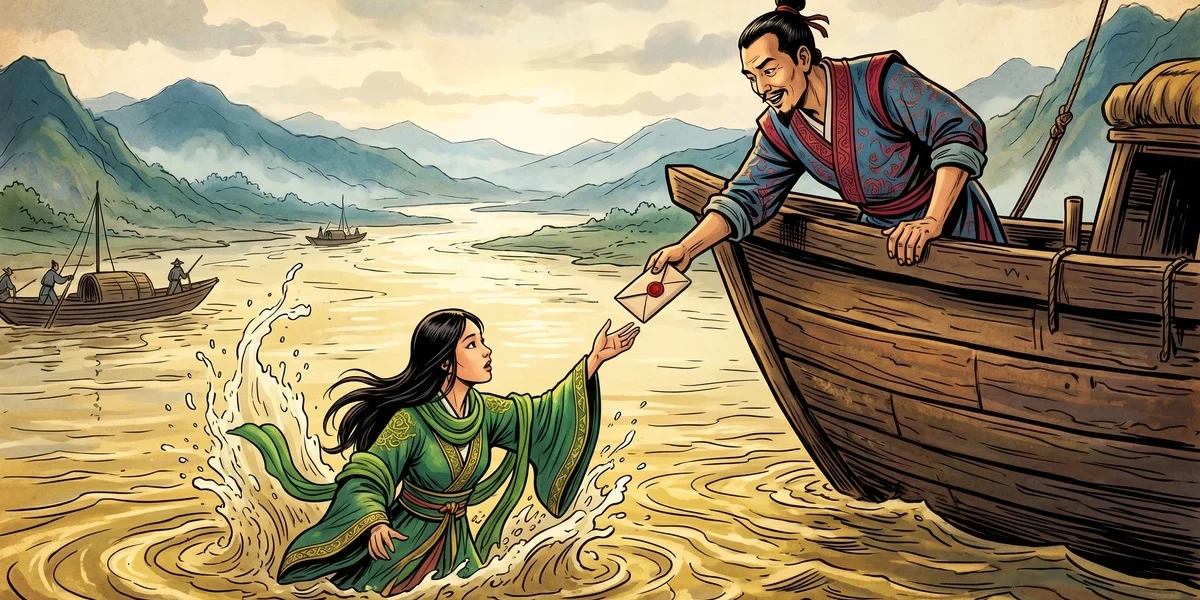
The Dangerous Reward: Once upon a time a man named Hu-Wu-Bau, who lived near the Great Mountain, went walking there one day. And there, under a tree, he met a
Origin and Tradition
The Dangerous Reward belongs to a specific and philosophically interesting tradition within Chinese folk narrative: tales that examine the ambiguous nature of unexpected good fortune — wealth, gifts, or rewards that arrive without clear legitimate origin and that conceal within themselves dangers proportional to their apparent generosity. This tale type represents the Chinese folk tradition’s sophisticated engagement with what might be called the paradox of windfall fortune: the recognition that in a moral universe where cause and effect are strictly maintained, wealth or reward that arrives without visible cause must have a cause that is not yet visible — and that invisible cause may be as dangerous as the gift appears beneficial.
The tradition draws on multiple strands of Chinese moral and cosmological thinking. From the Confucian ethical tradition comes the suspicion of wealth that has not been earned through legitimate means — the Analects record Confucius saying that “wealth and rank gained improperly are to me as floating clouds” (VII.15), and the broader Confucian moral economy understood that goods circulate through legitimate networks of obligation and service, not arbitrarily. From the Daoist tradition comes the understanding that the universe maintains strict energetic balances — nothing is given without something being taken, and a gift that seems to offer something for nothing is likely concealing the something that is being taken. From the Buddhist karma doctrine comes the specific analysis: unexpected windfalls may be the payment of a karmic debt, which is fine; or they may be the incurring of a new one, which is dangerous.
The Nature of the Dangerous Reward: A Taxonomy of Hidden Peril
Chinese folk narrative developed several distinct categories of dangerous reward, each reflecting a different aspect of the underlying moral concern. The first category is the yao guai reward: treasure or goods given by a supernatural being — a demon, a spirit, a fox spirit in commercial guise — whose generosity conceals an obligation that will eventually be called in under terms far more onerous than the original gift. The second category is the stolen goods problem: a reward that turns out to be stolen property, possession of which implicates the innocent recipient in the original crime and brings legal or supernatural retribution. The third is the cosmological debt: wealth that represents an advance on the recipient’s future fortune, to be repaid through future misfortune at compound moral interest.
The fourth and perhaps most philosophically interesting category is the character test: a reward deliberately offered by a divine being, a disguised immortal, or a moral agent of heaven specifically to test whether the recipient has the wisdom and character to handle unexpected fortune without being corrupted by it. In this version of the story, the danger is internal rather than external — the reward itself is legitimate, but the recipient’s response to it determines whether it becomes a source of genuine good or a mechanism of character destruction. This category connects the dangerous reward tale to the broader Chinese genre of fortune-testing stories, in which the true gift is not the material good but the opportunity to demonstrate one’s character.
“The man who receives a gift from an unknown hand has already begun to pay for it; the only question is what form the payment will take.”
— Chinese folk proverb in the wei xian zhi shang cautionary tradition
The Narrative: Fortune That Demands a Response
The story opens with the protagonist — a person of modest circumstances and generally good character — encountering an unexpected reward: gold found in the road, a gift from a grateful stranger whose identity is unclear, a prize in a situation where the protagonist’s contribution seems disproportionately small relative to the reward offered. The immediate question is whether to accept. The cautionary variant of the story begins with acceptance: the protagonist takes the reward without sufficient investigation of its source or conditions, and the story then follows the chain of consequences — legal, supernatural, social — that the acceptance triggers.
The wisdom variant begins with the protagonist’s hesitation and investigation: something about the circumstances of the reward — its excessive generosity, the stranger’s evasiveness about the source, the absence of any clear legitimate chain connecting the gift to the protagonist’s actions — prompts a pause before acceptance. Through investigation or the intervention of a wise counsellor, the true nature of the reward is revealed: it may be stolen, it may be the payment from a supernatural being that carries concealed conditions, or it may be a test. The protagonist’s handling of this information — refusing the reward, returning it to its rightful source, accepting it only under conditions that neutralise its danger — is the moral climax of the narrative.
Chinese Folk Ethics and the Morality of Receiving: The Gift as Social Act
The dangerous reward tale reflects a broader Chinese folk ethical tradition in which the act of receiving a gift or reward is understood as a morally significant social act that creates obligations and establishes relationships. The Chinese concept of renqing (人情 — human feeling, the social currency of obligation and reciprocity) governs gift-giving and receiving as surely as it governs any other social exchange: to receive a gift is to incur an obligation; the larger the gift, the larger the obligation. Gifts from unknown sources — whose obligation network one cannot trace — are therefore inherently dangerous, because the obligation created by acceptance cannot be properly managed without knowing to whom it is owed.
This analysis of the gift as social obligation sits alongside the supernatural dimensions of the dangerous reward narrative in Chinese folk culture, and the two reinforce each other: whether the danger is conceived in social terms (the obligation network of renqing) or supernatural terms (the karmic debt, the demonic claim), the underlying structure is the same — the unexpected reward creates an unmanaged claim on the recipient’s future, and the wisdom to navigate that claim requires understanding the invisible structure of moral causation that has produced the apparently inexplicable windfall.
Why This Story Endured
The dangerous reward story endured because it addressed a temptation that is permanently and universally present in human life: the desire to receive without giving, to gain without cost, to benefit from fortune that seems to have no downside. Every age produces its version of the suspicious windfall — the deal too good to be true, the gift whose giver’s motivations are unclear, the opportunity that promises extraordinary return for minimal legitimate effort — and the Chinese folk tradition’s exploration of the moral and practical dangers of such opportunities remains as relevant as ever.
The story also endured because it teaches a specific and practically valuable form of moral attention: the capacity to pause in the presence of apparently good fortune and ask not “how can I benefit from this?” but “what is the actual structure of this situation, and what does it require of me?” This quality of attentive moral analysis — the willingness to investigate the invisible before accepting the visible — is the practical wisdom that the dangerous reward tradition cultivates, and its cultivation remains as necessary in a world of sophisticated fraud, hidden obligations, and manipulative generosity as it was in the villages and market towns of imperial China where the stories were first told.
You May Also Like
 Chinese Folk Tales
Ages 6-8
Chinese Folk Tales
Ages 6-8
How The River-God’s Wedding Was Broken Off
How The River-God's Wedding Was Broken Off - a folk tale retold for young readers with a clear moral, simple words, and the warmth of a bedtime story from...
 Chinese Folk Tales
Ages 9-12
Chinese Folk Tales
Ages 9-12
The Panther
The Panther: Once upon a time there was a widow who had two daughters and a little son. And one day the mother said to her daughters: “Take good care of the
 Chinese Folk Tales
Ages 9-12
Chinese Folk Tales
Ages 9-12
The King Of Huai Nan
The King Of Huai Nan: was a learned man of the Han dynasty. Since he was of the blood royal the emperor had given him a kingdom in fee. He cultivated the