The Weaver Girl and the Magic Loom
The Weaver Girl and the Magic Loom: In a palace overlooking a city of jade and silk, there lived a young woman named Xiang who possessed a gift that none could
Origin & Tradition
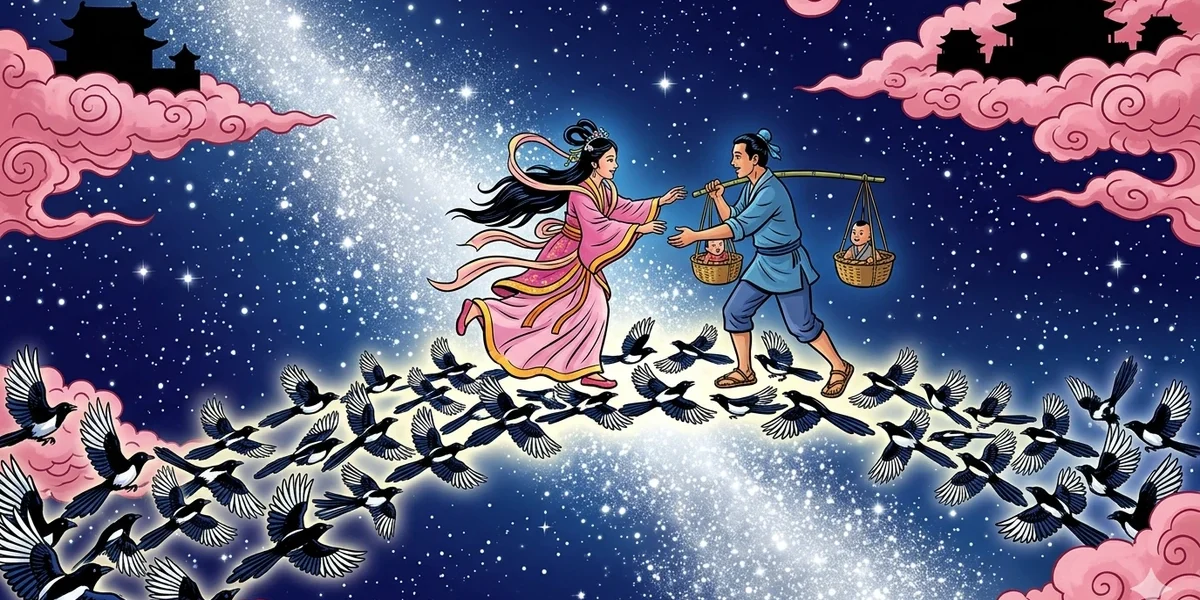
The Weaver Girl (织女, Zhi Nu) is one of the most ancient figures in Chinese mythology, her identity inseparable from the star Vega — one of the three brightest stars in the summer sky, visible in the constellation the Chinese tradition called the Weaving Maid. The earliest literary reference to her weaving appears in the Shijing (Classic of Poetry, c. 11th-7th century BCE): “The Weaving Maid works her shuttle all day long / but makes not one scrap of patterned cloth.” This lament — the weaver who weaves without producing fabric — was already understood as an image of frustrated longing in the Zhou Dynasty. Over the following centuries, the fuller narrative accumulated: Zhinu as the granddaughter of the Jade Emperor, weaving the cloud-silk of the heavens; her descent to earth; her love for the cowherd Niulang; the Jade Emperor’s separation of the pair by the Silver River (the Milky Way); the annual reunion on the magpie bridge on the seventh night of the seventh lunar month. The story has been explored in this collection from multiple angles. This telling focuses on what the magic loom in the title encodes: the weaving itself, and what Zhinu’s craft means for the story’s moral architecture.
Beat I — The Loom and the Celestial Order
In the celestial realm, Zhinu’s function is not decorative: she weaves the yun jin (云锦, cloud-silk) — the luminous fabric of the heavens. This is not metaphorical employment. Chinese cosmological thought understood the visible sky as an ordered phenomenon that required maintenance: the patterns of clouds, the gradations of light and colour at dawn and dusk, the luminous bands of the Milky Way — these were understood as woven goods, the product of a divine artisanal process. Zhinu’s loom produces the fabric of visible order. When she weaves, the sky is beautiful and coherent; when she does not, it is — as the ancient Shijing lament observes — without pattern, without cloth, without the order that weaving provides.
Her craft is therefore a form of cosmic service. The word zhi (织, to weave) shares its root associations with words for arrangement, ordering, and coherent structure — the weave is not merely cloth but the imposition of intelligible pattern on raw fibre. Zhinu’s identity, in the story’s deepest layer, is constituted by this act: she is the one who weaves order into the sky. The magic loom of the title is magic precisely because it produces not ordinary cloth but cosmic pattern — the luminous fabric that makes the night sky beautiful and the heavens comprehensible.
Beat II — Descent, Love, and the Abandoned Loom
Zhinu descended to earth — to bathe in a river, in the most common version — and there encountered Niulang, the cowherd, guided to her hiding place by his divine ox. Their meeting produced the marriage that the celestial realm had not arranged: spontaneous, earthly, consequential. For a time she remained on earth, the loom in the celestial workshop standing idle, and the sky — in the subtle way of mythological realism — somewhat less luminous, somewhat less ordered.
She bore Niulang two children, twins, one in each arm — the image of earthly fullness. She was happy in a way the celestial realm, with its ordered perfection, could not provide: the warmth of a specific household, the love of a specific person, the particular joy of children. This happiness is real and is recorded with genuine feeling in the tradition. The story does not pretend that Zhinu’s earthly life was false or that her love for Niulang was a mistake. It insists, rather, that the earthly happiness was real and that the vocation she had set aside was also real — and that these two real things were in genuine conflict.
The Jade Emperor’s rage — or, in more sympathetic versions, his regret — at discovering Zhinu’s absence was not merely proprietary anger at a runaway granddaughter. It was, in the cosmological register, the appropriate response of the order-keeper to the discovery that the weaver of celestial cloth had stopped weaving. The sky was still there; the Milky Way still shone; but the living maintenance of heavenly order had ceased, and the fabric was, in some sense not immediately visible to mortal eyes, beginning to loosen.
Beat III — Zhi (志) as Vocation: The Conflict at the Story’s Core
The Weaver Girl story’s deepest tension is between qing (情, authentic feeling, love) and zhi (志, will/vocation/the thing one is called to do with one’s life). This is a different conflict from the qing/li tension of the Butterfly Lovers story, where the opposition was between feeling and social convention. Here the opposition is between feeling and cosmic vocation — between what Zhinu wants as an individual and what she is as a divine function.
The Chinese concept of zhi encompasses both personal ambition and vocational calling — it is the orientation of the will toward a particular purpose that gives a life its direction and meaning. For Zhinu, zhi is not an external imposition but the expression of what she most essentially is: she is the weaver of cloud-silk, not by assignment but by nature. Her craft is not something she does but something she is. This makes the conflict more painful than a simple qing/li opposition: to abandon the loom is not to resist society’s rules but to become less than herself.
The Jade Emperor’s separation of the lovers at the Silver River is, in this reading, not a tyrant’s cruelty but an act that restores what was lost — at a cost that the Jade Emperor himself is moved by. The annual reunion on the seventh night of the seventh lunar month is the Jade Emperor’s concession to qing: the minimum that love requires, granted within the constraints that vocation imposes. One night per year is enough for the heart to be sustained; the remaining three hundred and sixty-four nights are for the loom. Both duties are honoured; neither is fully satisfied.
This structure — the annual reunion as a compromise between qing and zhi — is more philosophically sophisticated than either the triumphalist “love conquers all” narrative or the bleak “duty destroys love” narrative. It holds both genuine goods in tension without resolving either into the other: the love is real, the vocation is real, the annual reunion acknowledges both. The tradition does not tell Zhinu she must give up her love; it tells her that her love and her vocation will coexist in an imperfect but sustainable equilibrium. One night per year, the magpie bridge forms; then the loom starts again.
Beat IV — The Magic Loom and What It Weaves
The phrase “magic loom” in this story’s title encodes something specific: the loom is magic not because it has extraordinary powers in the fairy-tale sense, but because what it produces is the visible order of the heavens. In Chinese artistic tradition, the great silk-weaving centres — Suzhou, Hangzhou, Nanjing — were understood to be practising, in earthly material, an art whose celestial original was Zhinu’s. The yun jin (cloud-silk) woven by imperial workshops in Nanjing, the most prestigious textile in Chinese court culture, took its name from the cloud-fabric of Zhinu’s celestial loom. Every weaver who sat at her earthly loom was, in some small and analogical sense, doing what Zhinu did: imposing intelligible pattern on raw fibre, making order visible in cloth.
The Qixi Festival (七夕, qi xi, the seventh night of the seventh month), which the story grounds, was historically associated with the arts of women — particularly weaving, embroidery, and needlework. Young women would set out offerings to Zhinu and petition her for skill in their craft: the divine weaver was also the patron of earthly weavers, the celestial original of an art performed by millions. The festival thus connected the cosmic myth to the everyday practice of women’s work in a way that dignified that work: to sit at a loom was to participate, however distantly, in the maintenance of heavenly order.
The Silver River that separates Zhinu from Niulang — the Milky Way — is itself a textile metaphor. The Chinese name Yin He (银河, Silver River) describes the Milky Way as a luminous stream; but the alternative name Tian He (天河, Celestial River) positions it as the boundary that the celestial order requires. The river is not merely a geographical obstacle; it is the structural boundary between Zhinu’s cosmic function and Niulang’s earthly world. It is wide enough to contain the tension between qing and zhi without either destroying the other.
“On either side of the Silver River, a loom stands waiting. Once a year the bridge forms and the weavers meet. Then the bridge dissolves, and the looms begin again. The weaving is what makes the sky beautiful; the longing is what makes the weaving urgent.”
— Distilled from the Zhinu oral tradition, Qixi Festival
Why This Story Has Lasted
The Weaver Girl story has persisted for three thousand years because it addresses a tension that no human life fully resolves: the conflict between individual desire and vocational calling. Every person who has experienced the pull between personal happiness and the work they were made to do can recognise Zhinu’s condition. The story’s refusal to resolve this tension cleanly — neither “abandon the loom for love” nor “abandon love for the loom” — is its most honest and most enduring quality. One night per year: it is not enough, but it is something. The loom waits. The love waits. Both are real.
Frequently Asked Questions
What is the magic loom in the Weaver Girl story?
Zhinu’s magic loom produces yun jin (cloud-silk) — the luminous fabric of the heavens, the ordered pattern visible in the night sky. The loom is “magic” not in the fairy-tale sense of granting wishes, but because what it weaves is cosmic order itself: the clouds, the gradations of celestial light, the coherent beauty of the night sky. When Zhinu abandons the loom for earthly love, the fabric of heavenly order begins to loosen. Her craft is not merely a job but the expression of what she most essentially is — the one who weaves pattern into the sky.
Why does the Jade Emperor separate Zhinu and Niulang?
In the cosmological reading of the story, the Jade Emperor’s separation restores what was lost when Zhinu abandoned her loom: the maintenance of celestial order. His anger or regret is not merely proprietary but structural — the sky’s weaver has stopped weaving, and the fabric of the heavens requires her return. The annual reunion on the seventh night of the seventh month is his concession to genuine love: the minimum that qing (authentic feeling) requires, granted within the constraints that vocational duty (zhi) imposes. One night per year is not cruel indifference; it is the Jade Emperor’s acknowledgment that both the love and the loom are real.
What is the Qixi Festival and how does it relate to the Weaver Girl?
The Qixi Festival (七夕, the seventh night of the seventh lunar month) commemorates Zhinu and Niulang’s annual reunion on the magpie bridge across the Milky Way. Historically it was primarily a festival of women’s craft skills — young women made offerings to Zhinu and petitioned her for skill in weaving, embroidery, and needlework, since the divine weaver was the celestial patron of all earthly weavers. In contemporary Chinese culture it is celebrated as a romantic occasion analogous to Valentine’s Day, emphasising the love story over the craft tradition.
How is this story different from other Niulang-Zhinu tellings?
This telling focuses specifically on Zhinu’s vocation — her identity as the weaver of celestial cloud-silk — and the conflict between that cosmic calling and her earthly love. Earlier versions of the story in this collection explored the Qixi astronomical tradition and precise star lore (P-458), and the comparative East Asian mythology and agricultural calendar dimensions (P-466). The magic loom angle focuses on zhi (vocational calling) versus qing (feeling), the cosmic significance of Zhinu’s specific craft, and the annual reunion as a philosophically sophisticated compromise between two genuine goods rather than a simple tragedy.
What is yun jin (cloud-silk) and why is it significant?
Yun jin (云锦, cloud-silk or cloud-brocade) is the most prestigious traditional textile in Chinese imperial culture, produced in Nanjing by workshops that supplied the imperial court. Its name derives from the visual resemblance of its complex woven patterns to celestial clouds — a deliberate evocation of Zhinu’s cosmic weaving. The Nanjing yun jin tradition, which has been practiced for over 1,600 years and requires two master weavers to produce even a short length of fabric, was inscribed on the UNESCO list of Intangible Cultural Heritage in 2009. The textile tradition thus preserves, in living craft form, the mythological legacy of the celestial weaver.
You May Also Like
 Chinese Folk Tales
All Ages
Chinese Folk Tales
All Ages
Old Dschang
Old Dschang: Once upon a time there was a man who went by the name of Old Dschang. He lived in the country, near Yangdschou, as a gardener. His neighbor, named
 Chinese Folk Tales
Ages 9-12
Chinese Folk Tales
Ages 9-12
The Legend of the White Snake: Love Beyond Form and Fear
The Legend of the White Snake: Love Beyond Form and Fear: In the misty valleys of ancient China, where dragons still whispered through bamboo groves and
 Chinese Folk Tales
All Ages
Chinese Folk Tales
All Ages
The Mysterious Buddhist Robe
The Mysterious Buddhist Robe: The short visit which the Emperor Li Shih-ming paid to the Land of Shadows had produced a profound impression on his mind.