The Mysterious Buddhist Robe
The Mysterious Buddhist Robe: The short visit which the Emperor Li Shih-ming paid to the Land of Shadows had produced a profound impression on his mind.
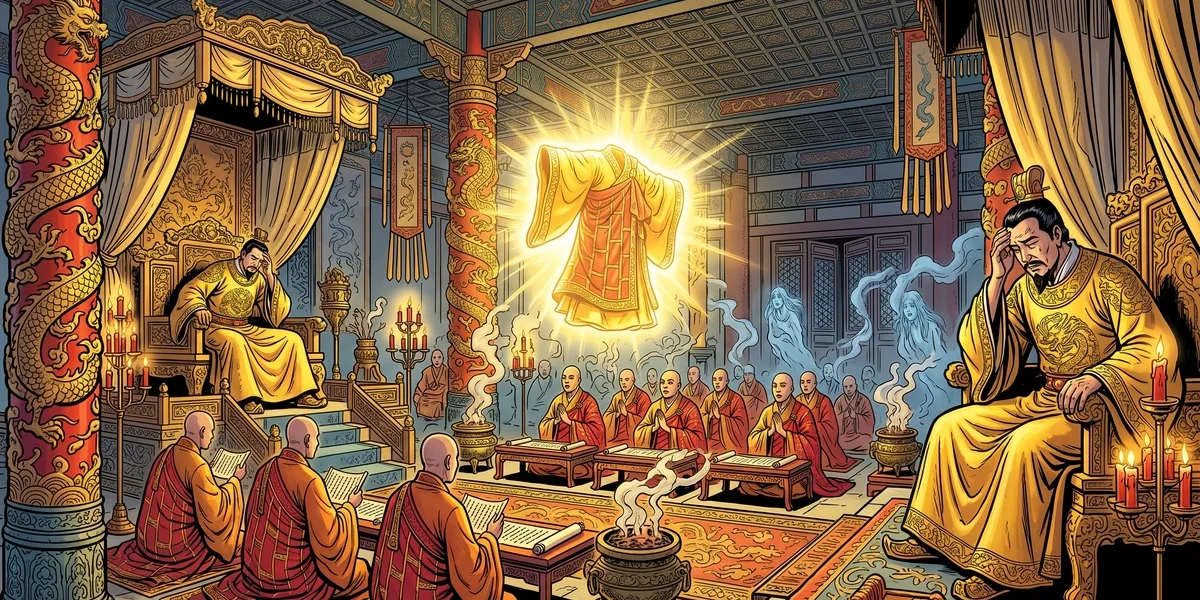
The Robe That Could Not Be Stolen: A Chinese Buddhist Legend
The Mysterious Buddhist Robe belongs to the rich tradition of Chinese Buddhist hagiographic legend (seng zhuan, 僧傳), stories that illuminate correct conduct through tales of sacred objects, spiritual tests, and the consequences of attachment. Related tales appear in the Taiping Guangji (太平廣記, 978 CE) and in later collections of miraculous accounts compiled by Song dynasty Buddhist chroniclers. The robe itself — the jia sha (袈裟) — is one of Buddhism’s most potent symbols, representing the transmission of dharma from teacher to disciple in an unbroken lineage. This legend explores what happens when a spiritually charged object encounters someone unprepared to receive it.
Within Buddhist doctrine, the robe worn by a monk carries accumulated merit from vows, practice, and the sanctified rituals of the ordination ceremony. To possess such a robe through theft rather than transmission is to hold a vessel filled with a power one cannot contain — a situation the legend treats with both dramatic intensity and gentle pedagogical purpose.
Beat I — The Robe of a Thousand Donors
In the hills above a prosperous Tang dynasty market town, an aging monk named Huizhi was known throughout the province for his impeccable discipline. For forty years he had kept every precept, never breaking a single vow of the Pratimoksha — the code of monastic rules. In his later years, the lay community of the town had gathered in reverence to present him with a remarkable gift: a jia sha robe sewn from silks donated by a thousand different households, each square of fabric stitched with the name of the family who contributed it. Local silk merchants, farmers who had recovered from drought, mothers whose children had survived illness — all had given freely, believing their merit would be woven into the cloth itself.
The finished robe was extraordinary. Under morning light it shimmered with what some described as an inner luminosity — a quality the monk accepted with quiet humility, never displaying it except during formal ceremonies. He folded it each night into a carved sandalwood box beside his meditation cushion, and those who sat near him during winter chanting claimed the hall felt warmer when it was worn, not from any physical fire, but from some quality they could not name.
Word of the robe spread, as word of remarkable things always does. A young man from a wealthy family in the capital — accomplished in poetry, bored with luxury, and drawn to the idea of power without its discipline — heard of the robe and conceived a desire for it. He reasoned, after the fashion of those who mistake proximity to sacred things for sacred quality itself, that possessing such a robe would confer upon him the monk’s reputation without requiring his decades of practice.
Beat II — The Theft and Its Consequence
The young man arrived at the monastery presenting himself as a sincere seeker. He was welcomed according to Buddhist hospitality — offered food, a sleeping mat, the freedom to attend teachings. He spent three days observing, locating the sandalwood box, calculating the monastery’s rhythms. On the third night, when the monks entered their deepest period of pre-dawn meditation, he crept to the elder’s cell and took the robe.
He fled the mountain by moonlight and reached the river road before sunrise, the folded silk pressed against his chest. But within an hour of his departure, something unusual began. The robe, rather than conforming to his body as cloth conforms to any wearer, seemed to grow heavy — not with physical weight alone, but with a quality of resistance, as though a thousand small hands were pulling it in a direction he could not walk toward. He stopped to rest and found he could not unfold it. Every seam he tried to separate seemed stitched with ten times its apparent strength.
By midday he had developed a fever. By evening, attempting to cross the river by ferry, he was delirious. The ferryman, a devout Buddhist, noticed the man clutching something in his robe and — when the thief briefly lost consciousness — recognized the embroidered names of townspeople he knew. He sent word upstream to the monastery. By the time Huizhi arrived the following morning, the young man was sitting in the mud by the riverbank, robe spread across his lap, weeping without understanding why.
The monk sat beside him for a long time without speaking. Then he simply picked up the robe, folded it, and placed it back in its carrying cloth. He offered the young man water and a rice cake from his traveling sack. “You came seeking something,” Huizhi said. “What was it really?” The young man — fever broken, clarity returning — could not answer, because he realized he did not know.
Beat III — Merit, Transmission, and the Logic of Sacred Objects
This legend encodes a precise Buddhist understanding of how sacred objects function. The jia sha in Mahayana tradition is not merely cloth — it is a node of accumulated gong de (功德), merit generated by the combined intention, sacrifice, and virtue of all who contributed to its creation and consecration. The thousand donors did not simply give silk; they gave spiritually charged attention. The monk who wore it did not simply receive cloth; he received a responsibility to channel their merit outward through continued virtue.
When the young man stole the robe, he encountered what Buddhist philosophy would describe as an incompatibility of yin yuan (因緣) — causal conditions. The robe’s accumulated merit had no corresponding virtue in him to meet it. This is not mystical punishment but a form of spiritual physics: a circuit requiring both poles to function. A lamp filament cannot light without a complete circuit; a transmission cannot take hold without a prepared receiver.
The fever, the inability to unfold the cloth, the strange heaviness — the legend presents these not as supernatural vengeance but as the natural consequence of misalignment. Chinese Buddhist literature from the Tang and Song dynasties contains numerous such accounts: sacred objects that resist improper use not through dramatic intervention but through a kind of quiet, persistent non-cooperation.
The resolution is equally instructive. Huizhi does not condemn the young man, does not summon magistrates, does not lecture. He offers water and a rice cake — the simplest forms of sustenance — and asks a single question that functions as the entire teaching: What were you really seeking? The question is a gong an-like invitation to self-examination rather than a demand for confession. The monk understands that the theft was not born of malice but of misdirected spiritual hunger, and he treats it accordingly.
Beat IV — Spiritual Inheritance and the Danger of Bypassing the Path
The deepest concern of this legend is one that recurs throughout the religious literature of every contemplative tradition: the temptation to seize the fruits of a path without walking it. The young man wanted the reputation that accrues to decades of practice. He wanted the warmth people felt in the monk’s presence, the deference communities offer to genuine virtue — all without the long, unglamorous work of actually becoming such a person.
This is not a uniquely Buddhist problem. Confucian texts warn against wearing the ritual garments of a scholar without possessing the learning they signify. Daoist literature cautions against performing the ceremonies of a dao shi without the internal cultivation they require. What Chinese religious thought shares across these streams is a conviction that outer form and inner substance must correspond — that the gap between them is not merely dishonest but actively harmful to the person who creates it.
The robe’s strange resistance is the legend’s way of dramatizing this principle for a popular audience. Most people will never steal a sacred robe, but the underlying impulse — to skip the difficult middle portion of any genuine transformation — is universal. The legend suggests that whatever inner quality a sacred object concentrates, it cannot be transferred by possession alone. It can only be received by a person who has done sufficient inner work to create the conditions of reception.
Huizhi’s response — patient, non-punitive, oriented toward the question beneath the question — models the approach the legend recommends. The young man is not lost; he is simply confused about the direction. The monk’s task is to reorient rather than punish, to ask the clarifying question rather than deliver the moralizing answer.
“The robe can be taken. The virtue it carries cannot. Only what is genuinely yours can be worn without weight.”
— Principle embedded in Chinese Buddhist hagiographic tradition
Why This Legend Has Lasted
The Mysterious Buddhist Robe has persisted because it addresses one of the most durable human temptations with unusual gentleness. Rather than simply condemning the thief, it traces his action back to something recognizable — spiritual hunger that has taken a wrong turn — and shows it being met with a response that is simultaneously firm and compassionate. The robe resists; the monk extends rice cake and water. Together these constitute the complete teaching: the universe does not bend its principles, but human beings within it can still be met with kindness.
The legend also functions as a meditation on what genuine transmission means in Buddhist practice. In Chan and Tiantai Buddhism, the robe-and-bowl transmission from master to disciple is among the most significant ceremonies — a conferral of spiritual authorization that must be earned through demonstrated understanding. To steal a robe is to try to counterfeit that authorization, and the legend shows why counterfeits ultimately fail: not because of divine intervention, but because spiritual development has its own logic, its own requirements, its own timeline that cannot be circumvented by cleverness or desire.
The Jia Sha in Chinese Buddhist Practice
The jia sha (袈裟) — the patchwork robe of Buddhist monks — has been central to Chinese Buddhist ceremonial life since the earliest transmission of Buddhism into China during the Han dynasty. Made traditionally from discarded cloth sewn into a pattern of rectangular patches (tian xiang yi, 田相衣, “field-pattern robe”), it symbolizes the monk’s renunciation of vanity, the patchwork suggesting that all material is equally impermanent and equally capable of serving the dharma when properly consecrated. Robe-and-bowl transmission ceremonies became key moments in Chan lineage succession, and the famous transmission of the Sixth Patriarch Huineng from Hongren — marked by the robe of Bodhidharma — is among the most celebrated events in Chinese Buddhist history. The legend of the Mysterious Buddhist Robe draws on this deep cultural reservoir, where the robe is understood not as clothing but as a living documentation of spiritual lineage.
You May Also Like
 Chinese Folk Tales
Ages 9-12
Chinese Folk Tales
Ages 9-12
The Monkey King’s Journey to the West: Pride and Redemption
The Monkey King's Journey to the West: Pride and Redemption: Before time itself had been properly counted, when the heavens and earth were still learning to
 Chinese Folk Tales
Ages 9-12
Chinese Folk Tales
Ages 9-12
The Bird With Nine Heads
The Bird With Nine Heads: Long, long ago, there once lived a king and a queen who had a daughter. One day, when the daughter went walking in the garden, a
 Chinese Folk Tales
Ages 9-12
Chinese Folk Tales
Ages 9-12
The Legend of Nian
The Legend of Nian: Long ago, before the dynasties grew great and the kingdoms sprawled across the land, there existed a creature of terror known as Nian.