The Monkey King’s Journey to the West: Pride and Redemption
The Monkey King's Journey to the West: Pride and Redemption: Before time itself had been properly counted, when the heavens and earth were still learning to
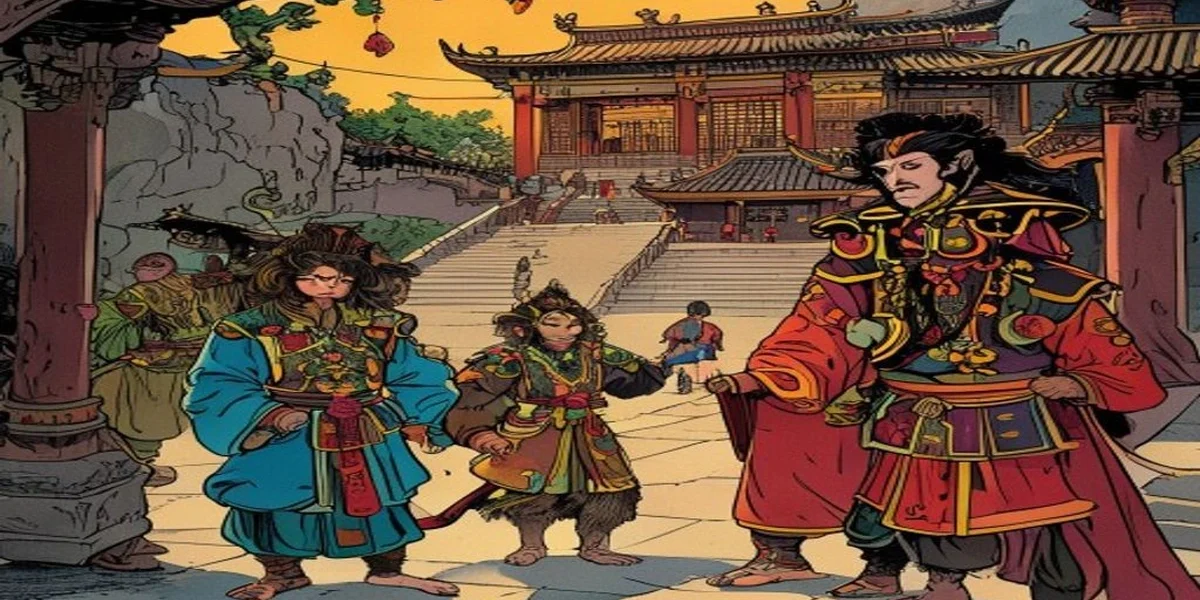
Sun Wukong and the Architecture of the Self: Xiyouji as China’s Greatest Novel of Spiritual Development
The Monkey King’s Journey to the West: Pride and Redemption engages Xiyouji (西遊記, Journey to the West), attributed to Wu Cheng’en (吳承恩, approximately 1500–1582 CE) and published in its final form around 1592 — universally regarded as one of the four great classical novels of Chinese literature and among the most influential works of imagination in the Chinese cultural canon. Its protagonist, Sun Wukong (孫悟空, the Monkey King), is arguably the most beloved character in Chinese literary history: a figure of anarchic energy, supernatural power, radical self-assertion, and eventually — after the journey that gives the novel its name — genuine wisdom and genuine compassion.
The novel operates simultaneously on multiple registers. On the surface level it is an adventure narrative following the monk Xuanzang (玄奘, based loosely on the historical Tang dynasty pilgrim of the same name) and his three supernatural disciples — Sun Wukong, Zhu Bajie, and Sha Wujing — on the journey from Tang China to India to retrieve the Buddhist scriptures. At the allegorical level it is a systematic account of the cultivation of the mind toward enlightenment, with each of the pilgrims representing different aspects of consciousness and different obstacles on the spiritual path. At the philosophical level it engages the Three Teachings of China — Buddhism, Daoism, and Confucianism — simultaneously, placing them in creative tension rather than resolving them into simple hierarchy.
Beat I — The Birth and the Rebellion: Pride Without Constraint
Sun Wukong is born from a stone — not from any parental union but from the concentrated qi of heaven and earth accumulated within a magical rock on Flower Fruit Mountain. His origin is thus primordial rather than genealogical: he is not the product of any lineage but of the universe’s own creative force concentrating into a particular form. This origin establishes him from the start as a figure outside the systems of social obligation — filial piety, loyalty to teachers, deference to hierarchy — that Chinese ethics organizes around biological and social relationships. He owes nothing to anyone, because he came from no one.
His early development is a compressed account of the cultivation that produces supernatural power without the discipline that directs it toward anything beyond itself. He studies with the Daoist patriarch Patriarch Subodhi, acquiring the seventy-two transformations, the somersault cloud that covers 108,000 li in one flip, and near-immortality through the cultivation of his vital essence. He acquires the magical staff — the Ruyi Jingu Bang (如意金箍棒, the Compliant Gold-Banded Cudgel) — from the Dragon King of the Eastern Sea. He strong-arms the Ten Kings of Hell into removing his name from the Book of Death. He demands and receives the title of “Great Sage Equal to Heaven” (齊天大聖, Qi Tian Da Sheng) from the Jade Emperor, who grants it to avoid conflict rather than because he recognizes its validity.
The character Sun Wukong presents at this stage is exhilarating and impossible: power without limit, desire without discipline, self-assertion without the capacity for genuine connection or genuine service. He disrupts the celestial peach banquet because he was not invited. He consumes Laozi’s pills of immortality because they were there. He challenges the entire celestial army and defeats it because he can. The novel presents this phase without moral judgment — it is genuinely entertaining, genuinely impressive, and genuinely without the qualities that would make it sustainable or ultimately meaningful.
Beat II — The Five-Hundred-Year Imprisonment and the Transformation It Produces
Buddha’s intervention — the cosmic wager in which Sun Wukong bets he can leap beyond Buddha’s palm, leaps the full distance of the observable universe, and arrives at what he believes is the edge of the cosmos only to discover that he has been leaping within Buddha’s palm the entire time — is one of the most celebrated episodes in Chinese literature and one of the most philosophically precise. Sun Wukong’s power is real; what Buddha demonstrates is not that the power is insufficient but that the universe it is being exercised in is larger than the power can encompass. The pride that believes it has exceeded all constraints has merely not yet encountered a constraint large enough to reveal itself.
The five-hundred-year imprisonment under Mount Wuxing (五行山, Five Elements Mountain) — pinned under stone by a talisman from Buddha himself — is not presented as punishment for wickedness but as the structural necessity for transformation. Sun Wukong cannot change through instruction or persuasion; he has too much power for anyone to force change on him. He can only change through experiencing the consequences of his condition sufficiently, over sufficient time, that the change becomes internally motivated rather than externally imposed.
When Xuanzang arrives and removes the talisman, freeing Sun Wukong, the exchange that follows is the novel’s central structural moment: Sun Wukong accepts the golden headband (金箍, the constraining band that Guanyin has provided for this purpose) — accepts, that is, a voluntary constraint on his own power in exchange for companionship and purpose. He does not submit to the headband; he accepts it, which is a fundamentally different action. The novel is careful about this distinction: the journey that follows is not the story of a subdued rebel but of a transformed one.
Beat III — The Journey as Cultivation: Sun Wukong’s Eighty-One Tribulations
The journey to India and back — through eighty-one specific tribulations (ba shi yi nan, 八十一難), each representing a specific challenge to the pilgrims’ spiritual development — is the novel’s account of how cultivation actually works: not through a single dramatic transformation but through the repeated application of whatever wisdom has been developed so far to increasingly difficult situations that reveal its remaining limitations.
Sun Wukong’s role in the journey is protector and problem-solver — the companion whose supernatural power serves the purpose of getting the group through what their human and partly-human limitations cannot navigate alone. This service function is structurally the opposite of his pre-imprisonment condition: where he previously used his power for his own self-assertion, he now uses it in service of others, and specifically in service of the most vulnerable and unglamorous member of the group — the monk Xuanzang, who has no supernatural power whatsoever and who is, for most of the journey, exactly as frightened, confused, and physically inadequate as the obstacles require him to be.
The relationship between Sun Wukong and Xuanzang is one of Chinese literature’s great asymmetrical partnerships. Xuanzang is, by every observable metric of power, inferior to his disciple: weaker, slower, less knowledgeable about the supernatural world, frequently deceived by demons that Sun Wukong’s truth-seeing eye identifies immediately, occasionally responsible for catastrophic misjudgments that set the group’s progress back by dozens of chapters. But Xuanzang has something Sun Wukong lacks throughout most of the journey: unshakeable compassion for all sentient beings, including beings who have just tried to eat him. This quality, which the novel presents as the specific virtue that makes the scripture retrieval mission cosmically meaningful, is what Sun Wukong is learning to develop through his service to the monk.
The most famous episode in this dynamic is the Three Blows of the White Bone Demon (白骨精, Bai Gu Jing) — in which a demon transforms itself sequentially into an old woman, a young woman, and an old man, in each form fooling Xuanzang while being immediately identified by Sun Wukong’s truth-seeing eye. Sun Wukong kills all three manifestations; Xuanzang, deceived by the apparently human appearances, banishes Sun Wukong from the group for murder of innocents three times over. The episode dramatizes the tension between Sun Wukong’s perceptual accuracy and Xuanzang’s compassionate misperception: the monk’s willingness to see all apparently human beings as innocent keeps him open to genuine compassion and open to fatal deception in equal measure. Sun Wukong’s accurate perception of evil protects the group and appears to Xuanzang as cruelty. Neither frame alone is sufficient.
Beat IV — Qi Tian Da Sheng to Victorious Fighting Buddha: The Completed Arc
The novel’s conclusion — in which all four pilgrims receive Buddhist titles appropriate to their spiritual development — gives Sun Wukong the title Dou Zhan Sheng Fo (鬥戰勝佛, Victorious Fighting Buddha). This title is the completed version of his original claim to be Great Sage Equal to Heaven: not the empty assertion of a being who wants to be equivalent to the highest power but the earned recognition of a being who has demonstrated, through the journey’s eighty-one tribulations, that his power has been brought into genuine service of something larger than itself.
The relationship between the opening claim and the closing recognition illuminates the novel’s central argument about pride and transformation. Sun Wukong’s assertion that he was equal to heaven was not simply wrong; it was premature. The power was real; the wisdom to use it appropriately had not yet developed. The five-hundred-year imprisonment, the golden headband, the journey — all of these were the conditions through which the wisdom that the power required caught up with the power itself. The title Victorious Fighting Buddha does not grant Sun Wukong a power he did not previously have; it recognizes a wisdom he has newly acquired.
The novel’s allegorical dimension makes this arc explicit: Sun Wukong represents the mind (xin, 心) in its primordial condition — unlimited in its movement, easily distracted, capable of extraordinary things, but not yet directed toward any stable purpose. The journey is the cultivation of the mind toward the stable purposefulness that the Buddhist and Daoist traditions call enlightenment — the condition in which the mind’s unlimited movement is not suppressed but directed by wisdom toward genuine service. The golden headband is not a permanent constraint; it disappears at the novel’s conclusion when it is no longer needed, because the external constraint has become unnecessary once the internal discipline it was training has been genuinely established.
“He claimed to equal heaven. Heaven was not offended — it was patient. Five hundred years and eighty-one trials later, he understood what the claim had always contained: not the destination but the direction.”
— Reflection on Sun Wukong’s arc in the Xiyouji tradition
Why This Legend Has Lasted
The Monkey King’s Journey to the West has endured for four centuries of continuous popularity because Sun Wukong is simultaneously the most entertaining and the most instructive character in the Chinese literary tradition. He is entertaining because his anarchy is genuinely anarchic — the pre-imprisonment Monkey King’s defiance of every institutional constraint is not merely comic but philosophically serious in its refusal to accept any external authority that has not earned recognition through demonstrated superiority rather than mere positional claim. He is instructive because his transformation is genuinely transformative — not the taming of a spirit who had always been wrong, but the maturation of a spirit who was right about his own power and wrong about what power is for.
Every generation of Chinese readers has found in the novel something that speaks to their own relationship with authority, with the cultivation of capability, and with the question of what the self is for. Sun Wukong’s journey is, ultimately, the journey from a self that is its own purpose to a self that has found something larger to serve — and the novel’s insistence that this transformation does not diminish the self but completes it is its most enduring gift to the tradition that has carried it.
Xiyouji in Chinese Literature and Global Culture
Xiyouji (西遊記, Journey to the West), attributed to Wu Cheng’en (approximately 1500-1582 CE) and published in final form around 1592, is one of the Four Great Classical Novels of Chinese literature alongside Shuihu Zhuan (Water Margin), Sanguo Yanyi (Romance of the Three Kingdoms), and Hong Lou Meng (Dream of the Red Chamber). The novel’s narrative is loosely based on the historical journey of the Tang dynasty monk Xuanzang (602-664 CE), who traveled to India to retrieve Buddhist scriptures and whose account of the journey, Da Tang Xiyu Ji (Great Tang Records on the Western Regions), is a genuine historical document. The novel expands this historical pilgrimage into a 100-chapter allegorical novel that draws on Buddhist, Daoist, and Confucian thought simultaneously. Sun Wukong’s character draws on earlier Chinese trickster figures and may have connections to the Hindu Hanuman tradition, though the relationship between these figures remains debated by scholars. The novel has been adapted into hundreds of films, television series, video games, and theatrical productions throughout Asia; the 1986 Chinese television adaptation remains iconic in China. Globally, the novel has influenced works from the Japanese manga Dragon Ball (which directly adapts its premise) to contemporary fantasy literature. The historical Xuanzang’s journey to India (629-645 CE) and his return with 657 Sanskrit texts are among the most significant events in the history of Buddhism’s Chinese transmission.
You May Also Like
 Chinese Folk Tales
All Ages
Chinese Folk Tales
All Ages
Black Arts
Black Arts: The wild people who dwell in the South-West are masters of many black arts. They often lure men of the Middle Kingdom to their country by promising
 Chinese Folk Tales
All Ages
Chinese Folk Tales
All Ages
Help In Need
Help In Need: Some twenty miles east of Gingdschou lies the Lake of the Maidens. It is several miles square and surrounded on all sides by thick green thickets
 Chinese Folk Tales
Ages 9-12
Chinese Folk Tales
Ages 9-12
Judge Bao and the Missing Gold
Judge Bao and the Missing Gold: During a time when justice was not merely an ideal but a practice guarded fiercely by those few with the wisdom and courage to