Help In Need
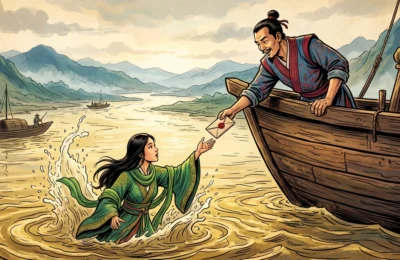
Help In Need: Some twenty miles east of Gingdschou lies the Lake of the Maidens. It is several miles square and surrounded on all sides by thick green thickets

Origin and Tradition
Help in Need belongs to one of the most ancient and widespread narrative traditions in Chinese folk literature: the bao en (報恩) cycle, stories organised around the moral axis of receiving grace and repaying it faithfully. Documented across regional collections from the Han dynasty administrative gazetteer literature through the great Qing-era compilations, bao-en tales function as living contracts between heaven, earth, and the human community. The story circulates in variant forms throughout the provinces of Shandong, Fujian, and Yunnan, each regional tradition inflecting the central action with local colour while preserving the ethical skeleton intact.
Scholars of Chinese narrative ethics, notably Wolfram Eberhard in his Typen chinesischer Volksmärchen (1937) and more recently Wilt Idema in his surveys of vernacular Chinese literature, have identified bao-en stories as constituting a distinct moral genre — tales whose purpose is less entertainment than social instruction. Where Western fable tradition tends to externalise morality through animal allegory, the Chinese bao-en form operates through human relationships rendered with realistic social detail: merchants, farmers, wandering scholars, river traders. The moral weight falls not on abstract virtue but on the specific, embodied act of recognising another’s suffering and choosing to respond. Help in Need exemplifies this tradition at its most direct.
The Narrative: A Compact of Compassion
The story opens in a time of hardship — drought, flood, or the sudden poverty that overtook rural Chinese communities with each turn of a difficult year. A traveller or villager, reduced to desperate straits by misfortune beyond his control, finds himself at the point of collapse: without food, without shelter, without the means to survive the coming night. The social world around him, preoccupied with its own anxieties, has contracted; neighbours avert their eyes, and the ordinary bonds of community courtesy have been strained past breaking.
Into this moment of extremity steps a figure of unexpected generosity — not a wealthy patron or a powerful official, but someone of comparable or even lesser means who nonetheless perceives the sufferer’s need and acts. The benefactor shares what little he has: a bowl of rice, a night’s lodging, a handful of coins scraped from a meagre store. The gesture is uncalculated, unrequested, and offered without expectation of return. This spontaneity is crucial to the story’s moral logic: the gift is given not as investment but as pure response to human need.
Moral Architecture: The Ethics of 仁愛 and Reciprocal Humanity
The story’s ethical structure rests on two interlocking Chinese concepts that the Western translation “help in need” only partially captures. The first is 仁愛 (rén ài) — benevolent love, the Confucian virtue that extends compassionate concern beyond family and kin into the wider human community. Confucius taught in the Analects that ren (仁), humaneness, is the foundational virtue from which all moral behaviour flows; stories like this one translate that abstract principle into concrete narrative action, showing what ren looks like when it is actually lived rather than merely professed.
The second concept is 義 (yì) — righteous duty, the obligation to respond appropriately to one’s moral situation. The benefactor in such tales is not merely kind; he or she is fulfilling a moral obligation recognised in the texture of the situation itself. Chinese folk ethics held that the perception of another’s need creates a binding claim on one’s capacity to respond: to see suffering and turn away was not neutral but morally blameworthy. The story dramatises this principle by rewarding not the calculating virtue-investor but the spontaneous humanitarian whose action flows from immediate moral perception rather than long-term strategic calculation.
“He who helps another in need plants a seed in the field of heaven; the harvest comes in its own season, by paths unseen.”
— Proverb from the Chinese bao-en tradition
Reciprocity, Heaven’s Ledger, and Social Order
The concluding movement of bao-en tales typically involves return: the recipient of grace, having recovered his fortunes through the benefactor’s intervention, finds himself in a position to repay the kindness — often at precisely the moment when the original benefactor faces his own crisis. This symmetrical structure is not mere narrative tidiness but encodes a specific view of moral causation that Chinese folk tradition shares with Buddhist karma doctrine while giving it a distinctively Confucian social expression: human goodness creates real effects in the social fabric, rippling outward through networks of obligation and recognition to return, eventually, to their source.
The Chinese concept of tianli (天理 — heavenly principle or cosmic moral order) provides the metaphysical scaffolding for this reciprocal movement. Heaven, in Chinese folk cosmology, observes human conduct and arranges circumstances accordingly, not through miraculous intervention but through the natural moral logic of community life. The person who helps in need does not merely earn gratitude; he or she aligns with the deeper grain of the universe, and that alignment eventually expresses itself through restored fortune, social recognition, or the timely aid of others. Help in Need is thus simultaneously a realistic social narrative and a theological statement about the moral structure of existence.
Why This Story Endured
The persistence of Help in Need across centuries of Chinese social upheaval — famine, dynastic collapse, civil war, the disruption of traditional community structures — speaks to the story’s function as a survival text. In societies where state welfare systems were minimal and individual survival depended on dense networks of mutual obligation, stories teaching the ethics of reciprocal aid were not entertainment luxuries but community necessities. The tale trained listeners in the habits of moral perception and generous response that kept communities coherent under pressure.
Folklorists studying Chinese village narrative traditions have noted that bao-en stories were among the most frequently told in communal contexts — at harvest festivals, wedding celebrations, and winter storytelling sessions when extended families gathered. Their ethical instruction was reinforced through repetition across generations, creating what anthropologist Fei Xiaotong called the “differential mode of association” (差序格局) — the concentric circles of moral obligation radiating outward from family to community to stranger — as a felt reality rather than an abstract principle. The story continues to resonate because the situation it addresses — the encounter with another’s suffering and the question of how to respond — is permanently, universally human.
You May Also Like
 Chinese Folk Tales
All Ages
Chinese Folk Tales
All Ages
The Wonderful Man
The Wonderful Man: There is a certain Prefectural city in the south of China, which has earned a reputation distinguishing it from all such towns throughout
 Chinese Folk Tales
Ages 9-12
Chinese Folk Tales
Ages 9-12
The Dangerous Reward
The Dangerous Reward: Once upon a time a man named Hu-Wu-Bau, who lived near the Great Mountain, went walking there one day. And there, under a tree, he met a
 Chinese Folk Tales
Ages 6-8
Chinese Folk Tales
Ages 6-8
The Miserly Farmer
The Miserly Farmer: Once upon a time there was a farmer who had carted pears to market. Since they were very sweet and fragrant, he hoped to get a good price