Yang Oerlang
Yang Oerlang: The second daughter of the Ruler of Heaven once came down upon the earth and secretly became the wife of a mortal man named Yang. And when she
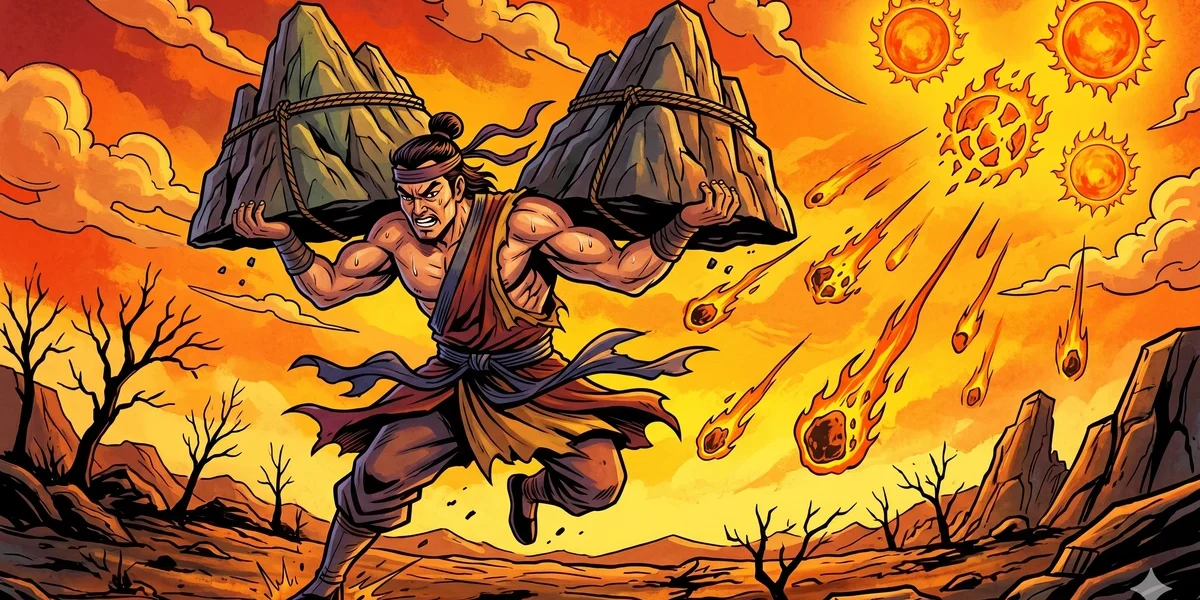
Erlang Shen and the God of the Third Eye: Divine Law, Filial Loyalty, and the Limits of Cosmic Authority
Yang Oerlang concerns Yang Jian (楊戩), better known as Erlang Shen (二郎神, the Second Son God) or Erlang Zhen Jun (二郎真君) — one of the most complex and beloved figures in Chinese folk religion and popular mythology. Erlang Shen is the nephew of the Jade Emperor, commander of celestial armies, possessor of the Third Truth-Seeing Eye (tian yan, 天眼) in his forehead, and the only deity in the entire Chinese pantheon who successfully fought Sun Wukong (the Monkey King) to a draw in the great battle described in Journey to the West. He is simultaneously a figure of divine legal enforcement and one of the tradition’s most prominent examples of filial piety — having, according to his origin legend, carved open a mountain with his divine ax to rescue his mother, who had been imprisoned inside it by the Jade Emperor as punishment for her unauthorized marriage to a mortal.
This dual nature — the celestial law enforcer who broke cosmic law for love of his mother — makes Erlang Shen theologically interesting in a way that simpler divine figures are not. He lives in his own temple rather than in the Jade Emperor’s celestial court, works independently rather than under direct imperial authority, and is sometimes described as being on semi-permanent probation for his act of filial disobedience — performing divine service without being fully reintegrated into the cosmic bureaucracy. He is, in the tradition’s own terms, a divine official who has learned something that pure law cannot teach.
Beat I — The God With Three Eyes and a Mountain-Cleaving Axe
Yang Jian’s origins in folk legend are multiple and regionally varied, but the dominant tradition held by the time of the Ming dynasty novel Fengshen Yanyi (封神演義, Investiture of the Gods) presents him as the son of a celestial official and a mortal woman — a union that violated celestial law, which prohibited the gods from marrying mortals without imperial sanction. His mother was condemned and imprisoned inside Mount Tao (桃山) as punishment; his father returned to the celestial realm; Yang Jian was raised by his uncle Guankou Erlang, a powerful local deity, from whom he eventually derived his name and divine authority.
He grew up without his mother — knowing she was imprisoned, knowing why, knowing that the imprisonment was legally correct by celestial standards and that the celestial law was not wrong in principle. What the law had failed to account for was the specific human quality of the mother who had been imprisoned and the specific grief of the son who had grown up without her. When Yang Jian reached the fullness of his divine power — the Third Eye of truth-seeing, the shape-changing abilities that would later allow him to match the Monkey King transformation for transformation, the divine ax that could cleave mountains — he returned and did what divine law explicitly forbade: he used his power to undo a legal punishment that he understood was correct by the law’s own standards but wrong by a standard the law could not articulate.
He split the mountain and freed his mother. The Jade Emperor, confronted with a nephew who had violated celestial order through an act that the entire celestial court found itself unable to condemn without also condemning filial piety — one of the foundational virtues of the cosmic order itself — arrived at an uncomfortable administrative resolution: Yang Jian was assigned to semi-independent duty, operating his own temple and performing divine enforcement tasks, without being formally reinstated to his previous celestial position. He had demonstrated that he was both willing and capable of subordinating law to love when the two conflicted at sufficient intensity. The Jade Emperor could not promote this; could not entirely punish it; settled for acknowledging it by keeping the god at arm’s length while continuing to use him when divine enforcement required someone with his particular combination of power and judgment.
Beat II — The Battle With the Monkey King and the Theology of Equal Power
The episode in Journey to the West in which Erlang Shen confronts the Monkey King Sun Wukong is among the novel’s most celebrated — and theologically interesting — set pieces. The Jade Emperor, having exhausted the celestial army’s capacity to subdue Sun Wukong, requests that Erlang Shen be called in. Erlang Shen arrives with his celestial dog (the Howling Celestial Dog, 哮天犬) and his seven brothers (a divine corps that operates under his independent command) and engages Sun Wukong in a battle of transformations that continues for seventy-two rounds without clear victory.
Both the Monkey King and Erlang Shen can transform into seventy-two forms; both have extraordinary physical capabilities; neither can decisively defeat the other. What eventually turns the tide is not any advantage in power but circumstance: while Sun Wukong has transformed into a temple and is distracted, Erlang Shen’s celestial dog bites him in the leg, disrupting his concentration and allowing the other celestial forces to intervene. Sun Wukong escapes by transforming further; the battle is eventually resolved through other means involving Laozi’s alchemy furnace and the Jade Emperor’s summons to Buddha.
The theological significance of the draw is considerable. Erlang Shen is the only divine figure who meets the Monkey King as an equal — neither subduing him nor being subdued. This equivalence is not accidental: both figures represent divine power operating outside the full integration of the celestial bureaucracy. Sun Wukong is famously uncontrollable, having rejected every official title the Jade Emperor offered him except the self-invented “Great Sage Equal to Heaven.” Erlang Shen is semi-independent, working for the celestial administration without being fully of it. The battle between them is, at one level, the battle between two divine rebels — one who rebelled through pure defiance of authority, one who rebelled through an act of love — meeting in a space where neither the full weight of celestial law nor any simple defiance of it fully applies.
Beat III — The Third Eye and the Epistemology of Divine Vision
Erlang Shen’s third eye — the tian yan or hui yan (慧眼, wisdom eye) embedded vertically in his forehead — is one of the most visually distinctive divine features in the Chinese pantheon and one of the most theologically interesting. It is described as the eye of truth-seeing: an organ of perception that sees through illusions, glamours, and transformations to the essential nature of what it regards. Where the two ordinary eyes see the world as it presents itself, the third eye sees the world as it is.
This capacity for direct perception of essential nature is what makes Erlang Shen uniquely effective as a divine enforcer: he cannot be deceived by the disguises and transformations that fool other divine officials. When the Monkey King transforms into a sparrow, Erlang Shen’s third eye sees the Monkey King behind the sparrow. When a demon pretends to be a devotee, the third eye sees the demon behind the devotion. This makes him, in the celestial bureaucracy’s terms, an invaluable asset for situations where the gap between appearance and reality is the precise problem that needs addressing.
But the same third eye that sees through illusions also sees the truth of his own situation — the gap between the cosmic law that imprisoned his mother and the human reality that made her imprisonment an injustice by a standard the law could not accommodate. This is the eye’s deeper theological function: not merely to see through deception but to see the full complexity of moral situations that simpler vision reduces to a single dimension. Erlang Shen acts on what his third eye shows him, which is sometimes the same as what the law prescribes and sometimes — in the case of his mother’s imprisonment — something more than what the law can see.
The visual icon of the third eye in Chinese religious art connects this figure to a broader pan-Asian tradition of divine truth-vision: the ajna chakra in Hindu iconography, the Buddha’s urna mark, the third eye of Shiva. Chinese popular religion absorbed and transformed these influences, producing in Erlang Shen a specifically Chinese version of the theme: the divine official whose truth-seeing allows him to perform both the law’s requirements and — when the law’s requirements and truth’s requirements diverge — the harder choice.
Beat IV — Divine Enforcement and the Mercy That Law Cannot Mandate
The tradition of Erlang Shen as both divine law enforcer and filial law-breaker creates a figure who embodies a tension that Chinese moral thought has consistently found interesting: the tension between formal legal authority and the informal moral claims that law cannot fully capture. The Confucian tradition addresses this tension through the concept of qing (情, human feeling/sentiment) as a supplement to fa (法, law) — the recognition that legal systems that do not account for the full range of human moral experience are incomplete even when formally correct.
Erlang Shen’s status as the god who chose filial love over celestial law when the two conflicted makes him the mythology’s image of what this principle looks like in practice. The Jade Emperor’s resolution — keeping him at semi-independent distance while continuing to use him — is the celestial administration’s recognition that the capacity for this kind of judgment is valuable even when it cannot be formally authorized. The god who can bend the law when love demands it is the god who understands what law is for, which is ultimately the protection of human values that law exists to serve. When law and the values it serves come apart, the figure capable of holding both in view and choosing between them is more valuable than the figure who can only apply the law mechanically.
This is why Erlang Shen, despite his formal semi-exile from the celestial court, retains his popularity in Chinese folk religion: he is worshipped not as an icon of pure law but as an icon of law tempered by judgment, of power in the service of something larger than power’s own internal logic. His temples throughout China serve as local expressions of this principle: places where divine enforcement can be requested, but where the god who answers is one who has demonstrated that he will not enforce against love when love has the stronger claim.
“He had three eyes and saw everything. What he saw most clearly was that the law was right and his mother should still be free. He chose his mother. The Emperor kept his distance. Both of them knew why.”
— Reflection on Erlang Shen in Chinese folk religious tradition
Why This Legend Has Lasted
Yang Oerlang has endured because Erlang Shen is a divine figure who has done something recognizably human — chosen love over law when the two conflicted — and survived with his divinity intact. He did not renounce his divine nature to free his mother; he used his divine power in service of a human obligation that his divine position had not extinguished. This combination makes him uniquely accessible among the figures of the Chinese pantheon: not a god who transcends human feelings but one who carries them into divine action.
His continued role as a divine enforcer — the celestial army’s most effective operative when genuine power is required — demonstrates the legend’s deeper point: the capacity for human feeling does not diminish divine effectiveness; it supplements and deepens it. The god who understands what love requires understands what law is for. The god who has exercised judgment against the formal requirements of his own position in service of a higher standard is the god best equipped to recognize when judgment rather than rule-following is the appropriate response to the situation at hand. Erlang Shen’s third eye sees what both law and love demand. His mountain-cleaving ax chose, once, between them. The choice defines everything else he does.
Erlang Shen in Chinese Religion and Literature
Erlang Shen (二郎神), also known as Erlang Zhen Jun (二郎真君) and identified with Yang Jian (楊戩) in the Ming dynasty novel Fengshen Yanyi, is one of the most widely worshipped figures in Chinese folk religion, with temples throughout China — particularly in Sichuan province, where the historical Erlang (associated with the hydraulic engineering achievements of Li Bing and Li Erlang at Dujiangyan) provided an earlier stratum of the cult. The Guankou temple complex in Guanxian (now Dujiangyan City), Sichuan, is among the most important. Erlang Shen appears in multiple major works of Chinese popular fiction: Fengshen Yanyi (封神演義, Investiture of the Gods, attributed to Xu Zhonglin, Ming dynasty), where he is a key military figure in the wars between the Shang and Zhou dynasties; and Xiyouji (西遊記, Journey to the West, attributed to Wu Cheng’en, Ming dynasty), where his battle with Sun Wukong is one of the novel’s memorable set pieces. His attributes — the Third Truth-Seeing Eye, the divine ax, the shape-changing ability, the Howling Celestial Dog, the seven celestial brothers — are consistently depicted in Chinese religious art and are among the most recognizable in the folk pantheon. The origin legend of his rescue of his imprisoned mother varies by region: some versions identify the mountain as Mount Tao, others as Mount Hua (Huashan), with the Huashan variant giving rise to the later legend of Chen Xiang (沉香), who also cleaved a mountain to rescue his mother in a story that directly parallels and may derive from the Erlang tradition.
You May Also Like
 Chinese Folk Tales
Ages 9-12
Chinese Folk Tales
Ages 9-12
How Molo Stole The Lovely Rose-Red
How Molo Stole The Lovely Rose-Red: At the time when the Tang dynasty reigned over the Middle Kingdom, there were master swordsmen of various kinds. Those who
 Chinese Folk Tales
Ages 9-12
Chinese Folk Tales
Ages 9-12
The Talking Silver Foxes
The Talking Silver Foxes: The silver foxes resemble other foxes, but are yellow, fire-red or white in color. They know how to influence human beings, too.
 Chinese Folk Tales
Ages 6-8
Chinese Folk Tales
Ages 6-8
The Flying Ogre
A Chinese Buddhist folk tale about a wandering monk, a terrified girl in a red coat, and a shape-shifting ogre — a gentle lesson about truth, pity, and clear sight.