The Panther
The Panther: Once upon a time there was a widow who had two daughters and a little son. And one day the mother said to her daughters: “Take good care of the
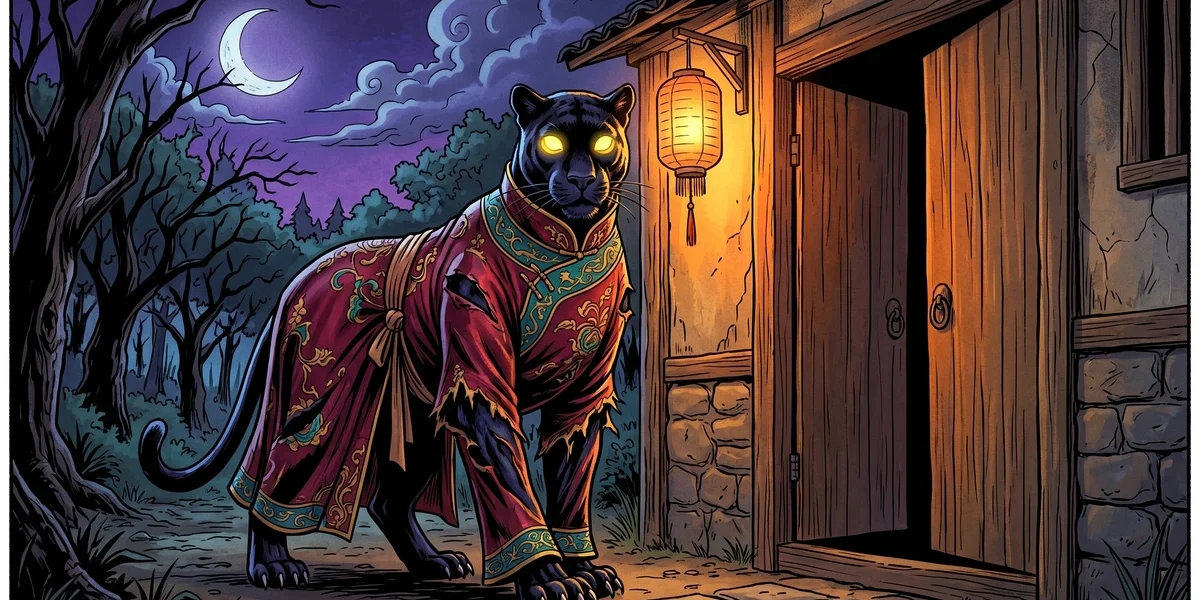
The Leopard at the Threshold: Shape, Transformation, and the Limits of Domestication
The Panther belongs to the rich Chinese tradition of bian xing (變形, shape-transformation) narratives — stories in which animals, spirits, or supernatural beings take human form, enter households, and reveal either the permeability of human society’s boundaries or the persistence of essential nature beneath acquired surface. Related accounts appear in Pu Songling’s Liaozhai Zhiyi (聊齋誌異) and in the earlier Bao Puzi (抱樸子) of Ge Hong, which catalogues the transformative abilities attributed to various animals after long accumulation of jing (精, vital essence).
The leopard (bao, 豹) occupies a specific niche in Chinese zoological mythology. Unlike the tiger — which is primarily feared as a straightforward apex predator — the leopard is associated with subtlety, concealment, and the uncanny ability to move unseen through spaces where it should not exist. The bao wen (豹紋, leopard pattern) is admired in Chinese aesthetics for its elegant repetition, but the same quality makes the animal symbolically double: beautiful and dangerous in the same breath.
Beat I — The Grateful Animal at the Gate
In a mountain village of Fujian province, a hunter named Chen Bogui returned one autumn evening to find a large leopard lying injured at the gate of his compound. The animal had been caught in someone else’s trap — a badly set snare that had mangled one foreleg without killing it — and had dragged itself some distance before collapsing. It was in considerable pain and clearly beyond ordinary escape.
Chen’s wife urged him to kill it immediately and take the pelt. His neighbors, when they heard, sent word advising the same. But Chen, who had spent enough time in the mountains to feel a complex relationship with the animals he hunted, found himself unable to dispatch a creature that had come to his gate as if seeking assistance. He set the leg, bound the wound with cloth soaked in medicinal wine, and brought the animal into an outbuilding where it would be protected from rain and cold.
The leopard recovered over several weeks. During this time it was, by all accounts, extraordinarily docile — eating the meat Chen provided, tolerating his touch during the daily dressing of its wound, and demonstrating none of the hostility one would expect from a wild predator in confinement. When it was healed, Chen released it at the forest edge. It stood for a long moment looking back at him, then disappeared into the trees.
This much was remarkable but not unprecedented in a culture that had extensive traditions of human-animal reciprocity. What happened next is where the legend takes its characteristic turn.
Beat II — The Woman Who Arrived at Winter’s Beginning
Two months after the leopard’s release, a young woman appeared at Chen’s gate. She was well-dressed in a way that suggested city origin — silk rather than hemp, shoes rather than cloth wrappings — but her explanations for her presence were vague. She claimed to be the daughter of a merchant traveling south, separated from her family’s party during a river crossing, and in need of shelter while she waited for word from her father. Her speech was refined; her manners were excellent; she was helpful with household tasks and undemanding in her requirements.
Chen’s wife, who had a farmer’s practical eye for human character, was uneasy without being able to articulate why. The woman did nothing wrong. She ate properly, slept at normal hours, never left the compound after dark, never asked suspicious questions. But the family’s two dogs — ordinarily friendly animals — refused to enter any room she occupied, and the chickens became disturbed in their coop whenever she walked near it.
The unease grew. One night Chen’s wife woke before dawn and, following an instinct she could not explain, went quietly to the outbuilding where the guest was housed. Through a gap in the wooden wall she saw, in the cold pre-dawn light, not a young woman sleeping on the pallet but a leopard — their leopard, unmistakable by the healed foreleg — curled in the corner. By morning, when the woman appeared at breakfast, she seemed entirely human. But Chen’s wife had seen what she had seen.
The story’s resolution varies by regional telling. In some versions Chen confronts the leopard-woman, who flees; in others, warned by the wife, the household simply locks its gates and the “woman” departs without incident the following day, pausing at the forest edge in a way that seems to echo the leopard’s original farewell. What all versions share is the ambiguity of the encounter: the leopard-woman meant no obvious harm, but her presence in the household was fundamentally incompatible with the household’s continuation.
Beat III — Bian Xing and the Question of Essential Nature
Chinese shape-transformation narratives operate within a complex philosophical framework that distinguishes between xing (性, essential nature) and xing (形, outer form). These two characters, homophonous but distinct in meaning, are the central concern of transformation stories: can an animal that has accumulated enough jing (精) to transform its outer form actually change its inner nature? Or does the leopard beneath the woman’s appearance remain, in every meaningful sense, a leopard?
The legend of the panther is agnostic on this question in a productive way. The leopard-woman is not evil — she saved nothing, harmed no one, and if anything repaid Chen’s kindness by living peacefully in his household. But her presence is ultimately incompatible with the domestic order precisely because her essential nature — predatory, wild, organized around different principles than human household life — cannot be permanently suppressed by the adopted form.
This is a more nuanced position than simple “animals cannot be trusted.” Chinese literature contains numerous counter-examples: fox spirits who become genuinely virtuous wives, snake women who protect their human husbands, even tigers who honor debts to humans who spared them. The distinction appears to hinge on transformation that is genuinely willed and sustained versus transformation that is tactical and temporary. The leopard at Chen’s gate appears to be in an intermediate category — grateful enough to return, but not capable of permanently crossing the threshold between wild and domestic.
The dogs’ and chickens’ instinctive recognition of the leopard beneath the woman’s form reflects another important element of this tradition: the belief that animals perceive essential nature more reliably than humans, who are susceptible to the surface presentation of things. The household animals see past the silk and refined speech to what is actually present. They are not fooled by bian xing because they do not process the social cues through which humans’ perception is filtered.
Beat IV — Compassion, Discernment, and the Limits of Hospitality
The legend raises a question that Confucian and Buddhist ethics both engage with: does the obligation to extend compassion and hospitality apply without limit, even when the recipient is fundamentally different in nature from the one extending it? Chen’s initial rescue of the leopard is presented approvingly — it is a human act of ren (仁, benevolence) toward a suffering creature. The leopard’s return is an act of bao en (報恩, repaying kindness), which is among the most highly valued qualities in Chinese moral life.
But the leopard’s repayment — taking human form and living temporarily in the household — creates a situation that neither party can sustain. The leopard cannot permanently become human; Chen’s household cannot permanently accommodate a leopard. The legend suggests that genuine kindness sometimes requires recognizing these limits rather than insisting on a continuation that serves neither party well.
The wife’s role is pivotal and subtly affirmed by the narrative. She is not portrayed as cruel or superstitious for being uneasy about the woman-guest; she is portrayed as possessed of clear-sightedness that her husband lacks. Her willingness to look through the gap in the wall — to seek knowledge rather than comfortable assumption — is what allows the household to navigate the situation without harm. The legend implicitly validates the wife’s instinctive discernment alongside Chen’s initial compassion, suggesting that both qualities are necessary: the compassion to help, the discernment to know when helping has completed its cycle.
“The leopard repays what it owes. But a leopard repaying a debt is still a leopard. Do not confuse gratitude with transformation.”
— Wisdom embedded in Chinese bian xing narrative tradition
Why This Legend Has Lasted
The Panther endures because it holds together two things that seem contradictory: genuine appreciation for the moral seriousness of non-human creatures, and a clear-eyed acknowledgment that essential natures differ and cannot always be reconciled by goodwill alone. It neither dismisses the leopard’s gratitude as meaningless nor pretends that gratitude can dissolve the fundamental difference between wild and domestic, predatory and pastoral.
The legend also serves as a meditation on limits — on the point at which compassion appropriately concludes. Chinese Buddhist thought emphasizes fang sheng (放生, releasing life) as a spiritual practice, but also acknowledges that released creatures return to their own nature. The leopard, having been healed and freed, returns — but returns as what it is. The legend’s wisdom lies in showing that this is not a failure of the original kindness; it is simply the natural completion of it.
The Bao (Leopard) in Chinese Cultural Symbolism
The leopard (bao, 豹) in Chinese iconography and literature occupies a complex symbolic position. Its spotted coat — bao wen (豹紋) — appears in bronzeware and lacquerwork as a pattern of elegant, disciplined beauty. In military symbolism, leopard imagery signified speed and ferocity; commanders of elite cavalry units were sometimes given leopard-related honorary titles. In supernatural literature, the leopard appears as a creature of particular cunning: unlike the tiger, which is power without concealment, the leopard is associated with intelligence, patience, and the ability to remain hidden in plain sight. Old texts suggest that leopards who lived long enough accumulated sufficient jing (精, vital essence) to take human form — typically appearing as attractive women who could pass undetected in human communities. This made them more unsettling in fiction than the tiger, which could at least be seen coming. The bao ren (leopard person) of Chinese folk narrative is never simply evil; the moral complexity of these tales typically centers on the ambiguous status of a creature that has genuinely crossed into the human world without fully leaving its own.
You May Also Like
 Chinese Folk Tales
Ages 6-8
Chinese Folk Tales
Ages 6-8
The Three Ruling Gods
The Three Ruling Gods: There are three lords: in heaven, and on the earth and in the waters, and they are known as the Three Ruling Gods. They are all
 Chinese Folk Tales
All Ages
Chinese Folk Tales
All Ages
The Monk Of The Yangtze-Kiang
The Monk Of The Yangtze-Kiang: Buddhism took its rise in southern India, on the island of Ceylon. It was there that the son of a Brahminic king lived, who had
 Chinese Folk Tales
Ages 9-12
Chinese Folk Tales
Ages 9-12
King Mu Of Dschou
King Mu Of Dschou: In the days of King Mu of Dschou a magician came out of the uttermost West, who could walk through water and fire, and pass through metal