Joha and the Donkey
The famous tale of Joha, his son and their donkey. On the road to market, every passer-by criticises how they use the animal, and Joha keeps changing to please each new critic until he has pleased no one and lost the donkey: the classic story of why you cannot satisfy everyone.
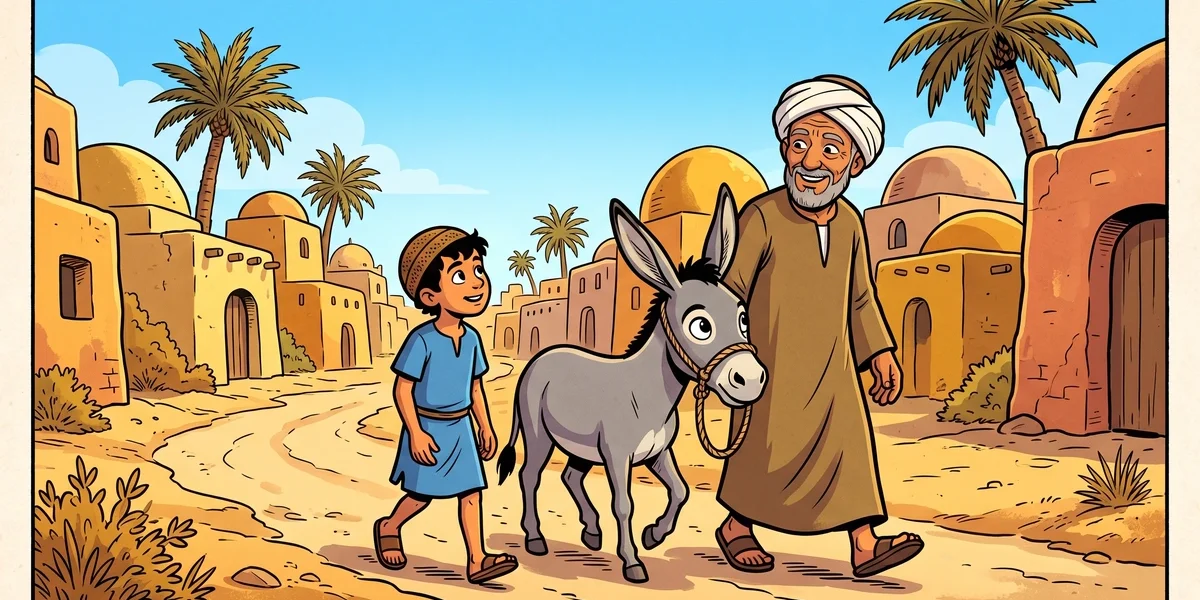
In the sun-baked villages of North Africa and the Near East there has always been a man called Joha – sometimes a fool, sometimes the wisest head in the marketplace, and very often both at once within a single afternoon. The tale of Joha and the donkey is the most travelled of all the stories told about him, and it is, at bottom, the simplest. A father, a boy and a beast set out on an ordinary road to an ordinary market. Nothing in the story is enchanted. There is no genie, no flying carpet, no buried treasure. The only force at work is the voice of other people, and the tale exists to show how completely that ordinary force can undo an ordinary man.
It is worth pausing, before the journey begins, on why this particular story spread so far. A tale with a monster in it travels because the monster is memorable. This tale has no monster, and it travelled further than almost any monster ever did. It went because every single person who heard it recognised the trap immediately. Everyone, in every village and every century, has at some point tried to arrange their conduct to satisfy a crowd of onlookers, and everyone has felt the arrangement collapse. Joha simply lives that experience out loud, on a public road, with a donkey for a witness.
Origin & Canonical Attribution
Tradition: A folk anecdote of the Arabic-speaking world, attached to the comic sage Joha (Arabic Juḥā, جحا) – the trickster-fool whose tales circulate from Morocco to Iraq and who, from the nineteenth century onward, became fused in the popular mind with the Turkish Nasreddin Hoca and the Persian Mulla Nasruddin.
The figure of Joha: Medieval Arabic sources treat Juḥā as a real if half-legendary person. Biographical tradition gives his full name as Abū al-Ghuṣn Dujayn al-Fizārī and places him in Kūfa under the Umayyad caliphate. He is named by the great ninth-century prose writer al-Jāḥiẓ, and a lost jest-book, the Kitāb Nawādir Juḥā (“Book of the Witticisms of Juḥā”), is recorded among early Arabic titles – making Joha one of the oldest continuously told comic characters in world literature.
Tale type: The story itself is the internationally catalogued tale ATU 1215, “The Miller, His Son and the Donkey” (in older Aesopic collections it is numbered Perry 721). Its theme is summed up in the folklorists’ own title for the type: Trying to Please Everyone.
Textual history: Though the tale has ancient analogues, its earliest surviving written form is credited to the thirteenth-century Andalusian Arab writer Ibn Saʿīd al-Maghribī. From the thirteenth century it also entered medieval European preaching, copied into collections of moral exempla for sermons such as the Tabula exemplorum. Its first appearance in a European literary fable-book is in Castilian: the Tales of Count Lucanor (El Conde Lucanor, 1335) of the Spanish prince Don Juan Manuel, as the exemplum “Of what befell a good man and his son leading a beast to market.”
Later canon: The fable was retold across Europe – in William Caxton’s English Aesop (1484) and, most famously, by Jean de La Fontaine as “Le Meunier, son fils et l’âne” (Fables, Book III, fable 1, 1668), where La Fontaine frames it as advice the poet Malherbe gave to his indecisive young friend Racan.
Public-domain status: Joha is a folk figure of immemorial antiquity and the tale type is the shared inheritance of many cultures; all the historical sources named above are firmly in the public domain. The retelling below is an original composition.
A Father, a Boy and a Donkey Set Out
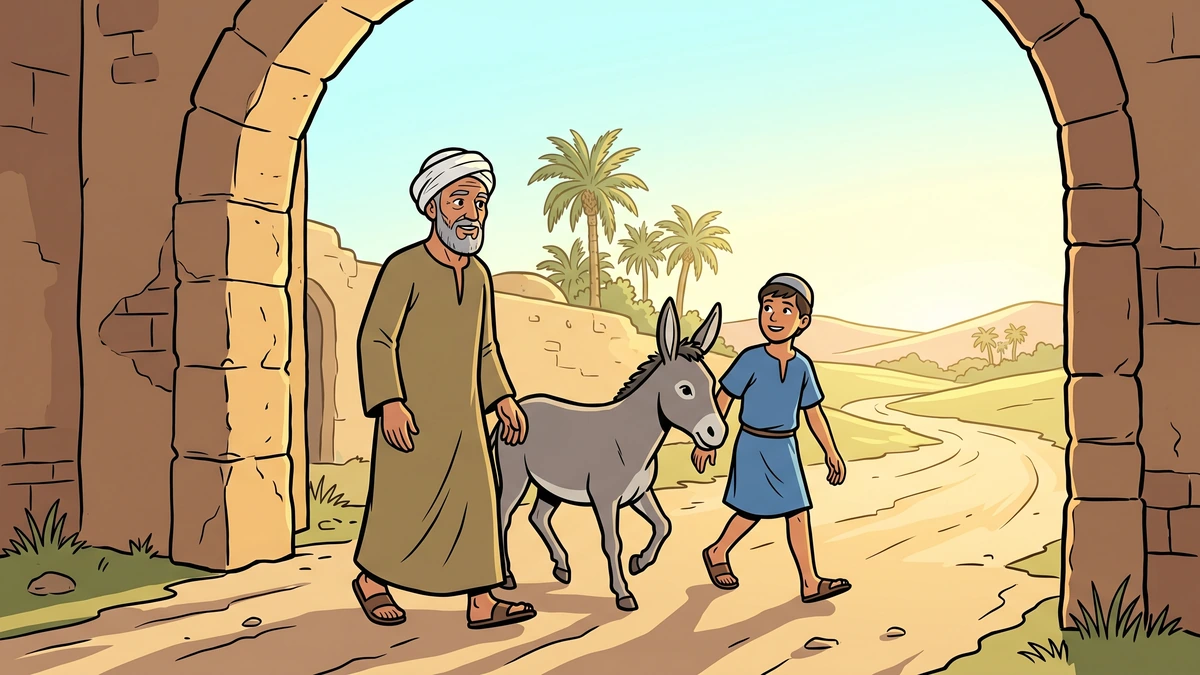
It was market day, and Joha rose before the sun to make ready for the road. The town with the great market lay a long walk off, beyond two villages and a river, and there were goods to be sold and goods to be bought, so he meant to start early and travel in the cool of the morning. He woke his son – a boy of perhaps twelve, bright-eyed and good-humoured, with his father’s own habit of half a smile – and the two of them led their donkey out through the gate while the village was still grey and quiet.
The donkey was no remarkable creature. It was a small, patient, sensible grey beast that had carried Joha’s firewood and Joha’s water-jars and Joha’s sacks of barley for more years than the boy had been alive. On this particular morning it carried nothing at all. The selling-goods were light and few, slung in a bag over Joha’s own shoulder, and the buying would be done at the market with coins. So father and son simply walked, one on either side of the unburdened donkey, content with the morning and in no special hurry, and the three of them went down the road together in the pleasant manner of travellers who expect the day to be easy.
Joha, it should be said, was a man genuinely without malice and genuinely without a plan. He did not set out to teach anyone a lesson and he did not set out to be taught one. He was simply going to market with his boy, the way his own father had once taken him. Had he been asked, before he left his gate, whether he was a man easily swayed by the opinions of strangers, he would have laughed and said no. Most of us would say the same. The road was about to ask him the question properly.
The First Voices on the Road
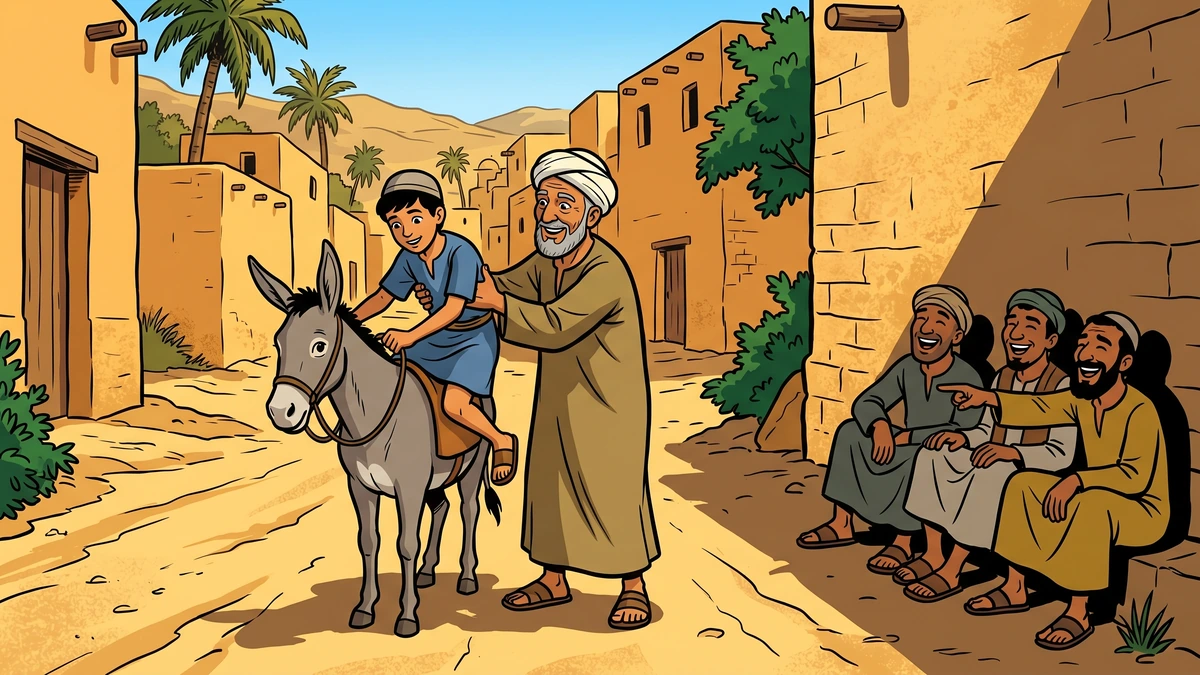
They had not gone far when they passed a cluster of men resting in the shade of a wall at the edge of the first village. The men looked up, and looked at the little procession going by, and one of them laughed and spoke loudly enough to be sure of being heard. “There is a sight,” he said. “A grown man and a strong boy, wearing out their sandals in the dust – and a perfectly good donkey walking beside them with nothing on its back at all. Did you ever see such foolishness? What is a donkey for, if not to spare a man his feet?”
His companions chuckled, and Joha felt the laughter land on him. He had not thought of himself as foolish a moment before. Now, suddenly, he could see exactly what the man saw – two tired travellers and an idle animal – and it did look foolish, put that way. He was an obliging man, and he disliked being thought a fool, and the remedy seemed obvious and harmless. He stopped the donkey and lifted his son up onto its back. “There,” he thought. “Now no one can call us wasteful.” And the boy rode, and Joha walked beside, and for a little while the road was pleasant again.
It did not last. Beyond the village they met an old man coming the other way, leaning on a stick, and the old man stopped square in the road and frowned at them with the full authority of his years. “Look at this,” he said, not troubling to lower his voice. “Look at the world today. A healthy young boy lounges on the donkey like a little prince, and his poor old father – grey-bearded, footsore – trudges along in the dirt beside him. Is this how the young honour the old now? Shame on the boy. Shame on the father for allowing it.”
The boy went red to his ears and began to scramble down before his father could even speak, for no twelve-year-old likes to be called a disgrace in a public road. And Joha, flustered now, thought: of course, the old man is right, it does look unkind. So he climbed up onto the donkey himself, and let his son walk, and they set off once more – the third arrangement of the morning, and Joha had not yet noticed that he was rearranging anything. He only felt, each time, the small relief of having silenced a complaint.
There Is No Pleasing Them
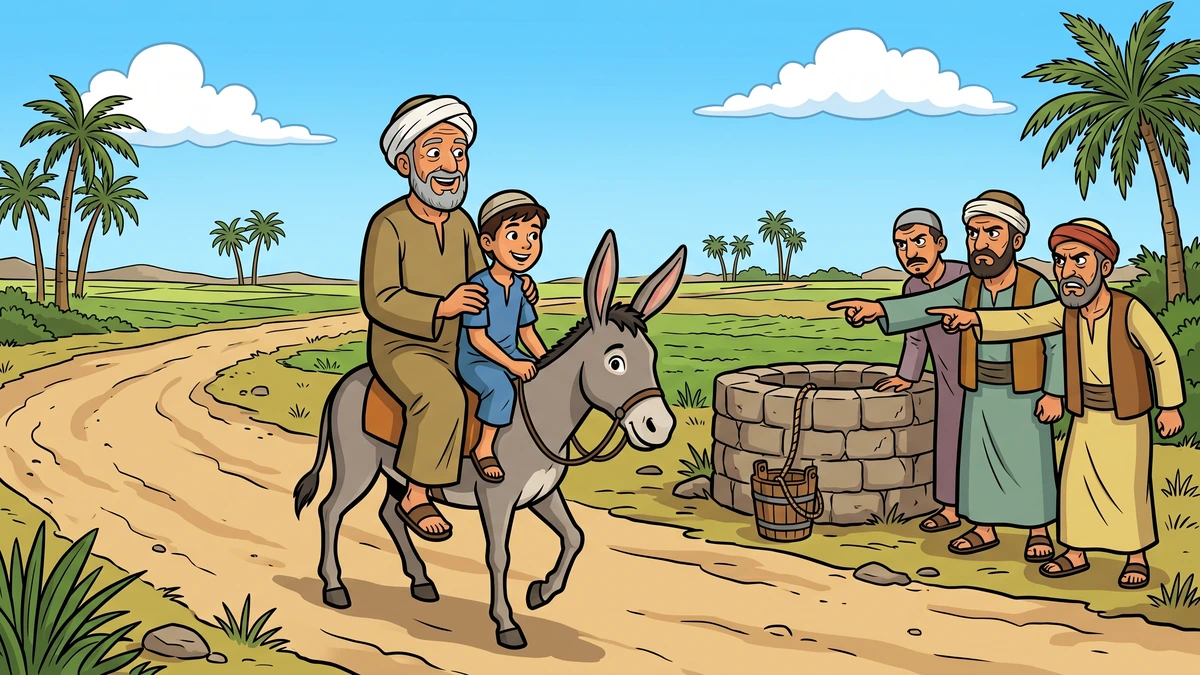
The relief, as before, was brief. The road now ran past a well where several women had gathered to draw water, and the women watched Joha ride by with his son walking in his shadow, and they did not keep their thoughts to themselves. “Will you look at that man,” said one. “Riding at his ease like a pasha, with his little son stumbling along on foot in the heat. Has he no heart at all? The child can barely keep up. A real father would never sit so comfortably while his own boy suffers.”
Joha’s ears burned. First he had been a fool, then a man who let himself be shamed, and now he was heartless – and each judgment had come from doing the very thing the last set of voices had demanded. He was beginning, dimly, to feel that something was wrong, but he could not yet see its shape, and the women were still watching, and the pull to satisfy them was stronger than the puzzlement. So he reached down and pulled his son up in front of him, and now both of them rode the donkey together, father and boy, and Joha told himself that surely – surely – this would answer everybody.
It answered nobody. Before the next village they came upon a knot of farmers, and the farmers looked at the small grey donkey carrying two whole human beings on its narrow back, and their faces darkened with real anger. “You brutes,” one of them said. “You great heavy pair, have you no mercy on a dumb animal? That poor beast’s legs are shaking. Its back will break under the two of you. A donkey is a living creature, not a cart – only a cruel and shameless man would load it so. Get down, both of you, before you kill it.”
And Joha got down, and his son got down, and the two of them stood in the road beside their donkey, and Joha at last understood. He counted it through in his mind. When the donkey carried nobody, he was a fool. When the boy rode, he was a disgrace. When he rode, he was heartless. When both rode, he was cruel. He had changed his conduct four times in a single morning, each time to please a stranger, and each fresh arrangement had simply produced a fresh accuser. There was no position left. He had tried every possible way of walking to market, and the world had condemned every one of them.
Carrying the Donkey
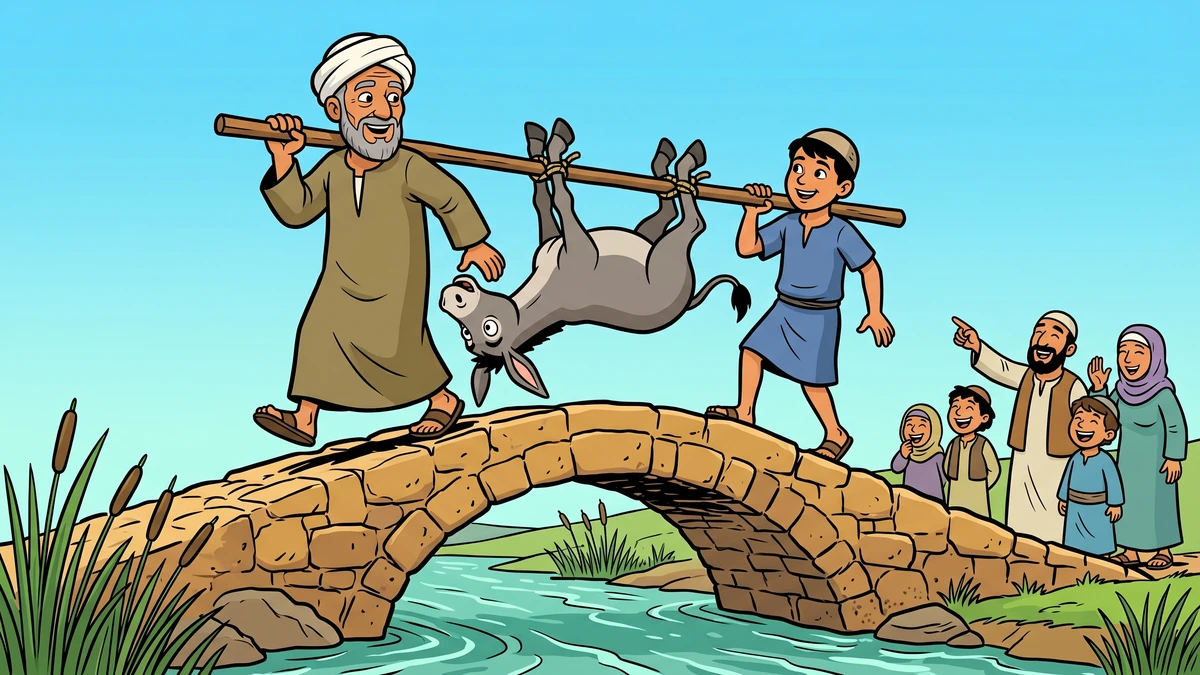
Now, a wiser Joha – the Joha of the tale’s own moral – would have stopped here, shrugged, and walked to market in whatever manner suited him and his son and his donkey best. But the Joha of the road had been so thoroughly knocked off his own judgment that he could no longer find it. He had one idea left, and it was the idea of a man who has surrendered his reason entirely to the crowd: if nobody could bear to see the donkey carry a rider, then the donkey must carry no one – and to be quite certain no passer-by could ever again accuse him of working the beast, he would carry the donkey.
So Joha and his son cut a stout pole, and they bound the donkey’s four legs together over it, and they hoisted the pole onto their shoulders, the astonished animal swinging upside-down between them, and in this fashion – sweating, staggering, ridiculous – they carried their own donkey down the road toward the market town. And of course the people who saw them now did not praise their tenderness. They roared. They pointed. Children ran alongside shrieking with laughter, and grown men held their sides, for in all their lives they had never seen anything so perfectly absurd as two human beings lugging a healthy donkey along a road on a pole.
The disaster came at the river. The road crossed it by an old narrow bridge, and as Joha and his son edged out onto the planks with their swaying burden, the donkey – frightened, jolted, hanging in a way no donkey was ever meant to hang – began to kick and struggle in earnest. The boy lost his grip. The pole lurched. And the donkey twisted itself free and fell from the bridge into the deep water below, and the current took it; and for all their shouting and splashing, by the time Joha and the boy scrambled down the bank the patient grey animal that had served the family faithfully for years had been swept away and was gone.
Joha stood on the riverbank, soaked and empty-handed, his son silent beside him. He had set out that morning with a donkey and a clear purpose. He had ended it with neither. And he had lost them not to a thief, not to a beast of prey, not to any misfortune of the road, but purely and entirely to his own inability to ignore what strangers thought of him.
The Moral of Joha and the Donkey
The lesson of the tale is not hidden; the story carries it on its surface, plain as the donkey on the pole. A person who tries to shape every action to the approval of every onlooker will, in the end, satisfy no one and lose what mattered most. The crowd is not a single judge with a single verdict. It is many judges with contradictory verdicts, and to chase all of them at once is to be pulled in every direction until you are pulled apart. Joha is not destroyed by cruelty or by bad luck. He is destroyed by the entirely well-meant wish to be thought well of by people he will never see again.
The Arabic moral tradition states the point with great economy, in a saying long associated with the jurist al-Shāfiʿī:
“رفضاء الناسِ غايةٌ لا تُدرَك” — riḍāʾ al-nāsi ghāyatun lā tudrak — “The approval of all people is a goal that can never be attained.”
If the goal itself cannot be reached, then arranging a whole life around reaching it is not modesty or courtesy – it is a quiet kind of folly, and the tale lets us laugh at it precisely so that we will recognise it in ourselves without flinching. The story does not tell Joha, or us, to be rude, or to despise good advice, or to care nothing for others. The boy on the donkey, the old man’s complaint, the farmers’ concern for the animal – several of those voices were not wrong in themselves. The error is not in listening. The error is in having no settled judgment of one’s own to weigh the listening against, so that the last voice heard always wins. A man who knows his own mind can take counsel from a hundred strangers and remain himself. A man who does not will be remade by each of them in turn, until there is nothing of him left but a figure on a bridge, carrying his own donkey.
Why the Tale Has Lasted
Few stories have been retold in as many languages as this one. The same plot that the Arabic tradition gives to Joha was set down by Ibn Saʿīd in the thirteenth century, copied into medieval European sermon-books as a warning against fickleness, made into a courtly fable by Don Juan Manuel in 1335, printed in Caxton’s Aesop, and turned into one of the most quoted poems in the French language by La Fontaine, who used it to counsel a young man paralysed by everyone’s advice. Folklorists eventually gave it its own number, ATU 1215, and recorded versions of it from across Europe, the Middle East, North Africa and beyond. A story does not spread that widely by accident. It spreads because it is true everywhere.
What keeps it alive is that its trap never closes. Every generation invents new crowds – the neighbours, the marketplace, and now the far larger and far louder marketplace of the modern world – and every generation rediscovers, usually the hard way, that those crowds cannot all be satisfied at once. Children laugh at the tale because the image of two people carrying a donkey is irresistibly silly. Older listeners laugh more quietly, because they have, in their own fashion and without any donkey, made exactly the same journey. That double laughter – delighted in the young, rueful in the old – is the surest sign of a folk tale that has earned its long life, and it is why Joha, the fool who is also the sage, has been walking this particular road for some eight hundred years and shows no sign of reaching the end of it.
Frequently Asked Questions
Who is Joha, and is he the same character as Nasreddin Hoca?
Joha (Arabic Juḥā) is a comic folk figure of the Arabic-speaking world, a trickster who is by turns foolish and shrewd. Medieval tradition gives him the name Abū al-Ghuṣn Dujayn al-Fizārī and places him in eighth-century Kūfa, and he is mentioned by the writer al-Jāḥiẓ, which makes him one of the oldest comic characters in literature. From the nineteenth century his stories merged with those of the Turkish Nasreddin Hoca and the Persian Mulla Nasruddin, so today the three names often carry the same tales.
What is the story of Joha and the donkey about?
Joha, his young son and their donkey travel to market. At every stage of the road, passers-by criticise how they are using the animal: first for letting it walk unridden, then for the boy riding while the father walks, then for the father riding while the boy walks, then for both riding and overloading it. Joha keeps changing to satisfy each new critic, finally tries to carry the donkey himself, and loses the animal in a river. The tale shows that no arrangement can please everyone.
What is the moral of the tale?
The moral is that trying to satisfy every onlooker is self-defeating, because different people want contradictory things and the crowd can never be pleased all at once. A person needs a settled judgment of their own; without it, they are remade by whichever opinion they heard last. The Arabic saying riḍāʾ al-nāsi ghāyatun lā tudrak – “the approval of all people is a goal that can never be attained” – captures the lesson exactly.
How old is this story and where did it come from?
The tale is internationally classified as tale type ATU 1215, “The Miller, His Son and the Donkey.” Its earliest surviving written version is credited to the thirteenth-century Andalusian Arab writer Ibn Saʿīd al-Maghribī. It entered medieval European sermon collections, appeared as a literary fable in Don Juan Manuel’s Tales of Count Lucanor (1335), and was famously retold by Jean de La Fontaine in his Fables of 1668.
Does the tale mean we should ignore all advice from others?
No. The story is not against listening to others – some of the voices on the road, such as the concern for the tired boy or the overburdened animal, are reasonable in themselves. Its warning is against having no judgment of one’s own to weigh advice against. A person who knows their own mind can take counsel from many people and remain themselves; a person who does not will simply obey whoever spoke last, as Joha does, with absurd results.
You May Also Like
 Arabian Nights
All Ages
Arabian Nights
All Ages
The Barber’s Story of His Fifth Brother
The barber's fifth brother, Al-Nashshar, invested his whole inheritance in glassware and, lost in a daydream of the fortune it would bring, kicked over the tray and shattered everything - the Arabian Nights tale that gave English the word 'Alnaschar'.
 Arabian Nights
Ages 9-12
Arabian Nights
Ages 9-12
The Fisherman and the Genie
A poor old fisherman draws a sealed copper jar from the sea and frees a furious ifrit who vows to kill him - then must use his wits alone to survive. A classic tale of the Thousand and One Nights, retold with full scholarly attribution.
 Arabian Nights
Ages 9-12
Arabian Nights
Ages 9-12
Scheherazade and the Sultan
Scheherazade and the Sultan: In the great city of Baghdad, there lived a Sultan named Shahriar who had been betrayed by his first wife. In his grief and rage