The Fisherman and the Genie
A poor old fisherman draws a sealed copper jar from the sea and frees a furious ifrit who vows to kill him - then must use his wits alone to survive. A classic tale of the Thousand and One Nights, retold with full scholarly attribution.
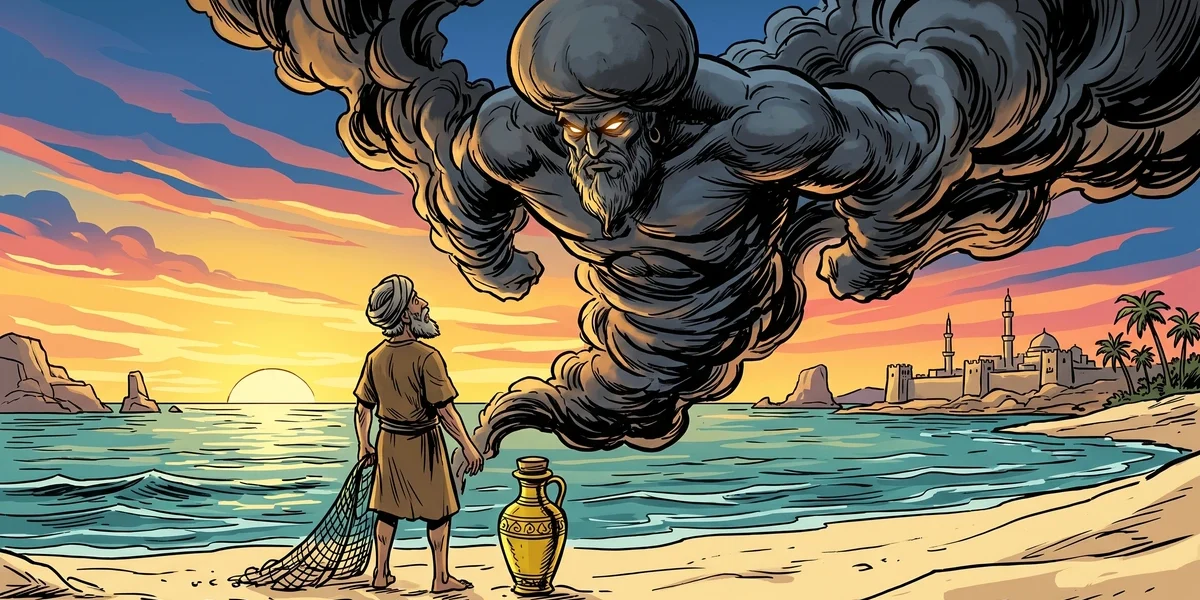
Few images in world storytelling are as instantly recognisable as a vast spirit of smoke pouring out of a small jar drawn up from the sea. That image belongs to The Fisherman and the Genie, one of the oldest and most beloved tales of the Thousand and One Nights — a story in which a destitute fisherman, armed with nothing but patience and a quick mind, outwits a furious immortal who has sworn to kill him. It is a tale about gratitude and ingratitude, about the slow poison of resentment, and above all about the truth that intelligence can master a force it could never hope to defeat by strength.
Origin & Canonical Attribution
Tradition: Arabian Nights (Middle Eastern frame-tale cycle)
Arabic title: Hikayat as-Sayyad ma‘a al-‘Ifrit (حكاية الصياد مع العفريت) — “The Tale of the Fisherman with the Ifrit”
Source collection: Alf Layla wa-Layla (The Thousand and One Nights). The tale is the second of the stories Shahrazad (Scheherazade) tells King Shahryar, narrated across the early nights of the cycle.
Principal Arabic editions: Bulaq 1835; Calcutta II / Macnaghten edition 1839–42; Calcutta I (1814–18); Breslau edition (Habicht / Fleischer).
Major translations: Antoine Galland, Les Mille et Une Nuits (1704–17); Edward William Lane (1838–40); John Payne (1882–84); Richard Francis Burton (1885–88).
Tale type: ATU 331, “The Spirit in the Bottle” — the malevolent demon imprisoned in a vessel who is tricked back inside by his rescuer. Folklorists trace the type to legends of King Solomon’s dominion over the jinn; a European cousin survives as the Brothers Grimm tale “The Spirit in the Bottle” (KHM 99).
Public-domain status: The Arabic text and all four classic translations cited above are firmly in the public domain. The retelling below is an original scholarly version prepared for this site.
The Thousand and One Nights reached its familiar European form gradually. A core of tales travelled from a lost Persian collection, the Hazar Afsana (“A Thousand Stories”), into Arabic by roughly the ninth century, gathering new material in Baghdad and later in Mamluk Cairo. “The Fisherman and the Genie” belongs to that ancient core: it already appears among the earliest surviving Arabic manuscripts and was one of the tales Galland translated for his pioneering French edition. Unlike the famous “orphan tales” such as Aladdin and Ali Baba — which have no early Arabic manuscript witness — the fisherman’s story is genuinely old, genuinely Arabic, and genuinely central to the collection.
The Fourth Cast of the Net
There was once, in a city by the sea, a poor fisherman well advanced in years. He had a wife and three children, and the whole of his livelihood lay in his net. By a habit as fixed as prayer, he cast that net four times each day and never more, for he had bound himself by an oath that four casts were the measure of what he would ask of fortune.
On the morning this tale remembers, he carried his net to the shore before the sun had cleared the water and made his first cast. When he hauled the net in, it dragged so heavily that he rejoiced, certain of a great catch — but the weight proved to be a dead donkey, and the net was torn. He mended it, waded deeper, and cast a second time. Again the net came up heavy, and again there was no fish: only a great jar packed with sand and mud. The third cast yielded potsherds and broken glass. Three times disappointed, the old man lifted his eyes to heaven and spoke not a curse but a prayer, asking only that the fourth cast — the last his oath allowed — might feed his children.

He flung the net a fourth time, waited, and drew it slowly toward the sand. Tangled in the meshes was a vessel of yellow copper, its mouth stopped with a cap of lead and stamped with the seal-ring of Sulayman ibn Dawud — Solomon, son of David — before whom, the old stories say, the whole tribe of the jinn once bowed. The jar was sealed, and it was heavy. “I shall sell this in the brass-market,” the fisherman thought, “and it will fetch more than any fish.” But first, being a curious man, he worked the leaden stopper loose with his knife to see what lay within.
The Ifrit and the Threat of Death

Nothing poured out at first. Then a thread of smoke rose from the jar’s mouth, and the thread became a column, and the column climbed until it blotted the sky and gathered itself into a shape: an ifrit of monstrous size, his head among the clouds and his feet upon the shore, his voice like the grinding of millstones. The fisherman’s knees gave way beneath him.
But the spirit did not thank his rescuer. Instead he roared a strange welcome: the fisherman must choose only the manner of his own death. The old man, astonished, asked what crime could possibly deserve such a reward for setting a prisoner free. And the ifrit told him.
He was, he said, one of the rebellious jinn who had defied the prophet-king Solomon. For that defiance Solomon had sealed him in this copper jar, stamped the lead with his seal, and cast him into the sea. “In the first hundred years of my imprisonment,” the ifrit confessed, “I swore to make rich for ever whoever freed me. No one came. In the second hundred years I swore to open all the treasures of the earth to my deliverer. No one came. In the third hundred years I promised him every wish his heart could frame. Still no one came. And then, in my rage, I swore that whoever freed me at last should die — and should only be permitted to choose the way of it.”
Here is the tale’s first deep turn. The ifrit is not lying and he is not, by his own lights, being unjust: he is simply the prisoner of his own resentment. Three centuries of gratitude have curdled, cast by cast, into three centuries of spite, until the creature can no longer tell rescue from injury. The fisherman has stumbled into the path of an immortal sulk.
The Fisherman’s Tale: King Yunan and the Sage Duban
The fisherman could not fight a being whose head touched the clouds. So he did what the heroes of the Nights always do when strength fails: he told a story. To show the ifrit what ingratitude costs, he recounted the tale of King Yunan and the wise physician Duban.
King Yunan, the fisherman said, was a powerful ruler afflicted by a leprosy that no doctor in his kingdom could cure. Then there came to his city an aged sage named Duban, learned in the books of the Greeks, the Persians and the Arabs. Duban did not dose the king with bitter draughts. Instead he fashioned a polo-mallet, hollowed its handle, packed it with a medicine of his own devising, and bade the king ride and strike the ball until the sweat ran. By that day’s end the disease had left the king’s body as though it had never been, and Yunan loaded the physician with honour and gold.
But the king had a vizier with a narrow and jealous heart, and the sight of a stranger so favoured was unbearable to him. Drop by drop the vizier poured suspicion into the king’s ear: a man who could cure with the touch of a mallet could surely kill the same way; such power in a stranger’s hands was a danger to the throne; gratitude was a luxury a wise king could not afford. The poison worked. Yunan, who owed Duban his very skin, ordered the sage put to death.
Duban begged for his life, and when begging failed he asked one last grace. He owned, he said, a rare book; if the king would behead him and then open the book, the severed head itself would answer any question put to it. The king, greedy for such a marvel, agreed. The sage was executed; the book was brought. Its pages were stuck fast, and the king wet his finger on his tongue to turn them, again and again — and the pages had been steeped in poison. So King Yunan died, killed by the very gift he had demanded, while the head of the man he had murdered looked on. “See, O ifrit,” the fisherman said, “the king destroyed the man who healed him, and so was destroyed in turn. Had Yunan spared Duban, God would have spared Yunan.”
The Clever Reversal
The ifrit was unmoved. He would still have the fisherman’s life; he granted only the promised choice of death. So the old man set his last hope not on mercy but on the spirit’s pride.

“Before I die,” he said, “answer me one thing truthfully, by the great Name engraved upon Solomon’s seal. Were you really inside this jar? It could not hold your hand, let alone the whole of you. I cannot believe it.” The ifrit, stung that a mortal should doubt his word, dissolved once more into smoke, narrowed and streamed, and funnelled himself back down into the copper vessel until not a wisp remained outside. At once the fisherman clapped the leaden cap, stamped with Solomon’s seal, back onto the mouth — and the seal of the prophet-king held the demon fast, exactly as it had held him for eighteen hundred years.
Now the voice came small and pleading from inside the jar. The fisherman answered it with the ifrit’s own argument. He would do, he said, just as King Yunan had been advised to do with a dangerous benefactor: he would throw the jar back into the sea, build a house on that very shore, and warn every fisherman who came after him never to haul up this place, lest the demon be loosed again. The ifrit wept, swore, and swore again, calling Heaven and Solomon’s seal to witness that this time he would repay his rescuer with nothing but good.
The fisherman was poor, and he was old, and he was — for all his hard usage — not a cruel man. He chose to believe the oath, but he kept the jar in his hand while he did so. He freed the ifrit a second time; and the spirit, chastened and now bound by a promise made in fear, kept faith. He led the fisherman inland to a lake set among four hills, a lake the old man had never seen though he had fished that coast all his life, and told him to cast his net there. The fisherman drew up four fish — one white, one red, one blue, one yellow — finer than any in the markets of the city. With a warning to fish that lake only once a day, the ifrit struck the ground, the hills opened to swallow him, and he was gone. Those four coloured fish would carry the fisherman’s fortunes to the king’s own table, and open the door to the next wonder of the Nights — but the fisherman himself, the tale is careful to tell us, went home that evening to feed his children, which was all he had ever asked of the sea.

The Moral of the Tale
“The Fisherman and the Genie” carries two morals braided into one. The first is a warning against ingratitude: the ifrit, the vizier and King Yunan are all destroyed — or nearly destroyed — because they answer kindness with harm, and the tale insists that such a debt always comes due. The second is a quiet promise to the powerless: that wit, patience and steadiness can master a strength that looks unanswerable. The fisherman never lifts a hand against the ifrit. He defeats him with a single, perfectly aimed question.
اتّقِ شَرَّ مَنْ أَحْسَنْتَ إلَيْهِ
Ittaqi sharra man ahsanta ilayh — “Guard against the harm of the one to whom you have done good.” This old Arabic proverb names the bitter truth the ifrit embodies: a rescued enemy may repay the rescue with a blade. Yet the fisherman’s answer to that truth is not cruelty but caution — he keeps the jar in his hand even as he chooses, in the end, to trust.
Why the Tale Has Lasted
“The Fisherman and the Genie” has outlived empires because its central image is unforgettable and its lesson is portable. The folklorists Stith Thompson, Ulrich Marzolph and Richard van Leeuwen place it at the head of tale type ATU 331, “The Spirit in the Bottle,” a pattern that reaches from the Solomonic legends of the late-antique Near East to the Brothers Grimm’s German tale of a student who frees a spirit named Mercurius from a glass bottle in a forest. In every version the heart of the story is the same trick: the only way to defeat a being too vast to fight is to flatter its pride into making itself small.
The tale also shows the Thousand and One Nights performing its favourite move — the story within a story. The fisherman saves his life by becoming, for a moment, a Shahrazad of his own: he answers a death sentence with a narrative, just as Shahrazad answers King Shahryar’s. Nested inside the frame is the tale of Yunan and Duban, and the fisherman’s survival proves the collection’s deepest claim — that a story told at the right moment can be the difference between living and dying. That is why, a thousand years on, a poor man, a copper jar and a column of smoke still hold readers exactly as they once held a furious king.
You May Also Like
 Arabian Nights
Ages 9-12
Arabian Nights
Ages 9-12
The Fourth Voyage of Sinbad: Escape from the Cannibals
The Fourth Voyage of Sinbad: Escape from the Cannibals: I have told you of my three great voyages, my friends, but the fourth was perhaps the most terrible and
 Arabian Nights
Ages 9-12
Arabian Nights
Ages 9-12
Sinbad the Sailor – The First Voyage
Sinbad the Sailor - The First Voyage: In the ancient city of Baghdad, where palaces rose like mountains and the markets overflowed with the riches of the known
 Arabian Nights
Ages 9-12
Arabian Nights
Ages 9-12
Hassan of Basra and the Bird Maiden
Hassan of Basra and the Bird Maiden: In the city of Basra, there lived a young merchant named Hassan ibn Ibrahim, known throughout the marketplace for his